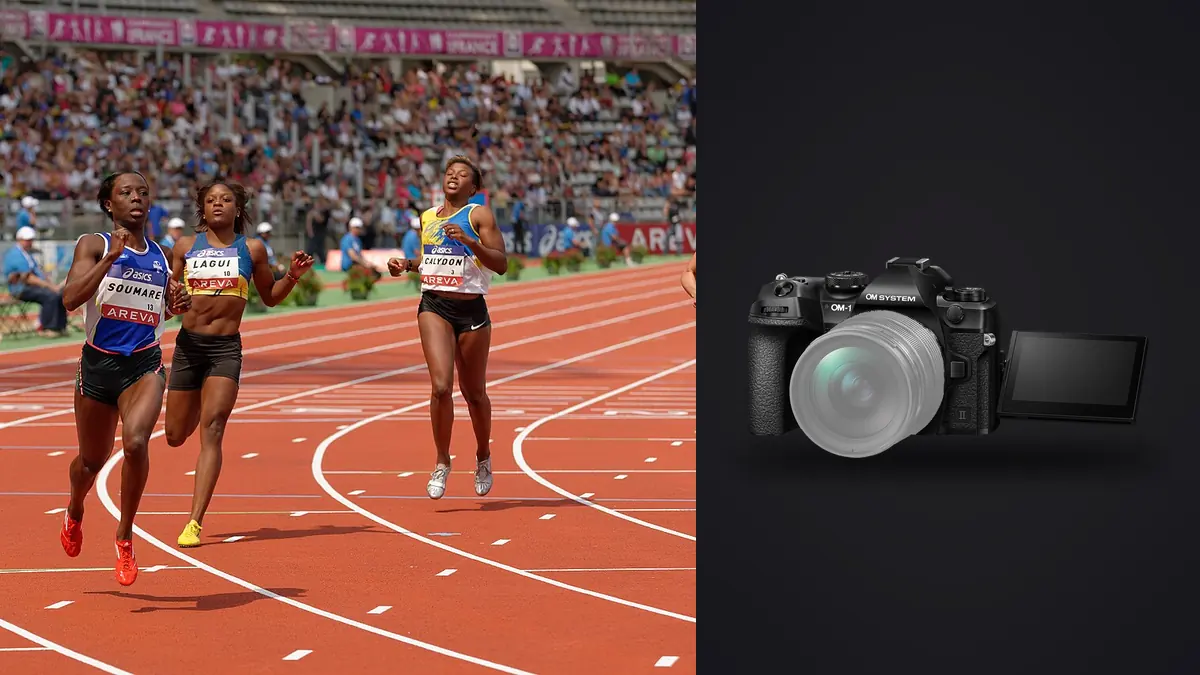
I picked up the OM-1 Mark II for a regional track and field season mostly out of curiosity about the crop factor, not because I was unhappy with what I'd been shooting before. Track meets are a strange test for any camera. You need reach for the far side of the oval, you need speed for the 100m and the long jump takeoff, you need a body that survives eight hours of sun or sudden rain, and you need enough buffer to not miss the moment because the card is still writing the last burst. The Mark II handles most of that better than people give Micro Four Thirds credit for, and it has a couple of quirks that will genuinely annoy you if nobody warns you first.
The sensor crop is the whole pitch, for better and worse
Micro Four Thirds has a 2x crop factor, so a 300mm lens shoots like a 600mm full-frame lens would, and it does it in a package that weighs a fraction as much. For track shooting from the infield or a media riser at the far turn, this is not a minor convenience. A 150-400mm f/4.5 PRO with its built-in 1.25x teleconverter gets you to an effective 300-800mm at f/4.5-5.6, on a lens that a person can hand-hold for a full meet without a monopod wrecking their shoulder. The equivalent full-frame combination, something like an 800mm prime or a 400mm plus teleconverter stack, is either enormously heavier or requires stopping down to apertures that don't help you freeze a sprinter's legs.
The tradeoff shows up the moment the light drops. Field events under stadium lights, or an indoor meet on a February evening, push you into ISO 3200 and higher more often than a full-frame body would need. The 20.4-megapixel stacked sensor is genuinely good for its size, better than the sensor in the original OM-1, but it is still a smaller sensor gathering less light per pixel than a full-frame competitor at the same aperture. If most of your track work happens outdoors in daylight, this barely matters. If you shoot a lot of indoor conference meets, budget mentally for noise reduction work you wouldn't otherwise need.
Autofocus on actual people, not just the marketing subjects
OM System's AI subject detection launched with categories aimed at wildlife and motorsport shooters: birds, airplanes, trains, cars and motorcycles. None of those are a 400m runner. What changed things for track work was the firmware update that added a proper human detection mode with face and eye priority, which finally gives sports shooters something built for the actual subject in front of them rather than a repurposed vehicle-tracking algorithm.
In practice it tracks a single runner in a lane reliably, sticking to the near eye even through arm swing and head turns. Where it gets less confident is a crowded start line with eight athletes bunched together, or a relay exchange zone where two runners overlap for a second. In those situations I've had the focus box jump to the wrong athlete or hesitate for a frame before locking back on. It's not a dealbreaker, but if you're shooting a start gun sequence, don't assume the AF will pick your intended subject out of a pack on its own. A single focus point placed manually on the athlete you actually want is still the safer call for that specific shot.
Burst modes, Pro Capture, and the buffer that actually matters
This is where the camera earns its keep for anything explosive, a starting gun, a high jump bar clearance, a baton handoff. Pro Capture buffers frames before you fully press the shutter, so when you react to the gun or the jump, you already have a stack of frames from before your reaction time kicked in. For events with a hard trigger moment, this changes how many keepers you come home with, because human reaction time simply cannot beat the moment a sprinter leaves the blocks.
Where it gets less forgiving is sustained bursts at the top speeds. The camera writes to dual SD UHS-II slots rather than CFexpress, and at the fastest electronic-shutter burst rate a long sequence will eventually outrun the card and the buffer will start to slow you down mid-sequence. It doesn't happen in the first second or two, but shoot a full 200m from gun to tape at the top burst rate and you'll feel the camera hesitate near the finish, right when you need it most. A fast V90-rated card narrows this problem but doesn't eliminate it the way CFexpress would on a full-frame flagship. Here's roughly how the shutter modes break down for what I actually shoot at a meet:
| Mode | Approx. top speed | AF/AE per frame | Pre-shutter buffer | Best use at a meet |
|---|---|---|---|---|
| Mechanical (Low/High) | up to 10fps | Yes | No | Field events, warm-ups, general coverage |
| SH1 (electronic) | 25fps | Yes | Optional, shorter pre-roll | Sprints, hurdles, jumps |
| SH2 / Pro Capture H | 50fps | Locked at first frame | Yes, largest pre-roll | Start guns, bar clearances, baton exchanges |
| Pro Capture with continuous AF | ~25fps | Yes, tracked | Yes | Long jump takeoff, discus release, pole vault plant |
The distinction that trips people up is that the absolute fastest mode locks focus and exposure on the first frame of the burst, so it's better suited to a moment you can pre-focus on (the bar, the takeoff board, the exchange zone) than to a runner closing distance on you at full speed. For that, the slightly slower continuous-AF Pro Capture mode is the better compromise, even though it costs you frame rate.
Weight and weather across a long meet day
Track meets run long, and a body around 599 grams with a 300mm f/4 PRO on it is a genuinely different physical experience from a full-frame body with an equivalent telephoto. I've shot ten-hour invitational meets, moving between the infield, the field event stations, and the stands, and the weight difference is the kind of thing you don't notice until you compare it to the day after, shooting a full-frame kit for a different sport, and your shoulder reminds you what heavier gear feels like.
Weather sealing has held up through a rained-out relay carnival and a dusty all-weather track surface without complaint. It isn't rated for submersion and I wouldn't push it in a downpour without a rain cover, but for the kind of weather a track meet actually gets, drizzle, wind-blown dust, condensation on a cold morning, it's been a non-issue.
Where a full-frame sports body still wins
I want to be direct about this rather than pretend the Mark II wins every comparison, because it doesn't. If you regularly shoot night meets under weak stadium lighting, or you deliver files to an agency with strict noise tolerances at ISO 6400 and above, a full-frame stacked sensor from a competing system will still out-resolve fine detail and hold color better at high ISO. The dynamic range gap has narrowed a lot from a few generations ago, and you can absolutely recover a blown sky or a shadowed grandstand in post, but it's not quite the same latitude a larger sensor gives you. For daylight outdoor track and field, most of that gap doesn't matter. For indoor and evening meets, it's worth knowing about before you commit a whole season to one system.
Getting from a full card to a finished gallery
A single meet with continuous shooting on sprints, hurdles, and field events regularly leaves me with three to four thousand frames, and Pro Capture sequences make that worse because every burst contributes a dozen near-duplicate frames of the same jump or the same stride. Sorting that by hand after a long day is the part of the job nobody enjoys, and it's the reason I moved my culling over to imagic a while back. It runs entirely on my own machine, so a folder of RAWs from a meet never has to leave my laptop before I've picked the shots I want to keep, which matters when a school or a parent group hands you an SD card and expects images back the same week. It scores sharpness and focus locally and groups the burst sequences and near-duplicates together, so instead of scrolling through twelve frames of the same bar clearance, I'm comparing four visually distinct options and picking the one with the cleanest extension and the sharpest face. I wrote up the mechanics of that scoring approach in more detail in how AI photo culling actually works, which is worth a read if you're skeptical that an algorithm can judge focus as well as a trained eye. Once the picks are made, the apply_my_style preset carries over the color and contrast treatment I use for outdoor track meets to the whole take, so I'm not manually matching white balance across three hundred images shot as the sun moved across the stadium. If your current workflow is still a manual first pass through every frame, these workflow tips cover some of the smaller habits that add up over a full season of meets.
Frequently Asked Questions
Is the OM-1 Mark II fast enough to cover sprints and field events in the same session without switching gear?
Yes, and that's honestly its strongest case. Swapping between a 40-150mm f/2.8 for close field events and a 300mm f/4 for the far side of the track, without changing camera bodies or worrying about a second battery system, is a real time saver on a meet where events overlap. The menu-level shutter mode switching between mechanical and Pro Capture is quick enough to do between events without digging through submenus.
Do I actually need the 150-400mm PRO lens, or does a 300mm f/4 cover most track work?
For most club and regional meets shot from a media area or the infield rail, the 300mm f/4 PRO (600mm equivalent) covers the far turn and the home straight comfortably, and it's dramatically lighter and cheaper. The 150-400mm earns its keep at larger stadiums where you're positioned further back, or if you regularly shoot multiple sports and want the built-in teleconverter's flexibility rather than owning two lenses.
How many photos does a typical meet produce, and how do you cull that fast enough to deliver on time?
Between three and five thousand frames is normal for a full day covering multiple events with Pro Capture in use. Culling that manually easily eats an entire evening. Running it through local AI-assisted culling first, grouping the burst duplicates and flagging the sharpest frame in each sequence, cuts that down to an editing pass on a few hundred real candidates rather than thousands of near-identical ones.
Does the smaller Micro Four Thirds sensor actually hurt image quality for print or agency delivery?
For web galleries, parent orders, and most local paper or team website use, no, the files hold up fine at normal print sizes and screen viewing. Where you'll notice it is large-format printing from a high-ISO indoor frame, or extreme crops on a distant subject, where a full-frame sensor's larger photosites give you more room to push before noise and detail loss become visible.