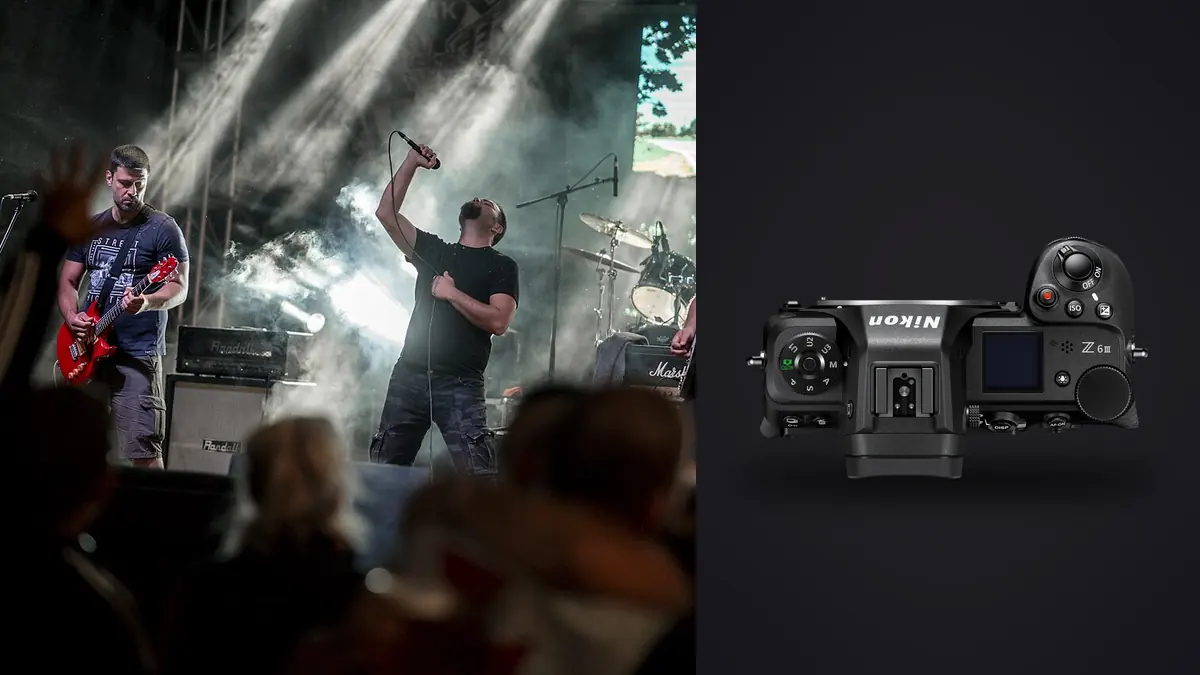
I shot my first dozen concerts on a Z6 II and swore at it more than once. Not because it was bad, it wasn't, but because dark clubs expose every weakness a camera has and the Z6 II's autofocus would occasionally hunt right through the one chorus that mattered. When the Z6 III came out I put off buying it for three months, mostly out of stubbornness, then rented one for a two-night arena run and never sent it back to the rental house. This isn't a spec sheet regurgitation (imagic keeps a full Nikon Z6 III spec reference if that's what you're after). It's what changed for me in the pit, what didn't, and where I still reach for a different body.
The sensor Nikon built specifically for people like us
The headline change is the 24.5-megapixel partially stacked sensor, Nikon's first time putting stacked-style readout speed into a Z6-series body instead of reserving it for the flagship Z9 and Z8. In practice that means the readout is fast enough that rolling shutter distortion, the slanted guitar necks and warped drumsticks you get from electronic shutter under fast motion, is far less of a problem than it was on the Z6 II. I still see it occasionally on a whip pan across a strobing wall of lights, but it's rare enough now that I stopped avoiding electronic shutter out of habit.
Resolution stayed at 24.5MP rather than chasing a higher megapixel count, and for concert work that's the right call. Files stay manageable across a three-hour arena set where you might come home with 3,000 to 6,000 raw frames, and the pixel size keeps high ISO cleaner than a 45-megapixel body would manage at the same sensor size. ISO 6400 to 12800 is where most club and small-theater work actually lives, and the Z6 III holds detail in the midtones at those settings without turning shadows into colored mush. Push to ISO 25600 for the darkest clubs and you'll see noise, but it's fine-grained and responds well to noise reduction rather than the blotchy, smeared look older sensors gave you.
Autofocus that stops guessing under moving lights
Eye-detect autofocus is where the Z6 III earned its keep on that first arena rental. Concert lighting is adversarial by design: backlights, silhouettes, strobes cutting to black between hits, a singer walking from a hot spot into total shadow mid-line. The EXPEED 7 processor's subject tracking held onto a vocalist's eye through lighting changes that would have thrown the Z6 II into a hunting loop. It's not flawless, heavy haze or smoke machines still confuse it occasionally, and a drummer half-hidden behind cymbals will sometimes make the camera lock onto a hi-hat instead of a face. But the miss rate dropped enough that I stopped shooting wide continuous bursts purely to hedge against focus failure, which meant fewer redundant frames to sort through later.
One habit that changed: I now trust 3D tracking more than I did on previous bodies, letting the camera hold a subject as they move across the frame rather than recomposing constantly. For a photographer working a barrier with maybe ninety seconds of clean sightline before a security guard or another shooter blocks the angle, that saved reaction time matters more than any spec on paper.
Reading a room the meter doesn't understand
Concert lighting breaks matrix metering constantly. A follow spot on a singer against a black backdrop reads completely differently than the same singer standing in front of a video wall blasting white content. I shoot manual with auto ISO for almost everything now, dialing in aperture and a shutter speed floor based on how much movement I expect, and letting ISO float. Here's roughly where I start depending on the room, adjusted from actual shows over the past few months:
| Venue / Set Type | Typical Light Level | Starting Point (ISO / Aperture / Shutter) | Metering Note |
|---|---|---|---|
| Small club, two-par backline | Very low, often under 20 lux at the singer's face | ISO 8000-12800, f/1.8, 1/500 | Matrix meter reads the dark room as darker than the subject; check the histogram, not LCD brightness, or you'll underexpose |
| Mid-size theater, single follow spot | Bright hot spot on performer, black background | ISO 800-1600, f/2.8, 1/320 | Spot meter on the face; matrix metering will overexpose trying to lift the surrounding black |
| Arena headline show, moving heads | Swings from near-dark to blinding within a bar of music | Auto ISO 1000-3200, floor shutter 1/640 | Manual aperture and shutter with auto ISO is the only realistic way to keep pace with the swings |
| Festival mainstage, LED wall behind band | Wall content throws shifting color into the meter every few seconds | ISO 800-2000, f/2.8, 1/800 | Wall brightness changes the reading second to second; underexpose slightly on purpose and recover in post rather than chasing it |
| Outdoor festival, daylight set | Full sun | ISO 100-400, f/4-f/5.6, 1/1000+ | Easiest of the five, but LCD glare makes chimping pointless; trust the histogram |
Silent shooting actually holding up in a real pit
A lot of venues and tour riders now require fully silent shooting once you're past the barrier, especially for seated or acoustic sets where a mechanical shutter slap is audible three rows back. I'd used electronic shutter on older Nikon bodies and hated it: banding under certain LED fixtures running at odd refresh rates, and enough rolling shutter skew on fast pans to ruin a frame. The Z6 III's faster sensor readout doesn't eliminate banding entirely (a handful of older LED PAR cans still flicker in a way electronic shutter catches), but it happens noticeably less often than on the Z6 II, and burst speed in full silent mode is genuinely usable at up to 20fps raw rather than being a compromised fallback mode you only use when forced to.
What that means practically: for the first three songs, no-flash photo pit rule that covers most professional shows, I now leave the camera in electronic shutter the whole time instead of switching back to mechanical for anything with fast motion. One less decision to make while trying to track a bassist jumping off a drum riser.
Buffer, cards, and what actually happens after the third song
Shooting 20fps raw for even a few seconds generates a lot of data fast, and this is where card choice stops being theoretical. With a CFexpress Type B card in the primary slot the buffer clears fast enough that I've never hit a hard wall mid-song. Drop back to SD UHS-II only and you'll feel the difference during a long burst on a fast-moving performer, the buffer fills and write speed becomes the bottleneck right when you don't want it to. I run CFexpress as primary and SD as an in-camera backup, which costs more upfront but means a single card failure after a one-night-only show doesn't end your career.
The bigger problem isn't the camera, it's what comes after. Three songs at 20fps across a full pit rotation with three photographers realistically means somewhere between 1,500 and 4,000 frames by the time you're walking out to file. A huge share of those are burst duplicates of the same jump, the same held note, the same crowd surf, five or six nearly identical frames where only one has the eyes fully open and the framing clean. I run everything through imagic before I touch Lightroom now, mostly because its local sharpness scoring flags the technically sharp frames out of a burst without me scrubbing through each one by eye at 1am after a show, and because it's processing on my own machine rather than pushing unreleased tour photos anywhere near a cloud server. The duplicate and burst clustering groups those near-identical jump shots together so I'm choosing one frame per moment instead of comparing thirty almost-the-same images side by side.
If you're new to sorting large concert takes generally, it's worth reading through how AI photo culling actually works before you build a habit around any particular tool, since the underlying logic (sharpness scoring, clustering, not just "AI magic") explains why some culling tools save real time and others just add another pass to your workflow.
Color under lights that were never meant to be color-accurate
LED walls and modern moving-head fixtures throw color casts that no white balance preset handles cleanly, because the light itself isn't consistent across the frame. A singer lit magenta from one side and blue from a wall behind them isn't a white balance problem you fix with one slider, it's a per-image judgment call. What I've settled into is shooting a flat-ish in-camera picture profile so I'm not baking in an aggressive color response, then doing the real grading afterward. Once I've built a look I like for a particular tour's lighting rig (a specific magenta-and-teal combination this band's LD favors, for example), I train imagic's apply_my_style feature on a batch of those graded images so the next night's set from the same tour gets that look applied automatically instead of me rebuilding sliders from scratch at 2am in a hotel room. It's not a substitute for judgment on the outlier frames, but it kills the repetitive part of grading two hundred similar-lit images the same way.
Lens pairing for the pit, not the studio
The body is only half the story. For barrier work I live on the 24-70mm f/2.8 S, wide enough to catch the whole stage from a tight angle and long enough to isolate a face when the crowd in front of you shifts. A 70-200mm f/2.8 S comes out for arena and stadium shows where the barrier sits thirty feet back from the stage. For small clubs where you're often shooting from three feet away, a 50mm f/1.8 S or the f/1.2 if you own one earns its keep purely on light-gathering, letting you shoot a stop or two lower ISO than the zoom would allow. I rarely bring a wide-angle prime unless the room itself, the crowd, the venue architecture, is part of the story I'm trying to tell.
Where I still have complaints
Battery life drops fast with the EVF brightness cranked up, which you need to do in a dark venue just to judge focus and exposure confidently. A three-hour arena show with an opener plus headliner will chew through a battery and leave the second spare looking thin by load-out. The menu system, while better organized than older Nikon bodies, still buries a couple of settings I change mid-set (auto ISO floor, AF area mode) deep enough that I've missed a moment fumbling for them. And at launch pricing the jump over the Z6 II is real money for a working photographer who shoots four or five gigs a month rather than as a full-time career; it's a better tool, but not a cheap upgrade decision.
None of that changes my answer when someone asks what to bring into a photo pit right now. It's the autofocus reliability and the quieter, faster electronic shutter that actually justify the upgrade, not any single spec on a comparison chart.
Frequently Asked Questions
Is the Z6 III fast enough for crowd surfing and mosh pit shots?
Yes, with a caveat. 20fps raw in electronic shutter easily keeps pace with a crowd surfer moving through a pit, and the faster sensor readout keeps the rolling shutter skew you'd expect from that kind of fast, chaotic motion mostly under control. The caveat is autofocus: a crowd surfer is often partially obscured by hands and heads, so I switch to a wider AF area rather than relying purely on eye tracking, which can lock onto the nearest raised arm instead of the person you're actually photographing.
Do I need a CFexpress card, or will SD UHS-II keep up for concert work?
For short bursts, SD UHS-II is fine. For sustained 20fps raw bursts of several seconds, which happens more often than you'd think when a band hits a big chorus, CFexpress clears the buffer noticeably faster and I've genuinely hit the SD-only wall mid-song on a previous body. I'd treat CFexpress as the primary card and use SD as an in-camera backup rather than the other way around.
How well does the Z6 III handle the color casts from LED video walls behind a band?
It handles them the same way any camera does: it records what's actually there, which is often a shifting mix of colors that no single white balance setting corrects cleanly. Auto white balance gets you a reasonable starting point, but expect to do per-song or per-scene color correction afterward rather than expecting one preset to cover an entire set with a changing backdrop.
Is the electronic shutter quiet enough for a seated acoustic show?
Yes, fully silent mode is genuinely silent from a normal shooting distance, which is what most acoustic and seated-venue riders require. The tradeoff is the same one every mirrorless body has in silent mode: a small number of older LED fixtures running at certain refresh rates can produce banding that a mechanical shutter wouldn't show. I test a few frames against the house lighting before committing to silent mode for an entire set.