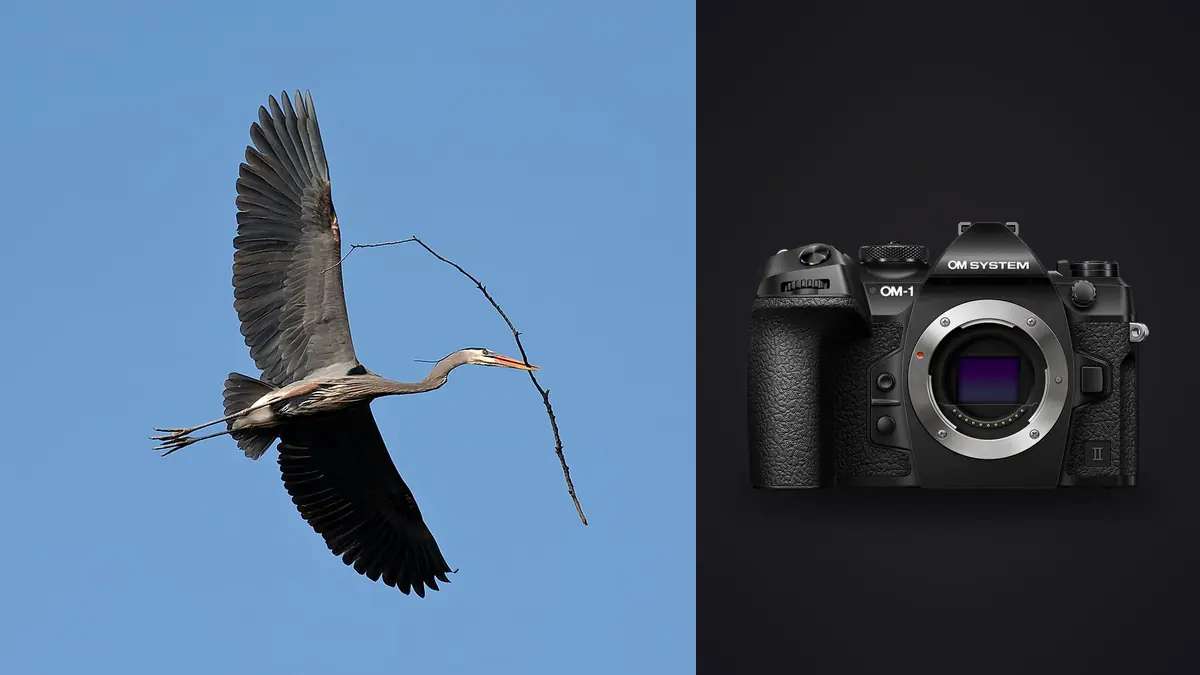
I picked up the OM-1 Mark II mostly to save my shoulder. Two seasons of hauling a full-frame body and a 600mm prime up a reservoir embankment to photograph ospreys plunge-diving had left me looking for something smaller that could still keep up with a bird folding its wings at forty miles an hour. What I did not expect was how much the smaller system would change my approach to the whole session, from the lens I reach for to how I sort the files afterward.
This is not a spec-sheet rundown. It is what changed in practice once I started using the OM-1 Mark II specifically for birds in flight, where the ospreys hunt over a local reservoir in spring, where a colony of common swifts screams past a barn roof at dusk in July, and where the camera's particular strengths and particular annoyances actually showed up.
What the Mark II Changes for Flight Work
The sensor is the same 20.4-megapixel stacked, backside-illuminated Four Thirds chip as the original OM-1. If you were hoping for a resolution bump, there isn't one, and for birds in flight I have made peace with that. What OM System actually touched between the original and the Mark II is the subject-detection algorithm and the processing pipeline behind it, and that is the part that matters most when you are tracking something unpredictable against open sky.
Bird detection on the original OM-1 was good but twitchy. It would occasionally lock onto a wingtip instead of an eye, or lose the subject entirely the moment a bird banked hard against a cluttered treeline. The Mark II's detection is noticeably steadier in exactly those situations. On osprey dives, where the bird goes from a lazy circling glide to a near-vertical stoop in under a second, the autofocus box now tends to ride the head and eye through the transition rather than snapping back to a generic subject box. It still loses birds sometimes, usually when a second bird crosses the frame or when the subject is silhouetted against low sun, but the failure rate dropped enough that I stopped treating Pro Capture as a crutch for bad tracking and started treating it as a tool for genuinely unpredictable moments, like the exact instant a swift peels off to feed a chick.
The 2x Crop, Honestly
The Four Thirds sensor's 2x focal length multiplier gets sold as a free reach bonus, and for birds in flight it mostly is, but not for the reason people think. A 300mm lens on this body frames like a 600mm on full frame, sure, but the bigger practical win is depth of field. At the same field of view and aperture, Four Thirds gives you more of the bird in focus, which matters enormously when a raptor's wings are swept forward on the downstroke and its head is a few centimeters closer to the lens than its wingtip. On full frame with a fast prime I was constantly fighting razor-thin depth of field on partially open wings. Here I can shoot at f/5.6 and get the whole bird sharp without stopping down enough to lose shutter speed.
Burst Modes and Buffer Reality
OM System's naming for its drive modes is not intuitive until you have used them for a season, and the numbers on the box do not tell you what actually happens when a bird you're tracking suddenly changes direction. Here is what I have found each mode is actually good for, based on a full spring of osprey sessions and a summer of swift chasing.
| Mode | Frame rate | AF/AE per frame | Pre-shutter buffer | Where I actually use it |
|---|---|---|---|---|
| SH1 (mechanical) | up to 10fps | Full tracking | None | Perched birds, slow wingbeats, quiet situations near a hide |
| SH2 (electronic) | up to 25fps | Full tracking | None | General flight tracking across open sky, the default I leave it on |
| Pro Capture SH | up to 50fps | Full tracking | ~0.5s (roughly 15 frames) | Osprey strikes on water, takeoffs from a perch, anything with a launch moment I can't react fast enough to catch |
| Pro Capture H | up to 120fps | Locked from first frame | ~0.5s pre-roll | Freezing individual wingbeats on a bird already tracked and centered, not for erratic flight |
The buffer numbers above assume a fast UHS-II card in the primary slot. Drop to a budget card and Pro Capture SH chokes noticeably faster, sometimes stalling mid-sequence right when the bird finally does something interesting. I learned this the hard way during a tern colony visit where a cheap card cost me the one clean strike sequence of the afternoon. Since then I only shoot Pro Capture on the fastest card I own, and I treat the second slot as backup storage rather than a second working card.
Lens Pairings That Actually Earn Their Keep
The camera is only half the equation, and for birds in flight the lens choice matters as much as the body. I have rotated through three options over the past year, and each has a distinct role rather than one being a strict upgrade over the others.
The 150-400mm f/4.5 Pro with its built-in 1.25x teleconverter is the one I reach for when I know I'll want reach on demand. Flicked into the teleconverter position it gives roughly 1000mm equivalent full-frame field of view at f/5.6, which sounds absurd until you're tracking a distant osprey circling before a dive and suddenly need every millimeter. It's heavy for this system at just under two kilograms, but that's still meaningfully lighter than the full-frame supertelephotos I used to carry, and the built-in hood and tripod collar are genuinely well thought out for handheld tracking.
For most ordinary sessions I actually use the 100-400mm f/5-6.3 IS more often. It's a fraction of the weight, autofocuses fast enough that I don't notice a difference against the Pro glass in good light, and the zoom range is more forgiving when a bird closes distance quickly, which swifts do constantly as they hawk insects low over a barn roof. The tradeoff shows in the corners wide open and in autofocus speed once light drops below dusk levels, where it visibly hunts more than the Pro lens does.
The 40-150mm f/2.8 Pro paired with the 2x teleconverter is my underrated combination for close water action, ospreys hitting the surface within thirty or forty meters, or gulls working a boat wake. Effective 560mm at f/5.6 with faster, more confident autofocus than either of the longer zooms, because the base lens is so well corrected to begin with.
Weight and Handling Over a Full Day
None of this matters if your arms give out before the light does. A body-and-lens combo that lets me hand-hold through a four-hour dawn session without a monopod is worth more to my actual keeper rate than another stop of dynamic range would be. That's the real argument for this system on birds in flight, not the spec sheet, just the fact that I'm still steady and still paying attention in hour three instead of nursing a shoulder.
Where I've Been Let Down
I want to be straight about the weaknesses, because gear write-ups that only praise a system aren't useful in the field. High ISO is the obvious one. Past roughly ISO 3200 on this sensor, shadow detail on a dark-plumaged bird against bright sky starts breaking up in a way that a full-frame body simply doesn't at the same ISO. On overcast days with fast-moving subjects I'm regularly pushed into that range, and I've had to accept some noise reduction compromises I wouldn't need on a bigger sensor.
Subject detection also still misfires in cluttered scenes. Reeds, branches, and chain-link fences in the background can pull the eye-detect box away from the bird, especially when the bird is small in the frame. It's better than it was, not solved. And weather sealing, while genuinely good in steady rain, doesn't mean I'd trust it in the driving coastal spray I sometimes get chasing terns, so I still carry a rain cover for anything beyond a light drizzle.
Sorting Through a Season's Worth of Bursts
The unglamorous part of birds-in-flight photography is what happens after the session, and Pro Capture makes that part heavier than it used to be. A single good evening at the swift colony can leave me with four or five thousand frames, most of them near-duplicates from a 50fps burst where only one or two actually nailed focus on the eye.
This is where I've leaned on imagic to keep the workflow sane. Its local sharpness and focus scoring runs across the whole take and flags which frames in a burst are actually critically sharp on the bird's eye versus which are soft from motion blur or a focus hunt mid-sequence, which matters a lot when fifty frames can look identical at thumbnail size. The duplicate and burst clustering groups each Pro Capture sequence together automatically instead of leaving me to scroll through near-identical frames one at a time trying to spot the difference. And because it runs entirely on my laptop rather than uploading anything, I can do a first pass at the reservoir car park with no signal, which is often when I actually have the spare twenty minutes to do it.
The other feature I've come to rely on is apply_my_style, trained on my own previously edited wildlife shots rather than a generic preset. A big flight sequence used to mean manually matching exposure and color across two hundred keepers so the set looked consistent. Now that first pass largely reflects how I already edit ospreys and swifts, and I'm adjusting a handful of outliers rather than starting from zero on every frame. If you're dealing with the same volume problem, it's worth reading through how AI photo culling actually works before assuming any culling tool will handle burst-heavy wildlife work the same way it handles a portrait shoot, because the two are not the same problem. For more on building a wildlife-specific editing workflow around imagic, see imagic for wildlife photography.
None of that fixes the underlying issue, which is that fast burst modes generate more files than any photographer can reasonably review by eye. It just means the review no longer eats the entire evening after the shoot.
Frequently Asked Questions
Is the OM-1 Mark II's bird detection actually better than the original OM-1, or is it a marketing claim?
In my experience it's a real difference, not a paper spec. The improvement shows up most on erratic, fast-changing flight, ospreys mid-stoop, swifts banking hard, where the original body's tracking would more often snap to a wing or lose the subject entirely. On a bird flying a predictable straight line across open sky, the two bodies perform close enough that you'd be hard pressed to tell them apart in a blind test.
Do I need the 150-400mm PRO, or is a smaller zoom enough for birds in flight?
It depends on what you're shooting and how close you can realistically get. For songbirds and swifts working close over a rooftop, the 100-400mm is genuinely enough and far more pleasant to hand-hold for hours. For distant raptors or anything you can't approach, like an osprey circling a reservoir before it commits to a dive, the extra reach from the 150-400mm's built-in teleconverter earns its weight.
Is Pro Capture worth using for every takeoff or strike, or does it just create too many files to deal with?
It's worth it for genuinely unpredictable moments, a perched bird about to launch, an osprey about to hit the water, where you can't react fast enough with a normal shutter press. I don't leave it on for general flight tracking though, because the file volume gets unmanageable fast and most flight sequences don't need a pre-roll buffer, just steady continuous tracking.
How much does the 2x crop factor actually help compared to a full-frame body with a longer lens?
The extra reach is real, but the bigger practical benefit for flight work is the added depth of field at a given field of view and aperture, which keeps more of a bird's wings and body in focus without needing to stop down and lose shutter speed. It doesn't outweigh the noise disadvantage at high ISO, so which system wins depends heavily on the light you're actually shooting in.