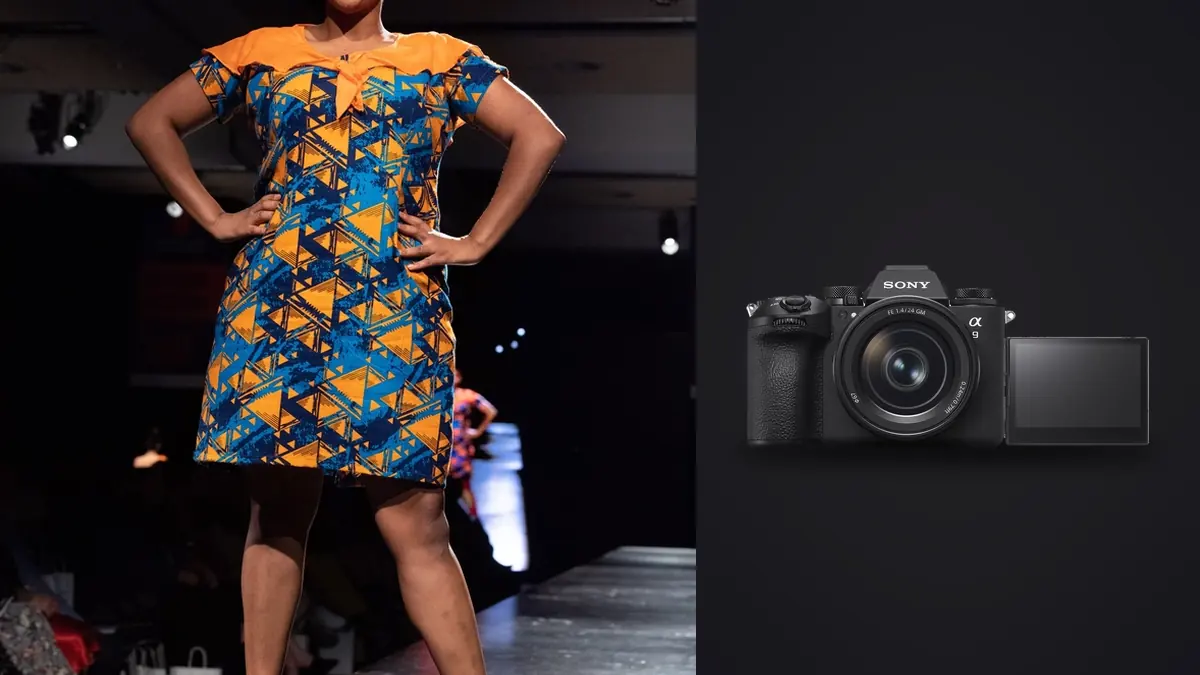
A commercial fashion lookbook day rarely looks like the tidy, single-light studio session people picture when they hear "fashion photography." It's usually eight to twelve looks, a location or two, a small army of stylists steaming garments between setups, and a client standing behind the monitor wanting to see wardrobe changes land on schedule. The camera in your hand has to keep pace with that chaos without becoming the bottleneck. That's the lens I want to look at the Sony A9 III through: not as a spec sheet, but as a tool that either helps or hurts on exactly this kind of day.
The headline feature is the global shutter, the first full-frame stacked sensor to read out the entire frame at once instead of scanning it top to bottom the way every other mirrorless camera does. For lookbook work specifically, that one engineering decision solves two problems that have quietly cost fashion photographers time and light for years: rolling shutter skew on fast-moving fabric and hair, and the flash power tax that comes with high-speed sync. Everything else about the camera, the 120fps burst, the AI subject recognition, the redesigned menu, is useful, but it's the sensor readout that changes how you actually plan a shoot day.
Why the Global Shutter Is the Actual Story Here
Every rolling shutter sensor exposes a scene a row or two at a time, sweeping down the sensor in a few milliseconds. Most of the time you never notice. Put a model in a mid-air jump with a coat flaring out, or shoot a fast pan following a walk, and that sweep becomes visible as skew, wobble, or a slightly bent horizon line. It shows up most on the frames you actually want, the ones with real movement in them, because that's exactly when the subject is moving fastest relative to the sensor's readout speed. On the A9 III, the entire 24.6-megapixel sensor exposes in one instant, so a jump shot at 1/8000s looks geometrically identical to a static one. For a lookbook built around movement (fabric flips, hair whips, a model stepping mid-stride toward camera) that removes a category of reject you'd otherwise be sorting out in the edit.
It also means there's no mechanical shutter in this body at all. Sony didn't bother including one because the global shutter design makes it redundant, which is a genuine first for a full-frame stills camera. Shutter shock and shutter-induced vibration, the kind that softens a frame just slightly at certain speeds with longer lenses, isn't a variable you have to think about anymore.
Flash Sync at Any Shutter Speed Changes How You Light a Set
This is the feature that actually changes a lookbook shoot's logistics, more than the burst rate does. Conventional cameras sync a flash at whatever speed their mechanical shutter fully opens, typically 1/200s or 1/250s. Shoot faster than that in bright sun and the shutter curtain is scanning across the sensor while it's open, so a normal flash pop only lights part of the frame. The workaround has been high-speed sync (HSS), which pulses the flash rapidly through the whole exposure, but that pulsing burns a lot of the strobe's output. A 500Ws pack in HSS at 1/2000s can behave like it's putting out a fraction of that, which forces you to either move the light closer, open the aperture wider than you wanted, or add more heads than the location can fit.
Because the A9 III's shutter is global, the entire sensor is exposed for the full duration you set, even at 1/8000s or the maximum 1/80,000s. A single flash pop lights the whole frame at full output no matter the shutter speed. On location that means you can shoot f/1.8 or f/2 at midday with a beauty dish for fill and still get full power out of it, instead of stopping down to f/8 to stay under sync speed or burning through ND filters to bring ambient down far enough that HSS becomes usable. For an outdoor lookbook where the brand wants a shallow, editorial look rather than a stopped-down catalog look, that's the difference between fighting the sun all afternoon and mostly ignoring it.
It's worth being specific about where this saves real time on set: reflector and diffusion changes that used to happen every time the light moved past noon, because your sync speed and aperture combination stopped working, mostly go away. You dial your look once in the morning and it tends to hold through the day.
The ISO Floor and What It Costs You in Dynamic Range
Global shutter sensors have a tradeoff that doesn't show up on a spec sheet the way resolution or burst rate does. The extra circuitry needed to read every pixel simultaneously eats into the space available for light-gathering, so the A9 III's native ISO floor sits at 250 rather than the 100 you'd get on a conventional sensor, and dynamic range at base is measurably narrower than something like the A7R V or the older A9 II. In practice this shows up on the frames with the widest range in a single scene, sequined or metallic fabric under hard sun next to shadow detail in hair or a dark garment.
On set this means being more disciplined about protecting highlights than you might be with a full-frame body built primarily for dynamic range. I've started shooting a stop or so under where I'd normally sit, watching the histogram on shiny fabrics specifically, and pulling exposure back up in the raw edit rather than trusting I can recover a blown sequin panel later. It's a small adjustment in habit, not a dealbreaker, but it's the one place the global shutter's advantages come with an actual cost attached.
Resolution Reality Check: Is 24.6MP Enough for a Lookbook?
24.6 megapixels is plenty for a web lookbook, a lineup of e-commerce product shots, or a full-page magazine spread. It gets tighter if the deliverable includes billboard-scale out-of-home ads or heavy crops pulled from a full-body frame for social, where the extra headroom on a 50 or 61-megapixel body buys you room to reframe after the fact without asking the client to reshoot. Whether that matters depends entirely on the contract, not the camera. If the brief specifies large-format print, it's worth asking upfront whether the client expects a higher-resolution body for that portion of the day, or whether the A9 III's speed advantages on the movement shots outweigh the resolution ceiling on the static ones.
| Camera | Resolution | Max flash sync | Continuous shooting | Rolling shutter distortion | Best fit on a lookbook day |
|---|---|---|---|---|---|
| Sony A9 III | 24.6MP | Full sync to 1/80,000s (global shutter, no mechanical shutter) | Up to 120fps with continuous AF/AE | None | Movement shots: jumps, fabric flips, walking sequences, outdoor strobe work in bright sun |
| Sony A7R V | 61MP | 1/200s native, HSS available with power loss above that | Up to 10fps | Moderate at fast electronic shutter speeds | Static beauty and product detail shots, large-format or heavily cropped deliverables |
| Sony A1 II | 50.1MP | 1/400s mechanical, HSS above that | Up to 30fps electronic | Minimal but present | Hybrid stills and video days where resolution and speed both matter |
None of these is the "correct" camera in an absolute sense. They trade resolution for sync speed and readout behavior in different directions, and a studio running enough volume to justify it will often own more than one, reaching for the A9 III specifically on the days the shot list has real motion in it.
120fps Bursts and the Culling Math That Follows
120 frames per second with full autofocus and exposure tracking sounds like a pure advantage until you're the one scrolling through the take that afternoon. A three-second burst on a walking or jumping shot is 360 frames, most of them nearly identical, differing only by a few degrees of hair movement or a slightly different foot position. Multiply that across ten looks and two or three burst moments per look, and a single lookbook day can easily produce four or five thousand frames that all need to get looked at, sharpness-checked, and narrowed down to the handful the client actually sees.
This is where the culling step, not the shooting, becomes the actual time sink in the day. I run these bursts through imagic before I touch Lightroom, because it clusters near-duplicate frames from a single burst together instead of making me scroll past three hundred versions of the same jump one at a time, and it scores sharpness locally so the soft-eye frames in a burst get flagged before I waste time zooming in on each one manually. For a rundown of how that kind of clustering and scoring actually works under the hood, this piece on AI photo culling goes into more detail than I have room for here.
The other thing that matters on fashion work specifically: unreleased collections are usually under some kind of embargo or NDA before the client publishes them, and a lot of cloud-based culling tools want to upload your take to score it. Because imagic processes everything on the machine you're culling on, nothing from an unannounced collection leaves your drive during that step, which has made it an easier sell to clients who ask how their images are being handled before launch.
Lens Choices and AF Behavior for Movement-Heavy Shots
The A9 III's AI-driven subject recognition tracks human pose, not just a face or an eye, which matters more on a lookbook than it would on a portrait session because the model is rarely standing still and facing camera. Walking toward the lens, turning mid-stride, or reaching to adjust a coat, the camera holds focus on the body even when the eye is turned away or briefly out of frame, and it picks the subject back up fast when they turn back.
For lens pairing, the 70-200mm GM II earns its keep on the walking and full-body shots where you want some working distance from the model and crew, and its fast, near-silent internal zoom doesn't fight the AF system during a burst. For closer beauty or detail inserts between full-look setups, the 50mm f/1.2 GM gives you the shallow depth of field that a global shutter sensor's full-power flash sync makes genuinely usable outdoors, since you're no longer forced to stop down just to stay under a sync speed ceiling. The 24-70mm GM II stays mounted for the in-between moments, environmental context shots and behind-the-scenes coverage the client often wants alongside the finished looks.
A Practical Field Workflow for Lookbook Day
A workable rhythm on a multi-look day looks something like this: shoot the look, do a quick back-of-camera check with the model and stylist, move straight into the next setup while an assistant, or you between changes, runs the last look's cards through culling. Because the scoring happens locally and fast, you can realistically be looking at a shortlist from look three while the crew is still steaming look five, rather than discovering during the overnight edit that a whole setup came back soft.
Once the shortlist is in hand, consistency across the full set of looks is the next problem, and it's a real one on lookbooks specifically because the client is looking at ten or twelve images side by side in a grid, where any tonal drift between looks stands out immediately. I lean on imagic's apply_my_style feature here, which builds a preset from a set of my own previously edited images rather than a generic filter, so a fresh batch from the day lands close to my established grade before I go in and do the per-image adjustments a lookbook actually needs.
None of this replaces a deliberate workflow, it just removes the parts of the day that used to be pure grinding. If you're looking to tighten up the rest of the pipeline beyond culling and grading, these workflow tips cover the adjacent pieces, from file naming to client review, that tend to matter just as much as the camera on a tight turnaround.
Common Mistakes When Shooting Lookbooks on the A9 III
The most common mistake I see, and made myself early on, is treating the 120fps burst mode as the default for everything. It's the right tool for a jump or a walk, but for a static three-quarter pose it just generates volume without adding value, and you pay for that volume later at the culling desk. Reserve the highest burst rates for the shots that are actually moving, and shoot single frames or a modest burst for the poses that aren't.
The second is forgetting the ISO floor. Because 250 is now your base rather than 100, reflexively dialing in the same exposure settings you'd use on another body can leave you a stop brighter than intended in flat, overcast light, which matters more on pale or white garments than it does on skin tones. Check the histogram on the actual fabric being shot, not just the model's face, especially for white or light-colored collections.
Frequently Asked Questions
Do I still need high-speed sync flash triggers with the Sony A9 III?
No, and that's the point. Because the shutter is global rather than a scanning mechanical or electronic curtain, a standard flash pop lights the entire sensor at full output regardless of shutter speed, so HSS mode on your trigger becomes unnecessary. You get full strobe power at 1/8000s the same way you would at 1/200s, which is not true of any camera with a conventional shutter.
Is 24.6 megapixels enough resolution for a commercial fashion lookbook?
For web galleries, e-commerce listings, and standard print spreads, yes, comfortably. It gets tighter for large-format out-of-home advertising or aggressive social crops pulled from a full-body frame, where a 50 to 61-megapixel body gives you more room to reframe after the fact. Check the deliverable spec before assuming resolution is a non-issue.
How many frames does a typical lookbook day on the A9 III actually produce?
It varies with how much movement is in the shot list, but a day of ten to twelve looks with a couple of burst moments each can land anywhere from three to six thousand frames once you count every jump, walk, and fabric-flip sequence. That volume is exactly why a culling step that can cluster bursts and flag soft frames automatically matters more with this camera than with a slower-shooting body.
Does the global shutter fix banding from continuous LED lighting?
Yes, and this is an underrated benefit for indoor or studio lookbook work. Rolling shutter sensors can pick up visible banding under LED panels that flicker at a rate not perfectly matched to the shutter speed, especially at faster electronic shutter settings. Because the A9 III reads the whole frame at once, that particular flicker-banding interaction doesn't occur, which is one less thing to test for when you're setting up continuous lighting on a rented stage.