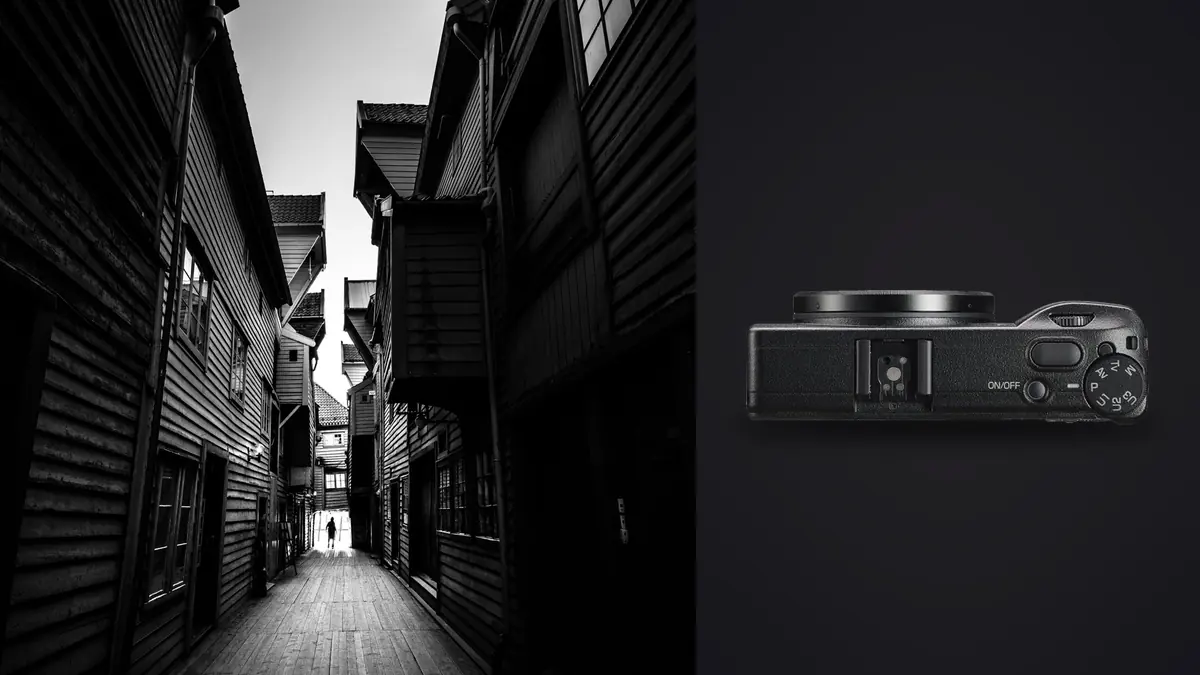
The 40mm Equivalent Changes How You Work a Scene
The GR IIIx is the same body as the standard GR III with one deliberate substitution: a 26.3mm f/2.8 lens instead of the 18.3mm f/2.8 that ships on the wider camera. On the APS-C sensor that works out to roughly a 40mm field of view, sitting between the classic 35mm reportage frame and a tight 50mm. Ricoh didn't add this as a second option by accident. The company had years of feedback from GR shooters who wanted something less wide, and 40mm is the compromise: not so tight that you lose context, not so wide that every frame needs a foreground element to feel composed.
For documentary work specifically, this matters more than the spec sheet suggests. A 28mm equivalent (what the standard GR III delivers) forces you close, which is great for immersive street work but can flatten a portrait or make a quiet observational moment feel like you're crowding the subject. At 40mm you can stand a natural conversational distance from someone, maybe two meters, and still fill the frame with intent. I've shot markets, protests, and small-town main streets with both focal lengths on GR bodies, and the IIIx is the one I reach for when the story is about a person rather than a whole environment.
Cropping In-Camera Instead of Zooming
Because the sensor is a 24.2 megapixel APS-C chip with plenty of resolution to spare, the GR IIIx also offers digital crop marks in the frame that simulate roughly 50mm and 71mm equivalent framings. This isn't a zoom, it's just cropping the file and showing you the result live, but it's genuinely useful for deciding composition before you press the shutter rather than cropping blind in post. Shoot the 50mm crop mode and you're still left with around 12 megapixels after the crop, which is plenty for web use, a magazine spread, or a modest print. I use this more than I expected to when I'm working a subject who won't let me get closer.
A Body Built to Disappear
The GR IIIx weighs about 262 grams with a battery and card loaded, and it's small enough to sit flat in a jacket pocket without printing an obvious camera-shaped bulge. That matters for documentary work in a way that's hard to explain until you've tried working a room with a DSLR and then again with something this size. People stop performing for the camera much faster when the camera barely registers as a camera. I've had subjects forget I was shooting entirely, which is exactly what you want for honest, unposed frames.
There's no viewfinder built in. Ricoh sells an optical accessory finder (the GV-2) that slides into the hot shoe, but it's a frame-line finder with no exposure information, not a through-the-lens experience, and most GR IIIx owners I know shoot off the rear LCD exclusively. In bright sun that screen washes out, and you learn to shoot semi-blind, trusting the zone focus settings rather than chimping every frame. It's a real limitation. It's also part of why the camera stays so small.
The leaf shutter built into the lens is the other quiet advantage. It's mechanically almost silent, nothing like the shutter slap of a mirrorless body with a focal-plane shutter, and it syncs with flash at speeds a focal-plane shutter can't touch. For documentary shooters working funerals, courtrooms, religious services, or anywhere a loud click draws eyes, this is not a minor feature. It's the difference between a usable frame and a scene where everyone turns to look at you.
Snap Focus Instead of Chasing Autofocus
The GR IIIx has hybrid autofocus (contrast plus phase detection) that's respectable in good light but can hunt indoors or in low contrast scenes, same as most compact AF systems. Street and documentary shooters mostly work around this with Snap Focus, a Ricoh-specific feature that's been on GR bodies since the film era in spirit if not in name. You set a fixed distance (1m, 1.5m, 2m, 2.5m, 5m, or infinity), assign it to a function button, and the lens jumps straight to that distance with zero AF hunting the instant you press the shutter. Combine that with a small aperture for depth of field and you can shoot from the hip or from waist height without ever looking through a finder.
The table below is a depth of field reference I built for my own use, calculated for the GR IIIx's 26.3mm lens at each of its six preset snap distances across three common apertures. These are approximate, based on a standard circle of confusion for a 24 megapixel APS-C sensor, but they're close enough to plan a day of zone-focused shooting around.
| Snap Distance | f/2.8 Near–Far | f/5.6 Near–Far | f/8 Near–Far |
|---|---|---|---|
| 1.0 m | 0.93 – 1.08 m | 0.87 – 1.17 m | 0.83 – 1.26 m |
| 1.5 m | 1.35 – 1.68 m | 1.23 – 1.92 m | 1.14 – 2.18 m |
| 2.0 m | 1.75 – 2.34 m | 1.55 – 2.82 m | 1.41 – 3.43 m |
| 2.5 m | 2.12 – 3.06 m | 1.83 – 3.93 m | 1.64 – 5.22 m |
| 5.0 m | 3.66 – 7.87 m | 2.89 – 18.4 m | 2.45 m – infinity |
The practical takeaway: set Snap Focus to 2m at f/8 and you have a working zone from about 1.4m to 3.4m with no autofocus lag at all, which covers most conversational street distances. Set it to 5m at f/8 and everything from 2.45m out is acceptably sharp, which is closer to how a lot of documentary photographers actually work a scene, staying loose and letting the zone do the work rather than hunting for focus confirmation.
The Raw Files Are Just DNG, and That Matters More Than It Sounds
Ricoh made an unusual choice with the GR line: raw files come straight off the sensor as Adobe DNG rather than a proprietary format like Nikon's NEF or Canon's CR3. There's no separate raw converter to install, no waiting for third-party software to add support after a new release, and the files open cleanly in whatever you're already using. On a documentary assignment where you might be editing on a borrowed laptop or handing files to a collaborator who doesn't own a GR, that compatibility is a genuine convenience.
What it doesn't solve is volume. A day of loose, reactive street shooting on the GR IIIx routinely produces DNGs in the 24 to 28MB range, and because the shooting style that suits this camera (working a scene, firing several frames as an expression or a gesture changes by a fraction of a second) tends to produce clusters of nearly identical shots, a single afternoon can leave you with 600 to 1,000 frames where maybe 40 are actually distinct moments. Sorting that by eye, especially when you're also trying to write captions or file a story on a deadline, is where the real time goes, not the shooting itself.
This is the part of the workflow where I run everything through imagic before I open a single frame in an editor. It scores sharpness and focus accuracy locally on the machine, which catches the frames where a Snap Focus zone was set half a meter off and the subject drifted out of the depth of field range, and it clusters the near-duplicate bursts so I'm choosing between three grouped options instead of scrolling through thirty similar frames one at a time. Because it runs entirely offline with no upload step, that also matters for documentary work specifically. If you're photographing people in a sensitive situation, a protest, a shelter, an ongoing legal case, sending those images through a cloud service before you've even decided what to keep is a real risk, and skipping that step entirely isn't a small convenience.
In-Camera Looks vs. Building a Consistent Edit
Ricoh bakes a set of Image Control presets into the GR IIIx (Positive Film, Negative Film, HDR Tone, Bleach Bypass, and a few others) and they're genuinely good, good enough that plenty of GR shooters deliver JPEGs straight out of camera without ever opening a raw editor. But if you're shooting raw for the flexibility, that convenience disappears, and you're left re-creating a consistent look frame by frame across a body of work that might span weeks or months of a single documentary project.
The way I've settled that for myself is training imagic's apply_my_style feature on a set of edits I'm already happy with from earlier in a project, then letting it apply that same treatment across new imports as I shoot. It's built from my own edit history rather than a generic film emulation, so a black and white documentary series I shot over a season looks like one continuous body of work instead of forty separate editing sessions with slightly different contrast decisions each time. If you haven't settled on a consistent grade yet, it's worth reading through a color grading workflow first so you have a baseline to train the style from.
Battery Life and the Single Card Slot
The DB-110 battery is rated by CIPA at around 200 shots per charge, and that number is honestly not far off in practice once you account for chimping shots on the LCD and leaving the camera powered on between frames while you're walking a scene. On a full documentary shooting day I carry two spares minimum, sometimes three if I'm also reviewing footage on the screen or using Wi-Fi to send a preview back to an editor. It charges over USB-C in camera, which is convenient with a power bank but slow if you actually need the battery back quickly.
There's a single UHS-I SD card slot, plus roughly 2GB of built-in memory as a genuine last resort if you fill or forget a card. For a documentary photographer used to dual-slot backup on a larger body, this is a real downgrade in redundancy, and it's worth building the habit of offloading cards more often than feels necessary rather than shooting an entire multi-day assignment onto one piece of media. Because the culling and scoring happens entirely offline, I can do that offload and a first pass through the images at night in a hotel room with no signal at all, which on assignments in places with unreliable connectivity has saved me more than once.
What This Camera Won't Do For You
Ricoh has never sold an official weather-sealing kit for the GR III or GR IIIx the way it does for its ruggedized WG compact line, so there's no manufacturer path to using this camera confidently in sustained rain or heavy dust. I've shot it in light drizzle and windblown sand without incident, but I treat that as luck rather than a spec I can rely on, and I wouldn't take it into a genuine downpour the way I would a sealed mirrorless body. If your documentary work regularly puts you outdoors in bad weather, that's a real constraint to plan around, not a footnote.
The 4fps continuous burst rate is also not built for anything resembling action. This is not the camera for a march that turns into a sprint or a subject who moves unpredictably fast. It's built for the photographer who works a scene patiently and waits for the moment to arrange itself, which suits a lot of documentary photography but not all of it.
A Realistic Field-to-Delivery Workflow
On a typical documentary day with the GR IIIx I'll come home with somewhere between 500 and 900 DNG files. The import and cull is where a disciplined process actually pays off, and it's worth reading through general workflow speed tips if you haven't built your own routine yet, since a lot of the time savings in a project like this come from habits rather than gear. My own sequence is: offload cards to two locations immediately, run the full import through imagic for sharpness scoring and burst grouping, work through the flagged clusters to pick single frames rather than the whole group, apply the trained style pass, then move only the selects into the actual editor for the handful of images that need individual attention. If you're new to the idea of software doing the first pass of that sort, this breakdown of how automated culling actually works covers the mechanics in more depth than I have room for here.
What that process buys me isn't a shortcut around editing, it's time back for the part of the job that actually needs a human eye: picking which of three nearly-identical frames has the right expression, the right hand position, the moment that reads as true rather than staged. The camera's job on a documentary assignment is to get out of the way. The GR IIIx does that better than almost anything else I own, and the workflow around it needs to do the same.
Frequently Asked Questions
Is the Ricoh GR IIIx suited to documentary work or is it really just a street snapshot camera?
It's genuinely capable of sustained documentary work, with the caveat that it suits a particular pace. The 40mm equivalent framing, quiet leaf shutter, and Snap Focus system are all built around patient, observational shooting rather than fast action, which describes a lot of documentary photography but not assignments that need to track quick movement. Photojournalists covering slower-moving, character-driven stories tend to get more out of it than those covering breaking news.
How does the GR IIIx's 40mm equivalent lens actually compare to shooting a 35mm or 50mm prime on a larger body?
It sits deliberately between the two, close enough to a 35mm for environmental context, tight enough to approach 50mm for a more isolated subject. The tradeoff against a larger body with an interchangeable 35mm or 50mm prime is that you lose the option to switch focal lengths mid-shoot, but you gain a camera small enough to carry everywhere, which for documentary work often matters more than lens flexibility.
Does the Ricoh GR IIIx shoot raw, and what format are the files?
Yes, raw capture is available alongside JPEG, and unlike most manufacturers Ricoh records raw files directly as Adobe DNG rather than a proprietary format. That means broad compatibility with raw editing software without waiting for a dedicated codec update, though file sizes still run in the mid-20MB range per frame, similar to other APS-C raw files.
Is the Ricoh GR IIIx weather sealed for outdoor documentary assignments?
No. Ricoh has not released an official weather-sealing kit or adapter for the GR III or GR IIIx, unlike some competing compacts that offer optional protective filters or gaskets. Light moisture is generally tolerated in practice, but there's no manufacturer guarantee, so sustained rain or dusty environments carry real risk without additional protection you'd need to source yourself.