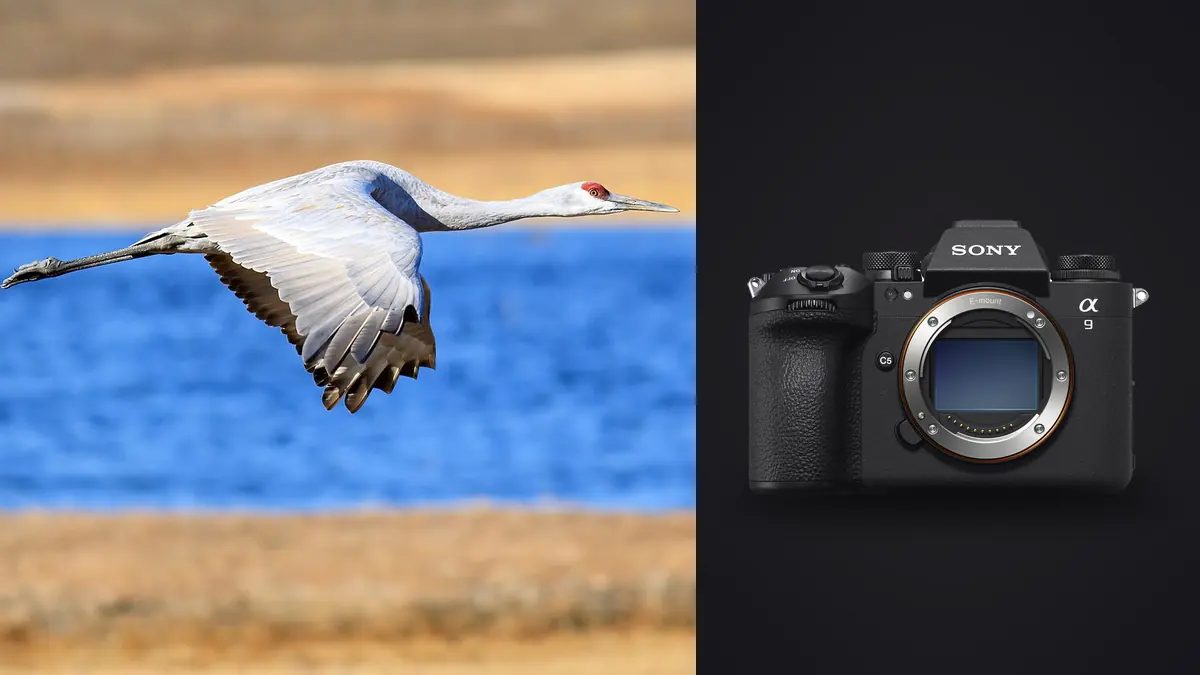
I spent four mornings in a row this spring parked on a riverbank hide waiting for common terns to dive, and by the third morning I'd stopped chimping after every pass. That's the thing nobody tells you about the Sony A9 III until you've actually flown it against fast, erratic birds: the camera changes how you shoot, not just what the spec sheet says it can do. Global shutter isn't a marketing checkbox here. For birds in flight specifically, it solves problems that every other stacked-sensor body still has, and it introduces a couple of new ones that don't show up in the launch keynote.
What global shutter actually removes from the equation
Every electronic shutter before this one, including Sony's own A9 II and A1, reads the sensor a row at a time. On a static subject you never notice. On a teal doing a hard bank at 15 meters, or a swift changing direction mid-wingbeat, that row-by-row readout means the top of the frame was exposed a few milliseconds before the bottom. The result is the wingtip skew and the slightly warped propeller look you've probably seen in your own burst sequences and blamed on panning technique. It usually wasn't your panning.
The A9 III reads the entire sensor at once. Every photosite exposes and clears at the same instant, so there's no readout lag to create that skew, no matter how fast the wing or how hard the bird is banking. I ran ospreys diving on a lake for a week specifically to test this, deliberately shooting into the fastest wing-beat portion of the stoop, and the wingtip geometry stayed honest frame after frame. On my old A9 II, the same shot type gave me a visibly bent leading primary in maybe one frame out of five at similar shutter speeds.
The other thing global shutter unlocks that matters more than people expect: flash sync at any shutter speed, all the way up to 1/80000s. For daytime fill flash on backlit raptors, that means you can drag the ambient exposure down and still get a clean flash pop without hunting for a high-speed sync mode that saps your guide number. I don't reach for flash on flight shots often, but on overcast days shooting owls at dusk it's genuinely useful in a way it wasn't on any previous Sony body.
The ISO floor nobody puts on the highlight reel
Here's the trade-off that gets buried under all the frame-rate talk. Because the global shutter sensor needs extra in-pixel circuitry to read every site simultaneously, Sony had to give up some full-well capacity, which pushes the native ISO floor up to 250 instead of the usual 100. In practice this means your dynamic range headroom at base ISO is a bit tighter than on the A9 II or the A1. Shooting bright white egrets against a dark treeline, I've had to be noticeably more careful about not clipping highlights than I ever was on the A1, because there's less room to recover them afterward.
It's not a dealbreaker for birding. Most flight shots are shutter-speed limited anyway, so you're rarely sitting at base ISO with headroom to spare. But if you shoot a lot of high-contrast scenes, backlit gulls, snowy owls in bright snow, that sort of thing, it's worth knowing going in rather than discovering it back at the desk when a blown wing feather won't come back.
Autofocus for subjects that don't fly in straight lines
The AI subject recognition system carries over from the A1 and A9 II generation but tuned specifically for birds as a first-class subject type, not folded into a generic "animal" bucket. It finds the eye on a bird that's a tiny fraction of the frame, and more importantly it keeps holding it through wing occlusion, which is the actual hard problem in BIF work. A gull flapping past a cluttered reed bed used to trip up older tracking systems constantly because the wing would sweep across the eye and the camera would grab the nearest contrasty edge instead. The A9 III holds on through that occlusion far more reliably than the A9 II did, though it's not flawless, small fast passerines against a busy background still occasionally jump to a wingtip or a branch.
Two settings changes made a real difference for me in the field. First, dropping the AF subject shift sensitivity down when I'm working a single bird against clutter, so the camera doesn't keep hunting for a "better" bird subject in the background. Second, bumping tracking sensitivity up when the flight path is erratic, terns and swallows especially, versus leaving it lower for something that soars in predictable arcs like a buzzard riding a thermal. Sony buried these in the AF menu in a way that suggests most testers never actually change them from default, but for BIF work they're not optional tweaks, they're the difference between a keeper rate in the 60s and one in the 90s on a busy afternoon.
Burst rate you'll actually use versus burst rate that exists
120fps with full AF and AE tracking sounds absurd on paper and it is genuinely useful for one specific thing: nailing wing position on a bird that's about to land or take off, where the geometry changes completely within a tenth of a second. Outside of that window I don't shoot at 120fps for general flight passes, because you end up with a genuinely unmanageable number of near-duplicate frames for a shot type that usually only needed 20 or 30fps to nail wing position anyway. My working setting for most flight sequences is 30fps, with 120fps reserved for takeoffs, landings, and strikes.
Pre-capture is the feature I didn't expect to lean on this hard. Half-press the shutter and the camera is already buffering up to a full second of frames before you commit to the full press. For a heron that explodes off a branch with basically no warning, that buffer has saved me more usable launch sequences than any amount of practiced reflexes. It's the single feature I'd miss most if I went back to an older body.
Buffer depth in practice, with a fast CFexpress Type A card, held up well past 400 raw frames before I saw any slowdown in my own testing, and dual card slots (CFexpress Type A or SD UHS-II) mean you're not stuck buying exclusively into the expensive format if budget is tight, though I'd only trust the A card for anything above 60fps bursts.
Lenses that actually keep the autofocus system fed
None of this matters if the glass in front of it can't move fast enough to use it. The 400mm f/2.8 GM and 600mm f/4 GM are the obvious pairings and they track as well as the body's ceiling allows. The 200-600mm G is the one most working birders actually own, and it holds up fine at 120fps down to about 500mm, but I noticed a small drop in hit rate at the long end in low light, more a lens-speed issue than an AF-system issue. Add a 1.4x teleconverter to the 400 f/2.8 and autofocus stays confident; stack a 2x on and you'll notice hunting increase in anything but good light, which tracks with how every telephoto behaves once you're past f/5.6 effective aperture.
How the A9 III compares against what most birders are already carrying
| Scenario | A9 III (global shutter) | A9 II | A1 / A1 II (stacked, rolling readout) |
|---|---|---|---|
| Wingtip skew on fast wingbeat species | None, sensor reads all at once | Visible on roughly 1 in 5 frames at high shutter speed in my testing | Reduced vs A9 II but still present under hard panning |
| Flash sync speed | Any speed up to 1/80000s | 1/250s mechanical, limited HSS | 1/400s mechanical, limited HSS |
| Max continuous shooting with full AF/AE | 120fps | 20fps electronic | 30fps electronic (A1 II) |
| Pre-capture buffer | Up to 1 second before shutter press | Not available | Not available on A1; added on A1 II |
| Native base ISO | 250 | 100 | 100 |
| Mechanical shutter present | No, fully electronic | Yes | Yes |
What a week of shooting at 120fps does to your card and your evening
The honest cost of this camera isn't the price tag, it's the file count. A single strong takeoff sequence at 120fps for two seconds is 240 raw frames of essentially the same bird in slightly different wing positions. Multiply that across a full morning in a hide and you're looking at tens of thousands of frames that need sorting before you even get to the ten or twelve that are actually worth editing.
This is where I stopped trying to cull by eye. I run the day's card through imagic before I do anything else, letting its local sharpness and focus scoring rank the burst by actual eye-region sharpness rather than by which thumbnail looks fine at a glance, and letting the duplicate and burst clustering group each flight pass into its own stack instead of me scrolling past three hundred near-identical frames of the same wingbeat. It runs entirely on the machine, nothing gets uploaded anywhere, which matters when you've got a card full of raws and a laptop with no signal in a hide. Once the stacks are narrowed down, I lean on the apply_my_style preset trained on my own past edits to get a consistent starting grade across the keepers before I touch anything by hand, which saves a genuinely absurd amount of time when half your shortlist is backlit gulls that all need the same highlight recovery.
If you're new to culling burst-heavy wildlife work in general rather than specifically BIF, it's worth reading through how AI photo culling actually works before you dive into a 120fps body, because the workflow assumptions that work fine for a wedding shooter or a landscape photographer break down fast once your card counts are in the tens of thousands. I'd also point anyone building a faster field-to-edit pipeline at a few workflow habits that compound over a season, most of which apply directly to high-burst wildlife shooting even though they weren't written with it specifically in mind.
Frequently Asked Questions
Is the resolution drop to 24.6MP a real problem for cropping distant birds?
It's the thing I hear most from people coming off a 50MP A7R body, and in practice it matters less than you'd think for BIF specifically, because you're rarely cropping as hard on a bird filling a third of the frame as you are on a static subject shot wide and cropped tight afterward. Where I do notice it is on small passerines shot at distance where I'd have leaned on extra resolution to crop in post. For that specific case, more reach on the lens matters more than more megapixels on the body would have.
Does the higher base ISO actually show up as visible noise in real files?
At ISO 250 to 800, no, it's clean. Where it becomes visible is past ISO 6400 in low dawn or dusk light, where I'd say the A9 III shows slightly more noise than the A1 at matched exposure, though it's a difference you're seeing at 100% crop, not in a normal print or web export. For birding specifically, most flight work happens in good light anyway since you need the shutter speed regardless of what the sensor can do at high ISO.
Do I need 120fps for birds in flight or is that overkill for most shooters?
Overkill for general flight passes, genuinely useful for the specific moments of takeoff, landing, and prey strikes where wing geometry changes fastest. I'd tell most birders to live at 20 to 30fps as a default and reserve the top speed for those short, unpredictable windows, both to save your card space and to save yourself the culling headache afterward.
Is the A9 III worth it over a used A9 II for someone starting out in birding?
If budget allows it, yes, specifically because of the wingtip skew issue, not the frame rate. A used A9 II is still a very capable birding camera and significantly cheaper, but you will see rolling shutter artifacts on fast wingbeat species that you simply won't see on the A9 III. Whether that's worth the price gap depends on how often you're shooting the specific species and light conditions where it shows up, teal, swifts, and diving terns far more than soaring raptors.