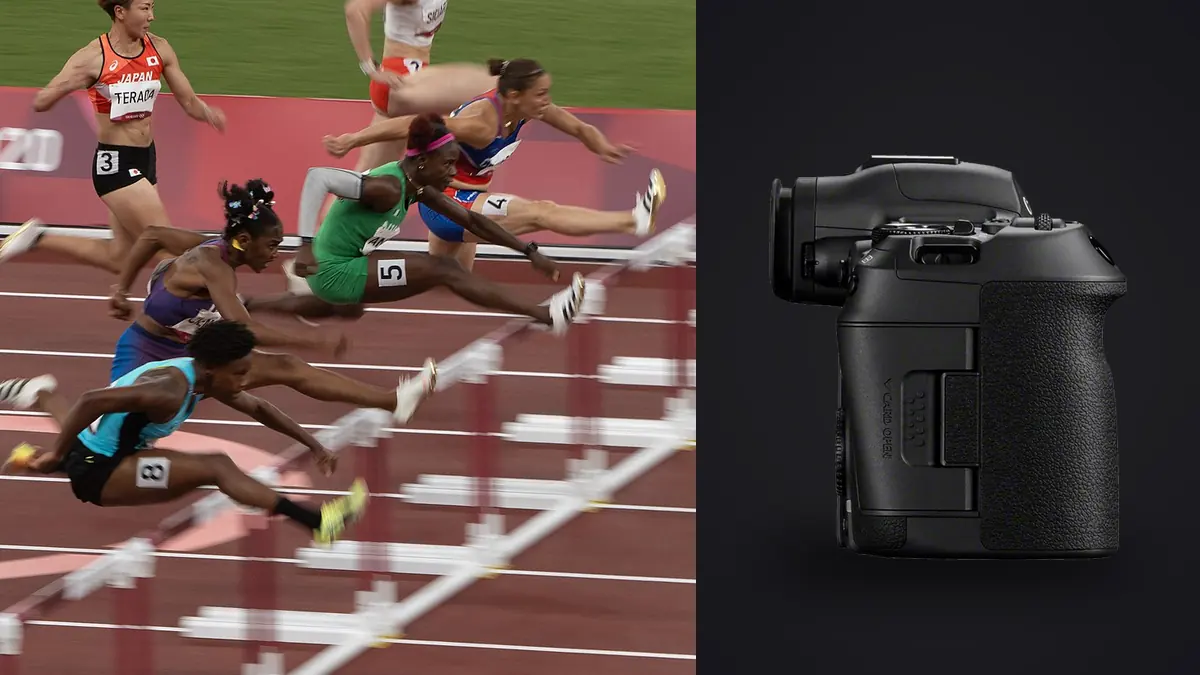
I shot my first track meet with the Canon EOS R5 Mark II on a cold April morning at a regional qualifier, and by the third heat of the 400m I'd already changed my shutter mode twice. That's the honest starting point for this piece: the R5 Mark II is an excellent tool for track and field, but it doesn't do the thinking for you. Athletics is a genuinely strange sport to shoot because it's really six or seven different sports happening on the same oval at the same time, and each one wants a different camera setting.
What actually matters for this sport
Forget the spec sheet for a second. When you're standing on the infield with a 400mm lens and a meet official telling you to stay behind the line, three things determine whether you go home with usable frames: how fast the autofocus locks onto a moving human at distance, how many frames you can fire before the buffer chokes, and whether the sensor read-out is fast enough that a sprinter's legs don't turn into jelly on a pan.
The R5 Mark II's 45-megapixel stacked sensor handles the third point better than any Canon body before it. Rolling shutter is still physically present (it's a CMOS sensor, not magic), but the read-out speed is fast enough that I stopped seeing the skewed-pole effect I used to get on the old R5 when panning hard through a 200m curve. That alone changed how I shoot bends. I used to avoid electronic shutter entirely for anything with lateral motion. Now it's my default for 80 percent of a meet.
Autofocus: the part that actually wins or loses you the shot
Canon's subject detection on this body recognizes people specifically, and it's genuinely good at picking a face out of a pack. Where it gets interesting is a mid-distance race like the 1500m, where six or seven athletes are bunched together for the first two laps. Full auto subject detection will happily jump between runners as they cross in front of each other, which is exactly what you don't want if you're trying to follow one specific athlete for a sponsor or a college recruiting reel.
My workaround: I register the athlete with a half-press and a spot AF point on the bib number or the shoulder the moment there's separation, usually coming out of the first bend, then let Case tracking hold onto them through the pack. Eye Control AF is worth trying if you wear glasses or contacts and your eye tracks reasonably steady, but on a long lens at full extension I found it drifted enough during fast pans that I turned it off for anything past 300mm. It's better suited to closer, more static subjects like field events.
For the 100m and 200m starts, I switch off wide-area tracking entirely and pin a single AF point on the blocks. Sixteen athletes bursting off the line at once is the one situation where letting the camera decide who to focus on will burn you every time.
Field events want a completely different brain
Long jump, triple jump, and pole vault are closer to shooting a golf swing than a sprint. The athlete is mostly static, then explodes through a two-second window. I preset focus on the board or the bar, drop to a smaller number of AF points, and let servo AF do fine adjustment rather than full tracking. Eye Control AF actually earns its keep here, since the athlete's head stays roughly where you're already looking through most of the approach.
Frame rate and shutter choice, event by event
The R5 Mark II will go to 30fps with the electronic shutter, but I don't run that setting all day. Battery drain and file count both punish you, and at 45 megapixels a full day of 30fps bursts will fill a 325GB CFexpress card faster than you'd think. I vary the setting by event, and after two full seasons this is roughly where I've landed.
| Event type | Shutter mode | Frame rate | AF setup | Notes |
|---|---|---|---|---|
| 100m / 200m start and drive phase | Electronic (silent) | 20-30fps | Single fixed point on blocks | Silent shutter matters here, starters hate hearing mechanical clatter near the gun |
| 400m curve, panning shot | Electronic | 20fps | Case 2 tracking, wide zone | Stacked-sensor readout keeps lane markings straight even on a hard pan |
| 800m-1500m pack running | Mechanical or electronic 1st curtain | 12fps | Registered subject, spot point | Lower rate is fine, the story is positioning and elbows, not micro-frames |
| Long jump / triple jump | Mechanical | 10-12fps | Pre-focus on board, small zone servo | Flash sync isn't relevant outdoors but mechanical avoids any banding under stadium lights at evening meets |
| Pole vault | Electronic | 20fps | Eye Control AF or single point on bar | Pre-continuous shooting is genuinely useful here, catches the plant before you consciously react |
| Relay handoffs | Electronic | 20fps | Wide zone, both runners in frame | Widen your zone rather than tracking one athlete, the exchange itself is the shot |
The pre-continuous shooting mode deserves a specific callout because it changed how I shoot the vault and the gun starts. Half-press the shutter and the camera buffers roughly half a second of frames before your full press, so the moment you react to the crack of the gun or the pole bending under load, you're actually capturing frames from before your brain registered the action. It sounds like a gimmick until you use it and realize how many "first step" shots you'd otherwise miss by a frame or two.
Buffer depth is the number nobody tells you the truth about
Canon's marketing depth figures assume a fast CFexpress Type B card, and they're not wrong, but they're also not the whole story. On a V90-rated SD card in the second slot, write speed drops hard enough that a long 30fps burst during a close 100m final will start to stutter the rear buffer counter within two or three seconds. I run CFexpress in the primary slot for anything I'm actually going to shoot fast, and treat the SD slot purely as backup or for JPEG proxies I hand off to a meet's live results team.
In real numbers: with a good CFexpress card I can hold 30fps electronic through most of a sprint final (roughly 4-6 seconds) without the buffer fully choking, and it clears fast enough between heats that I'm rarely locked out. Drop to a budget SD card as your only slot and you'll hit a wall inside two seconds, which is exactly the two seconds that matters for a 100m.
Lenses that actually make sense trackside
An RF 100-500mm covers most of a stadium meet from the stands or from behind the designated media line, and the extra reach matters more than people expect once you're shooting from the far side of a 400m oval. For infield access at bigger meets, an RF 70-200mm f/2.8 handles field events and close relay work where you need speed over reach. If your meet allows infield positions and you can justify the weight, an RF 400mm f/2.8 with a 1.4x teleconverter gives you separation and background compression that a zoom simply can't match for a hero shot of a sprinter mid-stride.
The in-body stabilization on the R5 Mark II is rated aggressively by Canon, but at a track meet you're rarely shooting slow enough shutter speeds for stabilization to be the deciding factor. What it does help with is handheld stability during long tracking pans at 1/2000s and faster, where fatigue over a three-hour meet starts to show up as micro-shake you wouldn't notice in a studio.
Sorting the take afterward
Here's the part nobody warns new sports shooters about: a single day at a meet with six or seven events shot at 20-30fps produces an absurd number of frames, often four or five thousand from one body. Culling that by eye, event by event, comparing near-identical frames of the same stride, is the single most time-consuming part of the job, and it's the part that actually determines whether you deliver galleries within 24 hours or three days later when nobody cares anymore.
This is where I've leaned on imagic for the last several meets. It runs entirely on my laptop with no upload step, which matters at venues where the wifi is unreliable or nonexistent (most high school and college tracks fall into this category). It scores sharpness and focus locally across a burst and groups near-duplicate frames from the same sequence, so instead of scrolling through forty nearly identical frames of a hurdler clearing the same barrier, I'm looking at the handful that are actually in focus with the best limb position. For anyone curious about the mechanics behind that kind of scoring, how AI photo culling works covers the underlying approach in more detail than I need to get into here.
The other feature I actually use every meet is apply_my_style, which learns from edits I've already made and applies a consistent look across a new batch. Track meet galleries go out to parents, athletes, and sometimes college recruiters within a day or two, and having every event come out with matching color and contrast without re-grading four hundred images by hand is a real time saver, not a marketing line. If your current bottleneck is the hours between shooting and delivery rather than the camera itself, it's worth reading through a faster photo workflow alongside whatever culling approach you land on.
Where it falls short
I don't want to oversell this. The R5 Mark II is heavy enough over a full meet day that my shoulder notices it by the final event, especially paired with the 100-500mm. Battery life at high frame rates with the EVF running is optimistic on paper and mediocre in practice; I carry three batteries for a full day and use all three on a busy invitational. And Eye Control AF, while improved, still needs a calibration session before each shoot if lighting has changed much, which is one more thing to remember before the first gun goes off.
Frequently Asked Questions
Is the electronic shutter safe to use for fast panning shots like the 400m curve?
Mostly yes with this body. The stacked-esque sensor read-out is fast enough that I stopped seeing the diagonal skew on vertical elements (lane lines, hurdles) that older Canon sensors showed under a hard pan. It's not zero rolling shutter, but at track-meet pan speeds I haven't found it to be a practical problem.
Do I need CFexpress cards, or will a fast SD card keep up?
For anything above about 12fps in long bursts, CFexpress in the primary slot is the difference between a clean buffer and a locked-out camera mid-final. SD UHS-II is fine as a backup slot or for slower events like distance races, but I wouldn't rely on it alone for sprint finals.
What's the practical benefit of pre-continuous shooting for track events?
It buffers frames from just before your full shutter press, so reaction-time events like a gun start or a vault plant get captured a frame or two earlier than human reflexes allow. It's most useful on events with a single, unrepeatable trigger moment rather than continuous action like a pack running a lap.
Is Eye Control AF worth using for track and field specifically?
It's more useful for field events, where the athlete stays roughly centered and closer to the camera, than for long telephoto pans where small eye movements translate into large tracking errors at distance. I use it selectively rather than as a default across the whole meet.