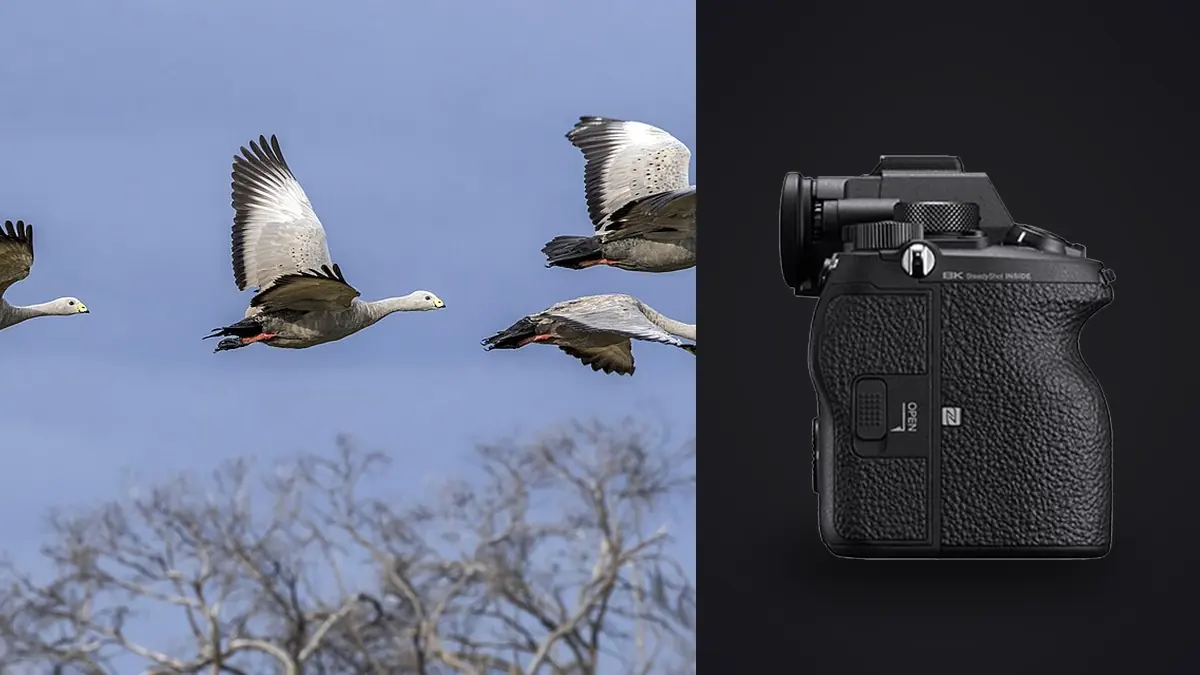
The first time I pointed the A1 at a pair of ospreys working a river mouth, I wasn't testing the camera, I was trying to solve a problem I'd been carrying for two seasons: a previous body that would happily nail a perched kestrel and then lose the plot the second it took off against a bright sky. Birds in flight are the least forgiving test you can put an autofocus system through. The subject is small relative to the frame, it changes direction without warning, it crosses branches and waterlines and other birds, and you usually get one real pass at it before the light or the moment is gone. The A1 doesn't fix all of that. But it changes what you're capable of catching often enough that it's worth talking through in specifics rather than spec-sheet generalities.
This isn't a review in the traditional sense. It's what I've actually landed on after a couple of years shooting terns, raptors, waterfowl and the occasional lucky peregrine stoop with this body, including the parts where it still lets me down.
Why the sensor readout matters more than the megapixel count
Everyone leads with 50.1 megapixels when they talk about the A1, and for landscape or studio work that's a fair thing to lead with. For birds in flight, the number that actually changes your keeper rate is how fast the stacked sensor reads out. Rolling shutter distortion on a fast-moving wing at a high shutter speed used to be a real problem on earlier mirrorless bodies with electronic shutter, you'd get a slight skew on the leading wingtip during a hard pan. On the A1 I genuinely struggle to find it, even panning hard on a gull cutting across the frame at speed. That single thing is what let me commit to shooting electronic shutter, silent, all day, instead of switching back to mechanical for anything with fast wing motion.
The 759-point phase-detection array covering roughly 92 percent of the frame is the other piece that matters practically, not just on paper. It means a bird doesn't have to be dead center for the camera to pick it up and hold it. Birds rarely fly through the middle of your frame on a predictable line, they drift, they bank, and having usable AF coverage out toward the edges buys you real compositional room instead of forcing you to crop dead-center shots after the fact.
The AF settings I actually run, not the defaults
Subject recognition: on, but with a caveat
Setting subject recognition to Birds does what it says for anything reasonably large in the frame, herons, raptors, ducks. It locks onto the eye and holds it through fairly aggressive movement. Where it gets shakier is small, fast passerines against cluttered backgrounds, barn swallows working a hedge line being the case that comes up most for me. At that size and speed the system sometimes loses the eye and grabs the nearest high-contrast edge instead, which might be a wing or a twig behind the bird. For swallows and swifts I'll often drop subject recognition and just run Wide with a fast, aggressive tracking sensitivity, letting the general tracking algorithm do the work rather than the bird-specific eye detection.
Tracking sensitivity: dialed down more than people expect
I run AF tracking sensitivity at 3 (the standard middle setting) for the majority of flight work, not the most locked-on extreme. Cranking it to the stickiest setting sounds like the right move for keeping focus on a moving subject, but against branchy backgrounds it makes the system reluctant to hand off correctly when a bird crosses in front of foliage, and it can hang onto the wrong plane for a beat too long. Over open water or open sky, where there's nothing competing for the AF's attention, I'll bump it up a notch. It's a background call more than a subject call.
Focus area: Zone for predictable flight lines, Expand Flexible Spot for erratic ones
For something flying a relatively straight, readable line (a heron on approach, a gull gliding), Zone tracking with subject recognition gives the most consistent results. For anything twitchy and unpredictable I switch to Expand Flexible Spot and drive the focus point myself, because a big open Zone box on an erratic flier tends to pick up whatever's nearest to the center rather than the bird you actually want.
Drive mode: 30fps is a tool, not a default
Hi+ at 30fps electronic is extraordinary for capturing the exact wingbeat position you want on a takeoff or landing sequence, but I don't leave it there all day. For general flight tracking where I want a clean sequence without drowning in near-duplicate frames later, I shoot Hi at 20fps and save the full 30fps for moments I know are going to be short and decisive, a stoop, a strike, a fight over a fish.
Where the A1 genuinely struggles for this kind of work
None of this is a camera without real friction points for wildlife shooting specifically.
CFexpress Type A cards are the biggest one. Slot 1 needs them to hit the full 30fps buffer depth, and they're smaller, harder to find, and considerably more expensive per gigabyte than the CFexpress Type B or SD cards other systems use. If you're already invested in another mount's card ecosystem, this is a real added cost, not a footnote. Running SD UHS-II in both slots works, but you give up meaningful buffer depth and clearing speed at the higher burst rates, which matters a lot when a feeding frenzy doesn't wait for your buffer to clear.
Battery life is the other one worth being honest about. The CIPA rating sits around 430 shots through the viewfinder, which looks thin next to a body like the A9 II. In practice, active burst shooting during a good flight session eats through a battery faster than that number suggests in frame count but the shots-per-charge math still means I carry three batteries for a full dawn-to-midday session and don't think twice about it.
And weight. Paired with something like the FE 600mm f/4 GM, you're carrying close to 3.8kg of camera and lens for hours, handheld, tracking a moving subject. The body itself is reasonably compact at 737g, but the system as a whole rewards either a good strap setup or accepting the FE 200-600mm as your primary lens rather than the biggest glass you own.
How the A1 compares to the other Sony bodies you'd actually consider for this
If you're deciding between staying with an A9 II, stretching for the A1, or going the resolution route with an A7R V, here's how they actually stack up for flight work specifically. These are typical published and tested figures, actual buffer depth will vary with your card and compression settings.
| Spec | Sony A1 | Sony A9 II | Sony A7R V |
|---|---|---|---|
| Resolution | 50.1MP | 24.2MP | 61MP |
| Max burst, AF/AE tracking | 30fps (electronic) | 20fps (electronic) | 10fps (electronic) |
| AF points / frame coverage | 759 points, ~92% | 693 points, ~93% | 693 points, ~79% |
| Compressed RAW buffer (approx.) | ~155 frames | ~239 frames | ~84 frames |
| APS-C crop reach | 1.5x, ~21MP | 1.5x, ~10MP | 1.5x, ~26MP |
| CIPA battery life (EVF) | ~430 shots | ~690 shots | ~440 shots |
| Typical used price, 2026 | $4,000-5,000 | $2,000-2,800 | $2,800-3,500 |
The A9 II is, frame for frame, the more forgiving buffer for pure burst endurance, and it's meaningfully cheaper now on the used market. What you give up going that route is the resolution cushion for cropping a distant bird after the fact, and the wider effective AF coverage that makes off-center compositions easier to nail in the moment. The A7R V's resolution is tempting for the crop-in-post crowd, but a 10fps ceiling is a real limit the moment a bird does anything sudden. For me, the A1 sits in the middle deliberately: enough resolution to crop a distant raptor into something usable, enough burst rate to catch a wingbeat position, without going all-in on either extreme.
Lenses that actually make sense on this body
The FE 200-600mm f/5.6-6.3 G is the lens I reach for on probably 70 percent of outings. It's not the sharpest glass in the lineup wide open at 600mm, but it's light enough to handhold for hours, focuses fast enough to keep up with the A1's tracking, and the reach is enough for most shoreline and marsh work. Add the 1.4x teleconverter for reach on genuinely distant subjects and you're still in a package you can carry all day.
The 400mm f/2.8 GM is the one I bring when light gets marginal, dawn flights over water, backlit raptors against a bright sky. The extra stop and a half over the 200-600 at its long end is the difference between a clean ISO 3200 file and a noisy 12800 one. It's also considerably heavier, and I notice the difference in my shoulder by hour three.
The 600mm f/4 GM only comes out for planned sessions, a known nest, a known perch, somewhere I'm not going to be hiking for miles. It's the sharpest option by a clear margin, but between the weight and the narrower field of view for erratic fliers, it's not what I grab for general BIF work.
The part nobody mentions: what a good morning does to your card
A genuinely active flight session at 20 to 30fps produces numbers that sound absurd until you've lived them. A single decent three-hour outing chasing terns diving on baitfish can leave me with 3,000 to 5,000 raw frames, most of them near-duplicates of the same three or four seconds of action, wings up, wings down, eye sharp, eye soft. Going through that by eye, one frame at a time, is how a two-hour edit session becomes a six-hour one.
This is where I stopped fighting the volume and started using imagic to get through it. It runs entirely on the machine, no upload queue for gigabytes of RAW files before you can start working, which matters when you're editing from a laptop at a rental with poor signal after a shoot. Its focus scoring catches the difference between the frame where the eye is genuinely sharp and the one two frames later where the bird had already started to turn its head, which is a distinction that's brutally hard to make by eye at 100% zoom across five hundred near-identical frames. The burst clustering groups those thousands of frames from a single dive sequence together instead of leaving you to scroll past duplicates one at a time, and I've trained the apply_my_style preset on my own past edits so a first pass on a fresh batch of flight shots already leans toward the contrast and color treatment I'd apply by hand, rather than starting from a flat baseline every time.
None of that replaces knowing your settings in the field. But it's changed how much of a season's shooting I actually finish editing instead of letting a backlog of unedited cards pile up, which was a real problem before. If your workflow bottleneck is the same one, it's worth reading through how AI photo culling actually works before assuming manual review is the only option, and a few workflow habits helped me cut the review time down further on top of the software itself.
Frequently Asked Questions
Do I really need CFexpress Type A cards, or will fast SD cards get the job done?
SD UHS-II cards will work in both slots, and for casual flight shooting at Hi (20fps) or lower, you likely won't notice much of a limit. Where it matters is sustained 30fps bursts, where SD buffer depth and clearing speed fall well short of what CFexpress Type A gives you in slot 1. If you're shooting brief, decisive bursts rather than long sustained ones, SD is a reasonable way to avoid the extra card cost.
Is 30fps overkill for birds in flight?
For a lot of situations, yes. I only reach for the full 30fps during short, high-value moments, a strike, a takeoff, a landing, where I want the exact wingbeat position. For general tracking of a bird crossing the sky I shoot 20fps, because the extra frames at 30fps mostly just mean more near-duplicates to sort through afterward without meaningfully improving my odds of the sharp frame.
Would the A9 II track birds better since it's built as a sports body first?
The A9 II's buffer depth is genuinely better for pure sustained burst endurance, and its AF coverage is close enough to the A1's that most people wouldn't notice a difference in tracking quality itself. What you lose is resolution for cropping distant subjects and the newer subject-recognition refinements the A1 picked up. If your subjects are consistently close and fast (shorebirds, gulls at a jetty), the A9 II is a legitimately strong, cheaper choice. If you're regularly shooting distant raptors you'll want to crop into, the A1's extra resolution earns its keep.
What kind of hit rate should I actually expect on a flying bird's eye at 600mm?
Against open sky or water with subject recognition on, I land a genuinely sharp eye on somewhere around 60 to 75 percent of frames in a clean sequence, which is high enough that culling is about picking the best wing position rather than hunting for any usable frame. Against cluttered backgrounds, branches, reeds, other birds, that number drops meaningfully, sometimes under 30 percent, and no amount of AF refinement fully solves a subject that keeps getting occluded by foliage. That gap is exactly why reviewing every frame by eye afterward doesn't scale once you're shooting bursts this size.