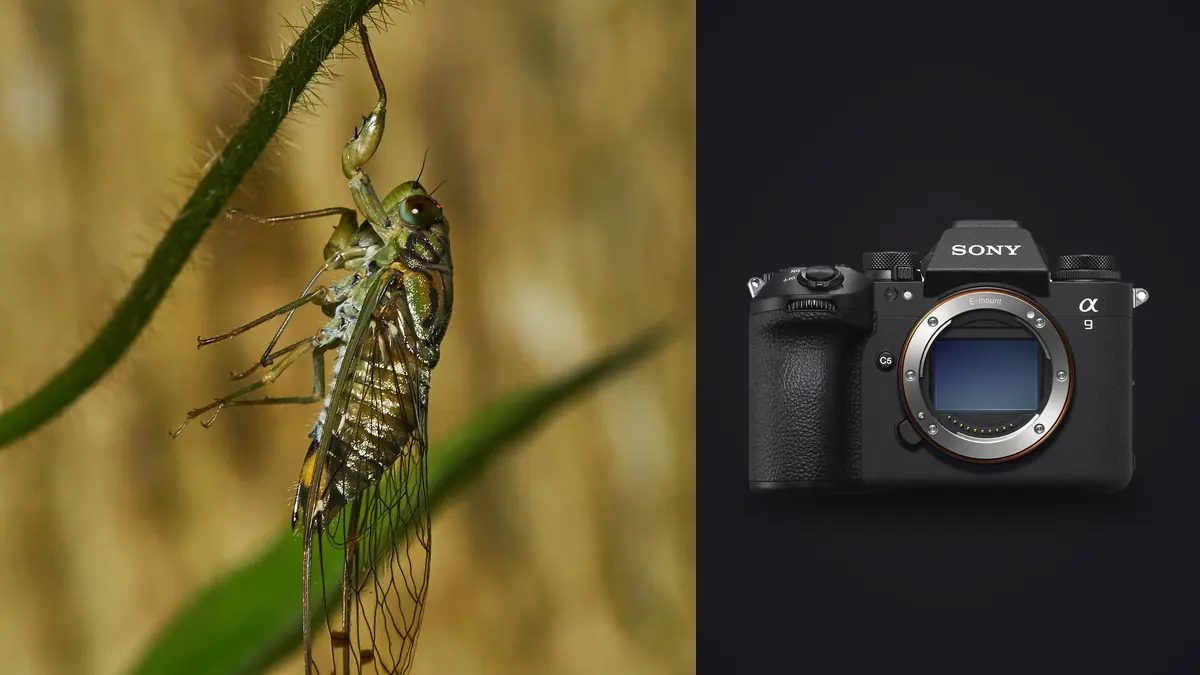
The first time I put a Sony A9 III on a macro rig, I wasn't chasing action shots. I was crouched over a clump of teasel trying to photograph a robber fly eating a hoverfly mid-air, using a twin flash bracket and a shutter speed fast enough to freeze the wings without turning them into a grey blur. On every camera I'd used before that morning, going past 1/250s meant either killing my flash power with high-speed sync or accepting rolling shutter smear on anything with fast wingbeats. The A9 III doesn't have that problem, and it's the single reason I keep recommending it to people who shoot insects with flash, even though nobody designed it as a macro camera.
Global shutter solves a problem macro shooters actually have
A global shutter reads every pixel on the sensor at the same instant instead of scanning line by line. For most photography that's a nice-to-have. For insect macro it removes two specific headaches. First, wingbeat distortion: a dragonfly's wings can move at 30 to 40 beats per second, and a rolling shutter sensor scanning top to bottom will catch the leading edge of a wing in one position and the trailing edge a fraction of a millisecond later, so you get a wing that looks bent or skewed even though the shutter speed on paper should have frozen it. I've thrown out sharp-everywhere-else frames because a wingtip looked like it was made of rubber. The A9 III doesn't do that, full stop.
Second, and more useful in practice: flash sync. Because there's no mechanical curtain to coordinate with the flash pulse, the A9 III syncs strobes at literally any shutter speed, up to its maximum of 1/80000s. On a normal body you're capped at native x-sync (usually 1/250s on Sony glass), and if you want faster you're stuck with high-speed sync, which chops your flash into a pulse train and can cost you two or three stops of usable power. For macro work at f/11 to f/16, where you're already starving the flash for depth of field, that lost power is the difference between a lit subject and underexposed mush. With the A9 III I've shot fill flash at 1/2000s and 1/4000s at full power, in daylight, without HSS at all. That single change altered how I approach backlit dew and bright midday insect work more than any lens purchase has.
What changes on a twin-flash macro rig specifically
If you run a bracket-mounted twin flash (the common setup for true 1:1 insect work), the A9 III lets you drop ambient exposure with shutter speed alone rather than stopping down further or adding ND. That keeps your aperture where you actually want it for depth of field instead of where exposure math forces it. It's a small workflow change but it removes a compromise I'd been making for years without really noticing it.
Autofocus on subjects smaller than your thumbnail
The A9 III's 759-point phase-detect array and real-time subject recognition include an insect category, and it genuinely helps on dragonflies, butterflies, and bumblebees, subjects with enough contrast and size for the system to lock onto an eye. On anything under about a centimeter, though, I've found it starts to hunt, and I switch back to manual focus with focus peaking or a focus rail rather than trust the AI box to find a jumping spider's anterior median eyes. That's not a knock specific to this body; every AI subject-recognition system I've tested has the same size floor. Where the A9 III pulls ahead is tracking speed once it does lock: following a hoverfly hovering and darting in place, the AF doesn't lag behind the way older Sony bodies would.
Practically, I run back-button focus and leave the lens's focus limiter switch set to the macro range so the system isn't hunting through infinity. Pairing the body with the FE 90mm f/2.8 Macro G OSS is the obvious native match, but I've also had good results with extension tubes on the FE 24-70mm GM II for handheld habitat shots where full 1:1 isn't the point.
120fps produces a genuinely different problem: too many frames
The A9 III's headline spec, 120fps with full AF and AE tracking and effectively zero viewfinder blackout, is real and it changes what you can capture. A mating pair of damselflies in flight, a bee's legs mid-pollen-transfer, a mantis strike, these are all things you simply miss at 10 or even 20fps because the decisive instant lasts a few milliseconds. But a 40-minute morning session shooting bursts to catch one of those instants can leave you with three or four thousand frames, most of which are near-duplicates of each other differing only by which wing is up.
Going through that by eye in Lightroom is its own kind of exhausting, and it's exactly the workflow I offloaded to imagic. I run the burst through its local sharpness scoring and duplicate clustering before I ever open a full editor, since it groups the near-identical frames from a single burst and flags the one where the compound eye facets are actually resolved instead of just looking sharp at thumbnail size. Because everything runs on-device rather than through a cloud upload, none of that footage, including the exact bog location for a species I'd rather not have geotagged and indexed somewhere, leaves my laptop. For anyone shooting insects at 120fps regularly, some kind of automated first pass isn't optional anymore; the volume makes manual culling a real bottleneck on your editing time. If you haven't set up a culling pass at all yet, it's worth reading through how AI photo culling actually works before you're staring down a card full of 8,000 frames from a weekend trip.
How it compares to the other bodies people actually debate for this
Nobody buys a body in a vacuum, so here's how the A9 III stacks up against the two cameras I see insect macro shooters cross-shopping most: the 61-megapixel A7R V for resolution, and the OM System OM-1 Mark II for the depth-of-field advantage a smaller sensor gives at the same framing.
| Spec | Sony A9 III | Sony A7R V | OM System OM-1 II |
|---|---|---|---|
| Sensor / resolution | 24.6MP full-frame, global shutter | 61MP full-frame, stacked | 20.4MP Four Thirds |
| Native ISO floor | ISO 250 | ISO 100 | ISO 200 |
| Flash sync speed | Any shutter speed (to 1/80000s) | 1/250s native, HSS above | 1/250s native, HSS above |
| In-camera focus bracketing | Up to 299 shots | Up to 299 shots | In-body stacking, up to 15 composited frames automatically |
| Effective DOF at f/8, same framing | Baseline | Baseline | Roughly 2 stops deeper (crop factor) |
| Body weight (approx.) | 702g | 723g | 599g |
| Street price, body only | ~$5,998 | ~$3,898 | ~$2,399 |
None of these is objectively "best." The A7R V wins if you're printing large or cropping hard into small subjects and don't rely on flash at odd shutter speeds. The OM-1 II wins on sheer usable depth of field for handheld focus stacking in the field, and it's genuinely lighter to carry on a five-hour hike. The A9 III wins if flash sync and wingbeat freezing are the actual bottleneck in your keeper rate, which for a lot of dedicated insect shooters, they are.
The resolution trade you're making
24.6MP is plenty for web use and reasonable prints, but it's noticeably less forgiving than the A7R V's 61MP when you need to crop in tight on something that only filled a third of the frame. I shoot most insects close to 1:1 with the 90mm macro specifically because I know I don't have cropping headroom to compensate for imprecise framing the way I would on the higher-resolution body. If your subjects are mostly small (aphids, tiny beetles, jumping spiders under a centimeter) and you're used to cropping aggressively in post, the resolution gap is worth weighing seriously before you buy in.
Dynamic range at base ISO is the honest trade-off
Global shutter sensors carry extra per-pixel circuitry that eats into the light-gathering area, and the A9 III's dynamic range at ISO 250 measures a bit behind the A7R V and A1 in shadow recovery, roughly a stop by most independent testing. For insect macro with backlit wings and sunlit dew, that's not academic: a blown highlight on a dewdrop is genuinely harder to pull back than it would be on those other bodies. I've adjusted by metering a little more conservatively and leaning on flash fill for control rather than trying to recover everything from a single ambient-light exposure. It's a real limitation, not a dealbreaker, but I wouldn't buy this body purely for its RAW flexibility.
Field conditions: dew, cold mornings, and batteries
Most insect activity worth photographing happens at dawn, when the subjects are cold, sluggish, and easier to approach before the day heats up and they take off at the first shadow you cast. That means shooting in wet grass and condensation for an hour or two before anything dries out. The A9 III carries the same weather sealing as Sony's flagship A1, and I haven't had a moisture scare with it yet despite kneeling in dew-soaked meadows more mornings than I'd like to admit. Battery life is the other field reality: the NP-FZ100 is rated around 500 shots CIPA, but that number means almost nothing once you're firing 120fps bursts for a fast subject. On a heavy burst morning I've drained a battery in under two hours. Carry at least two spares if you're serious about a full session.
Focus stacking and a consistent edit across dozens of near-identical frames
For static subjects, dew-covered beetles at first light, resting butterflies, I still shoot a manual focus-bracketed sequence and composite it in Helicon Focus rather than trust in-camera stacking blindly, since the A9 III's in-camera bracketing (up to 299 shots, adjustable step size) is a capture tool, not a blending tool. Once I've got a 30 to 50 frame stack, though, getting a consistent color and tone treatment across every frame before stacking matters, since even small exposure or white balance drift between frames shows up as banding in the final composite. I use imagic's apply_my_style feature here, trained on my own prior insect macro edits, to push a consistent baseline grade across the whole stack before it goes into the stacking software, rather than eyeballing 40 individual frames by hand.
Frequently Asked Questions
Is the Sony A9 III overkill if I only shoot insects occasionally?
Honestly, yes, for a lot of people. If you're not using flash at unconventional shutter speeds and you're not chasing fast fliers like dragonflies or robber flies mid-flight, the global shutter and 120fps burst don't buy you much over a cheaper stacked-sensor body. It earns its price specifically for flash-heavy or fast-subject work; for slow, static macro of resting beetles and plants, almost any current mirrorless body with decent focus bracketing will get you there.
What lens should I actually pair with it for true 1:1 macro?
The FE 90mm f/2.8 Macro G OSS is the obvious native choice and focuses fast enough to keep up with the body's tracking. For subjects smaller than about a centimeter where you want more than 1:1, the Laowa 100mm f/2.8 2X Ultra Macro in FE mount gets you to 2:1 magnification, though it's manual focus only, which pairs fine with the A9 III since you'll likely be manually focusing tiny subjects anyway.
Does the lower resolution actually matter for insect work?
It matters most if you routinely crop hard into small subjects that filled less than half the frame. At true 1:1 or closer, 24.6MP resolves plenty of detail on a compound eye or wing vein. Where I notice it is on subjects I couldn't get close enough to, where I'd have leaned on the A7R V's extra resolution to crop in during editing.
How do I realistically manage the number of frames a session like this produces?
Build a culling pass into your workflow before you sit down to edit, not after. Sorting a burst-heavy session by sharpness and grouping near-duplicates automatically, the way imagic does locally on your machine without uploading anything, turns a few thousand frames into a shortlist you can actually make decisions on. It's worth pairing with a faster overall editing routine too; our piece on speeding up your photo workflow covers habits that compound well with high-burst shooting specifically.