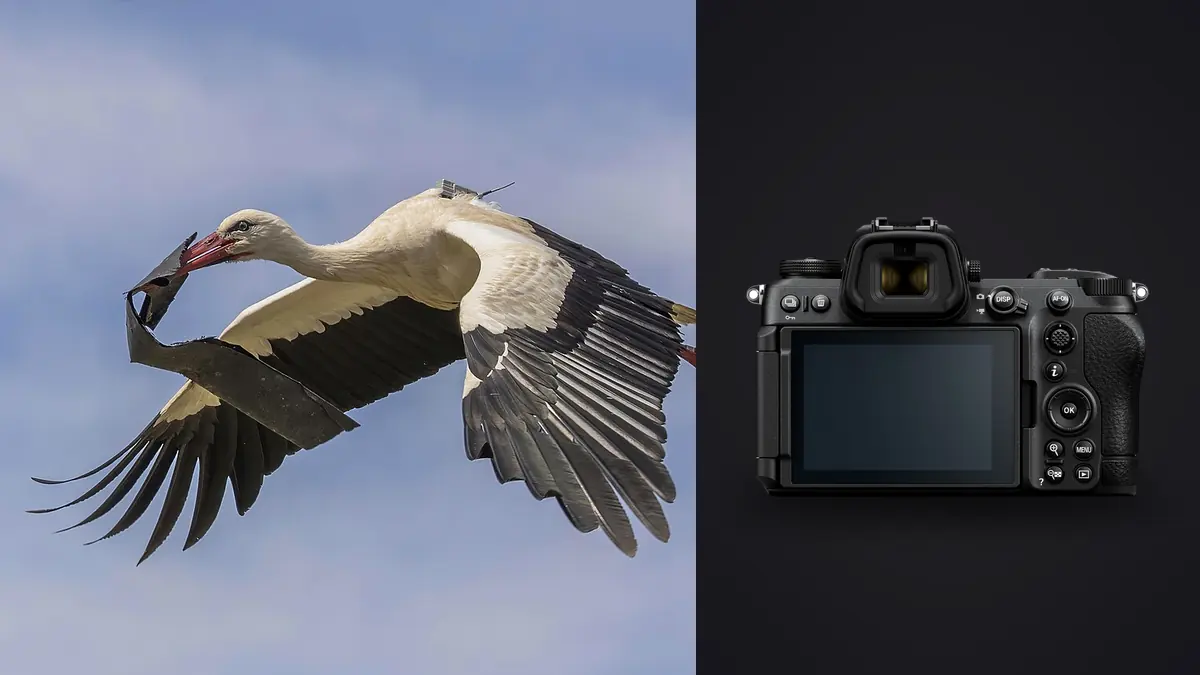
I picked up the Nikon Z6 III eight months ago mainly for event and portrait work, and it sat in my bag doing exactly that job well for the first few weeks. Then a friend talked me into a dawn session at a local wetland chasing egrets and ospreys, and I ended up using the Z6 III for wildlife far more than I expected to. It is not marketed as Nikon's flagship action camera, that badge still belongs to the Z9 and Z8, but for a lot of birders and wildlife shooters who don't want to spend flagship money, it turns out to be a genuinely capable tool once you understand where its limits sit.
This is not a spec-sheet rundown. It's what actually happened across a few dozen outings chasing herons off a pond, ospreys diving on fish, and one frustrating afternoon trying to track swifts against a bright sky where nothing worked particularly well. I'll get into where the camera earns its keep and where you'll want to manage your expectations.
Why the Z6 III ended up in my wildlife bag at all
The short version: the partially stacked sensor. Nikon didn't go all the way to a fully stacked design like the Z9, but the readout speed on the Z6 III is meaningfully faster than the Z6 II it replaced, and that shows up in two places that matter for birds in flight: rolling shutter distortion on fast wingbeats and the responsiveness of the electronic viewfinder during a burst.
On the Z6 II, panning hard on a gull banking overhead in electronic shutter mode gave me visibly skewed wingtips on maybe one frame in five. On the Z6 III, that problem hasn't disappeared, but it's dropped to something closer to one in fifteen or twenty, and mostly on the fastest wingbeat species like teal taking off from water. For anything with a slower wing cadence, herons, raptors, gulls in a glide, I rarely see it anymore.
The other piece is the electronic viewfinder itself. Nikon put a 5.76-million-dot panel in this body that stays blackout-free through a continuous burst, and after years of shooting mirrorless bodies that gray out or stutter mid-sequence, tracking a bird through an unbroken viewfinder feed changes how you shoot. You keep the subject centered through the whole pan instead of guessing where it went during the blackout gap.
Autofocus: bird detection is good, but it's not the Z9's
Nikon's subject detection on the Z6 III includes birds as one of its recognized categories, and when a bird is reasonably large in the frame, three or four hundred pixels across say, it locks onto the eye with confidence and holds it through moderate direction changes. That part genuinely works.
Where it gets less certain is small, fast, erratic subjects against cluttered backgrounds. Swallows and swifts cutting across a tree line gave the AF system real trouble in my testing. It would grab focus, lose it to a branch, grab it back, and by the time it settled the bird had usually changed direction again. I don't think this is a Z6 III-specific failing so much as a hard problem for any current mirrorless system, but I noticed the Z9 bodies I've rented handle that same scenario with slightly more persistence, likely down to the faster processing pipeline behind the identical detection algorithm rather than a smarter algorithm itself.
My practical settings after a lot of trial and error: 3D-tracking with bird detection turned on, AF-C, and Group-area AF as a fallback for anything smaller than a sparrow against a busy background where the wide-area bird detection starts hunting. Wide-area AF with bird detection is my default for anything larger than a heron in open sky.
Where the AF settings actually made a difference
Two changes moved the needle more than anything in the AF menu itself. First, dropping the number of focus points doesn't help with birds the way it might with a static portrait subject, wide-area or auto-area with bird detection outperformed a small pinpoint AF area almost every time I tried it, because a tight AF box loses the bird the instant it changes trajectory. Second, setting AF-C priority to release rather than focus when a bird takes off unpredictably meant I stopped missing the first two frames of a launch sequence while the camera dithered on confirmation.
Buffer, cards, and shutter modes for a real flight sequence
The Z6 III gives you 14fps on the mechanical shutter and up to 20fps electronic at full resolution 12-bit RAW. Those numbers only tell part of the story, what matters is how long you can hold that rate before the buffer chokes and the camera slows down mid-sequence, which is exactly the moment a bird decides to do something interesting.
I run a 325GB CFexpress Type B card in the primary slot and an SD card in the second slot purely as backup, not for continuous writing. With that setup, 20fps electronic RAW held for genuinely long bursts, past the point I'd normally let go of the shutter button anyway. Drop to an SD-only setup and you'll hit the wall on a five or six second burst, which is often exactly how long an osprey dive takes from stoop to splash.
| Shutter mode | Max rate | Rolling shutter risk on fast wingbeats | Best use |
|---|---|---|---|
| Mechanical | 14fps | None (physical shutter) | Backlit scenes, flash sync, when you want zero skew risk |
| Electronic (Hi) | 20fps | Low to moderate on fast wingbeats, rare on gliding birds | Most flight sequences, silent shooting near nesting sites |
| Electronic, Pre-Release Capture on | 20fps (buffered before shutter press) | Same as above | Unpredictable launches, perched birds about to take off |
That Pre-Release Capture mode deserves a specific mention because it changed how I photograph perched birds. Turn it on and the camera continuously buffers frames before you fully press the shutter, so when a kingfisher launches off a branch a half second before you react, you've already got it. I missed count of how many launch sequences I used to lose entirely to human reaction time before I started using this properly.
Lens pairings that actually kept up
I've run three lenses on this body for flight work, and they behave differently enough that it's worth breaking down rather than giving a blanket recommendation.
| Lens | Effective reach | Handheld BIF usability | Where it struggles |
|---|---|---|---|
| Nikkor Z 100-400mm f/4.5-5.6 VR S | Good baseline reach | Excellent, light enough for hours of handheld tracking | Runs out of reach on small or distant birds |
| Nikkor Z 180-600mm f/5.6-6.3 VR | Long reach, budget-friendly | Good, but the extra weight shows after an hour of tracking overhead | Slower AF hunting in low light past 500mm |
| Nikkor Z 100-400mm S + 1.4x teleconverter | Extends reach at f/6.3-8 | Still workable, AF slows noticeably in flat light | Hunts more on small, fast-moving birds against sky |
The 100-400mm S has been my most-used combination purely because I can hold it up and track a bird for a full ten-minute stretch without my arm giving out, and the AF motor keeps pace with the body's tracking well. The 180-600mm gets you real reach for smaller subjects at distance, herons across a wide pond, ospreys hunting far offshore, but I noticed my hit rate on erratic subjects dropped slightly with it mounted, partly the extra mass slowing my own panning and partly a touch more AF hunting in anything but good light.
Handling the volume: what happens after the shoot
A three-hour morning chasing birds in flight on this camera at 20fps produces an absurd number of frames. A single decent osprey dive sequence can run 80 to 150 shots on its own, and most of them are near-duplicates separated by a fraction of a second, wings in slightly different positions, focus drifting a hair between frames. Going through that manually used to eat my evening.
I run everything through imagic before I open a single frame in an editor. It scores sharpness and focus locally on the machine, no cloud upload, which matters to me both for speed and because I'm not waiting on an internet connection to sort three hundred wildlife frames. It also clusters the burst sequences and near-duplicate shots together automatically, so instead of scrolling through 140 nearly identical osprey frames one at a time, I'm looking at maybe eight or nine genuinely distinct moments in the dive, each representing the sharpest frame from its own cluster. That alone probably saves me forty minutes per outing.
The other piece that's become part of my actual workflow is the apply_my_style preset. I trained it on a batch of my own previously graded wildlife shots, the color balance I like on green wetland backgrounds, how I tend to handle skin-tone-adjacent feather colors on herons and egrets, and now a fresh batch of culled keepers gets that look applied automatically before I do any fine adjustment by hand. It's not doing anything I couldn't do manually, it's just doing what I'd already do to every image, without me doing it three hundred times.
A few things that surprised me, good and bad
The good: battery life held up better than I expected across a full morning of continuous EVF use and high-speed bursts, I generally got through a session without swapping batteries, something I couldn't say about older mirrorless bodies I've used for the same kind of shooting. The in-body stabilization also earns its keep on slower subjects, a perched owl at dusk handheld at a shutter speed I wouldn't have trusted on a DSLR.
The less good: the buffer clearing indicator in the viewfinder is easy to miss mid-shoot, and I've had a couple of moments where I thought I was still recording a burst and the camera had actually already cleared and was ready, meaning I second-guessed myself and lost a beat. And the bird detection AF, while good, does occasionally lock onto the wrong bird in a mixed flock, grabbing the nearer, larger subject when I actually wanted the smaller one further back. There's no reliable way to redirect it mid-burst other than half-pressing again and hoping it re-evaluates in your favor.
Is it the right camera for birds in flight specifically
If you're choosing between the Z6 III and a used Z9 at similar money, and flight photography is genuinely your primary use case, I'd lean toward the Z9 for the fully stacked sensor and its more persistent AF tracking in chaotic scenes. But most people asking this question aren't in that situation, they're deciding between the Z6 III and staying on an older body, or between the Z6 III and a competing brand's mid-tier body at a similar price. In that comparison, the Z6 III's blackout-free EVF and genuinely solid bird detection make it a real step up for anyone who has been shooting flight sequences on an optical viewfinder DSLR or an older mirrorless generation.
It's a camera that handles wildlife well as a strong secondary strength rather than being purpose-built for it the way Nikon's flagship bodies are. For the price gap, that trade felt worth it to me, and after eight months of actually using it in the field for exactly this kind of shooting, I haven't regretted the choice.
Frequently Asked Questions
Does the Z6 III's rolling shutter actually cause problems for birds in flight?
Occasionally, mostly on fast-wingbeat species like teal or small ducks taking off, where you might catch a slightly skewed wingtip on the odd frame. On gliding birds, raptors, herons, gulls in a soar, I almost never see it. If you're shooting mostly slower, larger birds, it's a non-issue in practice.
Is 20fps electronic shooting actually usable, or should I stick to the mechanical shutter?
For flight sequences specifically, electronic at 20fps is what I use the vast majority of the time. The extra frame rate genuinely helps you land the wing position you want out of a wingbeat cycle, and the rolling shutter risk on most subjects is low enough that I don't think about it. I switch back to mechanical mainly for perched birds in harsh backlight or when I want a completely silent shutter near a nest.
How much does bird detection AF actually help compared to standard subject tracking?
Considerably, once the bird is large enough in frame for the system to recognize it as one. It goes straight for the eye and holds it through banking turns far better than generic subject tracking did on older bodies. It's less reliable on small, distant, or heavily obscured birds, where I fall back to wide-area AF and do more of the tracking work myself.
What's a realistic way to handle the number of frames a flight session produces?
Don't try to eyeball every frame from a long burst individually, it's not a good use of an evening. I run everything through imagic first so the near-duplicate frames from each burst get grouped and the sharpest one per cluster gets surfaced, then I only make final calls on a manageable shortlist instead of scrolling through hundreds of frames that differ by a hundredth of a second. If you're still doing that step manually, it's worth reading up on how AI photo culling actually works before you write off the idea.