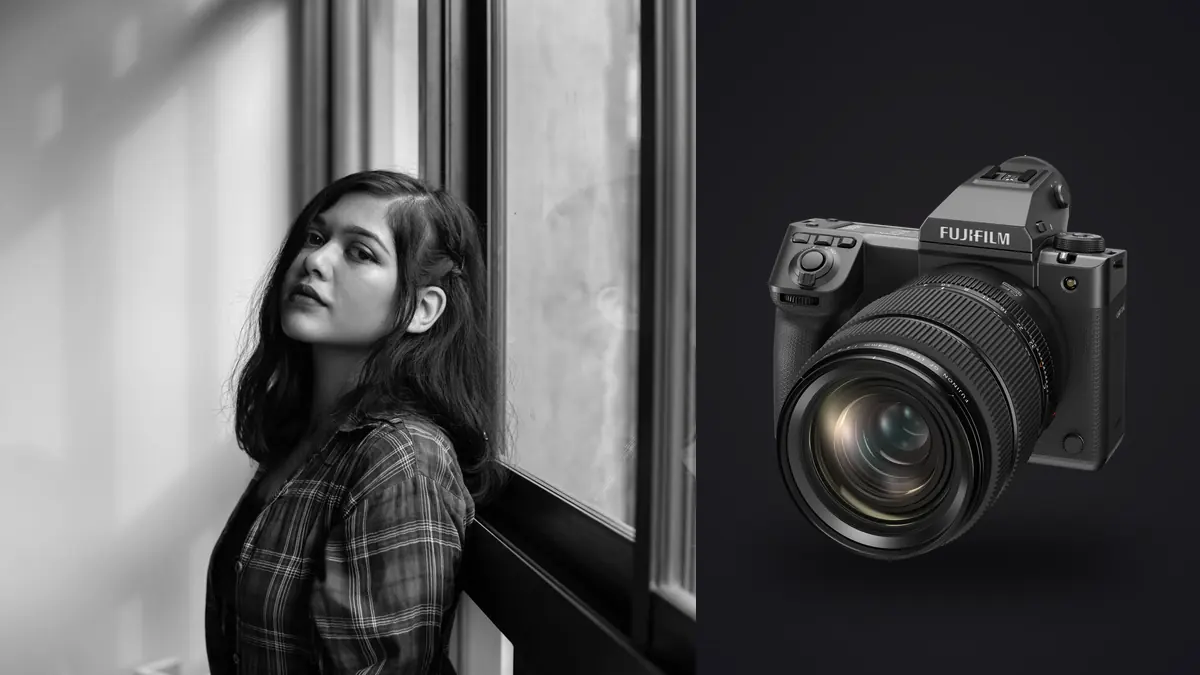
Boudoir work asks a camera to do two things that don't usually pair well: disappear in a small, private room with one client and no crew, and still resolve enough real detail that a 30x40 print doesn't fall apart under raking light. The Fujifilm GFX 100 II is a strange candidate for that job on paper. It's a medium format body built with commercial and landscape shooters in mind, and here it is getting hauled into bedrooms, guest suites, and cramped Airbnb rentals where you're working three feet from someone with the blinds half closed. I've shot boudoir sessions with one for the better part of a year, alongside a full-frame body I still keep in the bag as backup, and the honest verdict is mixed: it earns its keep for some parts of this work and actively gets in the way for others.
What the bigger sensor actually buys you indoors
The GFX 100 II's sensor measures 43.8 by 32.9mm, noticeably larger than a 35mm full-frame sensor's 36 by 24mm, and it packs 102 effective megapixels onto that area. For landscape work the appeal is obvious. For boudoir, the more useful part isn't the pixel count, it's what that sensor area does to tonal transitions on skin under mixed, low-key light. Bedroom lighting is rarely clean: a single window, a lamp with a warm bulb, maybe a small softbox camera left or right. Fuji rates the sensor past 14 stops of dynamic range, and in practice that shows up as smoother roll-off from highlight to shadow across a shoulder or collarbone, with less of the banding or plasticky look you get pushing a smaller sensor's shadows in the same light.
Where the resolution does matter directly is crop flexibility. Boudoir compositions get reframed constantly in editing, tighter on a detail, a different aspect ratio for print versus web, sometimes a full recompose because the original framing included a doorway or a nightstand you didn't clock during the shoot. At 102MP you can crop hard and still have enough resolution left for a large print. I treat that as insurance rather than a reason to shoot loose on purpose; framing well in camera is still faster than fixing it later, on this body or any other.
Native ISO runs from 80 to 12800, extendable further, and that range matters more here than it would in a studio because you're often stuck with whatever ambient light the room has. I'll push to ISO 3200 or 4000 without much hesitation for available-light frames near a window at dusk, and the files still hold together for print at that sensitivity, which isn't something I'd say about every camera I've owned. Past 6400 the shadows start showing texture that reads as noise rather than skin, so I treat that as the practical ceiling rather than the number in the menu.
Lenses that work at the distances a bedroom actually gives you
This is where the GFX system's limitations show up fastest. Fuji's G-mount glass leans toward focal lengths and minimum focus distances built for studio and location portrait work with room to move, not a queen bed against one wall and a closet door you can't shoot past. The 0.79x crop factor relative to full-frame focal lengths also means you have to recalculate your instincts. An 80mm on this body behaves like roughly a 63mm in terms of field of view, not the tight portrait length the number suggests.
| Lens | Full-frame equivalent | Max aperture | Approx. min. focus | Where it earns its place |
|---|---|---|---|---|
| GF30mmF3.5 R WR | ~24mm | f/3.5 | 0.3m | Getting the whole room in without backing into a wall |
| GF80mmF1.7 R WR | ~63mm | f/1.7 | 0.7m | Main workhorse; enough separation at close range without needing much floor space |
| GF45-100mmF4 R LM OIS WR | ~36-79mm | f/4 | 0.5m | One lens for a whole session when swapping glass mid-shoot isn't practical |
| GF110mmF2 R LM WR | ~87mm | f/2 | 0.9m | Classic compression, but needs more room behind you than most bedrooms allow |
In practice the 80mm f/1.7 lives on the body for most of a shoot. It's fast enough for available light, close-focusing enough to work in tight rooms, and the field of view sits in a range where you're not backed against a wall to get a three-quarter shot. The 110mm is genuinely beautiful glass, but I only reach for it when I've got a hallway or an open living space to fall back into, which is not most rented locations. The 30mm earns its keep for the wider environmental frames clients often want alongside the tighter work, the kind that show the whole room rather than isolate the subject.
Autofocus in the kind of light boudoir actually happens in
Fuji built the GFX 100 II's autofocus around the same subject-detection system used in the X-H2S and X-T5, and it's a real improvement over earlier GFX bodies, which historically lagged behind Fuji's APS-C and full-frame lineup for tracking accuracy. Face and eye detection hold up reasonably well in the kind of single-source, low-key light common to this genre, a lamp or one window rather than a lit studio. It's not as fast to lock as a mirrorless sports body, and it doesn't need to be; boudoir is a directed, slow-moving genre, not one where you're tracking a subject running toward you. Where I've had it hunt is in very low, warm tungsten light with the subject mostly still and low contrast between skin and background, a linen duvet in particular gives it trouble. In that situation I fall back to a single focus point on the eye rather than trusting the wider subject-detect area.
Pacing a session around a camera that isn't built to rush
The GFX 100 II is not a fast-operating body, and that's a fair trade for what it's doing elsewhere, but it does shape how you run a session. Buffer depth at full resolution is limited enough that firing off a quick burst to catch a natural laugh or a shift in weight, the kind of thing you'd do without thinking on a sports-oriented full-frame body, isn't really the tool's strength here. Mechanical shutter tops out around 8fps and the buffer clears slowly given the file sizes involved, so I've had to retrain the instinct to burst-shoot through a pose and instead direct more deliberately, one or two frames per micro-adjustment rather than ten.
That turned out to suit boudoir better than I expected. This genre already rewards a slower, more conversational pace, giving a client time to settle into a pose rather than machine-gunning through options and hoping one lands. The camera's operating rhythm nudges you toward that anyway. Where it gets frustrating is documentary-leaning boudoir, the in-between candid moments a client doesn't fully pose for, where a full-frame body with a deeper buffer and faster clearing time will simply keep up better.
The real cost of 102 megapixels is the day after the shoot
A 102MP uncompressed raw file from this body runs close to 200MB. A boudoir session, even a restrained one, produces more frames than people expect, because you're shooting through small shifts in pose, hand position, and expression rather than big changes in setup. Two hundred to four hundred frames in an afternoon is normal, and at that file size you're looking at 60 to 80GB of raw data before you've touched an edit. That's a real storage and workflow cost, not a footnote.
It also makes the culling pass slower if you're doing it by eye, scrubbing full-resolution files one at a time to catch the one where the eyes are actually open and the pose reads well. This is the part of the workflow where I lean on imagic rather than doing it manually. It scores sharpness and eye closure locally on the machine and groups near-duplicate poses into bursts, so instead of opening four hundred individual 200MB files I'm looking at maybe sixty grouped clusters with the sharpest, most in-focus frame from each one already flagged. For a genre where a huge share of frames are minor variations on the same pose, that clustering step alone probably saves more time than any other change I've made to the workflow. If you want the mechanics of how that kind of local scoring actually works, this breakdown of AI photo culling covers it in more detail than I will here.
Privacy is not a side consideration in this genre, it's the job
This is the part of the GFX 100 II conversation that gets skipped in most gear reviews, because most gear reviews aren't written for boudoir photographers. Client trust in this work is built almost entirely on how carefully you handle the files, and a lot of the culling and editing tools built for the broader portrait market assume you're fine uploading a session to a cloud service for AI-assisted sorting or syncing. For intimate and boudoir work, that assumption is a liability, not a convenience. I don't want anyone's raw files touching a server I don't control, full stop, and I've turned down otherwise decent culling tools for exactly that reason.
That's the specific reason imagic stays in my kit for this genre and not just as a nice-to-have: everything, the culling, the scoring, the editing, runs locally on the machine, and nothing gets uploaded anywhere to process it. For most photography that's a preference. For boudoir it's closer to a requirement, and it's worth checking before you adopt any tool in this workflow, not just this one.
Editing skin at full resolution without overdoing it
102 megapixels is unforgiving on skin. Pore-level texture, faint bruising, stray hairs, all of it shows up at full resolution in a way it simply doesn't on a 24MP file, and the instinct for a lot of editors coming from smaller sensors is to reach for heavier smoothing than the image actually needs. I've found it works better to under-retouch on the first pass and judge at export resolution rather than at 100% zoom, because what reads as "too much detail" while pixel-peeping often looks completely natural in the final delivered size.
For color, Fuji's film simulations are a genuinely useful starting point on this body, particularly Astia and the softer end of Provia, for skin tones that don't need much correction before you start the real edit. But consistency across a full session, and across sessions with the same client over months, is still a manual problem unless your tools solve for it. This is the other place imagic earns a spot in the workflow: it can learn a grading style from edits you've already made and apply that same look automatically across a new batch, so a client's second or third session doesn't require rebuilding your color choices from scratch. If color consistency across a shoot is a weak point in your current process, this guide to color grading workflow is worth a read regardless of what camera you're shooting.
Weight, and why handheld isn't automatic
Body alone, the GFX 100 II runs a little over a kilogram, and with the 80mm f/1.7 attached you're carrying close to 1.6kg for a session that might run two or three hours. The 8-stop in-body stabilization genuinely helps at slower shutter speeds in low light, and I shoot handheld for the large majority of a boudoir session because a tripod kills the spontaneity this genre depends on. But by hour two, wrist and shoulder fatigue is real in a way it isn't with a lighter full-frame body, and it changes how many angles you're willing to chase for a given shot. If your sessions run long or you shoot several bookings back to back, that's worth factoring in before committing to this body as your only camera for the genre.
Frequently asked questions
Is 102 megapixels actually necessary for boudoir, or is it overkill?
For most delivered images, no, you won't use anywhere near the full resolution. Where it pays off is cropping flexibility after the fact and large prints, which some boudoir clients do order as albums or wall art. If you rarely print bigger than 16x20 and don't reframe heavily in post, a 24-45MP full-frame body will get you most of the same result with less storage overhead.
Does the crop factor change which lens I should bring compared to a full-frame kit?
Yes, and it trips people up coming from full-frame. Multiply the G-mount focal length by roughly 0.79 to get the equivalent field of view. An 80mm here behaves closer to a 63mm, which is part of why it works better than the 110mm in genuinely small rooms.
Can this body handle a full session without a second card slot filling up?
It has dual slots, CFexpress Type B and SD UHS-II, so card capacity isn't usually the constraint, backup discipline and overall storage further down the pipeline is. A single busy session can produce 60 to 80GB of raw files, which adds up fast across a full month of bookings.
Is the autofocus reliable enough for boudoir's slower, more directed shooting style?
Yes, more reliable than earlier GFX bodies, and boudoir doesn't demand the fast subject tracking that sports or events do. The one situation where it's worth double-checking focus manually is very low, warm, low-contrast light, tungsten lamps against pale linens in particular, where subject-detect autofocus can hesitate.