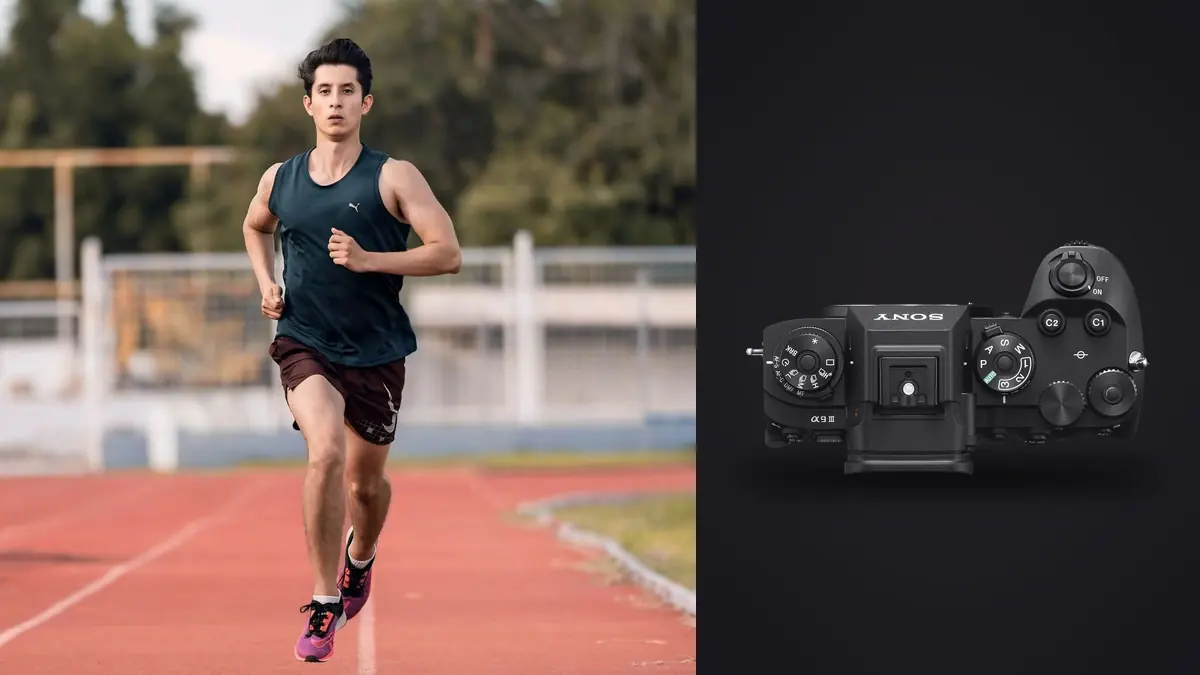
I shot my first meet with the Sony A9 III at an indoor conference championship in February, the kind of venue with banked turns, sodium-vapor floodlights that never quite settle, and eight lanes of sprinters coming off the blocks under a scoreboard clock that flickers at its own refresh rate. It's a rough test for any camera's shutter. It's also exactly where the A9 III's global shutter sensor earns its keep. This isn't a spec sheet rundown. It's what actually changed in my workflow once I started shooting track and field with a camera that reads every pixel on the sensor at the same instant instead of scanning it line by line.
What a Global Shutter Actually Fixes at a Track Meet
Every rolling-shutter camera I've shot track with, including the A9 II I used for three seasons before this one, has the same weak point: fast horizontal motion combined with a panning camera produces skew. A sprinter's torso leans forward slightly in the frame that shouldn't. A hurdle bar bows. A relay baton, mid-handoff, smears at an angle that has nothing to do with the actual geometry of the pass. It happens because the sensor exposes row by row, and if the subject or the camera moves during that scan, the top of the frame and the bottom of the frame were captured at slightly different moments.
The A9 III's sensor reads the entire frame in one pass, so that skew is gone, full stop, regardless of shutter speed, subject speed, or how hard you're panning to keep a 400m runner centered off the final bend. I noticed it first on long jump takeoffs, where the plant leg used to show a faint lean under fast panning at 1/2000. On the A9 III that leg is exactly where it should be. The same goes for pole vault, where the pole itself used to pick up a slight curve in frames shot mid-swing.
Where it gets more nuanced is stadium lighting. Indoor tracks under LED ribbon boards and older fluorescent gym lighting have always been a banding problem for rolling-shutter cameras, because the light source pulses at a rate that doesn't line up cleanly with the sensor's scan. A global shutter reads everything at once, so that specific row-by-row banding pattern disappears. What can still bite you is exposure-level flicker, where an entire frame comes out darker or lighter than the one before it because your shutter window landed on a dim part of the light's pulse cycle. That's a different problem and it's why I still run a flicker test lap before finals under any indoor lighting rig I haven't shot before.
Autofocus and Drive Settings by Event
Track and field isn't one sport, it's a dozen different motion problems stapled to the same schedule, and I don't run the same AF area or drive speed for a 100m final that I do for discus. Here's the breakdown I've settled into after a full outdoor season with this body.
| Event | AF Area | Drive Speed | Why This Combination |
|---|---|---|---|
| 100m / 200m sprints | Tracking: Expand Spot, human pose priority | 30 fps mechanical-feel electronic (saving buffer for finals bursts) | Lane discipline means the subject stays in a predictable corridor; expand spot recovers fast if a competitor's arm crosses in front. |
| Hurdles | Tracking: Zone, whole-body priority | 120 fps in short 8 to 10 frame bursts at the bar | The clearance moment is under half a second; only full speed catches the exact leg extension over the bar every time. |
| Long / triple jump | Tracking: Spot S, locked to torso | 60 fps continuous through takeoff to landing | Board-to-sand distance is short enough that a single continuous run covers the whole jump without gaps. |
| Pole vault | Tracking: Expand Spot, manual recompose at bar clearance | 120 fps for the 1.5 seconds around bar height | Vaulters cross the plane of focus fast near the top; pre-capture plus max burst is the only reliable way to get the arch. |
| Shot put / discus / javelin | Tracking: Spot M, locked pre-release | 20 fps, single controlled bursts at release | The throw itself is brief but the wind-up is slow and predictable, so a slower rate saves buffer without losing the moment. |
| 4x100 / 4x400 relay handoffs | Tracking: Zone widened to cover both runners | 60 fps through the exchange zone | Two subjects converging means a wider zone avoids the AF box snapping to the wrong runner mid-pass. |
| Distance / mid-distance pack running | Tracking: Wide, bib-number priority when available | 10 fps continuous over longer stretches | Packs run for minutes, not seconds; a slower rate keeps card space and buffer available for the sprint to the tape. |
Buffer Depth and Card Choices for 120fps Bursts
The 120fps top speed is the headline number, but the number that actually determines whether you miss the vault clearance is buffer depth, and that depends heavily on which card is in the slot. With a fast CFexpress Type A card I can run a 120fps burst well past the length of any single track event without the frame rate stepping down, and clearance back to a ready state between bursts is quick enough that I don't think about it during a normal event rotation. Drop in a UHS-II SD card instead (which the dual slots also accept) and the buffer runs out noticeably sooner at full frame rate, and clearing time after a long burst is long enough that I've missed a second attempt at a jump because the camera was still writing.
My practical rule at this point: CFexpress Type A in slot one for anything I'm shooting at 60fps or above, SD as a backup slot for anything at 20fps or under. Mixing card types across the two slots also means I'm not fully dependent on one format if a card fails mid-meet, which has happened to me exactly once and was enough to change how I pack a bag.
Base ISO 250 and Why That Matters Under Stadium Lights
Global shutter sensors store charge locally at each pixel rather than reading it off immediately, and that architecture pushes the A9 III's native ISO floor up to 250 instead of the 100 you'd get on a rolling-shutter body. On a bright afternoon outdoor meet this actually forces some adjustment. Shooting a 200mm f/2.8 wide open at 1/2000 in full sun, I'm sometimes fighting to stay under the histogram's right edge even stopped down a click, because ISO 250 is as low as the sensor goes. I've started carrying a variable ND for midday finals in direct sun, something I never needed on the A9 II.
Indoors it's a non-issue and arguably a wash in my favor. Indoor tracks are dim enough that I'm rarely shooting anywhere near base ISO anyway, usually sitting between 3200 and 6400 to hold a fast enough shutter for hurdles or vault, and the A9 III's high-ISO files hold up cleanly at those settings. The banding improvement under LED boards matters more indoors than the higher floor costs me.
Flash Sync at Full Shutter Speed
Because there's no rolling curtain to sync against, the A9 III can fire flash at any shutter speed up to 1/80000s. I don't use this during live competition (strobing a sprinter mid-race is a good way to get your credential pulled), but it's changed how I handle post-race portrait setups at the finish area and indoor meets where ambient light is too weak to freeze motion on its own. Combined with a speedlight at high power, I can shoot a staged victory shot at 1/8000 with the background rendered dark and the subject frozen sharp, without the sync-speed ceiling I'd hit on almost any other body.
The RAW Backlog After a Meet
The honest downside of a camera this fast is what it does to your card and your evening. A single three-second burst at 120fps is 360 frames. Multiply that across every heat, every hurdle flight, every long jump attempt, and every vault height across a six-hour dual meet, and I've come home with anywhere from 4,000 to over 8,000 compressed RAW files depending on how many events I'm covering. At roughly 25 to 28MB per compressed RAW frame from the 24.6MP sensor, that's 100 to 200GB from a single day, and coaches or parents wanting same-night galleries don't care that most of those frames are near-duplicates from the same half-second burst.
Manually scrubbing through a card that size looking for the one frame per burst with clean form and locked focus isn't a realistic use of the two or three hours between the final event and a delivery deadline.
Where imagic Fits Into the Culling Pass
This is the part of the workflow I changed the most this season. I run every card through imagic before I open anything in an editor. The local sharpness scoring reads focus on each frame directly off the file, which matters a lot on a 120fps hurdle burst where six frames can look nearly identical at thumbnail size but only two actually have the lead leg in sharp focus over the bar. The burst clustering groups those sequences automatically so I'm reviewing one stack per jump or one stack per stride cycle instead of scrolling through hundreds of frames in a flat folder.
For meets where I'm delivering edited galleries the same night, apply_my_style has cut real time off the back half of the workflow. It's trained on my own previously edited sets, so once I've culled a meet down to the keepers, it applies my usual color and contrast treatment across the batch as a starting point rather than me building tone curves from a blank state at 11pm. And because all of this runs locally on my laptop with nothing uploaded anywhere, it's a workflow I'm comfortable using at youth and high school meets where the subjects are minors and I'd rather not have thousands of their photos passing through a cloud processing service, however briefly. If you're setting up a culling pass from scratch, our breakdown of how AI photo culling actually works covers the sharpness and clustering logic in more depth than I can here.
Settings I Actually Dial In Before First Call
- Pre-Capture buffer on for field events. Vault, jumps, and throws all have a wind-up phase where I don't know the exact instant to press. Pre-capture rolling back roughly a second means I stop missing the actual takeoff.
- Compressed RAW, not lossless. At this frame count, the file size difference between compressed and lossless RAW across a full meet is the difference between one card and three.
- AF subject recognition set to Human, not Auto. Auto detection occasionally locks onto a bib number or a shoe logo on the infield during long jump; Human keeps it on eyes and torso.
- Mechanical shutter sound simulation on. The camera is silent by nature, but officials and other photographers appreciate knowing when you're firing near the track surface.
- Back-button AF-C, always. Track schedules involve a lot of waiting between short bursts of action, and separating focus from the shutter button avoids refocus hunting during the dead time.
Frequently Asked Questions
Does the global shutter eliminate distortion on every kind of panning shot, or just some of it?
It eliminates the specific skew and warping that comes from a sensor scanning row by row while the subject or camera moves, which is the majority of what track photographers run into on sprints, hurdles, and vault. It doesn't change motion blur from a shutter speed that's genuinely too slow for the action, and it doesn't prevent exposure flicker under lighting that pulses unevenly during your exposure window. Those are separate problems with separate fixes.
What ISO should I plan around for an outdoor afternoon meet?
Start closer to base than you're used to on other bodies, since 250 is the floor rather than 100. On a bright day with a fast prime wide open you may need a stop or two of neutral density to avoid overexposure, something worth packing that you might not have needed with a lower base-ISO camera.
How many RAW frames should I realistically expect to cull after a full track meet?
For a multi-event dual or invitational where you're covering sprints, jumps, and throws across several hours, four to eight thousand compressed RAW frames is a normal range at 120fps burst usage. A local culling pass that clusters bursts and scores sharpness automatically is close to mandatory at that volume if you're delivering the same evening.
Is the A9 III overkill for covering a single dual meet versus a full multi-day championship?
The 120fps ceiling and buffer depth matter most when you're covering several events back to back with tight turnarounds between heats, which is closer to a championship schedule than a small dual meet. For a single-event dual meet you could shoot most of it comfortably at 20 to 30fps and never touch the top speed, though the global shutter's skew-free panning is useful regardless of how many events are on the card that day.