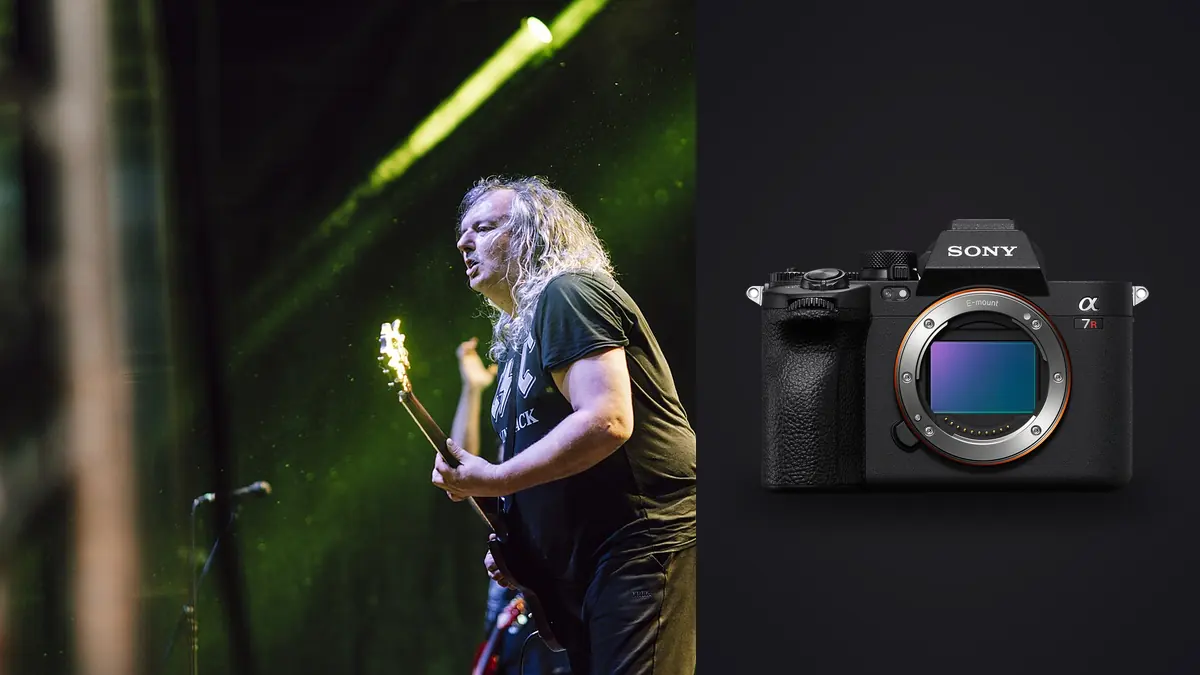
The first time I brought a Sony A7R V into a photo pit, another shooter next to me laughed and asked why I'd bring a "landscape camera" to a rock show. He wasn't entirely wrong to ask. A 61-megapixel sensor is an odd choice for a genre built on three songs, no flash, terrible light, and a photographer sprinting between barricades trying not to get an elbow in the lens hood. But after two festival seasons and probably ninety club and arena shows with the A7R V as my main body, I've landed somewhere more useful than "overkill" or "perfect." It's a camera with real strengths for this work and one real weakness that you have to manage on purpose, not discover the hard way at 1am when a media desk wants files in six hours.
This isn't a spec sheet regurgitation. It's what changed in my actual settings menu, my lens choices, and my post-show routine once I started shooting live music with this body instead of the A7 IV I used for three years before it.
The resolution problem nobody mentions in the marketing
Sony sells the A7R V on detail: 61 megapixels of it, enough to crop a wide stage shot into a usable close-up after the fact. In the pit, that same resolution is the thing fighting you. Bigger files mean a shallower buffer, and buffer is the currency of concert photography. A singer hits a note, throws their head back, and you've got maybe four frames of a 40-frame burst that actually land the expression and the light at the same time. If the camera chokes on frame eighteen because the buffer's full, you've lost the shot regardless of how sharp the sensor is capable of being. Shooting full-frame compressed RAW at the A7R V's top mechanical rate, I run out of buffer noticeably sooner than I did on the 33MP A7 IV, and far sooner than shooters running a 24MP body. That's not a flaw, it's just the tradeoff of the sensor Sony put in this camera. The fix, which took me a full festival season to actually commit to, is shooting APS-C crop mode for anything that's genuinely a burst situation (a chorus hit, a jump, a guitarist windmilling), and only dropping back to full-frame 61MP for static or slow-moving moments where I actually want the resolution, like a wide stage shot I know I'll want to crop into a vertical for an Instagram grid later.
| Capture mode | Effective resolution | Typical RAW file size | Buffer at top burst rate (my cards, my tests) | What I actually use it for |
|---|---|---|---|---|
| Full-frame, Lossless Compressed RAW | 61MP | 90-110MB | Around 20-25 frames before slowdown | Only when I need every stop of dynamic range on a brutally lit stage and I'm not bursting |
| Full-frame, Compressed RAW | 61MP | 55-65MB | Roughly 35-45 frames | Wide stage shots, crowd shots, portraits between songs |
| APS-C crop, Compressed RAW | ~26MP | 25-30MB | 85-100+ frames | Three-song pit bursts, extra reach on the 70-200 without a teleconverter |
| Full-frame, Fine JPEG | 61MP | 20-25MB | 150+ frames | Fast-turnaround festival slots where a client needs edited files same night |
I've got APS-C crop mapped to a custom button (C1 on my body) so I can drop into it mid-song without digging through a menu. It's the single biggest workflow change I made after the first month of ownership.
Autofocus is where this camera actually earns its keep
Where the A7R V stops being a compromise and starts being genuinely better than the bodies I shot before it is autofocus in bad light. The AI-driven subject recognition (it's tracking human pose, not just an eye) holds onto a singer who's turning their head, dropping to a crouch, or getting hit by a spotlight that blows the frame white for half a second. On older Sony bodies, that kind of lighting chaos would cause hunting or a jump to the background. The A7R V mostly just keeps tracking the person. That matters more at a club show than an arena one. Arena stages are lit for the cameras in the pit; a 200-cap venue is lit for the room, which means single-source, harsh, constantly moving light that was never designed with autofocus in mind. That's exactly the scenario where the subject recognition earns its keep, because it's not relying on contrast in a static AF box, it's identifying "this is a person" and holding on even as the light around them falls apart. I still shoot back-button focus, continuous AF-C, wide tracking zone rather than a small spot, because in a pit you don't have time to place a focus point precisely, you have time to point the camera in the general direction of the singer and trust the subject recognition to do the rest.
ISO ceiling in practice, not on paper
I treat ISO 6400 as my comfortable working ceiling on this camera for anything I intend to deliver as a full-color final image. Push to 12800 and it's still usable, especially converted to black and white, but the shadows start to show the kind of grain that reads as "iPhone in a dark bar" rather than "intentional." I try not to go past that unless the alternative is missing the shot entirely, which, to be fair, happens constantly in this genre. A dim blue wash during a ballad is not a moment you skip because the ISO math is inconvenient. What I stopped doing entirely is worrying about noise reduction in-camera. I shoot RAW, I let the files be as noisy as they need to be to get a fast enough shutter speed, and I deal with it in post. Trying to bake noise reduction into a JPEG at a show is how you end up with waxy skin under stage lighting that's already unflattering enough.
The silent shutter tradeoff
Plenty of festival photo pits and virtually all theater or seated-venue gigs require silent shooting. The A7R V's electronic shutter is genuinely silent, which matters when you're three feet from a performer during a quiet acoustic break and a mechanical shutter clack would be audible on the front row's phone videos. The tradeoff is rolling shutter. Fast-moving elements, a flag being waved, a drummer's stick blur, LED wall content scrolling behind the band, can skew or band under electronic shutter in a way they won't under mechanical. I test the venue's LED walls with a couple of silent-shutter frames before the set starts whenever I can get in early, because banding from an LED panel refresh rate clashing with your shutter speed is not something you can fix later, and it ruins otherwise great frames in a way that's easy to miss on a small camera screen under stage lighting.
Lenses that actually make sense for this
- 24-70mm GM II is my main lens for maybe 70% of a set. Wide enough for full-stage shots from a tight pit, long enough for a decent headshot from the barricade.
- 70-200mm GM II comes out for arena and festival mainstage work where the pit is roped off further back, or when I want a compressed, isolated look on a single performer against a busy LED backdrop.
- 20mm F1.8 G lives in the bag for crowd shots and confetti moments, the kind of frame that needs the whole room in it plus a fast enough aperture to still separate the performer from the chaos.
None of that is A7R V-specific advice exactly, but the resolution of this body changes how forgiving cropping is with a shorter lens, which is part of why I've leaned on the 24-70 more than I expected to. A 61MP frame shot at 70mm crops down to a very usable "200mm-equivalent" tight shot if I need it, in a way a 24MP file wouldn't survive as cleanly.
The part that actually changed my night: getting home with 1,800 photos
Here's the tradeoff that nobody selling you on 61 megapixels mentions. A three-band bill, three songs per act in the pit, shot at the burst rates this genre demands, and I'm regularly walking away with 1,200 to 1,800 RAW files in a single night. At 60-100MB per file in full-frame mode, that's a genuinely large card and a genuinely large culling job before a single image gets touched in an editor. This is where I stopped trying to cull concert galleries manually on a laptop at 2am, and started running the take through imagic before I open anything in Lightroom. It's a local, one-time-purchase app, no subscription, everything processed on my own machine rather than uploaded anywhere, which matters when a chunk of my nights happen on hotel wifi that can't handle syncing gigabytes of RAW files to a cloud culling service even if I wanted to. It scores sharpness and focus on the actual files, so the blinks, the motion-blurred strums, and the frames where the AI tracking briefly caught the drummer instead of the singer get flagged before I waste time opening them. It also clusters burst sequences (the same chorus hit shot at 10fps in APS-C crop) so I'm picking a best frame from a group of twelve instead of scrolling through all twelve one at a time trying to remember which one had the cleanest expression. The other piece that's specifically useful for this genre is apply_my_style, imagic's feature that trains a preset off edits I've already made. Concert lighting is wildly inconsistent from venue to venue, one night is all magenta and teal, the next is warm tungsten with a single hard spot, but I want a consistent look across a whole gallery regardless of what the venue's lighting designer did that night. Building that look manually for every show used to eat the better part of an editing session. Having a starting point trained on my own past edits gets me to a usable baseline fast enough that I'm adjusting a handful of images instead of grading from zero every time. If you're new to the idea of software doing the first pass on a shoot before you touch it, how AI photo culling actually works is a decent primer, and if the concert grind specifically is eating your evenings, these workflow tips cover more of the ground I'm not repeating here.
Settings I actually run at a show
For anyone weighing whether to bring this body into a pit, here's roughly where my dials sit by the time the first song starts:
- Aperture priority, wide open or one stop down on whatever lens is mounted, because depth of field control matters less than shutter speed staying high enough to freeze movement.
- Auto ISO with a ceiling set around 8000, shutter speed floor set to 1/500 for most rock and pop, 1/320 for slower or more static acts.
- Back-button AF-C, wide tracking zone, subject recognition set to human.
- APS-C crop toggled on for anything I expect to burst, full-frame for wide or static frames.
- Electronic (silent) shutter for any seated or quiet venue, mechanical for loud rooms where rolling shutter risk on moving lights isn't worth it.
Frequently Asked Questions
Is 61 megapixels actually a disadvantage for shooting a three-song set?
Not a disadvantage exactly, but it's a tradeoff you need to manage. The resolution costs you buffer depth at full-frame settings, which matters during a genuine burst moment. Switching to APS-C crop for burst-heavy sections of a set solves most of it while still giving you a very usable ~26MP file, and you keep the full 61MP for the wide or static shots where the resolution actually adds value.
What ISO can the A7R V realistically handle in a dim club?
I'm comfortable to 6400 for color work I intend to deliver as-is, and I'll push to 12800 when the alternative is losing the shot, usually converting those frames to black and white where the grain reads as intentional rather than like a compromise. Past that, I only shoot if there's genuinely no other option.
Does the silent electronic shutter cause problems with stage lighting?
It can. Rolling shutter under electronic shutter has caused visible banding for me on a handful of LED video walls whose refresh rate happened to clash with my shutter speed, and it can skew fast-moving elements like a waved flag or a drummer's stick. I test a few frames on the venue's LED content before the set if I have the chance, and I'll switch back to mechanical shutter in loud rooms where silence isn't a requirement.
How do you deal with the sheer number of files after a big show?
Honestly, this is the part that changed my workflow the most. A single arena night can leave me with well over a thousand 60-100MB RAW files, and culling that manually used to take longer than the show itself. Running the take through imagic to flag sharp frames and cluster near-identical burst shots before I open Lightroom cuts that culling time down dramatically, and because it runs locally I'm not stuck trying to upload gigabytes of RAW files over a venue's or hotel's wifi at 1am.