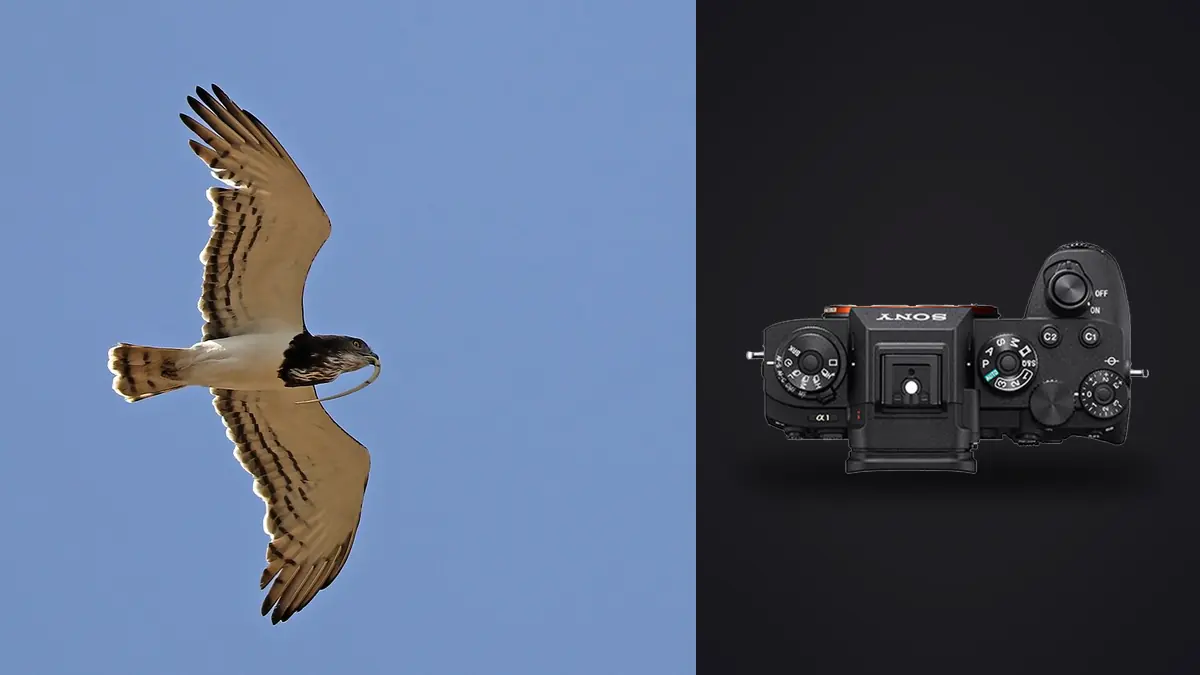
The Sony A1 was never marketed as a wildlife specialist the way the a9 line was built to be. It is a generalist flagship that happens to shoot 30 frames per second off a stacked sensor, and that combination is either devastating or mediocre for birds in flight depending entirely on how you configure it. Left on the settings it ships with, the A1 hunts on cluttered backgrounds and chokes on its own buffer mid-sequence. Set up properly, it will track a tern folding into a dive and hand you a dozen frames with the eye sharp. This is what changes the keeper rate, not the spec sheet.
Why the sensor readout matters more than the resolution
Everyone talks about the 50.1 megapixels first, but the number that actually matters for flight work is the readout speed. Because the A1's sensor is stacked, it scans roughly five times faster than a conventional sensor of similar resolution, which is why the electronic shutter is usable for panning shots without the wing tips smearing into a diagonal skew. Try the same silent-shutter panning technique on an older non-stacked body, an a7R IV for example, and a gull's wingbeat against a fast pan will visibly bend. On the A1 it does not, at least not in any way you will see printed larger than a wall poster.
That readout speed is also why I leave the shutter on fully electronic for almost all flight work now, something I would not have done on cameras from five years ago. No mechanical shutter shock, no vibration at the top of a long lens, and no shutter count ticking up on a body you might want to sell in three years. The tradeoff is battery life: electronic shutter and continuous AF calculation at 30fps drains an NP-FZ100 faster than the CIPA rating suggests, and a long morning at a rookery will eat two batteries if you are shooting seriously.
Autofocus settings that hold up once birds stop cooperating
Real-time Tracking with Bird/Animal Eye AF sounds like it solves the problem on its own, and for a single bird against open sky it mostly does. The trouble starts in a mixed flock, over reeds, or against a tree line, where the eye detection will happily lock onto the wrong gull or grab a branch behind your actual subject. A few settings changes fix most of that:
- AF area mode: Expand Flexible Spot for anything against clutter, so the camera has a defined starting point instead of guessing across the whole frame. Wide only for isolated birds against clean sky, where letting the camera hunt the frame actually saves time.
- AF subject shift sensitivity: pushed toward the locked-on end (around 3 on the -2 to +2 scale most people report working) so the AF does not jump to a closer branch the instant your subject's wing crosses in front of it.
- AF transition speed: faster for erratic small birds like swallows or terns, slower for a soaring raptor holding a steady line, since a fast transition speed on a smooth subject just adds jitter you did not need.
- Focus area registration: a custom button that snaps the AF point back to center is worth setting up, because losing a bird mid-burst and hunting for it with a joystick costs you the whole sequence.
None of this is exotic. It is closer to admitting the eye detection is a tool that needs boundaries, not a fully autonomous system, especially once there is more than one bird in the frame.
Frame rate, buffer depth, and the card that keeps up
Thirty frames per second with a blackout-free electronic viewfinder is the single biggest practical advantage the A1 has over a mechanical-shutter competitor for this kind of shooting. You keep the subject framed through the entire burst instead of losing the viewfinder image between shots, which matters enormously when you are trying to hold a fast-moving bird in frame at 600mm. The catch is what happens after the burst, because the buffer and card speed decide how long you can actually hold the trigger down.
| Camera | Top continuous rate | Compressed RAW buffer (approx.) | Rolling shutter risk | Resolution |
|---|---|---|---|---|
| Sony A1 | 30 fps (electronic) | ~230 frames | Very low (stacked sensor) | 50.1 MP |
| Sony A9 III | 120 fps (global shutter) | 1,000+ frames | None (global shutter) | 24.6 MP |
| Nikon Z9 | 20 fps RAW / 30 fps JPEG | Effectively unlimited to card | Very low (stacked sensor) | 45.7 MP |
| Canon R5 II | 30 fps (electronic) | ~190 frames | Low (stacked sensor) | 45 MP |
The A1's roughly 230-frame compressed RAW buffer sounds generous until you realize 30fps burns through it in about eight seconds. Once it's full, the camera throttles to whatever speed the card can clear frames at, and that is where the wrong card ruins a session. A CFexpress Type A card in the primary slot is not optional if you shoot this way seriously; a fast SD UHS-II card will get you through casual bursts but stalls the moment you hold the shutter for a real flight sequence. My habit now is short, deliberate bursts of a second or two timed around the actual moment (wings at the top of the stroke, the strike on a dive, the instant of a landing) rather than holding the trigger from the moment a bird lifts off. It produces fewer near-duplicate frames to sort through later and it respects the buffer.
Glass that actually pairs with this body
The 200-600mm F5.6-6.3 G is the lens most A1 owners end up with for birds, and it earns that reputation. At roughly 2.1kg it is handholdable for a morning session, autofocuses fast enough to keep up with the body's tracking, and the price gap to Sony's supertelephoto primes is large enough that most people never close it. Where it runs out of room is low light: f6.3 at the long end starts to fight the A1's autofocus once the sun drops, and a 1.4x teleconverter pushes it to f9, which is workable in bright conditions but noticeably slower to lock in shade.
The 600mm f4 GM is the better tool if you are shooting dawn light at a nest or roost consistently, both for the extra stop and a half of light and for how it holds contrast on a bird against a bright sky. It is also nearly a kilogram heavier and a lot more money, so it is a lens you buy once you know you are committed to this specific kind of shooting rather than one you start with.
Worth remembering: the A1's APS-C crop mode still delivers about 21 megapixels at a 1.5x multiplier, which turns a 600mm lens into an effective 900mm without touching a teleconverter or losing autofocus speed. I use it more than I expected to for distant birds where framing room matters more than absolute resolution.
Metering and exposure decisions the camera won't make for you
Multi-metering will consistently underexpose a dark cormorant against a bright sky and overexpose a white egret against dark water, because it is averaging a scene that has no business being averaged. I shoot manual exposure with Auto ISO for birds in flight, shutter speed locked at whatever the situation demands (1/3200 to 1/4000 for something small and erratic like a tern or swallow, closer to 1/1600 to 1/2000 for a larger, slower wingbeat like a heron or an eagle) and aperture wide open on the lens, then let ISO float. That way the exposure does not lurch mid-burst as the bird crosses from open sky into a tree line behind it, which is exactly what happens if you leave the camera on aperture priority with evaluative metering.
For white birds specifically, herons, egrets, swans, gulls, I dial in negative exposure compensation, usually somewhere between minus one and minus one and two-thirds stops, because blown feather highlights do not come back in RAW the way people hope they will. The A1's highlight-weighted metering mode helps here too, biasing the exposure reading toward not clipping the brightest part of the frame rather than the overall average, which on a white bird is usually the bird itself.
What actually happens to 8,000 frames afterward
A three-hour morning at a tern colony shooting in short 30fps bursts can easily produce eight to twelve thousand frames. Nobody reviews that by eye one at a time, not honestly, and pretending you will is how a card full of good work sits untouched on a drive for a month. This is the part of the workflow that has nothing to do with the camera and everything to do with what happens after you get home, and it is where I actually rely on imagic rather than scrolling through a grid view for two hours.
The parts that matter for this specific kind of shoot: imagic's local sharpness and focus scoring, which separates the frame where the eye is actually crisp from the three frames around it where wing motion blur fooled a quick glance, and its duplicate/burst clustering, which collapses a 40-frame launch sequence into the handful of genuinely different wing positions instead of forcing you to click through all of them individually. Because it processes everything on the machine rather than uploading anything, that also matters practically when you are working through several thousand RAW files from a field laptop with no reliable connection, which describes most of the mornings I am talking about here. Once the real keepers are picked out, imagic's apply_my_style feature (a preset trained on your own past edits rather than a generic wildlife preset pack) gets exported files most of the way to how you'd have graded them by hand, which saves the second hour that usually follows the first hour of culling. If you want the mechanics of how that scoring and clustering actually works, this breakdown of AI photo culling covers it in more depth than fits here.
None of that replaces judgment. A tool that scores sharpness cannot tell you which of three technically-identical frames has the better wing position, and it should not try to. What it does is get you from twelve thousand frames to three hundred worth actually looking at, which used to eat an entire evening on its own; the general workflow habits here apply just as much to a card full of birds as to any other high-volume shoot.
Settings I changed from the defaults and never went back
- Back-button focus, AF-C, shutter release decoupled from focus entirely. Standard practice for anything moving unpredictably, but worth stating since some A1s still leave the factory with shutter-button AF active.
- Drive mode defaulted to Hi+ (the full 30fps electronic option) with a custom button to drop to a slower rate for perched or walking birds, since 30fps on a preening heron is just wasted card space.
- Silent/electronic shutter on by default given how little rolling shutter risk the stacked sensor actually carries, reserving mechanical only for situations with strong artificial lighting where banding is a real concern.
- A custom button mapped to toggle APS-C crop mode on the fly, rather than digging into a menu when a distant bird suddenly needs the extra reach.
- Zebras set fairly high (around 100+) as a highlight warning, since blown-out white feathers on a gull or swan are unrecoverable in a way that shadow noise usually is not.
Frequently Asked Questions
Does the Sony A1's electronic shutter distort fast wingbeats the way older mirrorless cameras did?
Not in any way you're likely to notice at normal print or screen sizes. The stacked sensor reads out roughly five times faster than a conventional sensor, which is specifically what keeps fast panning shots from showing the diagonal skew you'd get on an older non-stacked body in silent mode.
Is the 200-600mm G lens good enough for serious bird-in-flight work, or do I need a prime?
For most daylight conditions it's genuinely enough, and it's the lens the majority of A1 owners actually use for this. The 600mm f4 GM earns its price mainly in low light (dawn, overcast, deep shade) where the extra stop and a half changes how confidently the autofocus locks, not in daylight sharpness where the gap is smaller than the price difference suggests.
How many photos should I realistically expect from a few hours of shooting birds in flight at 30fps?
Several thousand is normal if you're shooting active flight scenes rather than static perched birds, even with disciplined short bursts. Plan your culling workflow around that volume before you go out, not after you get home and see the number on the card.
Does the newer Sony A1 II change any of this guidance?
The A1 II (announced late 2024) refines the autofocus algorithms and adds a few ergonomic changes, but the core mechanics covered here, stacked-sensor readout speed, buffer management, AF area strategy, apply to both bodies. A used original A1 remains a genuinely capable and considerably cheaper way into this kind of shooting.