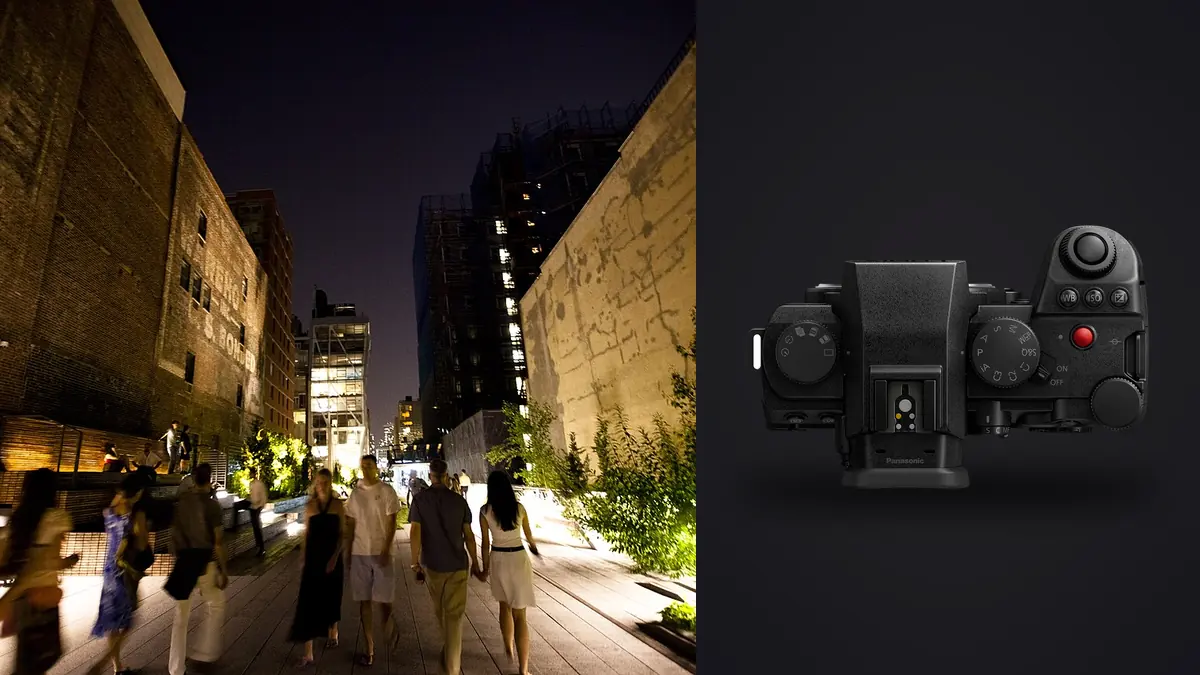
I spent five weeks last spring shooting a documentary project at a fish market in Catania with a Panasonic Lumix S5IIX as my only body. Before that project the camera had mostly done portrait sessions and second-shooter wedding duty, always with time to set up, always with someone else carrying a bag. Street documentary work is a different animal. Nobody waits for you to check focus, nobody signs a release before the shutter fires, and the gear either disappears into your hand or it becomes part of the story you're trying to avoid telling. Here is what I actually learned running the S5IIX that way, not what the spec sheet promises.
The weight you stop noticing, then notice again at hour six
The S5IIX body alone comes in around 740 grams, which sits in an odd middle ground. It's noticeably lighter than Panasonic's own S1 series, but it is not a pocket camera, and after the first hour of walking a market with it on a wrist strap, your hand knows it. Pair it with something like the Sigma 24mm f/3.5 DG DN and you're carrying just over a kilo of camera and glass all day, every day, for the length of a project. That's manageable. It's not what a Ricoh GR IIIx or a Fujifilm X100VI owner deals with, and I'd be lying if I said I never envied their jacket pockets on the fourth straight day of shooting.
What the extra weight buys back is a body that doesn't feel like it will fold under a full day of use. The magnesium alloy chassis and the weather sealing meant I didn't think twice walking through a market where fish guts and hose water were part of the daily cleanup routine. I would not have made the same bet with a lighter, less sealed compact in that environment. For documentary work specifically, where you often can't choose your conditions, that sealing is worth more than it sounds on paper.
Phase-hybrid autofocus in an actual crowd
The S5IIX was part of the first generation of Panasonic full-frame bodies to move off pure contrast-detect DFD autofocus and onto a phase-hybrid system, and it shows in a crowd. Earlier S-series bodies (the original S5, the S1) would visibly pulse and hunt when a subject crossed in front of a busy background, which is exactly the kind of moment street documentary work lives on. The S5IIX doesn't do that nearly as often. Human detection locked onto pedestrians walking toward me from twenty or thirty feet out reliably enough that I stopped thinking about it as a variable and started treating it as a given, which is the whole point of subject-detection autofocus.
Where it still hunts
It's not flawless. Fast, erratic subjects, a kid sprinting between stalls, a scooter weaving through foot traffic, still occasionally caused a half-second of visible refocus, and in backlit doorways with strong contrast between a dark interior and bright street, the system sometimes locked onto the doorframe instead of the person stepping through it. Sony's a7 and a9 series subject tracking is still a notch ahead in raw hit rate in my experience, and Fujifilm's newer X-Trans bodies have closed a lot of that gap too. But for a body in this price range, the S5IIX AF stopped being the thing I complained about, which for a Panasonic full-frame camera is a genuine milestone.
Staying invisible: shutter sound and the electronic shutter tradeoff
Mechanical shutter on the S5IIX has an audible, slightly metallic clack. Not loud, not obnoxious, but audible enough that in a quiet indoor market stall or a hushed waiting room it draws a glance. Switching to the fully electronic shutter solves that completely, silent frames, which matters enormously for documentary work where the goal is often to be forgotten rather than noticed. The tradeoff is rolling shutter. Panning with a moving vehicle or catching someone mid-stride with a fast lateral motion under electronic shutter occasionally produced the diagonal "jello" skew you'd expect from a sensor that reads out line by line rather than all at once. I also ran into visible banding under the sodium-vapor and fluorescent lighting common in covered markets when shooting electronic shutter, which mechanical shutter avoids entirely.
My working rule ended up being simple: mechanical for anything with real motion or artificial lighting, electronic only when I needed true silence and the subject was relatively still, a vendor mid-conversation, someone reading at a cafe table. It's a compromise every mirrorless camera in this class asks you to make, but it's worth knowing going in rather than discovering it after a shoot when you're looking at skewed frames you can't reshoot.
What the sensor actually gives you in light you don't control
Documentary work means shooting in whatever light exists, not the light you'd choose. Midday in the market meant harsh top-down sun cutting deep shadows under the stall awnings, and the 24.2 megapixel sensor recovered a surprising amount of shadow detail in post without the noise climbing into ugly territory, roughly two to three stops of genuinely usable recovery on a well-exposed raw file. At night, working the bars and side alleys near the port, I ran comfortably at ISO 6400 and pushed to 12800 when I had no other choice. Grain shows up at 12800, but it's fine-grained and doesn't shred fine detail the way older 24-megapixel full-frame sensors used to at that range.
In-body stabilization rated up to 6.5 stops with compatible lenses let me shoot handheld interiors at shutter speeds I wouldn't have attempted a few camera generations ago, down around 1/8s for static subjects when I needed the extra light. It won't freeze a moving subject at that shutter speed, obviously, but for ambient-lit interiors where the subject is relatively still, it meant I could keep ISO lower than I otherwise would have needed to.
Lenses that actually earned a place in the bag
I carried three lenses for most of the project and used two of them almost exclusively. The Sigma 24mm f/3.5 DG DN Contemporary became the default; it's small, sharp wide open, and close enough to a "normal" documentary focal length that I could shoot storytelling wides and tighter portraits without switching glass constantly. The Lumix S 35mm f/1.8 came out for evening work when I needed the extra stop of light and slightly more separation from background. I also tried the Lumix S 26mm f/8 pancake for a few days purely to cut bulk, and while it's genuinely tiny and makes the S5IIX feel closer to a compact, the fixed f/8 aperture is a real limitation the moment the light drops, which in a documentary context is often exactly when the interesting moments happen. It stayed in the bag more than on the camera by the second week.
What I didn't miss was a long lens. Street documentary work rewards proximity, and every zoom lens I tried carrying "just in case" ended up adding weight without adding usable frames.
How it actually stacks up against the cameras people usually mention in the same breath
Every conversation about street or documentary cameras eventually turns into a comparison with the same three or four bodies, so here's how the S5IIX actually compares on the things that matter for this kind of work, based on using all four at various points over the past two years.
| Camera | Body weight | Sensor | Discretion (shutter/size) | Subject-detect AF | Approx. street price |
|---|---|---|---|---|---|
| Panasonic Lumix S5IIX | ~740g | 24.2MP full-frame | Moderate; e-shutter is silent but body is not pocketable | Good, phase-hybrid, occasional hunting in hard backlight | ~$2,200 (body only) |
| Fujifilm X100VI | ~521g | 40.2MP APS-C | Excellent; small, quiet leaf-adjacent shutter, very low profile | Good, improved from prior X100 generations | ~$1,600 |
| Ricoh GR IIIx | ~262g | 24.2MP APS-C | Best in class; true pocket camera, near silent | None (contrast-detect only, no subject tracking) | ~$1,050 |
| Leica Q3 43 | ~743g | 60.3MP full-frame | Good; quiet shutter but the body reads as "expensive" instantly | Good, contrast/phase hybrid | ~$6,400 |
The honest takeaway from that table: the GR IIIx wins on pure discretion and the X100VI wins on the balance of discretion and image quality per dollar, but neither gives you interchangeable lenses, weather sealing to the same degree, or the video capability the S5IIX packs in (internal ProRes recording and unlimited record times, useful if your documentary work needs B-roll alongside stills, which mine increasingly does). The Leica buys you a gorgeous file and very little else that changes outcomes in the field. The S5IIX is the one I'd actually recommend to someone building a documentary kit from scratch who needs one camera to do both stills and video.
The part nobody warns you about: what a full documentary day does to your card and your evening
A single day at the market, shooting loosely with short bursts on fast-moving moments, routinely put 1,800 to 2,600 raw frames on the card. Multiply that across five weeks and you get a number that stops being a "sort through it tonight" problem and becomes a genuine workflow bottleneck. This is where I stopped trying to cull manually in Lightroom at 11pm after a full shooting day and started running everything through imagic first. It scores sharpness and focus locally on the machine, so a burst of twelve frames of the same vendor gesturing gets ranked by actual focus accuracy rather than me squinting at a laptop screen with tired eyes, and it groups bursts and near-duplicates automatically so I'm reviewing maybe 15 percent of what I shot instead of all of it. If you want the mechanics of how that kind of automated culling actually scores an image, this piece on how AI photo culling works goes into more depth than I will here.
The other thing that mattered for this specific project: everything processes locally, no cloud upload. Documentary and editorial work sometimes comes with a source or a subject who has real reasons not to want their images sitting on a server somewhere before a story runs, and being able to say the culling and grading pipeline never leaves my laptop was a genuinely useful thing to be able to tell people, not just a technical footnote.
Getting a consistent look across five weeks without redoing it every night
The other problem with a long-running documentary project is consistency. Market light at 7am looks nothing like market light at 1pm, and if you grade each night from scratch you end up with a set that feels like five different photographers shot it. I trained imagic's apply_my_style feature on a batch of edits from the first week once I'd settled on a look I liked, warmer shadows, slightly desaturated skin tones, contrast pulled back in the highlights, and let it apply that same treatment as a starting point across the following weeks of frames. It's a starting point, not a finish line; I still adjusted individual frames by hand. But going from a blank raw file to something close to final grade in one pass, instead of rebuilding the look from zero every session, saved real evening hours I'd rather have spent reviewing the day's shots for tomorrow's plan. If your workflow is currently a full manual re-edit every night, these workflow speed tips cover some of the same ground from a different angle.
Battery, cards, and the boring logistics that decide whether you keep shooting
CIPA-rated battery life sits around 370 shots per charge, which understates real-world use since that figure assumes constant EVF review between frames. In practice, shooting loosely and chimping the screen sparingly, I got closer to 500 to 600 frames per battery, plus whatever video clips I grabbed. I carried three batteries and never ran one all the way to empty on a normal day. Dual UHS-II card slots meant I could shoot raw-to-both for the days where a frame genuinely couldn't be reshot, a specific negotiation with a fishmonger who agreed to be photographed exactly once and never again. That backup redundancy is not a flashy spec, but on the one day a card threw an error mid-shoot, having a mirrored copy on the second slot meant the day wasn't lost.
Frequently Asked Questions
Is the S5IIX too big and heavy for serious street photography?
It's heavier and larger than dedicated street cameras like the Ricoh GR IIIx or Fujifilm X100VI, no question. Whether that matters depends on how you shoot. If you value pocketability above everything, this isn't your camera. If you want interchangeable lenses, full weather sealing, and video capability alongside stills in one body, the extra weight is a fair trade, and it's still noticeably lighter than Panasonic's S1-series bodies.
How does the S5IIX's autofocus compare to Sony or Fujifilm for fast-moving street subjects?
It's good, a real step up from earlier Panasonic full-frame bodies thanks to the phase-hybrid system, but Sony's a7 and a9 lines still edge it out on raw subject-tracking hit rate for erratic motion, and recent Fujifilm bodies have narrowed the gap further. For walking pedestrians and typical street pacing it's reliable enough to trust; for fast, unpredictable action like sports or wildlife-adjacent subjects it's not the class leader.
Which lens should I start with for documentary work on the S5IIX?
A wide-normal prime in the 24-35mm range is the workhorse focal length for this kind of shooting. The Sigma 24mm f/3.5 DG DN is small, sharp, and inexpensive enough to be a sensible first purchase; the Lumix S 35mm f/1.8 is the better choice if you shoot more evening and indoor work and want the extra stop. Skip the ultra-compact f/8 pancake unless size is your only priority, since the fixed aperture becomes a real limitation once light drops.
Is the fully articulating rear screen a problem for candid, unnoticed shooting?
It can be, if you leave it flipped out. Shooting from the hip or at waist level with the screen folded flat against the body keeps your profile low and your intentions unclear to people around you, which is usually what you want in documentary work. The articulating screen becomes genuinely useful for the rare high or low angle shot, but I kept it closed against the body probably 90 percent of the time on this project.
Where that leaves things
Five weeks in, the S5IIX earned its spot in the bag more than it fought for it. It's not the camera to buy if pocket size is your top priority, and it's not going to out-track a Sony body on erratic motion. But for documentary work that mixes stills and video, that needs to survive rough conditions, and that benefits from lenses you can actually swap when the situation changes, it did everything I asked of it without becoming the story itself. The gear that matters most in this kind of work is the gear you stop thinking about by the second week, and that's roughly where the S5IIX landed for me.