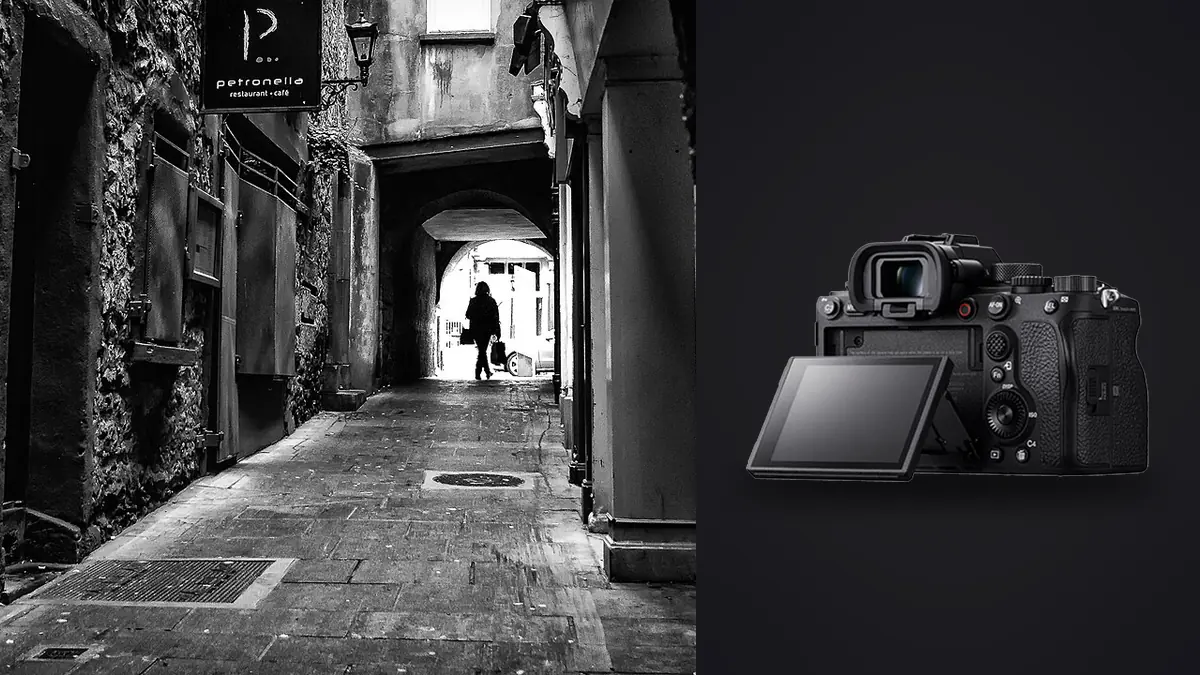
I spent four days in November shooting a housing protest march that wound through three different neighborhoods, and it was the first extended documentary job I did entirely on the Sony A1 after two years shooting a Fuji X-T4 for the same kind of work. The difference wasn't image quality. Both cameras make files that hold up printed at 24x36. The difference was how many real moments I walked away with at the end of each day, because the A1 doesn't blink while it's shooting.
Street documentary work lives or dies in the half second between a gesture starting and finishing: a hand reaching for a rolled-up sign, two strangers' eyes meeting across a barricade, a kid slipping past a line of officers. Most cameras blank the viewfinder mid-burst, so you're reacting to what you saw two or three frames ago rather than what's happening right now. The A1's fully electronic shutter runs up to 30 frames per second with a live, blackout-free feed in the EVF, so you're watching the scene continue in real time while it's being recorded rather than guessing at it.
The thing that actually changed how I work on foot
It's not the resolution and it's not the dynamic range, both of which are fine but not the reason I switched. It's that blackout-free viewfinder combined with a shutter you genuinely cannot hear over street noise. On the X-T4, even in its quietest electronic mode, I could feel myself hesitating before firing into a quiet room or a tense one-on-one conversation between a resident and a city official. With the A1 set to silent shutter, nobody in a doorway twenty feet away has any idea a camera fired twelve times. That changes your body language. You stop performing "I am taking your photo now" and you just stay present, which is most of what makes documentary work look unposed rather than staged.
There's a second-order effect too. Because you're not flinching at your own shutter noise or losing the viewfinder image, you track faces through a crowd instead of losing them. I've had sequences where a subject was fully obscured by someone walking through frame for four or five frames and reappeared, and because I never lost the live feed, I never lost the framing either. On a camera with blackout, you'd have re-found your composition after the fact and probably missed the reappearance.
Autofocus in the conditions this genre actually happens in
Documentary work rarely gives you even light. You're shooting into shop windows, under awnings, through chain-link fences, in transit stations lit by fluorescent tubes that flicker at a frequency your sensor can see even if your eyes can't. The A1's Real-time Tracking combined with human eye detection holds up better than any camera I've used in exactly these conditions: doorway silhouettes, backlit crowds, a face turning away and back. It doesn't nail every frame, nothing does, but the miss rate on a fast-moving subject partially blocked by another person is noticeably lower than what I got out of the X-T4 or, before that, an original A7 III.
One setting worth calling out specifically: Anti-flicker shooting. Transit platforms, underpasses, and a lot of institutional buildings use lighting that pulses at 100 or 120Hz, and without anti-flicker enabled you'll get inconsistent exposure and color banding across a burst shot at anything above about 1/125. Turn it on and leave it on if you're doing any indoor documentary work. It costs you almost nothing.
Focus area and back-button setup I actually run
I keep Wide focus area active with subject recognition set to Human, back-button focus separated from the shutter, and AF-C locked as the only mode I use for this kind of work. I don't switch to single-shot AF even for static portrait moments in the field, because the person I'm photographing rarely stays static for more than a second and I'd rather have the system already tracking when they move than have to re-acquire focus. The one adjustment I make depending on the story is AF subject shift sensitivity: I push it toward "responsive" in a crowd where I want the camera jumping to whoever's closest and most active, and toward "locked on" when I'm following one specific person through a scene and don't want the AF grabbing someone who steps in front of them.
Making a camera this capable a little less conspicuous
The honest downside of the A1 for street work is that it's not small. With the grip and a standard zoom it reads as "photojournalist with expensive gear," which is sometimes exactly the credibility you want at a press-credentialed event and exactly the wrong signal in a neighborhood where a big camera makes people close up. The lens does more to solve this than the body ever will. I've settled into three primes that cover almost everything I shoot, and they behave very differently in terms of how people react to them.
| Lens | Weight | How people read it on the street | Where I actually reach for it |
|---|---|---|---|
| Sony FE 40mm f/2.5 G | 173g | Small enough that it doesn't register as "pro gear," disappears fast in a crowd | Extended days on foot, anything where I need six-plus hours of shooting without shoulder fatigue |
| Sony FE 35mm f/1.4 GM | 524g | Visibly serious glass, people notice it even if they don't know the brand | Low light interiors, evening marches, anywhere I need the extra stop more than I need to be invisible |
| Sony FE 28mm f/2 | 200g | Close to the 40mm in how unthreatening it looks, wider field forces you physically closer | Confrontational or crowded scenes where I want environmental context in the same frame as the subject |
The 40mm is the one that lives on the body most days. It's close enough to a natural field of view that people who do notice the camera don't feel singled out by a long lens pointed at them, and at 173 grams it doesn't add up over a ten-hour shoot the way the 35mm GM does clipped to the same body all day.
What 30 frames per second costs you when you get home
Nobody warns you about this part clearly enough before you buy the camera. A single ninety-minute stretch of a march, shot the way I actually shoot it (short bursts at 20fps whenever something starts happening, longer ones at 30fps for the actual confrontation moments), routinely leaves me with four to six thousand frames. Compressed RAW on a CFexpress Type A card buffers out around 200-plus frames before the camera slows down, which in practice means you almost never hit the wall mid-burst, but you absolutely hit the wall that night trying to find the eleven usable frames sitting inside a folder of six thousand near-duplicates.
This is the part of the workflow that actually determines whether the story gets filed on time. I run everything through imagic before I open a single frame in an editor. It scores sharpness and focus locally on the machine, which matters twice over for this kind of work: once because I don't want to wait on an upload queue when I'm filing on deadline from a hotel room with bad wifi, and again because a lot of what I shoot involves people at protests or immigration actions who did not sign up to have their faces sent to somebody's cloud server. Everything stays on my drive. It also clusters the burst sequences and near-duplicate frames automatically, so instead of scrubbing through six thousand individual thumbnails I'm looking at maybe four hundred clustered groups and picking the sharpest, best-timed frame out of each one. There's more on how that kind of automated triage actually works at how AI photo culling works if you want the mechanics behind it.
The other piece that's saved me real hours is imagic's apply_my_style preset. Once I'd built up a consistent edit on my first two personal projects this year, I trained it on that body of work, and now a fresh set of selects comes in already graded close to my usual look before I touch a slider. I still adjust individual frames, documentary work has too much variation in available light for any auto-grade to be the final word, but it cuts the baseline grading pass down to almost nothing and I only spend real editing time on the dozen frames that are actually keepers. It's a one-time purchase rather than another subscription stacked on top of the ones I'm already paying for, which mattered enough that I checked imagic's pricing page twice before I believed it.
Where I still don't reach for the A1
For pure candid street photography, not documentary assignments but the kind of walking-around, no-agenda shooting where the entire point is to be invisible, I still sometimes grab a smaller camera instead. The A1 with any lens attached is heavier than a Fuji X100VI or a Ricoh GR III, and there's no getting around that weight when the goal is six hours of walking with nothing on your shoulder. Battery life is the other honest limitation: a full day of 20 to 30fps bursts, EVF constantly active, chews through the NP-FZ100 faster than the spec sheet suggests, and I carry three spares for anything longer than a half day. And at this price, it's simply not the camera I'd recommend to someone starting out in documentary work who needs to learn the genre before they need a camera this capable of keeping up with it.
Frequently Asked Questions
Is the silent shutter on the Sony A1 actually silent, or just quiet?
It's genuinely silent, there's no mechanical movement at all in that mode since the shutter is fully electronic. The only sound is whatever you've left enabled for the AF confirmation beep, which I turn off entirely for documentary work. The tradeoff is rolling shutter distortion on fast horizontal motion (a car passing close, someone swinging an arm quickly), which shows up as a slight skew. For walking-pace documentary subjects it's rarely visible.
Do I need the vertical grip for a full day of street documentary shooting?
I don't use one for this genre specifically because it adds bulk I don't want, but I know several photographers doing multi-day embedded documentary work who run the grip purely for the extra battery capacity rather than the vertical shutter release. If your day regularly runs past eight or nine hours without a chance to swap batteries, the grip solves that problem better than carrying spares in a pocket.
Is 30fps actually necessary, or is 10fps mechanical enough for this kind of work?
Ten fps mechanical is enough for most of a documentary day, honestly. I reserve 20 to 30fps electronic for the specific seconds where something is escalating, an arrest, a scuffle, a crowd surge, because that's where a quarter-second gap between frames is the difference between having the moment and not. Shooting everything at 30fps just means a much bigger culling job at the end of the day for very little extra hit rate.
How does the A1 compare to a Leica for this kind of work in terms of discretion?
It doesn't, and I don't pretend otherwise. A Leica M body with a small prime is smaller, quieter in a purely physical sense, and reads as far less threatening to a stranger than any A1 setup. What the A1 gives you instead is autofocus you can trust on a moving subject and a buffer deep enough to not miss the moment while you're still learning where it's going to happen. For a lot of documentary work, especially anything involving fast unpredictable action, that trade is worth the extra bulk.
None of this makes the A1 the right camera for everyone doing this kind of work. It's the right camera for the specific trade I needed: reliable autofocus on moving, partially obscured subjects, a shutter nobody can hear, and enough buffer depth to not think about the camera at all in the moment that matters. What you do with the six thousand frames afterward is a separate problem, and it's one worth solving with software before it eats your evening.