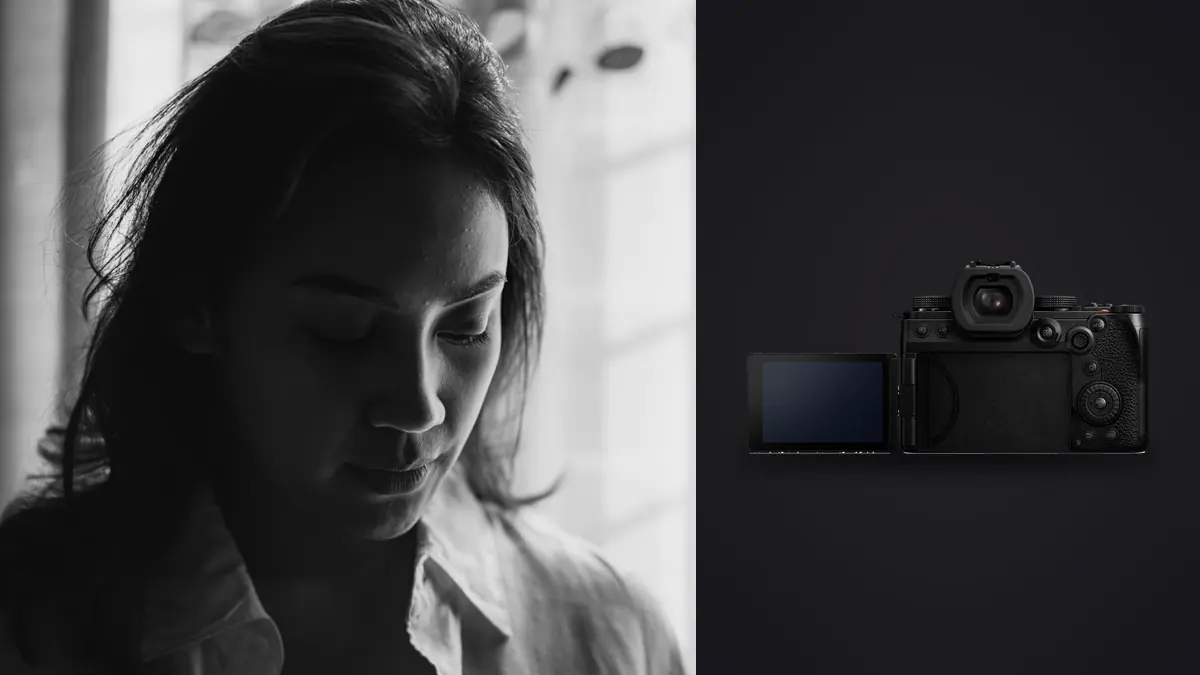
I picked up the Lumix S5IIx for a video project and ended up using it more for boudoir and intimate portrait sessions than anything else. That wasn't the plan. But a camera that stays quiet, focuses on a face in dim bedroom light, and doesn't need a flash bracket turns out to be exactly what this kind of session wants. Six months and roughly forty sessions later, here's what actually matters about this body for this specific genre, and what doesn't.
Why a Video-Leaning Camera Works for This Genre
The S5IIx gets marketed almost entirely on its video specs: internal ProRes, active cooling, waveform monitoring, all that. None of it is why it suits boudoir sessions. What matters is quieter, more boring stuff. The electronic shutter is genuinely silent, and for a client who is nervous about being photographed in a robe on a hotel bed, the absence of a mechanical clack after every frame changes the mood of the room measurably. A subject may well tell you, unprompted, that they forgot the shutter was firing at all. That's not a spec sheet line item, but it's the difference between someone holding their shoulders tense and someone actually relaxing into a pose.
Dual native ISO also does real work here. Sessions like this often happen with one window, maybe a single continuous LED as fill, and zero strobes, because popping flash in someone's bedroom at 7am tends to kill the intimacy you're trying to build. Shooting at ISO 3200 to 6400 on this sensor still gives me clean enough files to print at 16x20, which was not true on the older S1 body I ran for three years before this one.
Stabilization Changes How Close You Can Get
In-body stabilization rated around 7.5 stops (with a stabilized lens, less without) means I can shoot a 50mm at 1/15s handheld and still get a sharp eye. That sounds like a party trick until you're working in a small hotel room with low ceiling light and no room to set up a tripod without it becoming a whole production the client has to work around. Boudoir shoots live or die on the subject forgetting the camera exists. Every piece of gear you set up between you and them (tripod, remote trigger, light stand) adds friction. The stabilization on this body lets me stay handheld through almost the entire session, moving around the subject instead of asking them to move around fixed gear.
It's not magic. Anything under about 1/8s with a moving subject (and boudoir subjects breathe, shift, laugh) will still show motion blur regardless of how good the IBIS is. I still bump shutter speed up when someone's mid-laugh rather than trusting stabilization to save a frame with subject movement in it.
Autofocus Behavior with Skin and Fabric
Panasonic's phase-hybrid autofocus (introduced with the S5II line, carried into the S5IIx) fixed the single worst thing about the old S1/S5 contrast-detect system: focus hunting on skin in low contrast light. On the original S5 I lost real frames to the lens racking back and forth on a face lit only by window light. The S5IIx locks onto an eye through sheer fabric, through a hand held partly over the face, through hair falling across the eyeline, and it holds that lock as the person moves. Eye detection in particular is what makes shallow depth of field usable in this genre. I shoot the 85mm f/1.8 wide open constantly, and at f/1.8 on a full-frame body the margin for a missed eye is basically zero.
One caveat: face detection occasionally grabs the wrong face if there's a mirror in frame, which happens more than you'd expect in bedrooms and bathrooms. I've started manually placing the AF point rather than trusting wide-area detection whenever a mirror is visible.
Lens Choices That Actually Get Used
I own six lenses for this body and use three of them on a given session. Here's the breakdown of what earns its place in the bag versus what stays home.
| Lens | Typical Aperture Used | Best For | Why It Works (or Doesn't) |
|---|---|---|---|
| Lumix S 85mm f/1.8 | f/1.8 to f/2.2 | Close crops, single-detail portraits | Sharp wide open, cheap enough to not baby it, but needs 8+ feet of room in a small space |
| Lumix S 50mm f/1.8 | f/2 to f/2.8 | Three-quarter and full body in tight rooms | The workhorse; handles most hotel-room bookings where an 85mm can't back up far enough |
| Sigma 35mm f/1.4 DG DN Art | f/2.2 to f/4 | Environmental context, full room shots | Heavier and louder AF motor than the native primes, but the rendering is worth the weight |
| Lumix S 24-70mm f/2.8 | f/2.8 to f/4 | Location scouting, client walk-throughs before the real shoot | Rarely used for the actual final images; too clinical wide open for skin |
The 24-70mm is genuinely useful for the first ten minutes of a session, walking the space, checking angles, figuring out where the light falls at that hour. After that it goes back in the bag and the primes come out. Zoom convenience matters less than most gear guides suggest once you're actually in a small room with one subject.
The Screen, the Sound, and Client Comfort
The fully articulating rear screen gets underrated in most reviews of this camera because reviewers test it for vlogging. For boudoir work it means I can shoot from low angles (a common request, shooting up along the body from near floor level) without lying on the floor myself, which is its own kind of awkward in someone's bedroom. Flip the screen out, crouch, compose without pressing your eye to the viewfinder and losing eye contact with the subject between frames.
Dual SD card slots matter more here than in almost any other genre I shoot. These are files a client would be devastated to lose, and files that absolutely cannot end up anywhere they weren't intended. I run both slots in backup mode, formatted and wiped after delivery, and I never let a single card be the only copy of a session even for the drive home. That's not a camera feature so much as a discipline the camera makes easy to follow.
What Happens After the Shutter: The File Volume Problem
A 60 to 90 minute session on this camera generates somewhere between 700 and 1,400 RAW files once you count burst sequences during movement and the inevitable "just one more" requests. Culling that by eye, on a laptop, at 1am after a shoot, is where a lot of photographers burn out on this genre specifically. I moved my culling for these sessions onto imagic a while back mainly because the sorting happens locally on my machine rather than through a cloud service, which matters a great deal when the files are this personal. Nothing gets uploaded anywhere to get scored or sorted.
The burst clustering is the part that actually saves time on a boudoir session. Because so much of the work is a subject shifting through five or six variations of the same pose while I fire off a short burst, having those bursts grouped automatically (rather than scrolling past forty near-identical thumbnails one at a time) turns a two-hour cull into something closer to forty minutes. The sharpness scoring also catches the soft-focus frames from handheld shooting at 1/15s that I mentioned earlier, the ones that look fine on a 3-inch screen and fall apart at 100%.
I also built out an apply_my_style preset inside imagic, trained on maybe sixty of my own finished edits from past sessions, which gets applied as a starting point rather than a finished look. It's tuned to how I warm skin tones and pull back contrast on this specific camera's color science, so the baseline grade lands close to my hand-edited work before I go in and adjust image by image. It's not replacing the retouching, it's removing the fifteen identical clicks I'd otherwise make on every single frame before the real editing starts. If you're new to how this kind of local sorting differs from cloud-based culling tools, it's worth reading through how AI photo culling actually works before assuming every tool in this category handles your files the same way.
Color Science and Skin Tones Straight Out of Camera
Panasonic's standard color profile on this sensor runs slightly warm and a little soft in the shadows compared to Sony or Canon files I've pulled into the same edit. For boudoir that's mostly a gift. Skin doesn't need much correction before it looks natural, and the shadow rolloff means less clipping in the areas under a chin or along a hip where hard shadow lines look unflattering fast. Shooting V-Log flat is an option and I use it occasionally for video content from the same sessions, but for stills I mostly shoot the standard photo profile with a slightly reduced contrast setting in-camera, because grading a boudoir set from a fully flat log stills workflow adds a step most turnaround timelines don't need.
When I do want more control, particularly for a set that will get printed large, I'll shoot a stop underexposed and pull the file up in post rather than risk highlight clipping on skin, which the sensor handles less gracefully than shadow recovery does. That's a habit carried over from years on other Panasonic bodies, not something unique to the S5IIx, but it still applies here. Skin tone handling like this is really a subset of a bigger question about how much AI-assisted editing should touch portrait work in the first place, which our guide to AI editing for portrait photography covers in more general terms than I will here.
Where the Camera Falls Short for This Work
No built-in flash, which is a non-issue for boudoir specifically since I rarely use flash anyway, but worth noting if you're coming from a body where you leaned on pop-up fill even occasionally. Battery life is mediocre when the rear screen stays on and articulated for the low-angle shots described earlier; I carry three batteries for a 90-minute session and that's not generous. And the body itself, while not heavy by full-frame standards, is bulkier than the mirrorless bodies some boudoir photographers prefer specifically because a smaller camera reads as less intimidating to a first-time client standing in front of it. I haven't found that to be a dealbreaker, but a first-time subject may comment on the size before you start.
Frequently Asked Questions
Is the Lumix S5IIx worth the upgrade over the standard S5II for boudoir work specifically?
Honestly, mostly no. The S5IIx's headline additions (ProRes internal recording, active cooling for extended video, waveform monitoring) are video production features that a stills-focused boudoir photographer will rarely touch. If you're shooting stills only, the standard S5II gets you the same sensor, same autofocus, same stabilization, same silent shutter, for meaningfully less money. The S5IIx earns its price premium if you're also delivering behind-the-scenes video or reels content from the same sessions, which a growing number of boudoir studios do for marketing.
Can you shoot a full boudoir session with just one lens on this body?
Yes, and the 50mm f/1.8 is the one I'd pick if forced to choose. It covers full body shots in a tight room and can crop in reasonably close for detail shots without the working distance problems the 85mm runs into in small spaces. It's not the most flattering focal length for close facial crops, but it's the most versatile single option.
How do you handle client privacy with the files after a session like this?
Cards get formatted after delivery and confirmed backup, nothing sits on a phone or gets synced through a photo-sharing cloud service by default, and culling happens locally rather than through any tool that uploads files off my machine to sort them. That last part is a big reason I moved my workflow onto imagic rather than a cloud-based culling service for this specific genre; the images never leave local storage during sorting.
Is the silent electronic shutter actually silent, or just quieter?
It's genuinely silent in electronic shutter mode, no simulated sound, no mechanical movement at all. The tradeoff is a risk of rolling shutter distortion on fast movement, which barely matters for posed portrait work but is worth knowing if you're also using the same setup for movement-heavy shots like a subject walking toward camera.