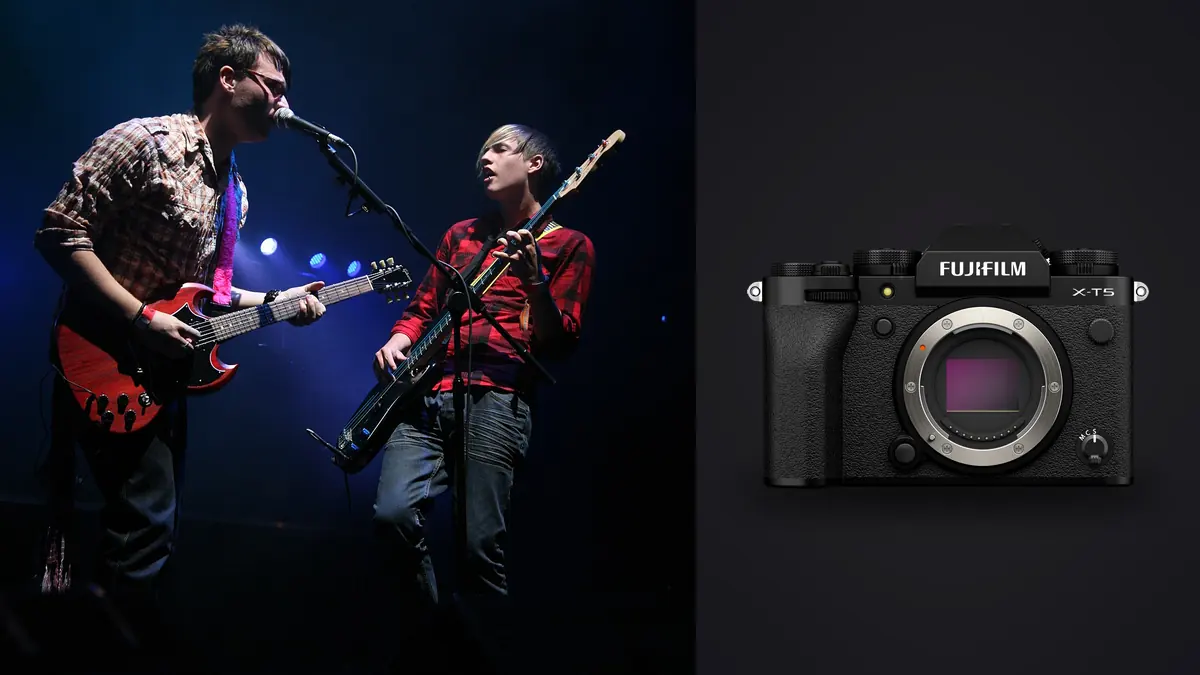
Three songs, no flash, and glass that has to carry the shot
Most photo pits still run on the same deal they did a decade ago: you get the first three songs, you shoot from the barrier, and you don't use flash. That rule shapes everything about how a camera behaves at a show, and it's worth starting there before getting into sensor numbers. The Fujifilm X-T5 is a 40.2-megapixel APS-C body with in-body stabilization, a healthy low-light autofocus rating, and a shutter that goes fast on paper. None of that matters as much as whether you can hold focus on a singer who won't stop moving under a light rig that's actively working against you. I've taken this camera into club rooms holding two hundred people and into a couple of amphitheater shows where the photo riser put me thirty meters back, and it behaves differently in each. That's really the story of this camera at gigs: it's excellent in specific conditions and needs real compensation in others.
The 40-megapixel question nobody asks until the card fills up
APS-C at 40 megapixels is unusual territory, and at a show it cuts both ways. The upside is real: with the crop modes (roughly 1.29x and 1.6x) you get extra reach out of a mid-range zoom without buying a longer lens, which matters when you're stuck at a barrier thirty meters from the stage and security won't let anyone closer. A 50-140mm becomes something closer to a 180mm equivalent in the tighter crop, and you're still working with a healthy file. The downside shows up back at the hotel or the van at 2am: a two-hour set shot at even a moderate clip produces 25 to 40 gigabytes of raw files, and a huge share of them are near-duplicates of the same jump, the same guitar swing, the same head-back vocal moment fired across a five-frame burst. Sorting that by eye, frame by frame, at full resolution, is where a lot of touring photographers lose an evening they don't have. It's the reason I stopped doing that culling manually and let imagic score sharpness and cluster the burst sequences on its own; going through forty near-identical frames of a drummer's stick coming down and getting the one where the head of the stick is actually sharp is not a good use of the hour after a show ends.
Shutter choice matters more than the number on the spec sheet
Fuji advertises fast burst numbers on the X-T5, but the number that actually matters at a gig is which shutter mode you're using, because stage lighting punishes the wrong choice. The X-T5 carries the same 40-megapixel sensor as the X-H2, not the stacked sensor from the X-H2S, which means its electronic shutter reads the sensor relatively slowly. Point that at a bank of LED wash lights or a moving-head fixture pulsing at its own refresh rate and you'll get banding across the frame, sometimes a hard line of underexposure cutting through a face. It's subtle in a JPEG preview on the back screen and obvious once you pull the file up on a real monitor. Mechanical shutter avoids that problem entirely, which is why I default to it for anything with visible LED fixtures (which, in 2026, is almost every venue). The tradeoff is fps and a shallower buffer, and dual SD UHS-II slots rather than CFexpress mean the buffer doesn't clear as quickly as it would on a body built for sports.
| Shutter mode | Practical top speed | Banding under LED/moving-head rigs | Raw buffer before slowdown | Best for |
|---|---|---|---|---|
| Mechanical | ~8fps full sensor, ~15fps in 1.29x crop | Essentially none | Roughly 15-20 frames compressed raw | Any venue with LED wash, moving heads, or strobes (most rooms) |
| Electronic shutter | ~10fps full sensor, ~20fps in 1.29x crop | Frequent, visible as a horizontal band | Deeper before slowdown, but files often unusable anyway | Static tungsten/incandescent stage lighting, silent sets, acoustic shows |
| Electronic first curtain | Same as mechanical, quieter | Rare, minor risk at very high shutter speeds | Similar to mechanical | Theater shows, seated venues where shutter clack draws attention |
Autofocus when the light rig is working against you
The X-T5's subject detection (face and eye recognition, with the option to prioritize a person even without the dedicated animal or vehicle modes lit up) is genuinely good in even, continuous light. A theater show with a fixed key light on the performer is close to a best-case scenario, and the camera tracks a singer's eyes through head turns without much drama. A club show with hazers running and lighting cycling through reds, purples, and hard backlight is a different animal. Backlit smoke kills contrast, saturated color washes confuse the color-aware part of subject detection, and a strobe hit mid-burst can cause a frame or two of hunting. I've had better luck dropping out of full-frame subject tracking and using a single, mid-sized zone that I can reposition with the joystick, essentially doing the job the algorithm is supposed to do but with a human deciding where "the shot" actually is. The camera's autofocus is rated down to around -7EV with a fast prime attached, which is genuinely dark, darker than most club stage lighting gets even in the gaps between cues, so the sensor isn't usually the limiting factor. The limiting factor is contrast, and haze plus colored gel lighting removes a lot of it.
ISO ceilings, film simulations, and skipping part of the edit
Native ISO on the X-T5 runs 125 to 12,800, with extended settings down to 64 and up to 51,200. In practice I treat 6,400 as the real ceiling for anything I intend to sell or submit to a publication, and I'll push to 12,800 only when the alternative is missing the shot entirely, which at a dim club stage happens more often than any spec sheet would suggest. Where the X-T5 earns its keep is the film simulation set. Shooting a build with Eterna baked into the raw preview keeps skin tones from blowing out under saturated stage washes, and it gives me a starting point that's already close to what I want rather than a flat log-style file I have to build color into from nothing. That said, I still shoot raw and don't rely on the in-camera sim as the final word, because a three-song set at a headline show still needs consistent color across a hundred-plus keepers, not a look I nailed on twenty frames and then have to hand-match across the rest. That's where imagic's apply_my_style feature has actually changed my workflow: once I've graded a handful of frames from a set the way I want them, the tool learns that edit from my own history and applies a matching pass across the rest of the selects, so the whole gallery reads as one consistent set instead of twenty different color decisions made at different points in a long night.
Building a lens kit that survives a packed photo pit
Space in a pit is tight, other photographers are swinging elbows for the same three songs, and security has opinions about bag size. I've settled on a two-body-worth-of-glass approach even when I'm only carrying one body: a standard zoom on the camera and a prime or two in a hip pack for when I want to get in close between songs. The 50-140mm f/2.8 is the workhorse for anything where I can't get near the stage, arenas and amphitheaters mostly, and its optical stabilization pairs with the body's IBIS for handheld video grabs between stills. The 16-55mm f/2.8 covers wide stage shots and the moments where the crowd itself is part of the picture. For genuinely small rooms, a 33mm f/1.4 prime is small enough not to draw attention and fast enough to keep ISO reasonable when a singer steps right up to the barrier.
| Lens | Approx. weight | Effective range (APS-C) | Where it earns its spot |
|---|---|---|---|
| XF16-55mm f/2.8 | ~655g | 24-84mm equiv. | Wide stage shots, crowd context, general club coverage |
| XF50-140mm f/2.8 OIS | ~995g | 76-213mm equiv. | Arena and amphitheater distance, tight face shots from the barrier |
| XF33mm f/1.4 | ~360g | 50mm equiv. | Small rooms, low light, staying unobtrusive in a packed pit |
| XF90mm f/2 | ~540g | 135mm equiv. | Portrait-style stage isolation, background separation with busy rigs |
What the stabilization actually buys you on stage
The in-body stabilization is rated up to seven stops depending on the lens, and it's easy to overstate what that means for gig work. It does nothing to freeze a performer swinging a guitar neck or a singer whipping their head on a downbeat; that's subject motion, and no amount of sensor-shift stabilization touches it. What it actually buys you is the ability to hand-hold a slower shutter for static or slow-moving shots, a wide establishing frame of the stage during a quieter song, a handheld pan across the crowd, or a deliberately dragged shutter on a light show where you want streaks rather than a frozen strobe hit. For anything with real movement in the subject, shutter speed still does the work, and I rarely drop below 1/250 for a performer who's actually performing, closer to 1/500 or 1/640 for anyone jumping or headbanging.
Small details that matter more than they should
A few things that don't show up in a spec comparison but affect a night at a venue: the three-way tilting rear screen is genuinely useful for shooting low over a barrier or holding the camera overhead above a crowd without craning your neck to see the frame, though it doesn't flip out to the side the way a fully articulating screen would. Weather sealing matters more than people expect for indoor club work too, not just outdoor festivals; a sweaty, humid room with two hundred bodies in it is closer to a rainstorm than most photographers admit. Battery life on the NP-W235 is enough for a full night covering openers and a headliner with a spare in a pocket as backup, and I've never had it die mid-set the way older Fuji batteries used to. The body itself, around 550 grams without a lens, is small enough that venue security rarely blinks at it the way they do at a full-frame body with a big white lens attached, which matters more for access than any image quality number does.
Sorting the aftermath: what actually happens after the show
The unglamorous truth about concert photography is that the shoot is maybe ninety minutes and the sort is two or three hours if you do it by hand. A 40-megapixel sensor firing bursts at a jump shot or a guitar solo produces stacks of frames that look identical at thumbnail size and only differ in whether the eyes are open, the hand is blurred, or the framing shifted by an inch as the performer moved. That's exactly the kind of grinding, repetitive review that used to eat my post-show evenings, and it's why I lean on imagic to do the first pass: it scores every frame in a burst for actual sharpness rather than just flagging "similar" images, groups the burst sequences together so I'm choosing between five frames instead of scrolling past forty, and does all of it locally on my laptop rather than uploading a night's worth of unreleased tour photos to somebody's cloud, which matters when a band's management has explicit rules about where images of an unreleased set can and can't go. If you haven't looked at how that kind of automated first-pass culling actually works under the hood, it's worth reading through how AI photo culling works before trusting it with a full night's shoot. It's a one-time purchase rather than a subscription too, which matters if you only shoot a handful of gigs a month and don't want another recurring line item on top of gear, insurance, and mileage.
Frequently Asked Questions
Is the X-T5's 40-megapixel sensor actually necessary for live music work, or is it overkill?
For most club and theater work it's more resolution than you'll use at full size, and the tradeoff is bigger files and a shallower buffer. Where it pays off is distance: the crop modes let you punch in on a subject from an arena riser without buying a longer, heavier lens, and cropping a low-light frame in post still leaves usable detail because you started with so many pixels. If you mostly shoot small rooms from close range, the resolution matters less than the low-light and autofocus behavior does.
Should I shoot mechanical or electronic shutter at a typical club show?
Mechanical, almost always, unless the venue is running plain tungsten or incandescent lighting with no LED fixtures at all, which is increasingly rare. The X-T5's electronic shutter reads the sensor slowly enough that LED banding shows up under moving-head lights and LED walls, and you often won't notice it until you're looking at full-size files later.
How many raw frames can I realistically burst before the X-T5 slows down?
Expect somewhere in the range of 15 to 20 compressed raw frames at the camera's higher continuous rates before the buffer starts to lag, and dual SD UHS-II cards (there's no CFexpress slot on this body) mean that buffer clears more slowly than on a sports-oriented Fuji body. In practice this pushes me toward shorter, more deliberate bursts timed to a specific moment rather than holding the shutter down through an entire chorus.
Do I need fast primes, or is a 2.8 zoom enough for most venues?
A 2.8 zoom covers the majority of situations, but the gap shows up in small, dim rooms where you're close enough to the stage that a wider aperture buys you a real stop or two of shutter speed headroom. A 33mm f/1.4 or similar prime in the bag for those nights, alongside a 16-55mm or 50-140mm zoom for everything else, covers nearly every venue size I've worked.