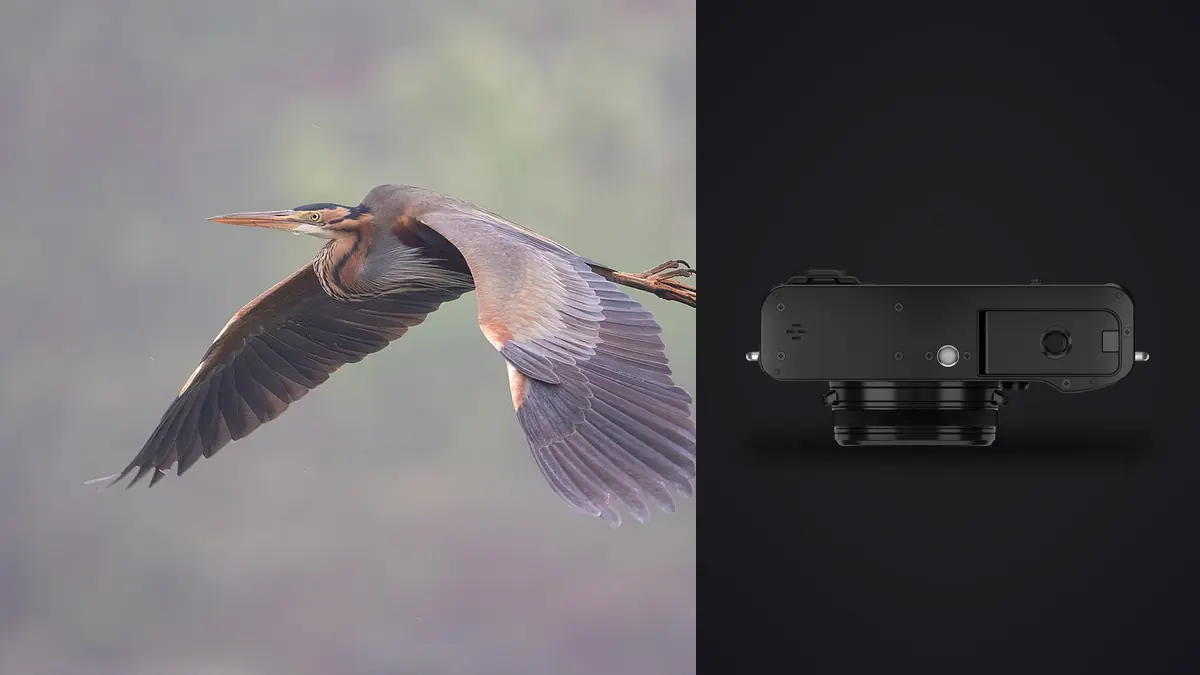
The Question Every Birder With an X100VI Asks
I get some version of this message every couple of months, usually from someone who just picked up a Fujifilm X100VI because they loved the files, the size, the whole idea of a camera that disappears into a jacket pocket, and then wondered if it could double as their birding camera too. The honest answer is: mostly no, but the "mostly" is doing more work than you'd expect, and the edge cases where it actually performs are worth understanding before you either give up on the idea or over-invest in accessories chasing a dream the lens physically cannot deliver.
This isn't a review of the X100VI as a camera. Plenty of people have covered the sensor, the film simulations, the hybrid viewfinder. This is specifically about what happens when you point a fixed 23mm f/2 lens at a heron, a kestrel, or a flock of geese lifting off a lake, and whether the answer changes with the right accessories or camera settings.
The Optics Problem Nobody Mentions in the Marketing
The X100VI has a 23mm lens, which gives roughly a 35mm field of view once you account for the APS-C crop factor. That is a fantastic focal length for street photography, environmental portraits, and travel work. It is a genuinely bad focal length for anything that requires you to fill the frame with a subject thirty meters away and moving fast, which describes the vast majority of bird photography, and almost all bird-in-flight photography specifically.
Doing the crop math so you don't have to
Here's the number that matters. A lot of serious bird photographers shoot somewhere around 400mm to 600mm equivalent focal lengths, because birds are small and skittish and rarely let you get close. Going from 35mm equivalent to 400mm equivalent is roughly an 11x difference in focal length. Since the frame area scales with the square of that ratio, cropping a 35mm-equivalent shot down to match a 400mm field of view throws away about 99% of your pixels. On the X100VI's 40.2-megapixel sensor, that leaves you with somewhere around 330,000 to 400,000 usable pixels, which is well below what most phone cameras output from a single frame, let alone what you'd want printed or even posted at any real size.
That's not a knock on the sensor. It's just what happens when you ask a wide-normal lens to behave like supertelephoto glass. No amount of megapixels fixes a focal length problem; more resolution just means you're throwing away a bigger, more detailed image instead of a smaller one.
Where the X100VI Actually Earns Its Keep in Birding
None of that means the camera is useless on a birding trip. It means you need to redefine what "bird photography" means for the session you're using it for. I've had good luck with the X100VI in three specific situations: habituated birds at close range (feeders, boardwalks, harbor gulls that have long since stopped caring about people), environmental shots that put the bird in its landscape rather than filling the frame, and documentary-style shots of the birding experience itself, other people glassing the treeline, gear laid out on a blind's shelf, that sort of thing.
The tele conversion lens, the TCL-X100 II, changes the math slightly. It's a 1.4x optical converter, taking the actual 23mm down to roughly 32mm, which works out to about 50mm equivalent. Stack that with the camera's built-in digital teleconverter crop modes and you can reach something in the neighborhood of 70mm equivalent before image quality starts to fall apart. That's still nowhere near telephoto territory, but it's enough to turn a distant heron on a dock piling into a recognizable subject instead of a smudge, provided the bird cooperates by staying put.
Subject-detection autofocus, borrowed from bigger cameras
What surprised me most was the autofocus. The X100VI runs the same X-Processor 5 and subject-detection AI that Fujifilm put in the X-T5 and X-H2 series, which includes a dedicated bird-detection mode. Point the camera at a perched bird and it will find the eye and lock on with a confidence that has nothing to do with the lens being wrong for the job. It's genuinely strange to have supertelephoto-grade subject tracking married to a focal length that can't take advantage of it, but for the close-range and habituated-bird scenarios above, that tracking is doing real work. In continuous AF with the electronic shutter, the camera will rattle off frames at up to 20fps in a cropped mode, which is plenty to catch a wing about to open even if the overall composition is loose.
The leaf shutter advantage
One thing that gets overlooked: the X100VI has a leaf shutter built into the lens assembly, which syncs with flash at any shutter speed and, more relevantly here, operates almost silently. For skittish birds at close range, a DSLR mirror slap or even a loud mechanical shutter can flush a subject before you get the shot. The X100VI's leaf shutter, especially combined with the fully silent electronic shutter option that goes up to 1/180,000s, lets you fire away at a bird fifteen feet away without it noticing you exist. That's a real, practical advantage for backyard and boardwalk birding that longer, louder rigs don't have.
Real Numbers: X100VI Birding Setups Compared
To put actual figures against the different ways people try to use this camera for birds, here's how the realistic options stack up. "BIF hit rate" below is a rough field estimate based on shooting geese, gulls, and herons at typical wetland distances, not a lab measurement.
| Setup | Effective focal length | Weight (camera + optics) | Realistic BIF hit rate | Best use |
|---|---|---|---|---|
| X100VI, bare | 35mm equiv. | 478g | Under 5% | Birds in landscape, habitat context |
| X100VI + TCL-X100 II | ~50mm equiv. | ~610g | 5-10% | Perched birds at moderate distance |
| X100VI + TCL + digital tele crop | ~70mm equiv. | ~610g | 10-15% | Close, slow-moving fliers (geese, herons) |
| X-T5 + 100-400mm zoom | 150-600mm equiv. | ~1,650g | 40-60% | Dedicated bird-in-flight work |
| Bridge superzoom (600mm+ equiv.) | up to 1,200mm equiv. | ~1,300g | 25-40% | Reach on a budget, distant subjects |
Those hit-rate numbers aren't scientific, they come from my own shoot logs over a handful of outings, but the gap between the X100VI column and the dedicated telephoto column is the honest takeaway. If bird-in-flight photography is the actual goal, this camera is not the tool, full stop. If it's a secondary camera you're bringing along anyway because it's small and you like the files, it can still contribute usable frames, just not the frame-filling action shots.
A Morning at a Heron Rookery: What Worked and What Didn't
I spent a morning at a great blue heron rookery with the X100VI as my only camera, partly out of curiosity and partly because I didn't want to carry two bodies on a muddy trail. The rookery had maybe a dozen active nests thirty to fifty feet up in dead trees, with birds constantly coming and going with sticks and fish. At that distance, even with the TCL-X100 II attached, individual herons were small in the frame, maybe filling 8-10% of the image width. Cropping in post got me usable habitat shots, birds silhouetted against the nest structure, but nothing I'd call a proper wildlife portrait.
Where the camera actually shone was on the ground. A heron waded into the shallows about twenty feet from where I was standing, and the silent shutter meant I could fire off a fifteen-frame burst as it struck at a fish without the bird so much as glancing my way. That sequence, cropped moderately, produced two frames I'd genuinely put in a portfolio. The lesson wasn't "the X100VI can shoot birds," it was "the X100VI can shoot birds that let you get close, and it will do it more discreetly than almost anything else in my bag."
Sorting Through the Wreckage: Culling a Birding Burst
Whatever camera you bring, birding produces a specific kind of chaos in your card once you're home: dozens of near-identical burst frames of the same wing position, half of them soft because the subject moved faster than the AF could track, a handful of duplicates from panning shots that barely differ. This is where the shoot stops being fun and starts being a chore, and it's honestly the part of bird photography that burns people out faster than the early mornings do.
I run these sessions through imagic before I touch anything else. It scores sharpness locally on the machine, no upload, no waiting on a server queue, which matters when you've got a few hundred frames from one heron sequence and want the ranked results in the time it takes to make coffee. It also clusters the burst and near-duplicate frames together, so instead of scrolling through fifteen versions of the same strike sequence one at a time, you're comparing them side by side and picking the one where the eye is actually sharp. If you haven't dealt with burst-mode wildlife photography before, the volume of near-duplicate frames catches people off guard, and it's worth reading up on how AI photo culling actually works before you're staring down a card full of them for the first time.
Once the keepers are picked, I lean on imagic's apply_my_style preset, trained on my own past edits rather than someone else's preset pack, to get a consistent starting grade across the set before I do targeted work on the two or three frames that are actually going somewhere. It's a one-time purchase rather than a subscription, which matters to me because birding trips are seasonal and I don't want to pay for editing software in months I'm not shooting. If your current workflow from card to finished folder feels slower than the shoot itself, it might be worth a look at some general faster photo workflow habits too, because camera choice is only half of the time sink.
So Should You Buy One for Birding?
If bird-in-flight photography is your primary goal and you don't already own an X100VI, buy a telephoto-capable camera instead. There's no accessory or crop trick that closes an 11x focal length gap, and you'll spend more on the tele converter and still come home frustrated. If you already own an X100VI for everything else it's good at (and it's good at a lot) and you're heading out on a birding trip anyway, bring it as a second body for habitat shots, close encounters, and the kind of quiet, patient photography where its silent shutter and small footprint are genuine advantages rather than compromises.
Frequently Asked Questions
Can the X100VI's autofocus actually track a bird in flight?
The autofocus system itself can track a moving bird reasonably well at 20fps in the electronic shutter mode, the bird-detection AI is the same technology found in Fujifilm's telephoto-friendly bodies. The limitation isn't tracking accuracy, it's that a bird in flight at typical shooting distances occupies a tiny fraction of the frame at 35mm (or even 70mm with accessories), so even a perfectly tracked subject ends up too small in the final image to be usable without extreme cropping.
Is the TCL-X100 II teleconverter worth buying just for birding?
Not on its own. It takes you from 35mm to roughly 50mm equivalent, which helps for perched birds at moderate range but does almost nothing for flight shots. If you're buying it specifically for birds, you'll likely end up disappointed. It's a better purchase if you already want it for portraits or general use and birding is a secondary benefit.
What settings help most when photographing birds with the X100VI?
Electronic shutter for silence and higher frame rates, continuous AF with bird or animal subject detection turned on, and a shutter speed of at least 1/1000s to freeze wing motion on anything larger than a sparrow. Shooting in the wide-crop DNG raw setting rather than the smaller in-camera JPEG crop preserves more pixels for the cropping you'll inevitably do afterward.
Would a used telephoto zoom camera be a better investment for someone serious about bird photography?
For flight shots and any frame-filling wildlife work, yes, without much debate. A body paired with something in the 100-400mm or 150-600mm range will outperform the X100VI on birds by a wide margin, even a used or older-generation combination. The X100VI's strength is everything else it does well as an everyday and travel camera; treating it as a birding-first purchase misunderstands what it's built for.