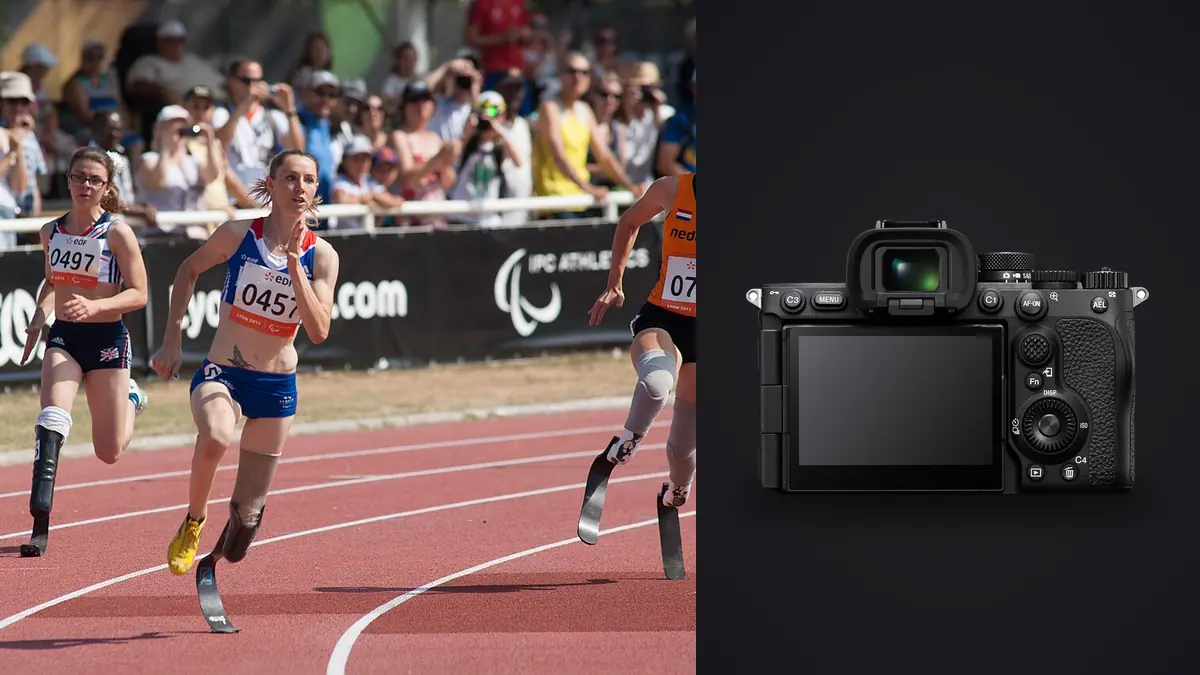
I did not buy the Sony A7R V for track and field. Nobody does. It is a 61-megapixel landscape and studio camera that Sony dressed up with an AI processing unit and a 4-axis screen, and on paper it looks like the wrong tool for a sport built around 10.3-second sprints and throws that peak for a fraction of a second. I shoot a regional athletics circuit most spring weekends, and the A7R V ended up in my bag anyway, first as a backup body, then as the camera I reach for more often than I expected. This is what actually happens when you point that sensor at a curve full of sprinters.
The frame rate is not the number that matters here
Ten frames per second is the ceiling on the A7R V, in both mechanical and electronic drive. That is roughly a third of what an A1 will do and nowhere near the 120fps blackout-free party trick of the A9 III. If you shoot this camera the way you'd shoot an A9 II, holding the shutter down through the entire 100m and hoping the right frame lands somewhere in a 30-frame burst, you will be disappointed and you will fill a card doing it.
What changed my mind about the body was realizing 10fps is plenty for track and field specifically, because the sport is more predictable than it looks. A sprinter's stride cycle, a long jumper's takeoff, a discus release, all of these have a rhythm you can anticipate once you've watched enough of them. I don't burst blindly anymore. I watch the athlete's rhythm for a lap or two, then fire short 4 to 6 frame bursts timed to the moment I actually want, foot strike, arm drive, the instant a javelin leaves the hand. At that cadence 10fps gives you two or three genuinely different compositions per burst instead of thirty near-duplicates of the same stride.
Autofocus is the actual reason to bring this camera
The dedicated AI processing unit Sony added for the A7R V line is the part that earns its keep on an oval. Human pose detection means the camera can identify and hold onto a runner's torso even when their head is turned away from you, which happens constantly in lane running and in the final drive off the blocks. I've had it lock onto a 400m runner through a full backstretch with their face never once toward the lens, tracking body position instead of relying on an eye it can't see.
Where it struggles is dense field-event scenes: relay exchanges with four bodies converging in a box, or a crowded infield during a long jump competition with officials and other athletes in frame. The subject-recognition net occasionally grabs the wrong person for a frame or two before correcting. I've learned to pre-select my zone (Zone AF with a tightened tracking area rather than Wide) rather than trust the camera to guess who I care about in a crowd, and accuracy improved noticeably once I stopped leaving it fully automatic.
Rolling shutter is the tradeoff nobody mentions in the marketing copy
This is the honest limitation, and it's the one that actually shapes how I shoot with this body. The A7R V uses the same non-stacked 61-megapixel Exmor R sensor architecture as the A7R IV, just with faster readout electronics behind it. That's a meaningfully slower readout than a stacked sensor like the one in the A9 series or A1, and it shows up as skew on fast-moving subjects in electronic shutter mode: a sprinter's legs can lean at an angle that never happened, or a discus mid-spin can look subtly warped along one edge.
My workaround is simple and it costs me almost nothing in practice. For anything moving fast laterally across the frame, sprint finishes, hurdles, the release phase of a throw, I shoot mechanical shutter, not electronic. It caps me at the same 10fps either way on this body, so I lose nothing in burst speed and the skew disappears. I save electronic (and silent shutter, which matters at indoor meets where a mechanical clatter during a false-start hush draws dirty looks from officials) for slower subjects: a coach on the sideline, warmups, distance runners on the back straight where the lateral speed across frame is much lower.
Lenses that actually make sense on this body for a track meet
The 70-200mm f/2.8 GM II lives on this camera at most meets I shoot; it covers the infield and near lanes and its close-focus distance is good enough for field events happening right in front of the stands. For the far side of a 400m oval, or for any meet where I'm not credentialed for infield access, the 200-600mm is the lens that actually gets usable frames, and 61 megapixels means I can crop into that reach further than I could on a 24 or 33-megapixel body and still print a magazine spread. That resolution cushion is genuinely the best argument for using this camera at a track meet at all: it turns a mediocre angle into a workable one after the fact.
APS-C crop mode is worth knowing about too. Switching to Super 35 crop turns the 200-600mm into roughly a 300-900mm equivalent at a 25-megapixel output, which is still a perfectly usable file for web and most print use, and it buys reach when I'm stuck in a stand with no infield access. I keep it mapped to a custom button rather than leaving it on permanently, since full frame is still the better choice whenever I have the working distance to use it.
Sony A7R V vs. the cameras built for this job
None of this makes the A7R V a better choice than a dedicated sports body if you're buying new specifically for track and field. It makes it a very usable one if you already own it, or if resolution matters more to your business than outright speed. Here's how it actually compares on the metrics that matter trackside, based on specs and my own field observations rather than lab charts.
| Camera | Resolution | Max burst (mech / elec) | Compressed RAW buffer | Rolling shutter behavior | Best role at a meet |
|---|---|---|---|---|---|
| Sony A7R V | 61MP | 10 / 10 fps | ~68 frames | Noticeable skew in e-shutter on fast lateral motion; clean on mechanical | Crop-heavy field events, sold prints, wide shots you'll punch into later |
| Sony A9 II | 24.2MP | 10 / 20 fps | ~361 frames | Mild, mostly a non-issue even at full e-shutter speed | High-volume wire work, sprint finishes at high frame rates |
| Sony A1 | 50.1MP | 10 / 30 fps | ~238 frames | Effectively stacked-sensor clean, minimal skew | The compromise body: resolution and speed together, for a price |
| Sony A9 III | 24.6MP | 120 / 120 fps | ~340+ frames | None (global shutter, no rolling readout at all) | Photo finishes, blocks starts, anything decided by a hundredth of a second |
If your job is selling wire photos of a finish line to a wire service by the hundredth of a second, none of what the A7R V does well matters and you want the A9 III. If your job is coming home with a handful of genuinely large, crop-friendly frames of the meet's best moments for a program, a sponsor, or prints for the athletes' families, the A7R V holds up a lot better than its spec sheet suggests.
Settings I actually run at a meet, not the ones in the manual
Mechanical shutter as the default, switching to electronic only for slower subjects as noted above. Zone AF, narrowed rather than left wide, with human pose priority on. Shutter speed floor at 1/1600s for sprints and hurdles, dropping to 1/1000s for distance events where I want a touch less freeze on the legs. Continuous shooting set to Hi rather than Hi+, since Hi+ on this body buys you nothing extra in fps, it only changes viewfinder blackout behavior, and I'd rather have a cleaner finder view to track a runner through. I shoot compressed RAW, not uncompressed, essentially always at a meet; the buffer depth difference between the two is large enough on this body that uncompressed will bite you exactly when you need the burst most, mid-race, and the visible quality difference for sports delivery is not worth that risk.
What a day of shooting actually leaves you with
A single afternoon meet with the A7R V regularly leaves me with 40 to 60GB of RAW files, sometimes more if I'm covering field events on the side. At roughly 60-80MB per compressed RAW frame, that adds up to several thousand files fast, and a meaningful chunk of them are near-duplicate frames from the same short burst, plus a fair number that look sharp on the back screen but are actually just off, a half-step of motion blur on a foot, or the rolling shutter skew from the one time I forgot to switch out of electronic shutter mid-race.
This is the part of the workflow I stopped doing manually a while back. I run the card through imagic before I touch anything else, letting its local sharpness and focus scoring flag the genuinely soft frames (the difference between a foot that's tack sharp mid-strike and one that's just slightly trailing is not always obvious at a glance on a laptop screen, especially after a long day), and its burst clustering groups each short sprint sequence together instead of leaving me to scroll through the same runner forty times over. Everything runs locally on the laptop, which matters more than I expected the first time I tried culling a meet's worth of files at a venue with no usable wifi; there's no upload step waiting on a bad connection before I can even start sorting. If you want the mechanics of how that scoring actually works, I wrote a longer breakdown of how AI photo culling works that covers it in more depth than makes sense here.
The other piece that's saved real time is the apply_my_style preset, trained on my own past edits rather than some generic sports look. A whole meet's worth of track and field images shot in changing light as the sun moves across the stadium needs to look consistent, and having a preset that's actually learned my own grading choices gets me most of the way there before I do any manual adjustment. It's not a substitute for judgment on the handful of hero shots, but for the bulk of a 200-image set it removes a lot of repetitive grading work. Between that and a tighter culling pass, I've cut what used to be a multi-evening sort-and-edit job down to something closer to one sitting; there's more general advice on tightening that loop in this rundown of faster photo workflow habits if you're starting from a slower process than mine.
Frequently Asked Questions
Is 10fps actually enough to catch a 100m finish?
It's enough if you time your burst rather than holding the shutter through the whole race. Start your burst a stride or two before the line rather than at the gun, and you'll typically get two or three frames right at or through the finish. What 10fps won't give you is the luxury of firing blind for the whole race and sorting it out later; that approach genuinely does need something faster, like an A9 II or A9 III.
Does the rolling shutter problem show up on ordinary prints, or only if you're pixel-peeping?
It depends on the subject and the shutter mode. On mechanical shutter I've never seen it, since the mechanical shutter reads the sensor differently than electronic does. On electronic shutter with fast lateral subjects, hurdlers close to the lens, a discus mid-release, it can be visible at normal viewing size, not just at 100% crop, particularly along a straight edge like a lane line or the discus rim. That's specifically why I default to mechanical for anything with real lateral speed.
Is the 200-600mm or a shorter GM zoom the better call for a track meet?
It depends entirely on where you're allowed to stand. With infield access, the 70-200mm f/2.8 covers most of a standard oval comfortably and focuses fast enough for close field events. Without infield access, stuck in general seating, the 200-600mm (or that lens plus APS-C crop mode for extra reach) is close to mandatory; the far side of an oval from the stands is a long way off even at 600mm.
Would you recommend buying an A7R V specifically for sports, or only using one you already own?
Only using one you already own, or buying it primarily for other work (portraits, landscape, studio) and treating sports as a secondary use. If sports and fast action is the primary job and budget allows it, an A9-series body or the A1 will serve you better on the days that matter most. The A7R V earns its place in a sports bag as a very capable second body with a resolution advantage, not as the camera you'd choose first if speed were the only criterion.