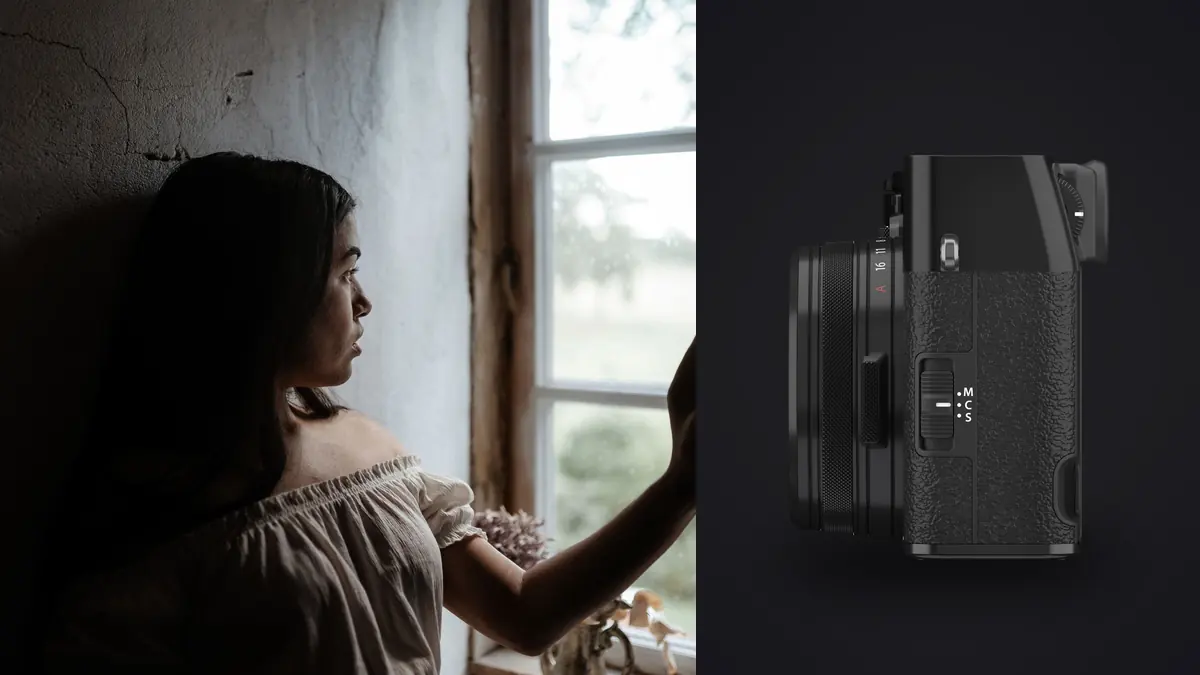
A fixed 23mm lens can sound like the wrong tool for a genre built on tight crops, shallow depth of field, and the ability to back off or move in at will. A few sessions in a rented Airbnb bedroom that is maybe eleven feet wide make it clear why the camera keeps showing up in this niche anyway. It's not despite the fixed lens. It's partly because of it.
Why a Fixed 35mm-Equivalent Lens Isn't the Handicap It Sounds Like
Boudoir work happens in small rooms. Bedrooms, hotel suites, the corner of a studio dressed to look like a bedroom. You rarely get the ten or twelve feet of working distance that a fixed 35mm-equivalent field of view seems to want. What actually happens is you end up shooting a lot closer than you would with a portrait zoom, and that changes the relationship in the room in a way that helps more than it hurts.
A camera with a compact body and a lens that doesn't extend or hunt for focus reads as less intimidating to a client who is already nervous about being photographed in lingerie or less. Clients often say that a big body with a 70-200mm hanging off the front feels clinical, almost medical. The X100VI looks more like something you'd bring on a trip. That perception changes how people hold their shoulders in front of it.
The tradeoff is real, though. At 23mm you are working close enough that lens distortion at the edges of the frame becomes something you have to manage on purpose, not something you can ignore. Keep the subject closer to the center third of the frame for anything from the waist up, and be deliberate about camera height. Shooting up at a reclining subject from below hip level with a wide lens will lengthen thighs and shorten torsos in a way that flatters nobody. I keep the camera closer to eye level with the subject for seated or reclining poses and only go low and wide for full-length shots where the stretch reads as intentional.
The Digital Teleconverter Isn't a Real Zoom, and You Should Treat It That Way
The X100VI's crop modes (which simulate roughly 50mm and 70mm equivalents by cropping into the 40-megapixel sensor) get pitched as a workaround for the fixed lens. They're useful for a tighter framing option without moving your feet, but you're throwing away resolution to get there, and at the 70mm crop you're down to something like 10 megapixels. That's fine for web delivery and even most print sizes clients actually order, but don't build a whole gallery around cropped frames if the client has ever mentioned wanting a large canvas print. Use the crop for a handful of tighter variations per setup, shoot the rest at native width, and crop properly in post if you need more reach than that.
Working Distance in a Real Bedroom, Not a Studio
Most boudoir shoots happen in spaces you don't control the dimensions of. Here's roughly what the 23mm lens gets you across the room sizes I actually work in, measured from where I was standing to the subject.
| Framing | Approx. distance needed | Fits in a 10x12 ft bedroom? | Notes |
|---|---|---|---|
| Full length, standing | 9-11 ft | Tight, often needs the doorway or a corner diagonal | Back against the wall for most standard bedrooms; shoot the diagonal to buy extra feet |
| Full length, on bed/reclining | 6-8 ft | Comfortable | Easiest framing in a small room since the subject isn't standing at full height |
| Three-quarter (mid-thigh up) | 4-6 ft | Comfortable | The sweet spot for this lens; minimal distortion, natural proportions |
| Close crop, waist up | 2.5-4 ft | Very comfortable | Watch for nose and hand distortion if you go under 3 ft |
| Detail shots (hands, jewelry, fabric) | 1.5-2 ft | Comfortable, but check minimum focus distance | The lens focuses close but isn't a macro; test before the shoot if details matter to the client |
The full-length standing shot is genuinely the hardest one to pull off in a small rental bedroom. I've resorted to shooting through an open doorway into a hallway more than once just to get the extra three feet of distance. It's worth scouting the location beforehand and identifying your longest sightline before the client arrives, because renegotiating room layout with someone already in wardrobe wastes time you don't get back.
The Leaf Shutter Matters More in This Genre Than People Expect
The X100VI's leaf shutter syncs with flash up to 1/4000s, which sounds like a spec sheet line until you're trying to balance a bright window against fill flash in a bedroom at 2pm. Most interchangeable-lens cameras cap flash sync around 1/200s or 1/250s without going into high-speed sync, which eats a stop or two of flash power and adds banding risk with certain lights. Being able to underexpose a blown-out window at 1/2000s and still pop in a softbox or speedlight without high-speed sync workarounds can save a midday shoot where the client's only available time is early afternoon.
The other side of the leaf shutter is how quiet it is. There's no mechanical slap, just a soft click. In a genre where the subject is already self-conscious, the sound of the shutter matters more than people give it credit for. A loud mechanical shutter draws attention to the act of photographing someone in a way that a quiet leaf shutter simply doesn't. Subjects often relax visibly once they realize they can barely hear the camera firing.
In-Body Stabilization Opens Up Available-Light Work
The IBIS in the X100VI is new to this body compared to earlier X100 generations, and it's the reason I now shoot a meaningful chunk of boudoir sessions with no flash at all. Curtained window light in a bedroom in the late afternoon is soft and flattering, but it's also dim enough that older fixed-lens Fujifilm bodies would push you toward higher ISOs or a tripod to keep shutter speeds safe. With stabilization rated for several stops of correction, I can hold 1/15s or 1/8s handheld for a static reclining pose and still get sharp results, which keeps ISO down and keeps the whole shoot untethered from a light stand.
This doesn't help with subject movement. A client shifting weight or adjusting a robe will still blur at those shutter speeds regardless of how stable the camera is. IBIS solves camera shake, not subject motion, so I still bump the shutter speed up for anything other than a genuinely held pose.
Film Simulations and What They Actually Do for Skin
Skin tone rendering is the single biggest reason photographers gravitate toward Fujifilm bodies for portrait and boudoir work over competing systems, and it's worth being specific about which simulations actually help rather than just naming all of them.
- Nostalgic Neg pulls warmth into midtones without oversaturating reds, which works well for warmer skin tones under window light. It can look muddy under mixed or cool lighting, so I don't reach for it under fluorescent-lit rentals.
- Reala ACE is closer to a neutral, print-film-like rendering and is a sensible default for anything a client will want printed, because it gives a cleaner starting point for retouching.
- Classic Chrome desaturates and adds a bit of contrast that suits moodier, low-key setups with darker linens and directional light, but it can read as flat on very pale skin without a contrast boost in post.
- Astia is the softest of the bunch and probably the most forgiving default for skin if you're shooting JPEG-first and don't want to grade every image individually.
Shoot RAW+JPEG and use the JPEG film simulation as a fast reference for client previews during the session, then finish the actual deliverables from RAW. That said, if your workflow leans on consistent, repeatable grading across a whole gallery rather than simulation presets applied per shot, that's a separate problem from picking the right in-camera look, and it's the one that actually eats time after the shoot ends. For a deeper look at building a consistent color pipeline across a full set, our guide to photo color grading covers the RAW side of that in more detail than film simulations alone can.
How the X100VI Stacks Up Against What Other Boudoir Photographers Actually Carry
I get asked constantly whether the X100VI is a genuine alternative to a full interchangeable-lens kit for this kind of work, or just a fun secondary body. Here's how it actually compares against the three cameras I see most often in boudoir photographer gear bags.
| Camera | Effective focal length | Max aperture | Body+lens weight | Flash sync | Best trait for this genre |
|---|---|---|---|---|---|
| Fujifilm X100VI | 35mm (fixed, 50/70mm digital crop) | f/2 | ~1.1 lb | 1/4000s (leaf shutter) | Discreet, quiet, fastest to set up in unfamiliar rooms |
| Fujifilm X-T5 + XF 23mm f/1.4 | 35mm | f/1.4 | ~1.6 lb | 1/180s (1/250s w/ some lenses) | Better low-light aperture, swappable if you want a second focal length mid-shoot |
| Sony a7C II + FE 35mm f/1.8 | 35mm (full frame) | f/1.8 | ~1.7 lb | 1/160s (HSS available) | Full-frame shallow depth of field, stronger AF tracking for movement-heavy sessions |
| Leica Q3 | 28mm (fixed, crop modes to 90mm) | f/1.7 | ~1.6 lb | 1/2000s (leaf shutter) | Higher resolution crop flexibility, but pricier and heavier than the X100VI |
The honest takeaway from that table is that nothing here beats the X100VI on discretion and setup speed, and nothing beats the X-T5 or a7C II combo on flexibility if a client wants both wide environmental shots and tight details in the same session without cropping. I use the X100VI as my primary body for shoots I know will be in tight, awkward spaces, and I still bring an interchangeable-lens body for anything involving multiple locations or a shot list that spans wide environmental portraits to macro-ish detail work.
The Part Nobody Warns You About: Sorting Through the Take
A single 90-minute boudoir session on a body this fast in continuous shooting easily produces 800 to 1,200 frames once you account for burst sequences on posing transitions. Most of those frames are near-duplicates: three or four shots of essentially the same pose with tiny shifts in expression or hand position. Sorting that manually after a shoot, on top of the sensitivity of the material itself, is the least enjoyable part of this work.
This is where I stopped trying to cull in Lightroom by eye and moved the first pass into imagic. It scores sharpness and focus locally on the machine, so a burst of six near-identical reclining shots gets ranked by actual focus accuracy instead of me squinting at a laptop screen at 1am trying to tell which of four frames has the sharpest eyes. It also clusters bursts and near-duplicates automatically, which for a genre that generates this much redundant material cuts the first-pass culling time down dramatically, often from a couple of hours to twenty or thirty minutes for a full session.
The part that actually matters more for this specific genre is that all of it runs offline. Boudoir and intimate portrait files are about as sensitive as client photography gets, and a workflow tool that requires uploading a client's unretouched images to someone else's server just to get a sharpness score or a duplicate cluster is a hard sell. Local processing isn't a nice-to-have here, it's close to a contractual expectation from clients, who often ask where their images are stored during editing. If you're weighing culling tools for this kind of work at all, it's worth reading how the underlying AI photo culling process actually works before trusting it with anything sensitive.
Once the keepers are picked, I also lean on imagic's apply_my_style preset, trained on my own past edits, to get a consistent starting grade across the culled set before I go in and do the individual retouching a boudoir gallery actually needs. It's not a substitute for real editing on this kind of work, but it means every image starts from the same baseline instead of me manually resetting white balance and exposure curves image by image across a hundred-plus selects.
Settings and Kit I'd Actually Recommend
For available-light bedroom work, I sit around f/2.8 to f/4 for most three-quarter and close crops. Wide open at f/2 the depth of field on a sensor and lens combination like this gets thin enough at close range that an eye can land sharp while a nose or shoulder in front of it goes soft, which reads as a mistake more often than it reads as intentional in this genre. I reserve f/2 for genuinely close detail shots where that falloff works in the image's favor.
ISO ceiling is somewhere around 6400 for me before grain starts fighting with skin texture in a way I don't like in finished images, though the newer sensor holds up better than the X100V's did at the same values. I keep auto-ISO capped there and let shutter speed float down to whatever IBIS can handle for the pose in front of me.
On the accessory side, a small collapsible reflector does more work in a rental bedroom than a second light most of the time, mostly because there usually isn't room for a second stand anyway. If I do bring flash, it's a single small speedlight bounced off a ceiling or wall rather than a softbox, both for space reasons and because the leaf shutter's sync speed means I don't need a lot of power to overpower a window.
Frequently Asked Questions
Is a 35mm-equivalent fixed lens too wide for tight boudoir crops?
Not if you're willing to physically move closer, which the genre's typical room sizes usually allow. Where it gets genuinely limiting is full-length standing shots in small rooms, where you may not have the floor space to back up far enough. Scouting your longest sightline in the room before the client arrives solves most of this.
Do I need to bring flash, or is available light enough with this camera?
For a well-lit bedroom with a decent window and reasonable time of day, IBIS and the sensor's low-light performance are enough for most of a session shot at f/2.8-f/4. I still bring a single small flash as backup for overcast days or rooms with poor natural light, since relying entirely on available light gives you no fallback if the weather or the room doesn't cooperate.
How do I keep client image files secure given how sensitive boudoir photography is?
Start with a workflow that doesn't require uploading files to a cloud service for basic tasks like culling or sharpness sorting. Encrypt drives you transport files on, and be explicit with clients about where their images live during editing and how long you retain them. This is as much a client-trust issue as a technical one, and it's worth stating your policy in writing before the shoot, not after someone asks.
Is the X100VI durable enough for on-location boudoir work outside a controlled studio?
It's not weather-sealed unless you add the optional filter adapter and a protective filter, and even then it's not a body I'd take into genuinely wet conditions. For indoor location work, hotel rooms, and rental properties, durability hasn't been an issue for me across regular use. Treat it like a precision compact, not a rugged body, and it holds up fine.