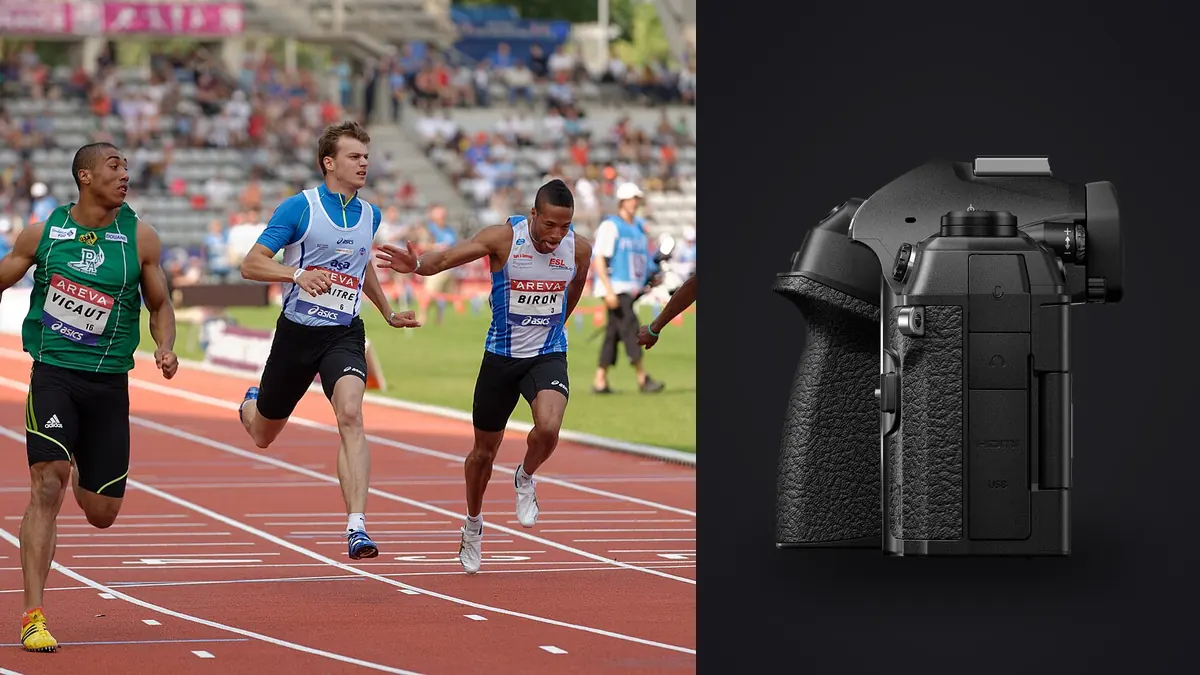
I picked up the OM-1 Mark II mostly out of curiosity about whether OM System had actually fixed the buffer complaints from the original OM-1, and I ended up using it for two full outdoor seasons and one indoor winter circuit before I felt ready to write anything opinionated about it. Track and field is a strange sport to shoot because it isn't one sport at all. A 100m final lasts under ten seconds and rewards absurd frame rates. A pole vault competition can run ninety minutes with maybe four usable jumps. A distance race asks you to track the same runner for laps while paying attention to nobody else. No single camera setting survives contact with all of that, and the OM-1 Mark II handles some of these disciplines much better than others.
This isn't a spec sheet regurgitation. I want to walk through what actually changes when you bring a Micro Four Thirds body to a track meet instead of a full-frame system, because the honest answer is "it depends on the event," and most reviews don't bother splitting it out that way.
The Crop Sensor Argument Actually Holds Up Here
Track and field is one of the few sports where the 2x crop factor of Micro Four Thirds works entirely in your favor. You are almost never close to the action. Sprinters are on the far side of the track, throwers are behind a cage, jumpers are down a runway you can't walk onto during competition. Reach matters more than anything else on the spec sheet.
Pair the OM-1 Mark II with the 150-400mm f4.5 PRO and you're carrying the field-of-view equivalent of a 300-800mm lens at f4.5 for a body-and-lens combination that still weighs under 2.5kg with the hood on. A Nikon Z 400mm f4.5 alone is heavier than that, and it doesn't get you anywhere near 800mm without stacking a teleconverter and losing stops. The built-in 1.25x teleconverter on the 150-400mm pushes it to an effective 375-1000mm equivalent range at f5.6, which for high jump or pole vault shot from the stands is genuinely useful rather than a marketing number nobody uses. If your budget doesn't stretch to that lens, the 100-400mm f5-6.3 IS II gets you 200-800mm equivalent for a fraction of the price and weight, and it's the lens I'd actually recommend to someone shooting their first few meets before committing to the bigger glass.
Autofocus for People Is Good, Not Magic
OM System built its AI subject detection reputation on birds, cars, trains and planes, and the marketing still leans hard on those categories. Human detection is in there too, and it works, but it isn't the same tool. It finds a torso and head reliably enough on an isolated runner in clean space, and it will grab an eye when the subject is close and unobstructed. Where it struggles is exactly where track and field struggles generally: crowded scenes. A relay handoff with four bodies overlapping, a false-start recall with an official jogging into frame, a finish line packed with six lanes closing at once. In those situations I stopped trusting subject detection and went back to a single small AF target that I steer myself, because the camera would occasionally lock onto the nearer, larger, wrong athlete instead of the one I actually wanted. For anything happening in open space (a lone sprinter coming down the home straight, a vaulter clearing the bar with nobody else near the pit) human detection does its job and frees you up to think about framing instead of focus point placement. Just don't expect it to read your intent about which of eight runners matters to you.
Frame Rates and Pro Capture Change How You Shoot Field Events
The headline spec is 120fps at SH2, but that mode locks focus and exposure on the first frame of the burst, which makes it close to useless for anything with real subject movement toward or away from you. What I actually use is SH1, continuous AF and AE at up to 50fps, which is still an enormous number for a working photographer and genuinely enough to isolate the exact instant a discus leaves a thrower's hand or a baton crosses between two runners' palms. Pro Capture is the feature that changed how I shoot field events specifically. It buffers up to 99 frames before you fully press the shutter, so as long as your half-press is active when the bar-clearing attempt happens, you get frames from before your reaction time kicked in. Pole vault and high jump are events where the "moment" is genuinely unpredictable (the bar can wobble and stay up, or fall on a graze you didn't see coming) and Pro Capture has saved me from missing the actual clearance more times than I can count. It's less necessary for sprints, where the moment is the finish line and you know exactly when it's coming. The tradeoff is buffer depth and card speed. OM System widened the buffer significantly over the original OM-1, and I can get well past 150 raw frames in a sustained SH2 burst on a fast CFexpress card before it chokes, but a track meet with back-to-back field events and no downtime will still fill a card faster than you expect if you're leaving Pro Capture armed the whole afternoon.
| Event | Effective focal length (2x equiv.) | Drive mode | Shutter floor | AF notes |
|---|---|---|---|---|
| 100m / 200m sprint | 300-500mm | SH1, 50fps | 1/2000s | Single AF target, track the lead runner into the lane, ignore subject detection in a packed field |
| 4x100 / 4x400 relay handoff | 200-400mm | SH1, 50fps + Pro Capture | 1/2000s | Manual target on the incoming hand; detection loses the plot with two bodies overlapping |
| Long / triple jump | 300-600mm | SH1, 25-50fps | 1/1600s | Pre-focus on the board, C-AF picks up motion on approach |
| High jump / pole vault | 400-800mm | Pro Capture SH1 | 1/1600s | Half-press early, let Pro Capture backfill the clearance moment |
| Shot put / discus / hammer | 300-500mm | SH1, 25fps + Pro Capture | 1/2000s | Human detection works well here, subject is isolated in the cage |
| Distance (1500m-10000m) | 200-400mm | Single or Low SH | 1/1000s | C-AF with a wider target, subject won't be near peak speed most laps |
Indoor Meets Are Where the Sensor Size Argues Back
Everything above assumes daylight or reasonable stadium lighting. Take the same body into a February fieldhouse with mixed sodium and fluorescent fixtures overhead and the conversation changes. This is the one area where I'd tell a full-frame shooter not to switch systems on my recommendation alone. The 20.4MP stacked sensor is genuinely good for a Micro Four Thirds chip, but it starts showing noticeable noise in the shadows past ISO 3200, and by ISO 6400 you're doing real work in post to keep detail in dark tracksuits and bib numbers. I've shot entire indoor meets at ISO 5000-8000 because a 200m banked indoor track leaves you no shutter speed margin to spare, and the files are usable, just not clean the way a full-frame body at the same ISO would be. If your local circuit is mostly indoor winter meets in old high school fieldhouses, factor that in before you commit to this system for the reach advantage alone.
Weather Sealing Actually Gets Used at Outdoor Meets
Track meets don't get cancelled for drizzle, and I've shot finals in genuinely unpleasant sideways rain more than once. The OM-1 Mark II carries an IP53 rating, which OM System has been fairly aggressive about testing and publicizing compared to most competitors who just say "weather resistant" without a number attached. I've had it soaked through a full afternoon session with the 150-400mm and never had a moment of concern, which is more than I can say for a couple of full-frame bodies I've used previously that developed intermittent button issues after similar treatment. It's a small thing until the one meet a season where it genuinely rains for three hours straight and you're glad you didn't have to pack it away.
Where the Real Time Sink Shows Up
None of the camera talk matters much if you can't get through the take afterward. A single afternoon of SH1 bursts across six or seven events routinely leaves me with four to six thousand frames, and the overwhelming majority of any given burst is redundant: the same runner's stride captured eight times a second, the same vault attempt with the bar in nearly the same position for a dozen frames in a row. Culling that by eye, frame by frame, is where most of an evening actually goes if you let it. This is the part of the workflow where I stopped trying to do everything manually. I run the take through imagic before I open anything in an editor, since it scores focus and sharpness locally on the files themselves rather than relying on the in-camera focus confirmation, which isn't always trustworthy at 50fps with a moving subject. It also clusters the burst sequences automatically, so instead of scrolling through forty nearly identical frames of a discus release I'm looking at the handful the software flagged as sharpest within each cluster. Because it runs entirely offline on the machine, I'm not uploading a meet's worth of images (some of which include minors) to anyone's cloud service just to get a sharpness pass done, which matters more with youth track meets than with most other assignments I shoot. Once the culling pass narrows a few thousand frames down to a couple hundred worth grading, I lean on imagic's apply_my_style preset, which was trained on my own previously edited work rather than a generic sports preset, so the color and contrast treatment it applies actually looks like what I'd do by hand for a track meet edit rather than a stock look built for something else. If you want more detail on how the underlying focus scoring works rather than just my summary of it, we've written about that separately in how AI photo culling actually works, and if the sports-shooting bottleneck for you is more about the full day's workflow than culling specifically, our faster workflow guide covers the rest of the pipeline from card to delivery.
Battery and Card Realities Nobody Puts on the Spec Sheet
A full day of high-speed bursts and Pro Capture standing by drains the BLX-1 battery faster than the official rating suggests, especially in cold weather at an outdoor winter meet. I carry three batteries for a full day of finals and never regret it. Card-wise, if you plan to actually use Pro Capture and SH2 the way they're designed to be used, a slow SD card will bottleneck the buffer clearing between bursts and you'll find yourself waiting mid-event. A fast CFexpress Type B card in the primary slot removes that problem entirely and is worth the cost if this is a body you're using for sports regularly rather than occasionally.
Frequently Asked Questions
Is the OM-1 Mark II fast enough to freeze sprinters at full stride?
Yes, at typical outdoor shutter speeds of 1/2000s or faster the sensor readout and 50fps continuous AF drive rate are more than adequate for freezing sprint action, including individual spikes contacting the track. The limitation isn't camera speed, it's your own reaction time and framing decisions once the pack starts to separate.
Do I need the 150-400mm PRO lens or will a smaller telephoto work for track and field?
The 100-400mm f5-6.3 IS II covers most track events adequately, especially sprints, jumps and throws from typical spectator or credentialed sideline positions. The 150-400mm earns its price mainly on distant field events shot from the far side of a stadium, or when you need the extra stop of light for late-afternoon or indoor sessions.
How does the OM-1 Mark II compare to a full-frame body for indoor track meets specifically?
Full-frame bodies generally hold an advantage in dim fieldhouse lighting because of larger photosites gathering more light per pixel, which shows up as cleaner files at the ISO 5000+ range many indoor meets require. The OM-1 Mark II remains usable there, but expect to do more noise management in post than you would with a larger sensor.
Can subject detection track a single runner in a crowded finish?
Not reliably. Human detection on this body works best on isolated subjects with clear space around them. In a tight finish across multiple lanes I switch to a single manually placed AF target rather than trusting the camera to guess which runner I care about.