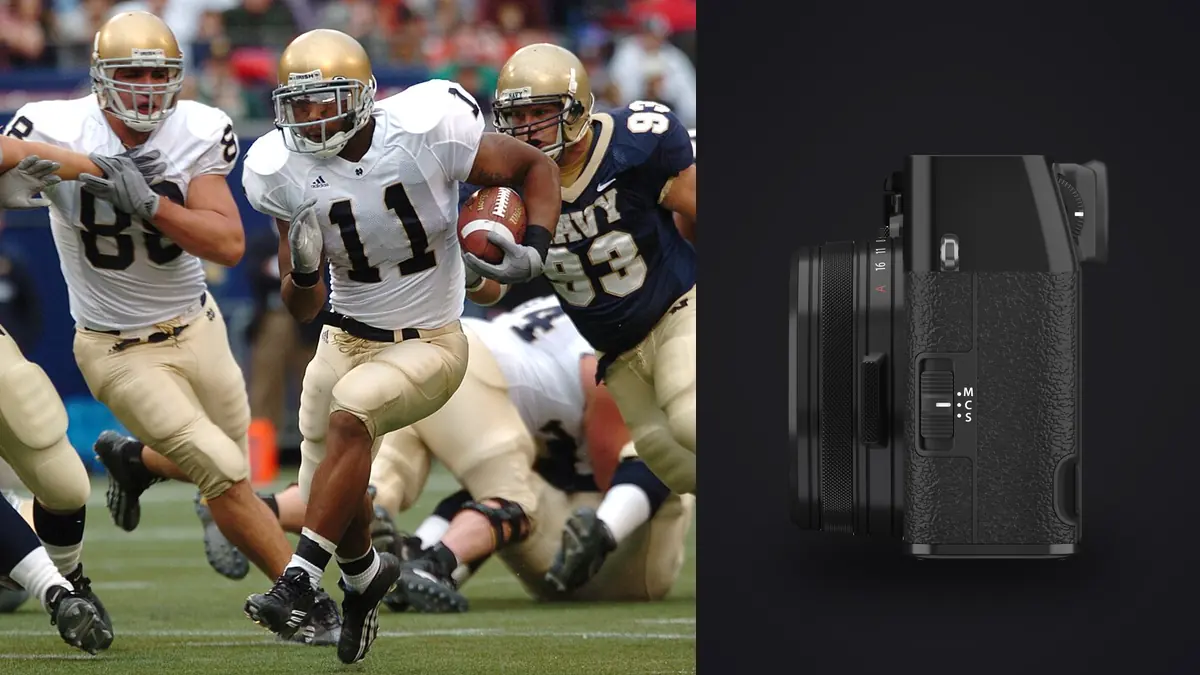
I brought the X100VI to a regional track meet on a whim last spring, mostly because I didn't want to carry a second bag with a 70-200 body into the stands. What I came away with wasn't a case for replacing a telephoto rig. It was a much narrower, more useful answer: this camera is genuinely good for a specific slice of track and field work, and mediocre to useless for the rest of it. Anyone telling you a fixed 23mm f/2 lens camera "handles sports just fine" either shot from the infield with press credentials or hasn't tried to fill the frame with a sprinter forty meters out.
This isn't a knock on the camera. The X100VI is one of the best walk-around cameras Fujifilm has ever built, and the 40-megapixel X-Trans 5 HR sensor resolves an absurd amount of detail for something this size. But "sports and track action" covers a lot of physical distances, and a fixed 35mm-equivalent lens only covers one of them well.
What You're Actually Working With
The relevant specs, stripped of marketing language: 23mm f/2 lens (35mm full-frame equivalent), the same 40MP APS-C X-Trans 5 HR sensor found in the X-T5 and X-H2, in-body stabilization rated to 6 stops (new to this generation, absent on the X100V), a leaf shutter that tops out at 1/4000s mechanically but reaches 1/180000s electronically, and a built-in 4-stop ND filter. Autofocus runs the same subject-detection algorithm as Fujifilm's higher-end bodies, with human, animal, and vehicle detection modes, though notably no dedicated "athlete" or general-motion tracking mode the way some sports-oriented systems phrase it.
None of that is a sports spec sheet. There's no interchangeable lens, so you can't reach for a longer lens when a race moves away from you. Buffer depth is respectable but not deep: shooting compressed raw plus JPEG, I got roughly 20 to 25 frames before the buffer started to choke the burst rate, which is fine for a 100m final but not for a mile watched from one spot.
Where the Fixed Lens Actually Earns Its Keep
The Home Straight, If You're Close
A 35mm equivalent field of view sounds hopeless for sprints until you remember how track meets are actually laid out. If you can get infield access, or a spot right at the rail near the finish, 35mm at close range gives you the runner's full body plus lane markings, other competitors, and the crowd behind them in one frame. It reads as reportage rather than a cropped highlight. I got some of my favorite frames of the whole day standing about eight meters back from the finish line, low, letting sprinters run almost into the lens. That's a shot a long telephoto simply can't make; the compression flattens the scene instead of putting you inside it.
Field Events, Not Track Events
Long jump, triple jump, and pole vault runways put you within 5 to 15 meters of the action if officials let you stand at the pit or the bar. At that distance, 35mm equivalent covers the athlete's full extension and the landing pit in a single frame without a crop. Shot put and discus are trickier since the throwing circle keeps spectators further back, and that's where the lens starts to feel genuinely limiting.
Relay Handoffs and Warmups
Exchange zones are chaotic and close, which suits a wide-ish prime. I found the handoff zone to be the single most reliable spot on the whole oval for this camera. Warmup areas and the moments before athletes step into the blocks are the other underrated use case: nobody's moving fast, the AF has time to lock, and the lens's rendering (that Fujifilm color science people go on about) actually gets to matter, instead of being an afterthought behind a missed focus point.
Where It Struggles
Anything happening on the back straight, in a middle-distance race where the field spreads out around a full 400m oval, or during a long jump watched from the stands rather than the runway, is where the fixed lens becomes the limiting factor rather than the autofocus or the buffer. You end up with athletes as small, sharply focused specks in a frame that's mostly track and sky. Cropping in post recovers some of it thanks to the 40MP sensor (a crop to roughly a third of the frame still leaves you around 13-14 effective megapixels), usable but noticeably softer than a native telephoto frame.
Rolling shutter is the other real issue. Fujifilm's sensor on this generation is quick, but pan hard across a sprinter at speed using the fully electronic shutter and you'll see the skew: verticals lean, wheels on bikes or discs in flight distort slightly. Sticking to the mechanical shutter avoids it entirely but caps you at 1/4000s and a slower burst rate, which is a real trade-off during a 100m final shot wide open.
The Digital Teleconverter, Honestly Assessed
The X100VI includes a digital teleconverter that simulates 50mm and 70mm equivalent framing by cropping and upsampling. It's better than nothing, and for web use or a printed program it's genuinely fine. But it's not a substitute for actual reach. At the 70mm equivalent setting you're working with a meaningfully smaller crop of the sensor before any interpolation, and the difference shows up immediately in fine detail like grass texture or the weave of a jersey. I use it for framing decisions in the moment (deciding whether to move closer rather than trusting the crop to save a shot) more than as a final output setting.
| Scenario | Effective distance | Best focal length setting | Shutter | Realistic keeper rate |
|---|---|---|---|---|
| 100m/200m finish, trackside | 5-10m | 23mm native | Mechanical, 1/2000-1/4000 | High |
| 400m/800m, back straight view | 40m+ | 70mm digital tele | Mechanical, 1/2000 | Low |
| Long jump / triple jump runway | 5-15m | 23mm or 50mm digital tele | Mechanical, 1/2000 | High |
| Shot put / discus circle | 20-30m | 70mm digital tele | Mechanical, 1/1600 | Medium-low |
| Relay exchange zone | 3-8m | 23mm native | Mechanical, 1/2000 | High |
| Warmup / blocks / pre-race | 2-6m | 23mm native | Mechanical, 1/500-1/1000 | High |
That table reflects one camera body, one lens, and my own positioning choices at three different meets this season, not a lab test. Your mileage will shift with how much infield access you're granted, which varies wildly between a school meet and anything with a credentialing process.
The Part Nobody Mentions: What Happens After
A day at the track with continuous autofocus and a 40MP file size means you come home with an absurd number of frames, most of them near-duplicates of the same three seconds of a race. I shot roughly 1,400 frames at one meet and kept 61. That ratio is normal for burst-heavy sports shooting, but it's also where a fixed-lens camera's honest limitations become a sorting problem rather than a lens problem: when three consecutive frames all look sharp at a glance, figuring out which one has the sharpest eyes and the cleanest limb position is tedious work by eye.
This is the part of the workflow I actually changed after that first meet. I run the day's card through imagic before I look at anything in Lightroom. It scores focus and sharpness locally on the files themselves (see how AI photo culling actually works if you want the mechanics) rather than relying on the in-camera focus point, which matters here because a lot of these frames are borderline: the subject-detection AF nailed the general area but the actual sharpest plane might be half a frame off from where I thought. It also clusters the burst sequences so the sprint finish or the handoff shows up as one group instead of ninety separate thumbnails to click through one at a time. Since it runs entirely on the machine, none of the meet photos, which usually include a good number of other people's kids, ever leave my laptop to get scored.
For the edit itself, I built an apply_my_style preset in imagic from a set of track photos I'd already graded the way I like them (slightly warm, contrast pulled up a touch, skin tones left alone). Running a fresh batch through that preset gets me most of the way to a consistent look across a meet without redoing the same color decisions sixty times over. It's not a replacement for actually looking at the images, but it removes the repetitive part of the job, which is the part covered in more general terms in this rundown on faster photo workflow.
What I'd Actually Tell Someone Considering This
If you're covering a meet where you'll have infield or near-track access, and you're mainly after finish-line drama, handoffs, and the human moments around the event rather than a full record of every heat from the stands, the X100VI is a legitimately good tool, arguably better than a telephoto zoom for the kind of close, contextual frame it produces. If you're stuck in general admission seating watching a 1500m from one fixed point on the backstretch, bring something with reach instead, or accept that most of your usable frames will come from the moments the field bunches up near you.
I still bring it to every meet. I just don't pretend it's covering the whole event by itself anymore.
Frequently Asked Questions
Is the X100VI's autofocus fast enough for sprint finishes?
Close-range, yes. Subject detection locks onto a runner reliably inside about 10-15 meters, and the phase-detect system keeps up with a sprint at that distance without much hunting. The problem isn't AF speed, it's that focal length limits how much of the frame the athlete actually fills once they're further away.
Can I use the digital teleconverter for actual sports coverage, or is it just for framing?
It's usable for web galleries, social posts, and printed meet programs where output size is modest. For large prints or anything you'd want to crop further in post, the resolution loss from the 70mm equivalent crop becomes noticeable, especially in anything with fine texture like grass or track surface.
How many usable frames should I expect from a full day at a track meet?
In my experience, somewhere between 3 and 6 percent of total frames shot end up as genuine keepers, and that's shooting fairly selectively rather than holding the shutter down constantly. A tool that clusters bursts and flags the sharpest frame in each group, which is the basic job imagic does, turns that sorting task from an evening into about twenty minutes.
Should I bring a second body with a telephoto lens instead?
If you have access to one and the budget for it, yes, for anything happening more than about 20 meters away. The X100VI isn't trying to be that camera. Where it genuinely outperforms a telephoto setup is close-range, high-context moments: handoffs, starting blocks, athletes reacting immediately after a race, where a wider field of view and a fast, quiet leaf shutter actually help rather than hurt.