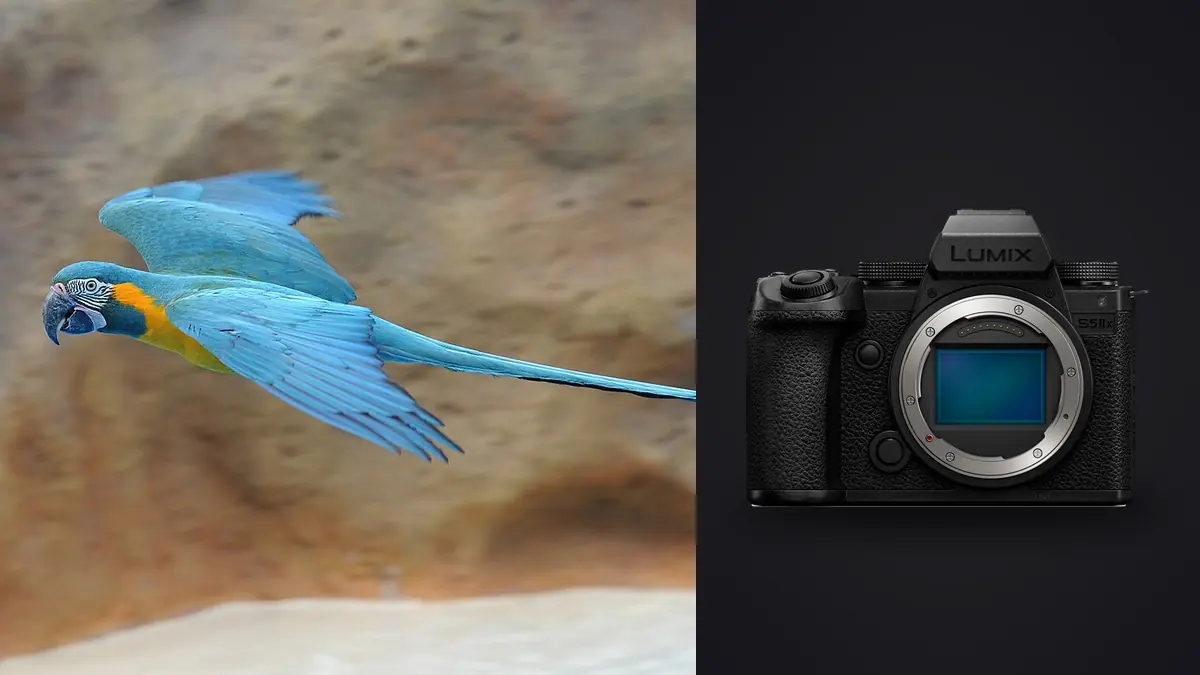
I spent four mornings in a row at a tidal estuary this spring trying to get clean panning shots of oystercatchers lifting off a mudflat, and the Panasonic Lumix S5IIx was the body doing the work. That's a reasonable test for a camera that, on paper, was built as much for video shooters as for stills photographers. The S5IIx shares its sensor and its autofocus core with the standard S5II. What it adds on top is a cooling fan, a CFexpress card slot, ProRes recording options, and a handful of hybrid-shooter conveniences. None of that is why a birder would buy one. What actually matters for birds in flight is whether the autofocus can find and hold a moving, mostly monochrome wader against flat grey sky, and whether the buffer survives a real burst without the camera stalling out for four seconds while a heron does the interesting part of its takeoff. Here's what happened when I pointed it at moving birds instead of B-roll.
The autofocus change that actually matters here
For years, the biggest knock against Panasonic's full-frame line for wildlife was the autofocus system itself. The older S1 and S5 bodies relied entirely on Depth From Defocus, a contrast-based method that estimates focus by comparing two slightly different lens positions rather than reading phase information directly off the sensor. It worked fine for portraits and landscapes. For a bird crossing the frame against a busy background, it pulsed and hunted in a way that made confident tracking difficult, and every wildlife photographer who tried a first-generation Panasonic full-frame body for birds has a story about missed sequences because of it.
The S5IIx doesn't have that problem, because it doesn't use that system. Panasonic put a phase-hybrid AF array across nearly the whole sensor, roughly 779 detection points by their own count, and it's the same core used in the S5II and the S1II. This was Panasonic's first real phase-detect implementation in a full-frame body, and it shows immediately once you're tracking something that changes direction. A gull banking into a headwind used to be the kind of subject that broke DFD-based tracking. On the S5IIx it mostly just stays locked, with the occasional stumble when the bird crosses in front of a cluttered background like reeds or a pier structure. That's a genuinely different camera to shoot birds with than its predecessors, and it's the single biggest reason this body belongs in a wildlife conversation at all.
Burst speed and what your buffer actually gives you
Headline burst numbers are where marketing and field reality tend to diverge, so it's worth breaking the S5IIx's shooting modes down by what they're actually good for rather than the number on the spec sheet.
| Shooting mode | Shutter type | Focus behavior | Where it's actually useful for BIF |
|---|---|---|---|
| Continuous H (mechanical) | Mechanical, up to 9 fps | Full AF/AE tracking every frame | My default for any bird that might change direction mid-sequence |
| SH30 high-speed burst | Electronic, up to 30 fps | Focus and exposure locked from the first frame | Freezing the exact instant of takeoff or a wing at full extension, useless if the bird turns |
| High-speed electronic with AFC | Electronic | Full AF/AE tracking, noticeably slower than the SH30 headline rate | A middle ground when I want more frames than 9 fps but still need the camera thinking |
| Pre-burst capture | Electronic, buffers before the shutter press | Locked to the pre-press moment | Catching the launch itself, since your reaction time is always slightly behind a bird's |
In practice, Continuous H with AF tracking is where I leave the camera parked for anything I actually intend to keep. The buffer, paired with a CFexpress Type B card in the S5IIx's dedicated slot, doesn't run out before I do. On a standard SD UHS-II card the story changes: buffer clearing slows noticeably during long bursts of RAW files, and you can watch the frame rate sag if you hold the shutter down through an entire flight sequence. If you're serious about birds in flight and buying this specific body, budget for a fast CFexpress card. Treating it like an SD-only camera undersells the one hardware difference that actually matters for burst-heavy shooting.
Rolling shutter is the tradeoff nobody mentions in the spec sheet
The 30 fps electronic mode is tempting, and I used it a handful of times to nail a single frame of a heron's wing at full downstroke. But electronic shutter on this sensor reads out line by line, and fast wingbeats against a bright sky will show it: straight wingtips can come out with a visible skew, and pans across a moving background occasionally show mild jello distortion. It's not dramatic, and most of the time you'd only notice at 100% crop, but I stopped using electronic shutter as my default for flight sequences and moved back to mechanical for anything where wing shape actually matters in the final frame. Save the electronic burst for the moments where you specifically want the frozen instant and don't care about micro-distortion in the wing edges.
Lens choices in the L-mount system
This is the part of the S5IIx story that has nothing to do with the camera body and everything to do with the mount it's attached to. L-mount's telephoto lineup has grown, but it's still thinner than what Sony or Canon shooters can pick from, and if you're coming from another system this is worth knowing before you commit.
| Lens | Approx. weight | Max aperture at long end | Field note |
|---|---|---|---|
| Panasonic Lumix S 100-400mm f/4-6.3 | ~985g | f/6.3 | The one I hand-hold most often, good balance for all-day panning |
| Leica Vario-Elmar-SL 100-400mm | ~1140g | f/6.3 | Optically close to the Panasonic, premium build and price to match |
| Sigma 60-600mm DG DN Sports | ~2470g | f/6.3 | Real reach without a teleconverter, but you'll want a monopod after an hour |
I've shot the Panasonic 100-400 the most because it's light enough to hand-hold through a full morning of walking a shoreline, and paired with the S5IIx's IBIS it's steady enough for slow panning shots even below 1/500. The tradeoff is reach: 400mm on full frame is on the short side for small or distant birds, and I've reached for a 1.4x teleconverter more than I'd like, which costs a stop of light the sensor can't really spare in early morning shade. The Sigma 60-600 solves the reach problem but turns the kit into a two-handed, monopod-friendly setup rather than a walk-around one. There's no native 500mm or 600mm prime in L-mount the way Nikon and Canon shooters have, so accept early on that you're choosing between a compact zoom with limited reach or a heavier zoom that covers more ground, and there isn't a lighter third option waiting in the wings.
How well subject recognition tracks actual birds
Panasonic's subject recognition, set to Animal mode, does a genuinely good job on perched birds with a clear head silhouette against sky or water. It found and held eye detection on a kestrel sitting on a fence post from further away than I expected, and it kept a box on a heron's head through a slow stalking walk without me touching the AF joystick. Where it gets less reliable is exactly the situation that defines bird-in-flight work: a small, fast subject against a busy or textured background, or two birds crossing paths where the camera has to decide which one you meant. In a mixed flock of terns wheeling over water, I lost tracking more than once when the box jumped to the nearest bird rather than staying locked on the one I'd originally selected. It's a meaningfully better system than anything Panasonic has shipped before, but I wouldn't call it as sticky as I've heard from shooters using the top competing systems on genuinely erratic small birds like swifts or swallows. For raptors, waders, and anything with a slower, more predictable flight path, it's dependable enough to trust.
Handling a long lens on a body this size
The S5IIx is a mid-size body, and with a 400mm zoom mounted it front-heavies quickly. The grip is deep enough to be comfortable, but I found myself supporting the lens with my left hand almost constantly rather than letting the mount take the weight, which is normal practice with any long glass but worth mentioning if you're coming from a smaller kit. Battery life held up better than I expected across a three-hour morning session with a lot of continuous AF and screen use for review, though I still carry a spare for full-day trips, as anyone shooting bursts all day should. The body survived a light drizzle at the estuary without any issue, and the weather sealing felt genuinely usable rather than a checkbox spec, but I haven't tested it in sustained heavy rain and wouldn't push it there without a rain cover.
Where imagic fits into a wildlife workflow
A single good morning of bird-in-flight shooting on this camera can produce several thousand frames once you count every burst, and most of them are near-duplicates of the same three or four seconds of a wing beat. Sorting that by eye is where a lot of the actual time in wildlife photography goes, more than the shooting itself most days. I run my culls through imagic afterward specifically because it does its sharpness and focus scoring locally on the machine rather than uploading a card full of RAW files somewhere, which matters when you're working from a laptop at a remote site with no real internet connection. It also clusters burst sequences and near-duplicate frames together automatically, so instead of scrolling through forty frames of the same takeoff, I'm looking at the handful of genuinely distinct moments with the sharpest one already flagged. That process lines up well with the workflow habits covered in our piece on how AI photo culling actually works, and if you shoot a lot of burst-heavy wildlife sessions it's worth reading alongside our general notes on speeding up a photo workflow. Once the selects are picked, I lean on imagic's apply_my_style feature, which trains on my own past edits rather than a generic preset, to get consistent color and contrast across a big batch of feather detail shots without redoing the same grading decisions fifty times over.
Frequently Asked Questions
Does the S5IIx autofocus keep up with fast fliers like swifts or terns?
It's usable but not the strongest performer in that specific category. Slower, larger, more predictable fliers like herons, raptors, and gulls track reliably. Erratic small birds moving at speed against a busy background are where I still lose the occasional sequence, more often than with the top dedicated wildlife systems on the market.
Should I shoot birds in flight with the electronic shutter to get 30 fps?
Only when you specifically want a single frozen instant and don't care about fine wing-edge distortion. For sequences where wing shape and clean edges matter, mechanical shutter at 9 fps with full AF tracking gave me more usable keepers overall than the higher electronic frame rate did.
What's a realistic minimum lens for serious birding with this body?
400mm is workable for waders, raptors on perches, and larger birds at moderate distance, but it's short for small or distant songbirds. If your subjects are consistently far away, plan on a 500mm-equivalent reach through either a teleconverter or a longer zoom like the Sigma 60-600, and accept the weight and light loss that comes with it.
Is the S5IIx worth paying more for over the standard S5II specifically for wildlife?
Honestly, mostly no. The sensor and autofocus system that actually drive bird-in-flight performance are identical between the two bodies. The S5IIx's extra cost buys the cooling fan, CFexpress slot, and video-oriented recording features, which matter enormously if you also shoot video professionally but do very little for a stills-only wildlife shooter. If birds are the only reason you're buying, the standard S5II gets you the same autofocus for less money.