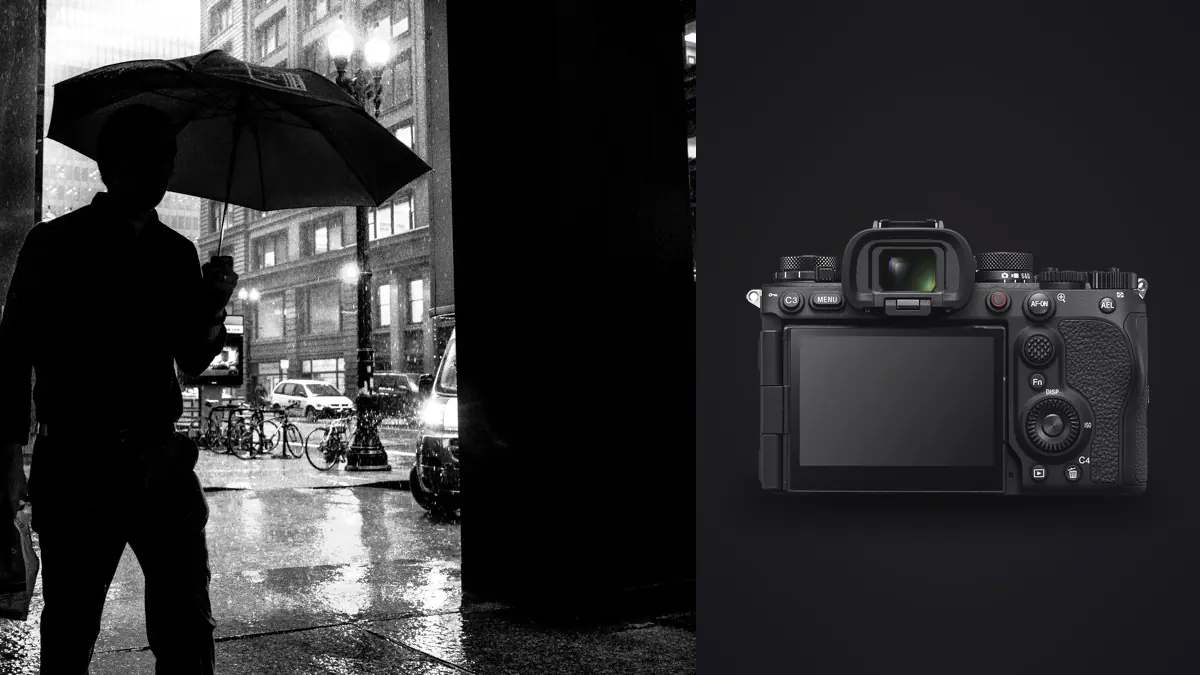
I picked up the Sony A9 III expecting to use it the way Sony built it: fast sports and wildlife work, a mechanical shutter finally removed from the equation, buffers deep enough for a whole football match. What I didn't expect was how much the global shutter sensor would change a completely different kind of shooting, the slower, more improvised world of street and documentary work, where the subject isn't a diving goalkeeper but a woman crossing against the light, or a market stall lit by one bare bulb and three flickering fluorescent tubes overhead.
This isn't a spec dump. I've shot the A9 III on three documentary trips now (a fishing town on the Portuguese coast, a week following a community kitchen in Manchester, and a few long nights around Naples) and I want to talk about what actually changes for this kind of work, what doesn't, and where the camera's sports-camera DNA gets in the way of a street shooter's habits.
The one change that actually matters: no rolling shutter, anywhere, ever
Every camera I'd used before this one, including the A9 II, reads its sensor line by line. At fast shutter speeds, a subject moving quickly through frame gets skewed: cyclists lean forward, car wheels turn into ellipses, a kid sprinting past a market stall looks like he's been stretched sideways. It's subtle enough that you don't notice it until you're looking at the RAW at 100% back at the hotel, and by then the moment is gone.
The A9 III's sensor reads every pixel at the same instant. There's no skew to correct in post because there's nothing to correct. I noticed this first on a panning shot of a moped weaving through Naples traffic at dusk, wheel spokes stayed spokes instead of turning into a smear of diagonal lines. It sounds like a small thing until you've spent years mentally avoiding certain angles and shutter speeds because you know the rolling shutter artifact will ruin the frame.
The second, less advertised benefit is banding. Sodium vapor streetlights, cheap LED shop signage, and flickering fluorescent tubes all pulse faster than the eye can see, but a rolling shutter sensor reads different parts of that pulse cycle across the frame, which shows up as horizontal bands of alternating brightness or color cast. I shoot a lot of night market and late-shift documentary work, and banding under mixed artificial light has cost me more usable frames over the years than almost anything else. With a global shutter, every pixel samples the same instant of that flicker cycle, so the banding simply doesn't happen, no anti-flicker mode needed, no shutter speed compromise to dodge it.
Flash sync is the third piece. Because there's no curtain and no rolling readout, the A9 III syncs flash at any shutter speed up to 1/80,000s. For documentary portraiture where you're using a speedlight to fill a subject against a bright doorway or a market awning, that means you can freeze ambient motion and control flash exposure independently, without hunting for a compatible shutter speed or switching into a high-speed sync mode that eats two stops of flash power.
The ISO trade-off nobody puts on the box
Global shutter sensors need extra circuitry at every pixel to hold and read the charge simultaneously, and that circuitry costs some light-gathering area. Sony's answer was a base native ISO of 250, compared to ISO 100 on the A9 II, the A7 IV, or basically every other full-frame body on the market. There's no expanded ISO 100 option either. Floor is floor.
In daylight this is a non-issue, you're rarely shooting street work at base ISO anyway once you factor in shutter speed and aperture choices. Where it shows up is in the kind of dim interior documentary work I do a lot of: community centers with fluorescent overheads, evening markets, kitchens, small churches. Shadows that would sit clean at ISO 100 on my A7 IV carry visibly more chroma noise at ISO 250 on the A9 III once you push exposure in post. It's not dramatic, maybe half a stop worse than I expected walking in, but it's real, and if you shoot a lot of underexposed available-light interiors and pull shadows aggressively, budget for it. I've started carrying an f/1.4 prime on documentary days specifically to claw back the stop I'd otherwise lose to the higher floor.
120fps and the burst problem it creates
The headline spec is 120 frames per second with full autofocus and auto-exposure tracking, in RAW, in a buffer deep enough to run for several seconds before it fills. There's also a pre-capture buffer function that starts recording up to one second before you fully press the shutter, so if you half-press and wait, the camera has already banked the frames leading into your reaction time. For a street shooter working the classic decisive-moment idea, that's a genuinely new tool: you're no longer racing your own reflexes against the gesture, the frame from before you consciously reacted is already sitting in the buffer.
The catch is obvious once you've shot a full day this way: you come home with an absurd number of RAW files. A two-second burst at 120fps is 240 frames of a single gesture, and on a documentary shoot with dozens of these moments across a day, you can end up with four or five thousand images by evening, the overwhelming majority of which are near-duplicates of each other with maybe three or four frames actually holding the peak expression or the cleanest composition.
This is where I lean on imagic rather than scrolling through a folder at 1:1 zoom for two hours. Its duplicate and burst clustering groups those 240 nearly identical frames into a single stack, so I'm reviewing one representative image per burst instead of every frame in it, and its local sharpness and focus scoring flags which frame in that stack is actually the sharpest on the eyes or the hands, since even at 120fps with tracking AF, focus still drifts a little frame to frame on erratic subjects. It runs entirely on the machine, nothing gets uploaded, which matters more than usual on documentary work where some of the people in frame haven't necessarily consented to their faces sitting on someone else's server.
Card capacity and file size matter here too. The A9 III shoots compressed RAW at roughly 25 to 30MB per file and lossless compressed closer to 40MB, uncompressed 14-bit RAW pushes past 50MB. At 120fps that's over a gigabyte of data every second in uncompressed mode. I shoot compressed RAW for documentary work almost exclusively now, not for the quality difference (I can't see one in practice) but because a day of heavy bursts in uncompressed mode will chew through a 160GB CFexpress Type A card before lunch.
How it actually compares for this kind of work
Spec sheets don't tell you much on their own, so here's how the A9 III stacks up against three cameras that regularly come up in street and documentary conversations, on the metrics that actually change how a shoot goes rather than the ones that sell well in a headline.
| Camera | Shutter type | Base ISO | Max burst (AF/AE tracked) | EVF blackout | Body weight | Launch price (body) |
|---|---|---|---|---|---|---|
| Sony A9 III | Global electronic | 250 | 120fps | None, ever | ~702g | $5,999 |
| Sony A7 IV | Mechanical / rolling electronic | 100 | 10fps | During burst | ~658g | $2,499 |
| Fujifilm X100VI | Leaf shutter, fixed lens | 125 | 20fps (1.29x crop) | During burst | ~478g | $1,599 |
| Leica M11 | Mechanical / electronic hybrid | 64 | 4.5fps, manual focus only | N/A (optical rangefinder) | ~640g | $8,995 |
Read that table for what it actually says: the A9 III wins decisively on anything involving unpredictable, fast subject motion and zero-blackout tracking, but it's nearly four times the price of an X100VI and over double an A7 IV, for a genre where most working documentary shooters don't need 120fps at all. The Leica sits at the opposite philosophical pole entirely, no autofocus, no burst rate to speak of, and shooters choose it for reasons that have nothing to do with anything in this table.
Autofocus and the zero-blackout viewfinder
The A9 III inherits the AI-based subject recognition from Sony's current generation, human, animal, bird, and vehicle detection, running across 693 phase-detect points covering close to the full frame. For street portraiture, the eye-detect tracking locks onto a face in a crowd and holds it through occlusion (someone walking between you and the subject, a bus passing) better than any Sony body I've used before it, including the A7R V.
What matters more day to day, though, is that the electronic viewfinder never blacks out, not during a single frame, not during a burst. On a rolling-shutter body, the viewfinder flickers or freezes for a fraction of a second with every shot, which is enough to lose the thread of a fast, unpredictable scene, someone gesturing, a fight breaking out, a crowd shifting. On the A9 III you watch continuous, live motion through the finder the entire time you're shooting, which changes how you frame follow-up shots because you're never guessing what happened in the gap.
The trade is that all this tracking intelligence is somewhat wasted on classic zone-focus street shooting, where you're pre-focusing on a spot and waiting for a subject to walk into it rather than tracking anything. If that's most of your street work, you're paying for autofocus sophistication you won't touch.
Building a RAW workflow that doesn't bury you
A camera this fast changes your editing math more than it changes your shooting technique. My rough workflow on a documentary day now looks like: shoot compressed RAW, offload both CFexpress cards at the end of the day, run the folder through imagic's clustering and sharpness scoring to cut the take down from a few thousand frames to a shortlist worth actually looking at, then apply my own trained preset (imagic's apply_my_style feature learns from edits I've already made, so a fresh batch gets my usual contrast curve and color balance applied automatically instead of me redoing it fifty times a night) before I do the final manual pass on the frames that are actually going in the edit. If you're new to building a culling step into your process at all, our explainer on how AI photo culling works covers the mechanics in more depth than I have room for here.
The offline part isn't incidental for documentary work specifically. A lot of what I shoot involves people who are vulnerable in some way, workers, undocumented families, people in the middle of a bad week, and I'm not comfortable routing their faces through a cloud culling service before I've even made an editorial decision about whether a frame is usable. Processing everything locally on the machine, without an upload step, isn't a nice-to-have on this kind of assignment, it's close to a requirement.
If your current process is still "scroll through everything in Bridge and star what looks good," it's worth reading through some faster patterns before you're staring down a five-thousand-frame day; our workflow speed guide has a few habits that pair well with a camera that shoots this fast.
Who this camera actually suits
If your street or documentary work regularly involves fast, unpredictable motion, protests, parades, kids, traffic, sport-adjacent scenes, or if you shoot in mixed artificial lighting at night often enough that banding has cost you real frames, the A9 III solves problems no rolling-shutter camera can solve at any price. If your work is mostly slower and more contemplative, zone-focused, one frame per moment rather than bursts, the ISO 250 floor and the six-thousand-dollar price tag are working against you for capability you won't use. I'd point that shooter toward an A7 IV or, honestly, the X100VI if a fixed 35mm-equivalent lens doesn't bother them.
The other honest caveat is weight and bulk for a body class that markets itself on discretion. At 702 grams body-only, plus a fast prime, the A9 III is not a small, quiet camera to carry around a market or a protest all day the way a Leica or an X100VI is. It's not heavy by pro-body standards, but if part of your street kit's appeal was being unobtrusive, this isn't that camera.
Frequently Asked Questions
Does the A9 III's higher base ISO actually hurt image quality for street work?
In good light, no, you'll rarely be shooting at base ISO anyway once shutter speed and aperture are set for the scene. Where it shows up is dim interiors and underexposed night scenes that you push in post; shadows carry noticeably more chroma noise than on a camera with a native ISO 100 floor. It's a real trade-off for low-light documentary work, not a marketing footnote, but it's not severe enough to rule the camera out on its own.
Is 120fps overkill for street and documentary photography?
For most street shooting, yes, a single frame or a short three-to-five-frame burst covers the moment. Where it earns its keep is fast, chaotic scenes (a crowd surging, a kid mid-jump, a car passing close) where the exact peak is genuinely hard to predict, and the pre-capture buffer that banks frames from before your reaction time. If you shoot mostly slower, composed street work, you'll rarely touch the top end of that burst rate.
Can you trust autofocus for candid portraits while shooting silently?
Yes, and this is one of the camera's real strengths for the genre. Because the shutter is fully electronic with no mechanical option at all, every shot is silent by default, no switch to flip, no risk of the mechanical shutter clunk giving you away mid-frame. Eye and face tracking holds onto a subject through brief occlusion better than Sony's previous generation, which matters when you're working a crowd rather than a posed sitting.
Is the A9 III worth it over an A7 IV for documentary work specifically?
Only if you're regularly shooting fast motion or fighting rolling shutter banding under artificial light on the A7 IV. The A7 IV is cheaper, has a lower ISO floor, and covers the vast majority of documentary and street scenarios perfectly well. The A9 III's premium buys you zero blackout, true global shutter, and burst depth that a slower-paced documentary practice usually doesn't need. Buy it for the shutter, not the frame rate number on the box.