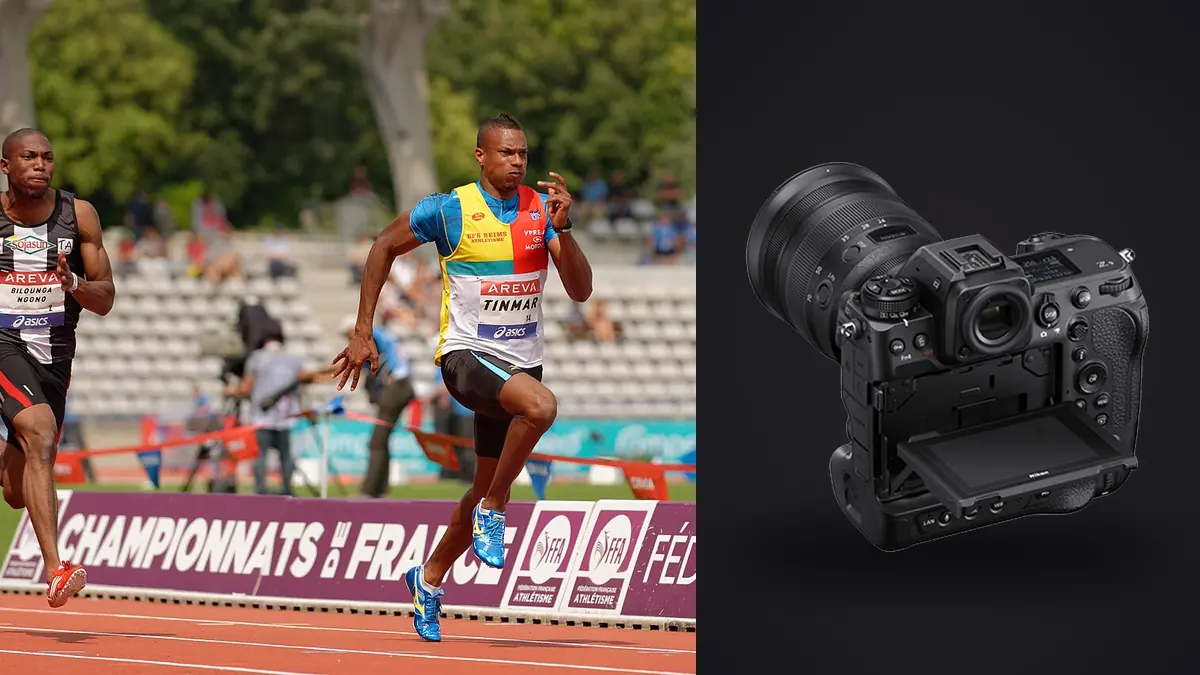
Why the Z9 Changed How I Shoot a Track Meet
I spent four seasons shooting high school and club track with a D850, and the single biggest complaint I had wasn't resolution or autofocus, it was the viewfinder blackout. Every time the mirror flipped for a frame, I lost the runner for a fraction of a second, and at 200m indoor tracks with tight turns that fraction of a second is exactly when a lead changes. The Z9 removed that problem entirely. There's no mechanical shutter to flip, no mirror, no blackout window in the finder. You watch the race the whole time you're shooting it. That single change altered how I frame a 4x100 handoff more than any autofocus upgrade did.
This isn't a spec sheet regurgitation. What follows is what actually matters when you're standing at lane one with a 400mm lens and a meet director yelling that finals start in six minutes: frame rate choices, autofocus behavior with runners at odd angles, how stadium lighting fights you, lens tradeoffs for covering sprints and field events in the same afternoon, and what to do with the thousands of RAW files you'll have by the time the 4x400 relay wraps up.
Frame Rate Isn't One Setting, It's Three Different Tools
The Z9 gives you a genuine choice between three shooting modes that behave like three different cameras, and picking the wrong one for the event in front of you either wastes buffer or costs you the frame that mattered.
Full-Resolution RAW at 20fps
This is my default for anything where I need to pick a single frame to print or sell later, meaning most sprint finals and the takeoff phase of long jump. Full 45.7MP RAW at 20fps blackout-free gives you enough frames per stride cycle to catch the leg extension you want without drowning in near-duplicate files. For a 100m final I'll typically fire from the blocks through the line, which at 20fps over roughly 10-11 seconds is around 200 frames per runner if I hold the trigger the whole way. I don't. I burst in 1-2 second windows at the gun, mid-race, and the lean, which keeps the take manageable.
30fps and 120fps Modes
The higher frame rates trade resolution for certainty. 30fps full-resolution JPEG is useful for relay exchanges where the baton pass window is genuinely under a quarter second and you'd rather have more chances at a clean hand-off than a slightly larger file to crop. The 120fps mode crops to roughly 11MP and only shoots JPEG, which sounds like a compromise until you've tried to nail the exact instant a pole vaulter clears the bar. For that one specific moment, a smaller, faster-cadence JPEG series beats a handful of RAW frames that might straddle the peak instead of landing on it.
Field Events Change the Calculus
Long jump and triple jump reward the RAW mode because the takeoff board is a fixed point, you can pre-focus and time your burst to the plant step. Pole vault and high jump reward the faster crop mode because the peak of the arc happens in a window you can't predict runner to runner, some vaulters hang, some don't. Throws (shot put, discus, javelin) are the one event group where I actually drop back to single-shot or a short 8-10fps burst, the release point is the only frame that matters and a 20fps burst just generates release-plus-nineteen-follow-through frames you'll delete.
Autofocus That Actually Holds a Runner in a Crowded Frame
3D-tracking on the Z9 is noticeably better at track events than it was on the D6/D5 generation of DSLRs I used to rent for this, mostly because subject detection understands a human running toward you at an angle, not just a face looking at the lens. Where it earns its keep is the 4x100 and 4x400 relay exchange zones, where you've got two runners overlapping in the frame for a second and a half. I run Auto-Area AF with people detection on for that specific situation and let the camera pick the lead runner, then I recompose with back-button focus locked once the exchange happens.
For the 100m and 200m sprint lanes, I go the opposite direction and use a single, fairly small AF point (or a small dynamic-area cluster) planted on the lane my subject is in, because with eight runners in frame at the gun, full subject detection will happily jump to whichever athlete is closest to center, which isn't always the one I'm tracking. Wide-area AF is genuinely great for the long jump and triple jump runway, where there's one athlete and open space around them, subject detection locks on early and doesn't wander.
One setting worth checking before finals: AF-C priority and the number of focus points active. I keep the Z9 on a 25-point dynamic cluster for most running events. That's a personal preference built from missing frames with the full 493-point wide area during a windy meet where flags and banners in the background kept pulling detection away from the runner.
Stadium Lighting Will Fight You, Here's the Settings Table
Outdoor afternoon meets are the easy case. Indoor and evening meets under sodium or LED stadium lights are where the Z9's electronic-only shutter can actually introduce banding if you're not using the flicker reduction menu setting, since there's no mechanical shutter to fall back on to dodge the flicker the way older bodies could. Below is what I actually dial in per event type, based on a mix of outdoor afternoon and indoor evening meets over the past two seasons.
| Event Type | Shutter Speed | Aperture | ISO Range | AF Mode |
|---|---|---|---|---|
| 100m / 200m sprints (outdoor day) | 1/2000-1/3200 | f/4-f/5.6 | 100-400 | Dynamic-area, small cluster |
| 400m / 800m (outdoor day) | 1/1600-1/2500 | f/4-f/5.6 | 100-400 | Dynamic-area, small cluster |
| Relay exchange zones | 1/2000+ | f/4-f/4.5 | 200-800 | Auto-area, people detection |
| Long / triple jump takeoff | 1/2000-1/2500 | f/5.6-f/6.3 | 100-500 | Wide-area, subject detection |
| Pole vault clearance | 1/2500-1/3200 | f/4-f/5.6 | 200-800 | Wide-area, 120fps crop mode |
| Shot put / discus / javelin release | 1/1600-1/2000 | f/5.6-f/8 | 100-640 | Single-point, pre-focused |
| Indoor evening meet (any running event) | 1/1000-1/1600 | f/2.8-f/4 | 3200-12800 | Dynamic-area + flicker reduction on |
Indoor evening meets are where I'll actually shoot wide open and push ISO into five-figure territory, because at 1/1000 or slower you start blurring the trailing leg on a sprinter mid-stride, and that's a technical failure, not a stylistic one. The Z9 handles ISO 6400-12800 well enough that grain is a non-issue after a modest noise reduction pass, but I'd rather manage noise than motion blur every time.
Lens Choices for a Full Meet Without Swapping Glass Constantly
A track meet is really three or four different shooting distances happening in the same afternoon, and no single lens covers all of them well. My actual rotation:
The 100-400mm S is what stays on the body for probably 60% of the meet. It covers sprint lanes from a reasonable trackside position, handles relay exchanges, and is light enough to hand-hold for hours without a monopod fighting fatigue. For field events happening on the infield, far side long jump pits especially, I switch to the 200-600mm, which gets me close enough without needing to relocate around the fence line every ten minutes. If I know in advance I'll be shooting a distant javelin runway or a far turn on a 400m oval track, the 800mm PF comes out, it's the one lens in the bag I mount on a monopod rather than hand-holding, purely because holding 800mm steady through a whole event window is a different kind of tired than holding 400mm.
The 400mm f/2.8 TC is the one I'd recommend if you only get to own one long prime for this and shoot indoor meets regularly, because f/2.8 at ISO 6400 under fluorescent-adjacent indoor lighting is a real difference from f/5.6 at the long end of a zoom. It's also heavy enough that a full meet with it hand-held will remind your shoulder about it the next morning.
Buffer, CFexpress Cards, and Not Losing the Meet to a Full Buffer
The Z9 uses dual CFexpress Type B slots, no SD card fallback, which matters for two practical reasons. First, card speed actually determines how fast your buffer clears mid-burst, a slower CFexpress card will visibly throttle you during a long relay burst at 20fps RAW. I run cards rated for sustained write speeds well above the camera's output requirement, and the difference versus a budget CFexpress card shows up specifically in back-to-back bursts, like shooting the gun, then the mid-race pack, then the lean, all within the same 100m final. Second, because there's no SD backup slot, I run the two CFexpress slots in backup (not overflow) mode for anything I can't reshoot, which is basically every finals race at a meet.
Buffer depth on the Z9 in full-resolution RAW is deep enough that I've genuinely never bottomed it out shooting a single race, even bursting through a full 400m. Where I have hit the buffer wall is stacking multiple events back to back without a gap to let it clear, back-to-back field event bursts during a busy meet with overlapping heats can get you there if you're not watching the buffer indicator.
What a Single Meet Actually Does to Your Card, and Your Evening
A full day covering a dual meet, sprints, relays, jumps, and throws, realistically produces somewhere between 2,500 and 4,000 RAW files once you add up every event and every burst. Most of those frames are near-duplicates from the same stride sequence, and maybe 3-5% of them are actually usable, in-focus, well-timed shots worth editing. Sorting that by eye at midnight after a meet is the part of sports photography nobody romanticizes.
This is the part of my workflow where imagic actually earns its place. I dump both CFexpress cards into it and let the local sharpness scoring flag which frames in each sprint burst are actually tack-sharp on the runner's lead leg versus the ones where motion blur crept in at 1/1600, since eight near-identical frames of the same stride can look fine at thumbnail size and only reveal the soft one at full zoom. The duplicate and burst clustering groups each race's burst into a single stack instead of leaving four thousand individual files in one folder, which is the difference between an editing session and a scrolling session. Because it runs entirely on my laptop with no upload step, I can do this sort trackside between events on venue wifi that barely handles email, let alone a cloud sync of a few hundred RAW files.
Once I've got the keepers, I lean on the apply_my_style preset, trained on my own past sports edits, to get a consistent look across a meet shot in three different lighting conditions (afternoon sun, meet-hall fluorescents, evening floodlights) without manually matching white balance and contrast across four hundred selects one by one. If you're new to the culling side of this, how AI photo culling actually works is worth a read before your next meet, and if you're trying to get through a whole weekend of results in one sitting, these workflow tips cover more of the sorting and delivery side than lens choice ever will.
Frequently Asked Questions
Does the Z9's electronic-only shutter cause banding under stadium floodlights?
It can, if you leave the flicker reduction setting off. Since the Z9 has no mechanical shutter option to dodge flicker the old-fashioned way, you need the menu-based flicker reduction active for indoor and evening meets under sodium or older LED fixtures. With it enabled and shutter speed kept above roughly 1/1000, I haven't run into visible banding across two indoor seasons. Outdoor daylight meets don't need it at all.
Is 20fps overkill for a 100m sprint final?
Not overkill, but you don't need to hold the trigger the whole race. I burst in short windows (the gun, mid-race, the lean) rather than one continuous 10-second burst, which keeps the RAW count manageable without missing the moments that actually matter. Holding down the shutter for the full race just multiplies your culling workload for marginal benefit.
What's the realistic lens for someone who can only bring one to a meet?
The 100-400mm S covers sprints, relays, and most field events from a normal trackside position without needing to relocate. It won't get you tight on a far-side javelin runway, but for a single-lens day covering a typical dual meet, it's the one I'd pack if forced to choose.
How many usable photos should I expect to end up with from a full meet?
From a day that generates 2,500-4,000 RAW frames, expect somewhere around 100-200 genuinely deliverable shots once you account for duplicate stride frames, motion blur, and events where nothing dramatic happened. That ratio is normal for high-frame-rate sports shooting, the volume is the tool doing its job, not a sign you're shooting wrong.
Should I shoot RAW or JPEG for field events like pole vault?
RAW for long jump and triple jump, where you're timing a single takeoff frame and want the dynamic range for a print or sale. For pole vault and high jump, where the peak moment is unpredictable and I'm relying on the 120fps crop mode to catch it, JPEG is the only option at that frame rate anyway, and the smaller file size lets the buffer run longer through a full clearance attempt.