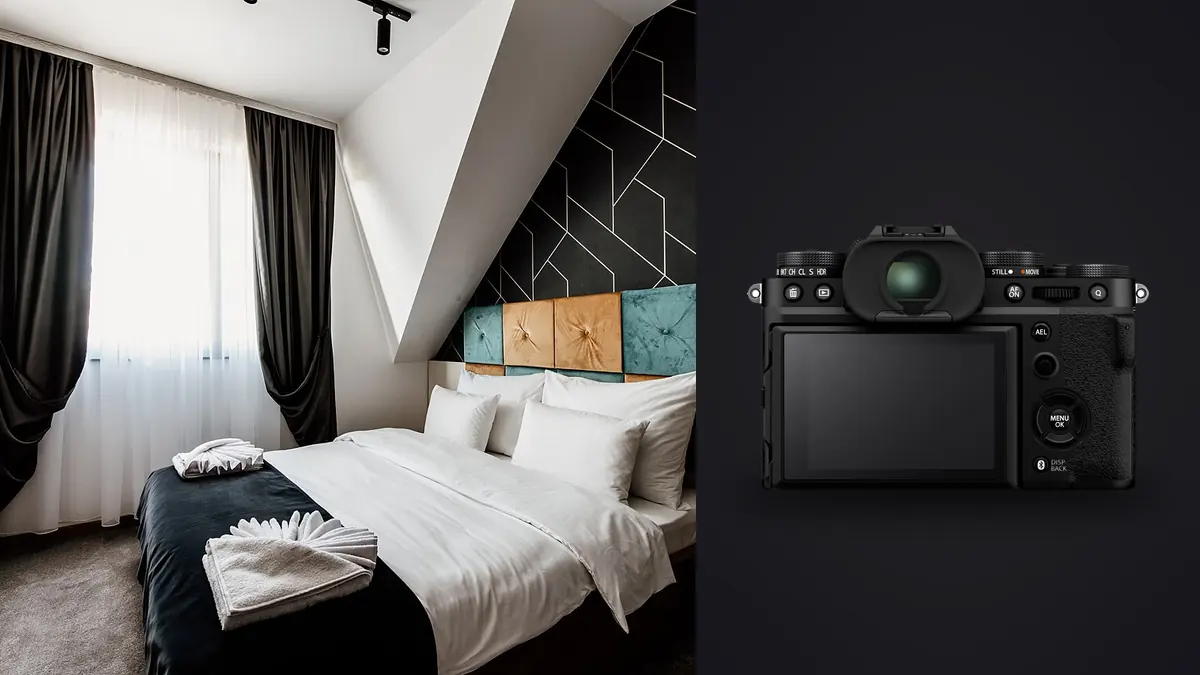
I picked up the X-T5 mostly for travel work, and it took me a full year of boudoir sessions before I admitted it had quietly become my main body for that genre too, ahead of the full-frame kit I used to reach for by default. That's not a marketing line, it's just what happened. The camera solves a set of problems that are specific to shooting in bedrooms, hotel rooms, and small studio suites with a client who is often nervous, half-dressed, and acutely aware of every sound the shutter makes.
Why This Body Keeps Coming Up in Boudoir Circles
Boudoir and intimate portraiture have a set of practical demands that don't line up neatly with how most cameras get marketed. You're rarely shooting in a huge space. You're often working close to the subject, sometimes uncomfortably close for a full-frame 85mm to make sense. The client is not a model who's done forty shoots, so the gear needs to disappear as much as possible, both visually and audibly. And you're almost always working with available light, a single continuous source, or a small speedlight bounced off a wall, not a three-light studio setup.
The X-T5 happens to fit that brief well. Fujifilm pulled the body size back down after the X-T4 had crept up in bulk, so the X-T5 sits in your hands closer to the older X-T3, small enough that it doesn't look like industrial equipment pointed at someone in their underwear. That sounds like a soft consideration until you've watched a first-time client visibly relax because the camera in front of her isn't the size of a shoebox. For broader portrait-genre workflow tips beyond this specific body, see imagic's portrait photography guide.
The Sensor: What 40 Megapixels Actually Buys You Here
The 40.2-megapixel X-Trans CMOS 5 HR sensor is more resolution than most boudoir photographers need for a full-body frame, and I say that as someone who was skeptical of the jump from the 26-megapixel sensor in the X-T3 and X-T4. Where it earns its keep is in the crop. A lot of the best boudoir frames get found after the fact, a hand resting on a collarbone, the curve of a shoulder against window light, a detail that wasn't the composition you shot but is buried inside it. Forty megapixels means you can punch into a third of the frame and still print it, or at minimum still deliver it at full web resolution without visible softness.
The tradeoff is file size and the extra work at culling time. A two-hour session with three or four outfit or lighting changes, shot the way I shoot (short bursts, five to eight frames per pose to catch the subject mid-breath rather than holding a fixed smile), routinely lands me 500 to 700 raw files at 40 megapixels each. That's not a small folder to get through by eye, and it's the first place I'd warn a photographer moving up from a 24-megapixel body: your culling workflow has to scale with the sensor, or you'll spend your evenings squinting at near-identical frames instead of editing. See the Fujifilm X-T5 camera page for the full sensor and body spec sheet.
Dynamic range on this sensor is genuinely good for skin. Recovering a stop or so of highlight on a shoulder blade caught in harsh window light, without the recovery looking grey and flat, is something I couldn't reliably do on older APS-C bodies. Native ISO tops out at 12800 with usable results well past that in a pinch, which matters more than people expect for boudoir, because a lot of the strongest images in this genre come from low, warm, single-source light where you don't want a flash changing the mood of the room.
In-Body Stabilization Changes How You Can Shoot This Genre
The 5-axis in-body stabilization, rated around seven stops depending on the lens, is the feature I'd least want to give up. Boudoir sessions are frequently shot handheld, without a tripod, because you're moving around the subject constantly, kneeling, stepping onto a bed, shifting angle every few frames to chase the light as it moves across skin. A tripod turns that process rigid and kills the intimacy of the session. IBIS lets me shoot at 1/30 or slower handheld with a prime lens and still get a sharp frame more often than not, which means I can lean on ambient light from a single lamp or a window instead of bringing in a flash that would flatten the mood.
It's not magic. A moving subject at 1/30 will still blur if she shifts her weight mid-exposure, and IBIS does nothing for that. But for the photographer's own hand shake in low light, it buys real stops, and in a genre where half the appeal is soft, low, unforced lighting, that matters more than it does for, say, sports or landscape work.
Handling in the Room: Size, Sound, and the Screen
The mechanical shutter on the X-T5 is quiet by DSLR standards but still audible, a soft clack rather than a slap. Switch to electronic shutter and it goes essentially silent, which I use constantly in this genre. Clients who are nervous about being photographed intimately often relax noticeably once they stop hearing a mechanical noise every time you press the button. The tradeoff is a risk of rolling shutter distortion with fast movement and some banding under certain artificial lights, so I default to mechanical under LED panels and switch to electronic under window light or continuous daylight-balanced sources where banding isn't a risk.
The tilting screen is a point of mild frustration. Fujifilm kept the three-way tilt mechanism on the X-T5 rather than moving to a fully articulating vari-angle screen, and for boudoir specifically, where you're often shooting from low angles or up on a chair, a screen that flips fully out to face you would be more useful than the tilt-only design. It works for the classic low-angle or overhead shot, it doesn't work as well when you're shooting from the side of the bed at an angle the tilt hinge wasn't built for. If your primary genre were boudoir and nothing else, this is a fair reason to look at the X-T4 instead, since Fuji actually stepped back to the simpler tilt after that model to save weight and cost, which reads as a step in the wrong direction for this specific use case.
Film Simulations as a Mood Tool, Not a Gimmick
I was dismissive of film simulations for years, treating them as a preview convenience I'd override in editing anyway. For boudoir work I've come around, because the simulation you shoot in shapes how the subject sees herself on the back screen during the session, and that reaction feeds directly into how relaxed and confident she is for the rest of the shoot. Showing someone a flat, clinical Provia frame straight off the sensor gets a different reaction than showing her a warm Classic Neg or Nostalgic Neg frame that already looks finished.
| Simulation | Skin tone character | Contrast / grain | When I reach for it |
|---|---|---|---|
| Provia / Standard | Neutral, true to life | Moderate, clean | Safe base when I know heavy retouching follows later |
| Astia / Soft | Gentle, flattering on pale or fair skin | Lower contrast, soft roll-off | Client's first look, especially first-timers who are nervous |
| Classic Chrome | Muted, slightly desaturated | Deeper shadows, restrained highlights | Moody window-light sessions, overcast daylight |
| Classic Neg | Punchier, cooler shadow tint | Higher contrast, visible grain at higher ISO | Editorial-leaning boudoir, darker set design |
| Nostalgic Neg | Warm amber cast on skin | Soft highlights, gentle roll-off | Golden hour, warm lamp-lit bedrooms |
| Eterna | Flat, low-saturation, cinematic base | Very low contrast | When I plan to grade heavily afterward and want headroom |
| Acros | Rich black and white, fine grain | Deep blacks, smooth midtones | Classic art-style boudoir, form and shadow over color |
None of this replaces proper post-processing, and I still shoot raw plus JPEG so I have the flexibility to override the simulation entirely. But choosing the simulation with intent, rather than leaving it on Provia by default, changes the energy of the session in a way that's hard to quantify but easy to feel once you've tried it both ways.
Lens Pairings That Actually Earn Their Keep
The APS-C crop factor is the thing people misjudge most when moving into this genre from full frame. A "portrait length" 85mm equivalent needs more working distance than a lot of bedrooms and small studio suites actually have. You can back a chaise lounge against the wall and still not have enough room for the XF56mm f1.2 at its intended working distance, which is a real problem specific to shooting in domestic-scale spaces rather than a rented studio with a cyclorama wall.
| Lens | Full-frame equivalent | Max aperture | Best use in a boudoir session |
|---|---|---|---|
| XF33mm f1.4 WR | ~50mm | f1.4 | Most forgiving in small rooms, natural perspective, my default |
| XF16-55mm f2.8 WR | ~24-84mm | f2.8 | Documentary-style coverage and detail shots in tight quarters |
| XF56mm f1.2 WR | ~85mm | f1.2 | Classic compressed portrait look, needs a larger room |
| XF50mm f1.0 | ~76mm | f1.0 | Extreme subject separation, low ambient light, close working distance |
| XF90mm f2 WR | ~137mm | f2 | Larger studio suites only, strongest compression, hardest to use in apartments |
My honest advice for someone building a boudoir-specific kit around this body: buy the 33mm f1.4 before the 56mm. It's the lens I use for the majority of a session, and the 56mm comes out for maybe ten to fifteen frames near the end, once we've moved somewhere with more breathing room.
Light in a Bedroom Isn't Studio Light
Boudoir work often happens in a bedroom at home or a rented apartment, not a dedicated studio, and the light in those spaces is inconsistent in ways a beauty dish never is. A single north-facing window, a bedside lamp with a warm bulb, hallway light spilling in from an open door. The X-T5's high-ISO performance and IBIS combine to let me lean on that light instead of fighting it with strobes, which tends to produce the softer, more believable mood this genre calls for. When I do bring a light, it's usually one small LED panel with a diffusion dome, bounced off a wall or ceiling rather than pointed directly at the subject, and I'll dial the film simulation to match whatever that source is doing to the color temperature.
What Happens After the Shutter Closes
This is the part that doesn't get talked about enough in gear reviews. A session that produces 500 to 700 raw files doesn't end when you pack the camera away, it ends when you've delivered a gallery, and the six or eight hours between those two points is where a lot of photographers in this genre actually lose time and money.
Boudoir and intimate work also carries a privacy expectation that other genres don't. Clients ask, reasonably, where their images go and who can see them before the final gallery is ready. That's part of why I moved my culling entirely onto imagic rather than a browser-based or cloud-syncing tool: it scores sharpness and flags focus misses locally on my own machine, and nothing gets uploaded anywhere in the process. For this genre specifically, being able to tell the person you photographed honestly that her raw files never left the laptop during editing is worth more than any workflow speed gain on its own, though the speed gain is real too.
The other piece that's specific to shooting five to eight frame bursts per pose is duplicate and near-duplicate handling. Most of those burst frames are near-identical except for a blink, a shift in expression, or a fraction of a stop of motion blur, and going through them one at a time in a grid view is where an evening disappears. Grouping burst sequences and surfacing the sharpest, best-expression frame from each cluster first is the single biggest time saver in my post-session workflow now, closer to ninety minutes for a full session where it used to take most of an evening.
Once the culling pass is done, I lean on imagic's apply_my_style preset, trained on my own previously edited boudoir sets rather than a generic filter, to get the bulk of a gallery to a consistent starting look before I go in by hand on the dozen or so hero images worth printing or framing. It's not a substitute for real retouching judgment, but it means every session in a series looks like it came from the same photographer instead of drifting session to session, which matters a lot when three or four sessions over a year should read as a consistent body of work.
A Few Things I'd Warn a Second Shooter About
Battery life is mediocre, plan for two spares minimum on anything longer than ninety minutes, especially if you're chimping the tilt screen constantly to show the client frames as you go, which you will be doing in this genre more than almost any other. The single UHS-II card slot pairing is fine, but at 40 megapixels a raw-heavy session eats through card space faster than people expect coming from a lower-resolution body, budget for larger cards than you think you need. And the weather sealing, while genuinely good, is mostly wasted in this genre; you're indoors almost every time, it's not the reason to buy this body for boudoir work even though Fujifilm markets it heavily.
Frequently Asked Questions
Is the smaller APS-C sensor a real disadvantage for boudoir compared to full frame?
Less than you'd think for delivered images, more than you'd think for working distance. Noise and dynamic range on the X-T5's sensor hold up well against full-frame bodies from a couple of generations back, and most boudoir clients are viewing images on a phone or a printed album, not pixel-peeping at 100%. Where the crop factor actually bites is room to work: an 85mm-equivalent lens needs more physical distance than a lot of bedrooms have, which is a space problem more than an image-quality one.
Do I need the vertical battery grip for a typical boudoir session?
I don't use one for this genre specifically. The grip adds bulk and weight, which works against the goal of keeping the camera visually unintimidating in an intimate setting, and boudoir sessions rarely run long enough in a single continuous burst to need the extra battery capacity the grip provides. I'd rather carry two spare batteries in a pocket.
How many usable images should a typical session actually deliver?
Out of 500 to 700 raw frames from a two-hour session with a few outfit changes, a typical final set runs somewhere between 40 and 70 finished images. The gap between shot count and delivered count is exactly why culling speed matters so much in this genre, you're throwing away the large majority of what you capture.
Which film simulation should I set as a default before a session starts?
I start most sessions on Astia. It's gentle on skin, doesn't push contrast too hard, and gives a flattering first look on the back screen for a client who may be nervous. I'll switch to Classic Neg or Nostalgic Neg once the mood of the session and the available light have settled, but Astia is the safest opening choice.