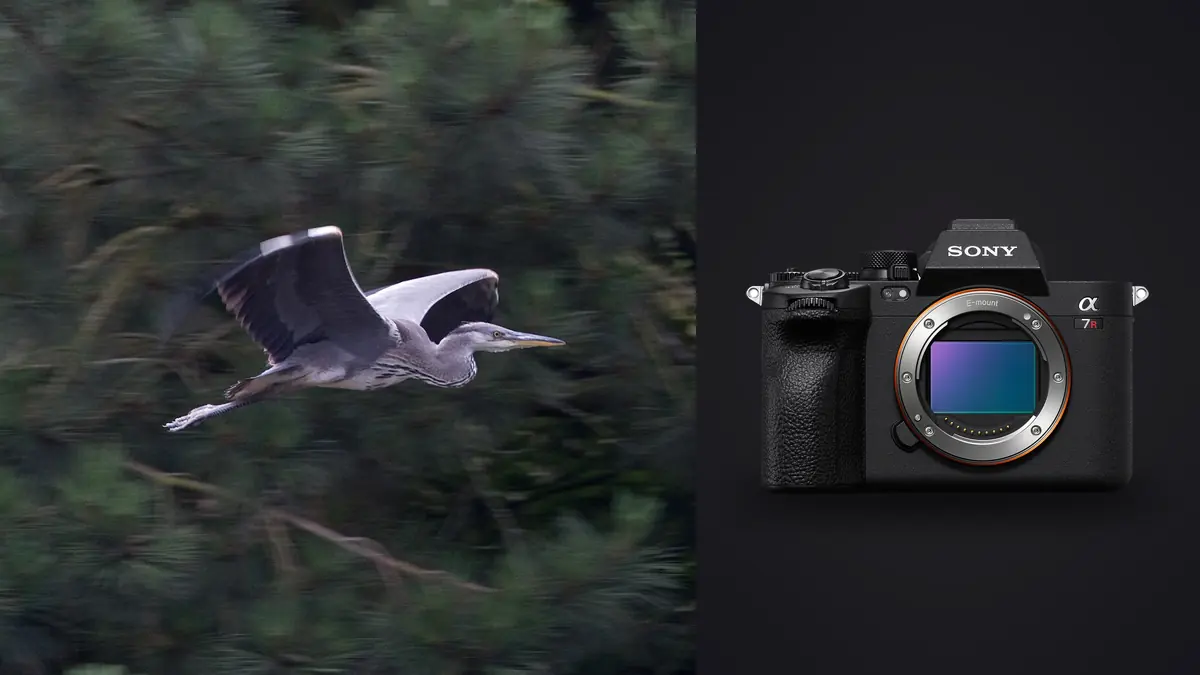
Why I Reached for a 61-Megapixel Body at a Tern Colony
On paper, the Sony A7R V is a landscape and studio camera that got dragged into wildlife work by accident. It was built around a 61-megapixel sensor for people who print billboards and crop architecture shots, not for tracking a common tern folding its wings into a dive at 40 miles an hour. I know the arguments against using it for birds in flight because I made most of them myself before I bought one: the files are enormous, the burst rate tops out at 10 frames per second where a Sony A9 III or an A1 will out-run it, and rolling shutter on a sensor this dense is a real risk with fast wingbeats.
Three seasons later, working coastal tern and osprey colonies plus a fair bit of raptor migration watching inland, I still shoot birds in flight with this body more than any other camera I own. The reason is simple: resolution is a form of reach. A 61-megapixel frame gives you enough pixels to crop a bird that only fills a quarter of the frame down to a full-bleed image and still print it at a reasonable size. That trade only makes sense if the autofocus can actually keep up, and this is where the A7R V surprised me. It borrows the same subject-recognition autofocus system Sony put in the A7 IV and the A1, and for birds specifically, it is genuinely good. The rest of this is what I've learned about getting it to behave.
The Autofocus Settings That Actually Change Your Keeper Rate
Subject recognition: birds vs. small fast-moving objects
Sony split subject recognition into categories: humans, animals/birds, insects, cars/trains, and airplanes. For birds in flight I keep this set to Birds specifically rather than the combined Animal/Bird option whenever the camera lets me choose it, because the bird-specific model is tuned to lock onto an eye against open sky, which is a much harder target than a mammal against foliage. Against a clean sky background it grabs an eye almost every time inside a couple hundred milliseconds. Against a busy background, like a heron lifting off a reed bed, it does noticeably worse and will occasionally jump to a wing tip or the near edge of the body instead of the eye. That's not a camera failure so much as a background problem no autofocus system fully solves yet.
One setting most people skip: Subject Recognition also has a sensitivity slider for how quickly it switches to a new subject entering the frame. For flocks (shorebirds working a tideline, swifts over a reservoir) I turn this down so the camera doesn't keep re-acquiring a different bird every time one crosses in front of my subject. For a single raptor against open sky, I leave it at default.
Tracking sensitivity and AF area
I run AF-C with Wide or Zone as my area mode almost exclusively for flight work, not Spot. Spot autofocus demands that you keep a small box precisely on a bird that's changing direction, and with a long lens the margin for error is tiny. Zone gives the subject-recognition system room to find the eye within a larger region while you handle the coarse tracking with the lens itself. AF tracking sensitivity (Sony numbers this 1 to 5, sometimes labeled by responsiveness) I set toward the faster end, around 4, for erratic flyers like terns and swallows, and closer to the middle for something that flies a predictable line, like a pelican gliding a shoreline. Faster tracking sensitivity chases every twitch, which sounds good until a bird banks hard and the AF jumps to background clutter for a frame or two.
Burst Speed, Buffer Depth, and the Rolling Shutter Trap
The A7R V's 10 fps ceiling is its most argued-about spec for this kind of work, and honestly it's the least of my problems in practice. Ten frames per second on a bird with a two or three beat-per-second wing cadence is still enough to catch multiple wing positions per second, which is what most flight shots actually need. Where the buffer bites is duration, not rate. Shooting compressed RAW on a fast CFexpress Type A card, I get a genuinely useful continuous run, somewhere in the range of three to four seconds of full-speed shooting before the buffer starts to slow down, which is plenty for a single pass but not for a long chase sequence where a bird works back and forth along a cliff face for ten seconds at a time. I've learned to fire in shorter, deliberate bursts timed to wingbeats rather than holding the shutter down the whole approach, partly for the buffer and partly because I end up with fewer near-duplicate frames to sort afterward.
Rolling shutter is the other real concern, and it only shows up with the electronic (silent) shutter. On fast wingbeats, particularly small birds like swallows or terns snapping their wings through the bottom of the stroke, I've seen visible skew where the wing appears to bend at an angle it never actually held. My rule now: mechanical shutter for anything with a fast wingbeat at close range, electronic shutter reserved for slower, larger birds like herons or vultures where the shutter speed advantage and silence (useful near nests) outweigh the skew risk.
Squeezing More Reach: APS-C Crop and Lens Pairings
Because the sensor starts at 61 megapixels, switching to the APS-C crop mode still leaves you with roughly 26 megapixels, which is more resolution than plenty of dedicated wildlife bodies deliver at full frame. That crop mode effectively multiplies your focal length by 1.5x, so a 600mm lens behaves like 900mm. I use this constantly for distant raptors on a wire or perched shorebirds where I don't need the extra corners of the frame anyway. The catch is autofocus area coverage shrinks along with the sensor crop, so tracking a bird that's moving fast and unpredictably across the frame gets harder in APS-C mode simply because there's less frame to work with before the subject exits it.
Lens choice matters more than body choice for keeper rate, and here's how the combinations I've actually used stack up:
| Setup | Effective Reach | Approx. Weight (body + lens) | Best For | Field Notes |
|---|---|---|---|---|
| FE 200-600mm G OSS @ 600mm, full frame | 600mm f/6.3 | ~2.95 kg | Budget-friendly reach, walkable | Hunts a bit in flat overcast light; sharp once locked |
| FE 200-600mm G OSS, APS-C crop | ~900mm equivalent | ~2.95 kg | Distant perched birds, slower flyers | 26MP crop still holds up for web and moderate prints |
| FE 100-400mm GM II + 1.4x TC | 560mm f/8 | ~1.85 kg | Hikes, boats, anywhere weight matters | AF holds up better than expected with the converter attached |
| FE 600mm f/4 GM OSS | 600mm f/4 | ~3.65 kg | Low light, serious dedicated outings | Noticeably faster initial AF acquisition than the 200-600 |
| FE 400mm f/2.8 GM OSS + 2x TC | 800mm f/5.6 | ~3.55 kg | Maximum reach in good light | Hunts more in dim conditions, needs a bright morning |
My honest recommendation for most people starting out: the 200-600mm covers 90 percent of birding scenarios and the crop mode covers most of the gap to the exotic super-telephotos. I only reach for the 600mm f/4 when the light is genuinely bad or the subject is small enough that f/4 versus f/6.3 changes whether autofocus locks at all.
Exposure and Drive Settings for Wings in Motion
Shutter speed for flight is one of those things everyone has an opinion on, and mine has moved over time. For most mid-size birds (gulls, terns, raptors) I shoot 1/2000s as a floor and go to 1/3200s for anything smaller or more erratic. That sounds aggressive, but the A7R V's high resolution means any softness from motion blur is much more visible on a screen at 100 percent than it would be on a lower-megapixel file, so I'd rather freeze the wingtips completely and add a touch of intentional blur later if I want it. Aperture I run wide open on the 200-600 (f/6.3 at 600mm) almost always; depth of field at that focal length and distance is thin enough that stopping down buys you very little extra sharpness on the bird while quietly starving your shutter speed.
Auto ISO with a minimum shutter speed floor set manually is how I actually run this in the field. I don't trust the camera's automatic minimum shutter speed calculation for birds because it assumes a slower, more general-purpose subject; I set the floor myself and let ISO climb. On the 61-megapixel sensor, noise at ISO 6400 is more visible pixel-for-pixel than it would be on a 24-megapixel body, but downsampled for web or a normal print it disappears, and I would rather have a clean, sharp bird at high ISO than a soft one at low ISO.
What Happens After the Shutter: Sorting Thousands of Nearly Identical Frames
This is the part nobody warns you about before you buy a 61-megapixel body for burst shooting: a single good afternoon at a tern colony, shooting in short bursts the way I described above, still produces 1,500 to 2,000 RAW frames, and at roughly 120MB apiece that's well over 150GB of data before dinner. Most of those frames are near duplicates of each other, three or four wing positions apart, with only one or two actually sharp on the eye.
I stopped trying to sort this manually a while ago. I run the take through imagic locally on my own machine, which matters here specifically because I am not uploading 150GB of RAW files to anyone's cloud between the boat launch and dinner just to get a first pass of culling done. The sharpness scoring catches focus misses fast (a huge share of a bird-in-flight take is technically fine exposure but soft on the eye because the subject banked mid-burst), and the duplicate and burst clustering groups those near-identical wing-position sequences together automatically instead of leaving me to eyeball twelve frames that look the same at a glance. I've also built an apply_my_style preset trained on how I've edited my own keeper bird-in-flight shots in the past, cropping tighter than default, pulling shadows up a touch, keeping color fairly neutral, so new takes get a starting point that already looks like my work rather than a flat baseline I have to fix every single time.
None of that replaces judgment. I still look at every frame the software surfaces as a contender before deciding what's a keeper. But going from 1,800 raw files to maybe 60 worth a second look, done overnight on my own laptop rather than waiting on an upload queue, is the difference between actually going out again the next morning and spending that morning still sorting yesterday's shoot. If you're new to this kind of triage workflow, it's worth reading through how AI photo culling actually works before you commit to a tool, and if buffer-driven burst shooting is new to your routine, a few workflow adjustments can save more time than any camera setting will.
Frequently Asked Questions
Is the Sony A7R V fast enough for birds in flight compared to an A9 III or A1?
It's slower on paper (10 fps versus 20-30 fps electronic on the newer bodies) but the autofocus algorithm is the same generation, and for most flight scenarios that aren't erratic small songbirds, 10 fps captures enough wing positions to get a clean shot. Where the A9 III genuinely pulls ahead is dense flocks and fast unpredictable flyers like swifts, where more frames per second means more chances at the exact right wing position.
Do I need CFexpress Type A cards, or will fast SD cards work for this?
You can shoot birds in flight on fast UHS-II SD cards, but the buffer clears noticeably slower, and on a long burst you'll feel the camera hesitate before you can fire again. CFexpress Type A is expensive for the capacity you get, but it's the difference between a two-second pause and an eight-second pause after a long burst, which matters when a bird is only in range for a few more seconds anyway.
Does the APS-C crop mode hurt autofocus tracking for erratic flyers?
Somewhat. The crop reduces the physical area the AF system has to work with, so a bird that changes direction sharply is more likely to exit the frame entirely before you can react, compared to shooting full frame and cropping afterward. I use crop mode for birds on a fairly predictable flight path and stick to full frame plus a longer lens for anything erratic.
Is 61 megapixels overkill for wildlife, or does it actually help?
It helps specifically because reach is expensive. A 600mm f/4 lens costs as much as a car; cropping a 61-megapixel frame down gets you most of that extra reach for free once you already own the body. The tradeoff is storage, culling time, and the fact that any focus miss is more visible at full resolution than it would be on a lower-megapixel sensor.