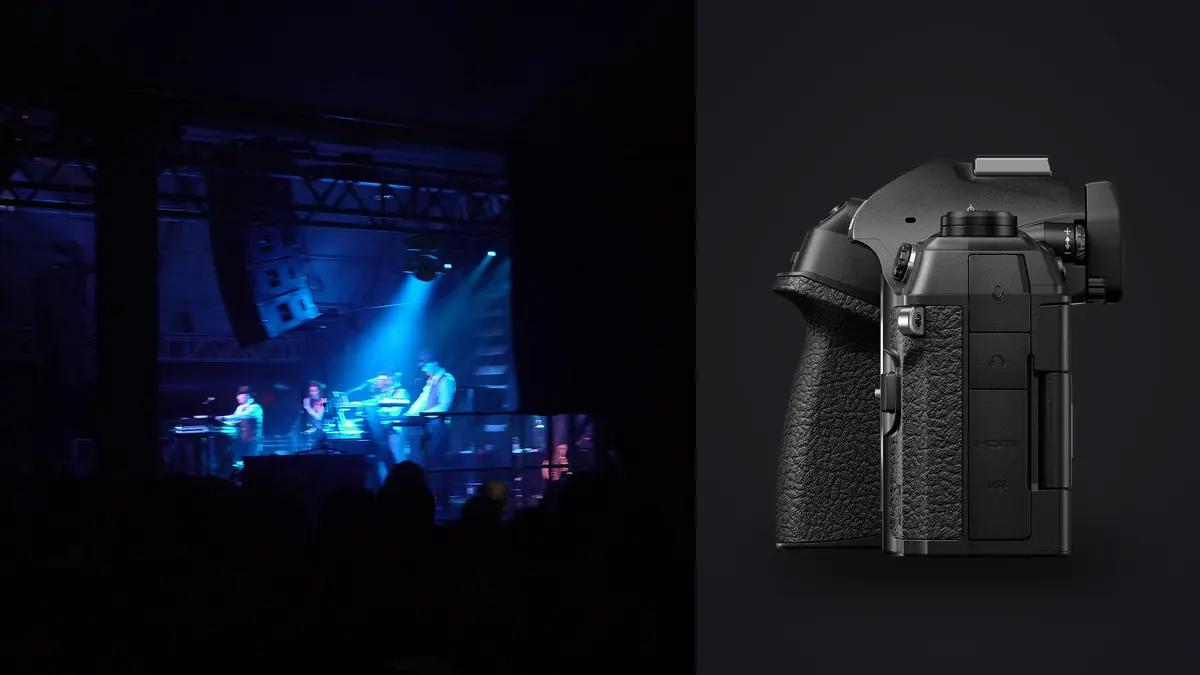
What the Photo Pit Actually Demands
Three songs, no flash, and whatever light the production designer decided to throw at the stage that night. That's the brief for most touring shows, and it's a brutal one for camera gear. You're moving fast, shooting from a barrier that shifts between kneeling and reaching over heads, and the light can swing from a single amber follow spot to a wash of blue and green that changes every four bars. I've carried the OM System OM-1 Mark II into rooms ranging from a 200-capacity club with one par can over the drum riser to an arena with a full LED wall, and it behaves differently depending on which of those two nights you're talking about.
This isn't a spec-sheet rundown. It's what actually happens when you point this camera at a singer under moving light, at 1/500s, hoping the autofocus commits to an eye instead of a guitar headstock.
Sensor Size and the ISO Ceiling You'll Actually Hit
The Mark II keeps the same 20.4-megapixel stacked BSI Four Thirds sensor as the original OM-1, now paired with the newer TruePic X processor. Native sensitivity runs 80 to 25600, extendable to 102400 if you're desperate. That resolution and sensor size is not the interesting part for concert work. The interesting part is where the noise floor sits when a support act is lit by two tungsten fresnels and nothing else.
In practice, I stop trusting ISO 6400 for anything I'd print above a certain size once the room gets that dark, and by 12800 the files need real noise reduction work before they're usable for a finished gallery. That's not a knock specific to this body. Every Four Thirds sensor concedes stops to full-frame at the top of the ISO range, and a smaller photosite count per unit area means you feel that gap sooner than you would on a Sony A7S III or a Nikon Z6III. Where the OM-1 Mark II claws it back is in situations where you don't need ISO 12800 in the first place, because the in-body stabilization and the crop-factor reach let you use a wider aperture or a slower shutter than a full-frame rig would allow for the same framing.
| Venue / lighting situation | Typical light level | ISO I actually shoot at | Shutter used | Field note |
|---|---|---|---|---|
| Small club, single-color wash | Very low, often under 50 lux on the performer's face | 6400-12800 | 1/250s to 1/320s | Grain is manageable if exposure is right in-camera; underexposing and pushing later is where it falls apart. |
| Mid-size theater, moving LED fixtures | Moderate, fluctuates fast | 3200-6400 | 1/500s to catch drummers and jumps | Auto ISO with a locked shutter and aperture is more reliable than chasing exposure manually song to song. |
| Arena, full LED wall behind the act | Bright but contrasty (backlit performers) | 800-3200 | 1/640s to 1/1000s for high-energy sets | Highlight clipping off the wall itself is the bigger risk than noise here. |
| Acoustic or seated set, house lights dimmed | Low but stable | 1600-4000 | 1/160s to 1/200s, IBIS carrying the rest | Slower shutter is workable because nobody's swinging a guitar; stabilization does the heavy lifting. |
Flicker Scan Matters More Than the Spec Sheet Suggests
LED stage lighting doesn't emit continuous light. It pulses, usually somewhere between 100Hz and a few kilohertz depending on the fixture and how the dimmer is driving it, and an electronic shutter can catch that pulse mid-cycle. The result is a horizontal band of underexposure sitting across half your frame, and it's inconsistent enough that you won't notice it on the rear LCD until you're looking at full-size files on a laptop after load-out. It's one of the more frustrating things about shooting silent electronic shutter under rig lighting, and it's exactly the situation the OM-1 line's flicker scan mode was built for.
Run the scan before a set starts (it takes a couple of seconds, cycling through shutter speeds to find one that avoids the flicker frequency of whatever's lighting the stage) and the camera will bias toward a compatible speed. It's not magic. If the lighting operator changes fixtures or a haze machine kicks in and shifts the visible frequency, you'll want to re-run it. But on a multi-band bill where you're shooting three or four different lighting rigs in one night, it's saved me from a set of otherwise unsalvageable frames more than once.
Pro Capture and the Three Songs You Get
Most photo pits give you the first three songs and nothing else, and inside that window you're trying to get the jump, the crowd-surf catch, the moment a vocalist leans out over the barrier. Pro Capture on the OM-1 Mark II runs the sensor continuously in a buffer while you have the shutter half-pressed, then writes a set number of pre-shutter frames the instant you commit to the full press. SH2 Pro Capture now tracks continuous autofocus at up to 50fps (the original OM-1 topped out at 25fps with AF tracking active in that mode), with up to 99 frames of pre-roll depending on how you've set the buffer.
| Shooting mode | Max rate | AF/AE tracking | Where I actually use it in the pit |
|---|---|---|---|
| Mechanical shutter | 10fps | Full tracking | Rarely, unless the venue explicitly requires an audible shutter for accreditation reasons |
| Electronic SH1 | 25fps | Full tracking | General set coverage, silent, my default for most of a song |
| Electronic SH2 | 50fps | Full tracking | A guitarist mid-windmill, a drummer's stick throw, anything with a genuine peak moment |
| Pro Capture SH2 | 50fps with pre-roll | Full tracking | Stage jumps and crowd-surf catches, where the peak happens faster than human reaction time |
The tradeoff nobody mentions enough: a 12-second Pro Capture burst at 50fps is 600 frames of a single jump. Do that eight or ten times across a set and you've generated a file count that no amount of enthusiasm for chimping on location will get you through before the venue kicks you out of the media room.
Reach Without the Extra Weight on Your Neck
The 2x crop factor of Four Thirds is usually framed as a compromise, and for wide, shallow-depth work it can be. For a photo pit or a far-back photographer's platform, it's an asset. The M.Zuiko 40-150mm f/2.8 PRO gives an 80-300mm full-frame equivalent field of view at a weight (760g) you can shoot handheld for an entire set without your shoulder giving out by the encore. Pair it with the 12-40mm f/2.8 PRO II (24-80mm equivalent) for wide stage shots and crowd context, and that's a two-lens kit that covers the vast majority of a pit assignment.
For arena and stadium work where you're shooting from front-of-house instead of the pit, the 150-400mm f/4.5 TC1.25x PRO gets you to an effective 300-800mm with a built-in teleconverter, still light enough to hand-hold on a monopod for a full set. And for the moments where you want subject separation on a single performer under a spotlight, the 25mm f/1.2 PRO (50mm equivalent) wide open is a different look entirely from the zooms, more intimate, shallower, closer to how a portrait reads.
Stabilization and the Slow-Shutter Trick
In-body stabilization rated up to 8.5 stops (with compatible PRO lenses) isn't just about handholding a telephoto in the dark. It opens up a specific creative option at concerts: dragging the shutter to 1/15s or 1/8s during a static vocal moment to pull light trails out of moving stage fixtures, without a tripod, without the frame turning into mush from your own hand movement. That only works when the performer is relatively still, obviously, but ballads and quiet bridges happen in every set, and it's a shot type that a full-frame body with less stabilization headroom makes you work harder for.
The camera's Live ND mode simulates a multi-shot neutral density effect (up to roughly six stops) in-camera, which is more useful for daytime festival stages or outdoor amphitheater shoots where you want motion blur on a moving light or a crowd in bright conditions than it is for a dark indoor club, but it's there if a festival slot lands you in harsh afternoon sun on a stage that's still running full production lighting.
What Happens After Load-Out
A three-band bill with Pro Capture used liberally can leave you with four to six thousand ORF raw files by the time the headliner finishes. Sorting that by hand, even with a fast culling eye, eats the entire next morning before you've touched a single edit. This is where the shooting style of this camera (high burst rates, pre-capture buffering, silent shooting that encourages you to just hold the trigger down through an entire chorus) creates a workload problem that has nothing to do with the images themselves being good or bad.
I run the take-home card straight into imagic before I do anything else. Its local sharpness and focus scoring picks out which frame in a fifty-shot Pro Capture burst actually landed critical focus on the singer's eye rather than the mic stand six inches in front of it, and the burst and duplicate clustering groups those near-identical frames together instead of making me scroll past forty variations of the same jump one at a time. Because it runs entirely offline, it works fine in a venue basement with no signal and a laptop battery you're trying to ration, which after a few tours is not a small thing. If you want more detail on how sharpness scoring actually distinguishes a genuinely in-focus frame from one that just looks sharp on a small screen, this piece on how AI photo culling works covers the mechanics.
Matching a Look Across Wildly Different Lighting Rigs
The harder problem on a multi-act night isn't culling, it's consistency. Opener under blue and white, headliner under a completely different LED program with heavy magenta, and you're trying to deliver a gallery that reads as one coherent body of work rather than four disconnected color palettes. Manually grading each set from scratch, song by song, is how a one-night gig turns into three hours of desk time you didn't budget for.
I built a preset in imagic's apply_my_style feature from a batch of my own previously graded concert edits, and it gets me most of the way to a consistent look across sets before I touch a single slider by hand, adjusting from that starting point rather than building the grade from zero every time the lighting rig changes underneath a new band. It's trained on how I actually edit, not a generic concert LUT, so it holds up better across the kind of lighting variation one gig throws at you than a preset pack ever did for me. For the color-grading side of this specifically, this guide to photo color grading is a useful companion if you're building your own look from scratch rather than importing one.
Where This Camera Falls Short for the Job
Worth being straight about the limits. The autofocus subject detection (human, animal, bird, and several vehicle modes) is genuinely strong for eye and face priority in good light, but in the darkest clubs with a single hard spotlight and a lot of contrast, I've had it hunt or lock onto a hand instead of a face more often than I'd like, especially with performers moving fast against a near-black background. It recovers quickly, but you notice it in a way you don't on a well-lit outdoor shoot.
Battery life is the other honest caveat. The BLX-1 is rated around 500 shots CIPA, but a night of heavy Pro Capture use, EVF on the whole time, and cold venue load-in areas will chew through that faster than the number suggests. I carry two spares as a baseline for anything longer than a single support-plus-headliner bill, three if I know Pro Capture is going to be doing most of the heavy lifting.
Frequently Asked Questions
Is the OM-1 Mark II good enough for shooting in genuinely dark clubs?
It's usable, not effortless. Below roughly ISO 6400 the files hold up well with minimal cleanup. Push into 12800 and beyond in a near-black room and you're trading detail for a clean exposure, which is true of every Four Thirds sensor against full-frame competition. Getting the exposure right in-camera at capture time matters more here than it would on a body with more dynamic range to spare in post.
Does Pro Capture actually change what you come home with?
Yes, for the specific shots that happen faster than a photographer can react (a stick throw, the exact peak of a stage jump, a crowd-surfer's hand hitting the barrier). It's less useful for general set coverage, where SH1's 25fps with full tracking is plenty and generates a far more manageable file count. Reserve Pro Capture for the two or three moments per set where timing genuinely beats framing.
How do I stop banding from LED stage lighting when shooting electronic shutter?
Run the camera's flicker scan before the set starts, ideally during the opener's soundcheck or the changeover if you can get access. It biases the shutter speed toward one that avoids the fixture's pulse frequency. Re-run it if the lighting operator swaps rigs mid-bill, which happens often on multi-band nights with different production packages.
What's a realistic two-lens kit for a photo pit with this system?
The M.Zuiko 12-40mm f/2.8 PRO II for wide stage and crowd context, and the 40-150mm f/2.8 PRO for the reach you need once you're pushed to the side of the barrier or shooting a wider stage. Together they cover a 24-300mm equivalent range at f/2.8 throughout, at a combined weight most photographers can carry through a full set without a second bag.