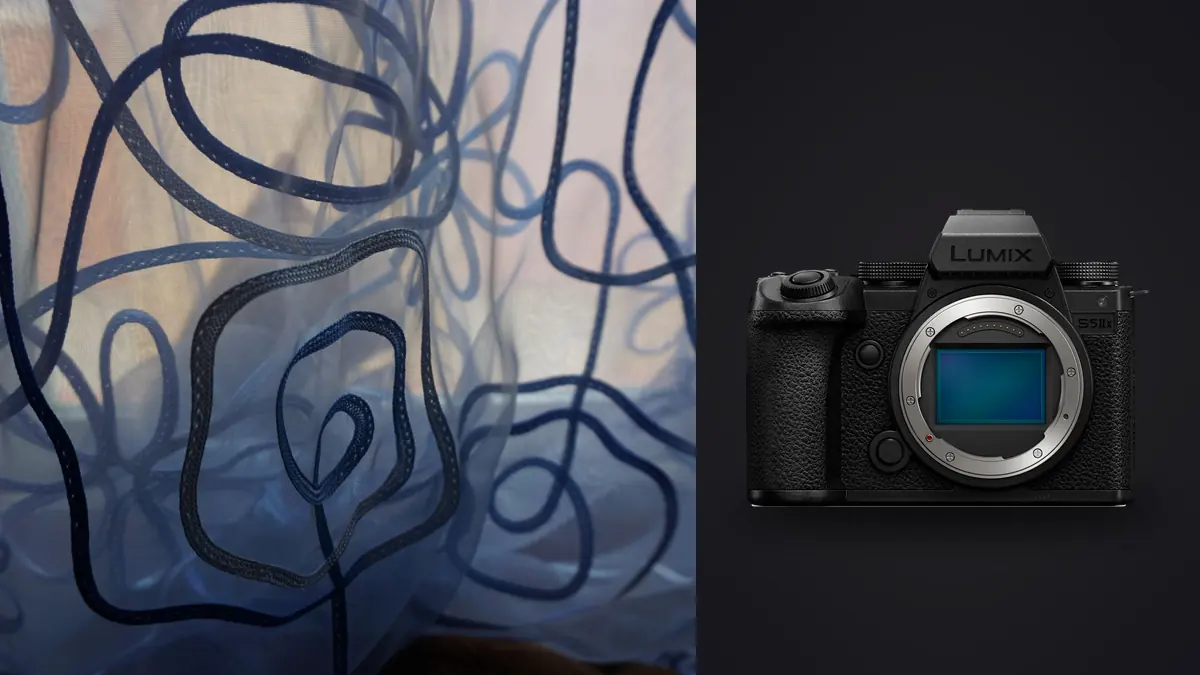
Boudoir work asks a camera to do something most gear reviews never test for: disappear into the background of a room where a client is already nervous. The Panasonic Lumix S5IIX gets recommended in boudoir photography groups more often than its spec sheet would suggest, and after a run of hotel-suite and in-home sessions with it, I understand why. It isn't the flashiest full-frame body on the market. It's the one that stops getting in the way once the shoot actually starts.
This isn't a spec dump. It's what changes in practice when you swap a bulkier DSLR or a video-first body for the S5IIX in a genre where trust, pacing, and discretion matter as much as resolution.
Body size and handling in a small room
Most boudoir sessions don't happen on a soundstage. They happen in a 12x14 hotel room, a client's bedroom, or a rented Airbnb with one usable wall of window light. Space is tight, and so is the emotional space you're working in. A camera that looks intimidating changes how a client holds her shoulders.
The S5IIX weighs just under 740g body-only with a card and battery in, which puts it closer to a large mirrorless than a pro DSLR in the hand. Paired with something like the Lumix S 50mm f1.8, the whole rig sits comfortably on a wrist strap between poses instead of dragging on a neck strap the entire session. That matters more than it sounds like it should when you're kneeling on a bed, shooting from a doorway, or working low across a chaise for twenty minutes at a stretch.
In-body stabilization is the other piece of this. Panasonic rates the Dual I.S. 2 system at roughly 6.5 stops with compatible lenses, and in real sessions that translates to shooting handheld at shutter speeds I wouldn't have trusted on older bodies, without setting up a tripod that turns a private moment into a lit set. For static, tripod-based boudoir work the stabilization matters less, but for anything documentary-leaning, walking the client through movement while you shoot, it's the difference between a tripod dictating the blocking and you following the client around the room.
Autofocus during a genre where hesitation shows
The S5IIX was Panasonic's first S-series body to move to phase-hybrid autofocus, replacing the old Depth From Defocus system that hunted visibly on earlier S5 bodies. That hunting was a real problem in boudoir work specifically: any pause between "camera focuses" and "shutter fires" reads on a client's face, especially when they're already holding a pose they feel self-conscious about.
With human eye detection active, the S5IIX tracks through partial profile turns, hair falling across the face, and low-light conditions well enough that I stopped thinking about focus mid-session, which is the actual goal. It's not flawless. In near-silhouette lighting against a bright window, eye-AF occasionally slips to the eyebrow or the near cheekbone, and heavily backlit hair can pull focus off the face for a frame or two. Both are recoverable in a normal shooting rhythm, but they're worth knowing before you rely on it for a single, unrepeatable expression.
Low light without switching to strobes
A lot of boudoir photographers shoot available light on purpose. Strobes can feel clinical in a bedroom setting, and continuous LED panels or window light keep the mood the client came for. That puts real pressure on high-ISO performance, and this is where the S5IIX's dual native ISO sensor earns its keep.
The second gain stage kicks in around ISO 4000, which in practice means a dim suite lit by a single continuous key light and window spill doesn't force a choice between motion blur and visible noise. I've pushed files to ISO 6400 for editorial-style low-key sets and still had clean enough shadow detail to grade without banding. Past ISO 12800 chroma noise becomes noticeable in the deep shadows, which is normal for a sensor this size, but it's usable noise, not the blotchy, color-shifted grain you get from older sensors pushed past their comfort zone.
| Light source | Typical working ISO | What to watch for |
|---|---|---|
| North-facing window, overcast day | 800 - 1600 | Clean files, plenty of dynamic range for skin highlights near glass |
| Single continuous LED panel, dimmed | 2000 - 4000 | Right at the second gain stage; noise stays fine-grained here |
| Practical lamps only (moody, low-key) | 4000 - 8000 | Shadow noise visible at 100% but fine for web and most print sizes |
| Candlelight or single small practical | 8000 - 12800 | Usable but grainy; better as an intentional stylistic choice than a default |
Skin tones and the V-Log question
V-Log comes preinstalled on the S5IIX at no extra cost, which matters because Panasonic used to charge for it as an add-on activation on the original S5. For stills shooters this is mostly irrelevant since most boudoir work is delivered as RAW stills, not flat log video. But if you shoot the hybrid photo-and-video packages many boudoir studios now sell (a short cinematic reel alongside the still gallery), having log baked in from day one means you're not paying twice for a body that already had the sensor capability.
For stills, Panasonic's standard color profile renders warm skin tones without the slightly orange cast I've seen out of some Sony bodies straight from RAW, which cuts down on the amount of selective color correction needed before a set is ready to share. It's not a substitute for a deliberate grade, but it's a better starting point than I expected going in.
A practical lens kit for the S5IIX in boudoir work
| Lens | Aperture | Best for | Approx. street price |
|---|---|---|---|
| Lumix S 50mm f1.8 | f1.8 | General coverage, tight rooms, natural perspective | ~$450 |
| Lumix S 85mm f1.8 | f1.8 | Compression and background separation from further back | ~$600 |
| Sigma 65mm f2 DG DN | f2 | Fabric, lace, and detail work with a slightly longer minimum focus | ~$700 |
| Sigma 85mm f1.4 DG DN Art | f1.4 | Deep subject separation in dim, moody setups | ~$1,200 |
| Lumix S 24-105mm f4 Macro OIS | f4 | Versatility in cramped rooms, plus true macro for jewelry and detail shots | ~$1,300 |
Most of the boudoir photographers I've compared notes with settle on a two-lens kit: something in the 50-65mm range for full-body and three-quarter shots in a small room, and an 85mm for tighter, more intimate compression work from across the space. The S5IIX's IBIS makes the slower f1.8 primes more usable in low light than they'd be on a body without stabilization, which is worth factoring in if budget is tight and you're deciding between a faster lens and a stabilized body.
The privacy angle nobody puts in the spec sheet
Boudoir is the one genre where the words "cloud backup" make clients visibly uncomfortable, and rightly so. Nobody wants to hear that their most private session got auto-synced to a server somewhere the moment the memory card was inserted. This is the part of the workflow that actually shapes which software I run after the shoot, not just which camera I bring to it.
I cull S5IIX sessions in imagic specifically because it processes everything locally on the machine, nothing gets uploaded anywhere during sharpness scoring or duplicate detection. For a boudoir shoot that might run 1,800 to 2,500 frames across several outfit changes and lighting setups, that local-first processing isn't a nice-to-have, it's the reason a client's images never touch a server they didn't explicitly agree to.
On the practical side, the S5IIX's continuous shooting produces a lot of near-duplicate bursts when a client is moving through a pose, small shifts in hand placement, breath, expression. imagic's burst and duplicate clustering groups those automatically so I'm choosing between five visually similar frames instead of scrolling past forty. Combined with the focus scoring flagging which frame in a burst actually landed sharp on the eyes (relevant given the eye-AF quirks mentioned earlier), the first pass cull on a full session drops from a couple hours to well under one. If you're new to how automated culling handles this kind of volume, how AI photo culling works covers the mechanics in more depth.
The other piece I lean on is imagic's apply_my_style feature, which trains an AI preset off my own past edits rather than a generic filter pack. A boudoir set needs a consistent look across the gallery, warm but not oversaturated skin, soft contrast, no crushed shadows, and having that baseline applied automatically to a fresh batch of S5IIX RAW files means I'm fine-tuning individual images instead of building the grade from zero every single session.
Video: the feature you may not need, but might use anyway
The "X" in S5IIX signals the video-forward variant of the S5II, with an active cooling fan, internal ProRes recording to a USB-connected SSD, and ProRes RAW output over HDMI. For a stills-only boudoir photographer, none of that is the reason to buy this body over the standard S5II, which is meaningfully cheaper and shares the same sensor, autofocus, and stabilization.
Where it becomes relevant is the growing number of boudoir studios selling a short cinematic video alongside the still gallery, ten to twenty seconds of slow-motion movement for the client to post or keep privately. Shooting that on the same body you're already using for stills, without swapping to a second camera mid-session, is a genuine convenience. If that's not part of your service menu, the fan and cooling hardware are just extra weight and battery draw you're carrying for no reason, and the standard S5II is the more sensible buy.
Card handling and the realistic session workflow
The S5IIX has dual UHS-II SD slots, which are worth running in backup mode for anything you cannot reshoot, given how irreplaceable boudoir sessions are; there's no reshoot for a session like this if a card fails. A typical two-hour session with two to three outfit changes runs somewhere around 1,500 to 2,000 RAW frames at 24.2 megapixels, which fills roughly a third of a 128GB card shooting RAW-only.
Battery life sits in line with most mirrorless bodies in this class, one battery comfortably covers a session, a second is cheap insurance rather than a hard requirement. Where the workflow actually slows down is after the shoot, not during it, which is why the culling step matters as much as anything that happens with the camera in hand. Between the volume of near-duplicate bursts and the number of frames shot at wider apertures where focus precision is unforgiving, a faster first pass through the files is worth more time saved than almost any other workflow change. For studios juggling this alongside other shoot types in the same week, 10 tips for a faster photo workflow has some adjacent habits worth layering on top of the culling step specifically.
Where it falls short
It's worth being honest about the limits. Rolling shutter in the electronic (silent) shutter mode is noticeable if a subject moves quickly, whip pans or fast fabric movement can show skew, so I stay on the mechanical shutter for anything with real motion and save silent shooting for still poses where the near-inaudible shutter genuinely helps the subject relax. Mechanical flash sync tops out around 1/250s, which is standard but worth knowing if you're pairing continuous light with an occasional flash pop for texture. And the menu system, while improved over older Panasonic bodies, still has the autofocus settings split across more submenus than I'd like when you're trying to make a quick change mid-session.
None of these are dealbreakers for the genre. They're the kind of thing you learn once, adjust your settings around, and stop thinking about by the second or third session.
Frequently Asked Questions
Is the S5IIX overkill if I never plan to shoot video?
Largely, yes. The active cooling fan, ProRes internal recording, and SSD output are the entire reason the S5IIX costs more than the standard S5II, and none of it affects still image quality, autofocus, or stabilization, which are identical between the two bodies. If video isn't part of your boudoir package now or in the near future, the S5II gets you the same shooting experience for less money and less weight on your wrist by session's end.
How does the S5IIX handle skin tones straight out of camera?
Reasonably well for a starting point. Panasonic's standard color profile tends toward warm, accurate mid-tones without the orange cast some competing sensors show in RAW, so less selective correction is needed before grading. It's still worth building a consistent edit on top rather than delivering camera-JPEG skin tones directly, since client expectations around softness and warmth vary studio to studio.
Does the electronic silent shutter cause problems during a session?
Only with fast movement. For static or slow-moving poses it's close to silent and genuinely helps nervous clients relax since there's no shutter clack breaking the moment. If a client is moving quickly, adjusting fabric, changing position fast, the rolling shutter effect in electronic mode can skew fine detail, so switching back to the mechanical shutter for anything with real motion is the safer default.
What's a realistic ISO ceiling for moody, low-light boudoir setups?
Up to roughly ISO 6400 the files stay clean enough for print and web delivery without extra noise reduction work. Between 8000 and 12800 the shadows show visible grain that reads as intentional and moody rather than broken, which actually suits a lot of low-key boudoir styling. Past that point it becomes a stylistic choice rather than a default setting, and adding even a small practical light source is usually the better fix.