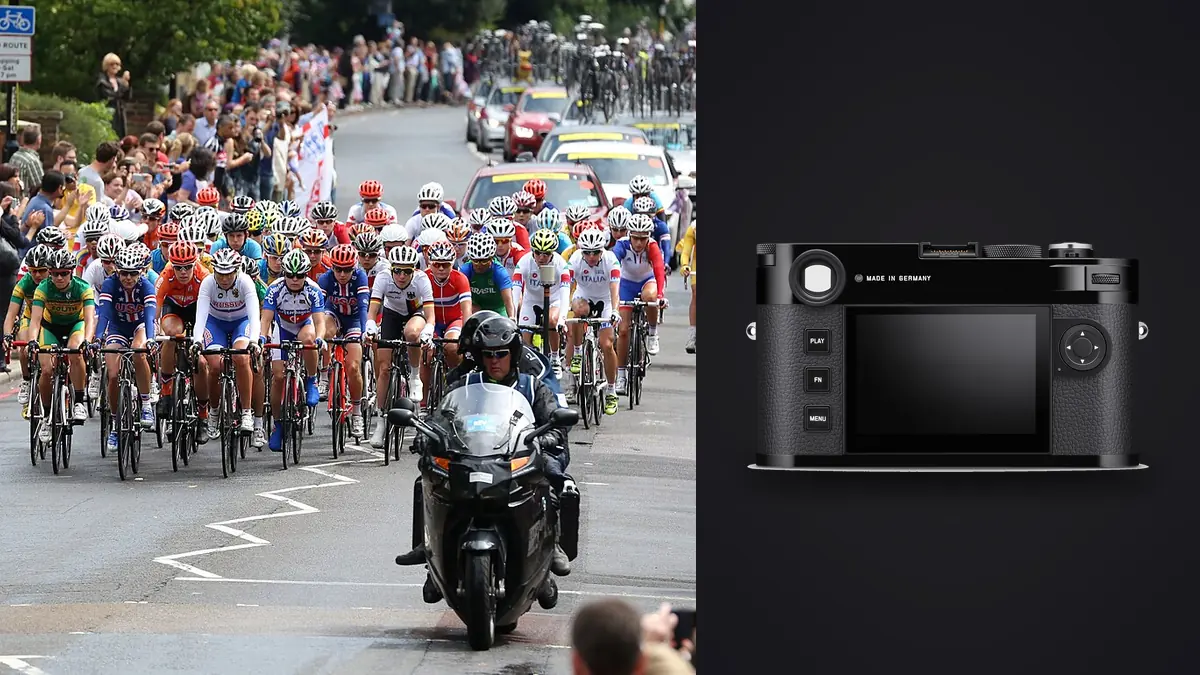
A friend teaching a photography elective asked me to shoot her school's regional track meet in June, mostly so she'd have images for the yearbook that weren't taken on a phone held over someone's head in the stands. I own three camera systems. The one I grabbed on the way out the door was a Leica M11 with a 90mm APO-Summicron, which is, on paper, close to the worst possible tool for photographing teenagers running around an oval at speed. No autofocus. No continuous shooting worth the name. A viewfinder that shows a double image you align by hand. I did it anyway, partly out of stubbornness and partly because I wanted to know if the reputation the M11 has for being useless outside of street work and portraiture is actually earned, or just a story people repeat because nobody bothers to test it.
The rangefinder problem nobody wants to admit
Rangefinder focusing works by superimposing a second, offset image over the main viewfinder image and turning the lens until the two align. It is fast and precise for a subject at a fixed or slowly changing distance. It falls apart the moment distance is changing quickly, because your thumb simply cannot re-align the patch as fast as a sprinter closes ground. Try to "chase" focus on a 200m runner coming out of the curve toward you and you will miss almost every frame. I know because that's exactly what I tried first, standing near the finish line trying to track a runner the way I would with a mirrorless body and eye-detect autofocus. It does not work. The M11 has no continuous autofocus, no subject tracking, and no way to fake either. Anyone telling you otherwise hasn't tried it at a meet.
What does work is refusing to chase focus at all and pre-committing to a distance instead. That's not a workaround unique to Leica glass, it's the standard technique rangefinder and zone-focus shooters have used for decades, and a track is actually a decent place to apply it because lanes, hurdles, and the curve markings give you fixed reference points to focus on ahead of time.
Zone focusing is the only technique that survives contact with a real race
Pick a spot before the gun goes off. A hurdle, the point where a lane crosses the 200m arc, the apex of the final curve, whatever gives you a clean, unobstructed sightline. Prefocus on that spot using the rangefinder patch while there's nobody there, then leave the focus ring alone. When a runner crosses your chosen point, fire. You're not tracking a moving subject through the viewfinder anymore, you're waiting for a moving subject to arrive at a spot you've already solved.
The aperture you choose decides how forgiving that spot is. Stop down and the usable zone around your focus point gets wider, which buys you a bigger window to react. As an example: with the 90mm APO-Summicron at f/4, focused on a point 25 meters away, the classic depth of field math (using the traditional 0.030mm circle of confusion most DOF calculators default to) puts your acceptably sharp range from roughly 18 meters to about 40 meters. That's a 22-meter stretch of track where a runner will register as sharp, which is a lot more forgiving than trying to nail focus to the centimeter.
Two caveats, both learned the hard way. First, that 0.030mm circle of confusion assumes a print viewed at a normal distance, not a 60-megapixel file examined at 100% on a monitor. Pixel-level sharpness falls off well inside that theoretical zone, so I treat the calculator's range as generous and stop down about a third further than it suggests if the shot needs to hold up cropped. Second, zone focusing rewards events where the runner's path is predictable, meaning distance events and mid-race splits on the backstretch, far more than it rewards the 100m final, where the whole race is over in ten seconds and there's no time to reposition if your first zone guess is wrong.
Where the technique breaks down
Relay exchanges and block starts are the two situations where zone focusing stops being a reasonable compromise and starts being a liability. A relay handoff happens in a roughly two-meter box, at speed, with two athletes' bodies overlapping, and if your prefocused zone is even slightly off you get a soft frame of the single most important moment in the race. Block starts are similar: everything happens in under a second, from crouch to full sprint, and a rangefinder patch just isn't fast enough to catch the exact instant of the gun with any reliability. I got usable block-start frames maybe one meet out of three, and only because I'd set my zone at the first-stride mark rather than the blocks themselves, accepting that I'd never get the crouch.
Lens choice changes the math more than people expect
Focal length affects zone focusing in a way that isn't obvious until you've shot with a few different lenses side by side. A longer lens narrows the depth of field at a given aperture, which sounds like it should make focusing harder, but it also lets you stand further back, which increases your subject distance and widens the zone again. The two effects partially cancel out, but not perfectly, and the practical differences between the lenses I tried were big enough to matter.
| Lens | Max aperture | Focus ring travel (close to infinity) | Closest focus | Weight | Best use trackside |
|---|---|---|---|---|---|
| Summicron-M 50mm f/2 APO-ASPH | f/2 | ~90 degrees | 0.7m | 300g | Infield shots from the rail, field events (long jump, shot put) where you can get close |
| APO-Summicron-M 90mm f/2 ASPH | f/2 | ~135 degrees | 1.0m | 530g | Backstretch and mid-distance action, general purpose from the stands |
| Elmarit-M 135mm f/2.8 | f/2.8 | ~180 degrees | 1.5m | 525g | Finish-line compression shots from fixed seating, needs the external Visoflex EVF to compose accurately |
The 90mm was the one I kept coming back to. The 50mm puts you close enough that framing changes fast as a runner approaches, which works against the whole idea of prefocusing on a fixed point. The 135mm needs the accessory electronic viewfinder because the M11's built-in frame lines don't extend that far and eyeballing composition through the rangefinder window at 135mm is a guessing game. The 90mm sits in the middle: enough reach to isolate a runner from the background clutter of a school track (fences, banners, other athletes warming up), a focus throw long enough to be precise without being so long that small adjustments eat up too much time, and it still shows accurate frame lines natively.
Frame rate and buffer are the quiet limiting factor
The M11 shoots at roughly 4.5 frames per second and the buffer runs out faster than that number suggests, especially in the full-resolution triple-DNG lossless mode where you're writing 60-megapixel files. A modern mirrorless body doing 20 or 30 frames per second gives you dozens of chances to catch peak stride or the moment a foot clears a hurdle. At 4.5 fps you get maybe three or four frames across an entire running stride, which means the difference between a great shot and a throwaway one often comes down to which fraction of a second you happened to press the shutter, not skill so much as luck stacked on top of preparation.
I switched to the reduced-resolution DNG mode (18MP) for anything I expected to burst on, since the buffer depth roughly triples and yearbook use never needed 60 megapixels anyway. For anything I planned to shoot as a single, carefully timed frame (the zone-focus technique described above), I stayed in full resolution. Knowing which mode you're in before the race starts matters more with this camera than with almost any autofocus body, because there's no time to dig through a menu once runners are on the track.
What the culling session actually looks like afterward
Here is the part nobody mentions when they talk about rangefinder sports photography: the miss rate. I came home from that meet with just under 1,900 frames and, being honest about it, somewhere around 65 percent were unusable, either soft because the runner crossed my zone a half-step early or late, or simply empty because I fired a fraction too soon. That's a much higher miss rate than would be acceptable on a paid shoot, and it's the honest tradeoff for using a manual-focus body on a fast-moving subject.
Sorting that volume by eye, on a laptop, at a picnic table outside the stadium, is exactly the kind of task I don't want to do manually anymore. I ran the folder through imagic and let its local sharpness scoring flag the genuinely in-focus frames first, since with a rangefinder the difference between "sharp" and "close but not quite" is often invisible at thumbnail size and only becomes obvious once you're looking at focus data rather than guessing. It also clustered the three or four frames I'd fired off in quick succession around each zone crossing into groups, so instead of scrolling a flat, unsorted roll of nearly identical frames I was comparing four shots of the same stride against each other and picking the sharpest one. Everything ran on the laptop itself with no upload step, which mattered more than I expected sitting in a school parking lot with no reliable wifi and a drive home to make.
The other piece that saved real time was the apply_my_style preset. I'd already built a look on a batch of my own edited race photos from earlier in the season (slightly cooler shadows, a bit of extra contrast to hold up on the projector screens the school uses for the yearbook slideshow), and having that applied automatically across nearly 700 keeper frames meant I wasn't re-grading each one from a flat starting point. If you're trying to get faster at this kind of high-volume, low-hit-rate shoot in general, it's worth reading through how AI photo culling actually works and separately a few workflow habits that speed up the whole process, because a lot of what slows people down at this stage has nothing to do with the camera and everything to do with how the files get triaged afterward.
Where the M11 genuinely does not belong
I want to be straightforward about this rather than pretend the workaround solves everything. If a client needs guaranteed, bib-number-sharp coverage of every heat, every start, and every finish at a meet, an autofocus body with a long telephoto and 20+ fps is the correct tool and there's no rangefinder technique that changes that math. The M11 got me usable, often genuinely nice-looking frames of the events with predictable pacing (the 1500m, the 3000m, most of the field events), and it got me almost nothing reliable out of the 100m dash or relay exchanges. If your job actually depends on the sprint results, bring or borrow a second body. Using the M11 for the whole meet was a stylistic choice for a low-stakes yearbook assignment, not a serious recommendation for anyone shooting a meet where the fast events are the ones that matter.
Frequently Asked Questions
Can the Leica M11 autofocus for sports or fast action at all?
No. The M11 is a manual-focus rangefinder body with no autofocus system, continuous or otherwise, and no subject tracking. Any sharp frame of a moving subject comes from either zone focusing (prefocusing on a fixed point and waiting for the subject to arrive) or from focusing on a slower, more predictable portion of the action, not from the camera tracking anything.
What's a realistic keeper rate shooting a track meet with an M11?
In my experience, expect to throw away well over half your frames, even with careful zone focusing. I kept roughly 35 percent of the nearly 1,900 frames from a single meet, and that ratio was worse for sprint events and better for distance events and field events where the subject's position was easier to predict ahead of time.
Which Leica M lens works best for track and field?
A 90mm, in my case the APO-Summicron-M 90mm f/2 ASPH, was the best balance for shooting from the stands or infield rail. It gives enough reach to isolate a runner from background clutter without needing an accessory viewfinder, and its focus throw is long enough for precise prefocusing without becoming slow to adjust between events.
Is the M11 durable enough for a full day outdoors at a meet?
Physically, yes. It carries an IP54 rating against dust and light moisture, which covers a normal day at an outdoor track. The practical limits are elsewhere: battery life runs down faster than a DSLR's if you're chimping the rear screen between events to check focus, and that same rear screen washes out badly in direct midday sun, which makes checking your zone-focus hits harder than it should be. I started relying on the histogram and a small loupe rather than trusting what I could see on screen.