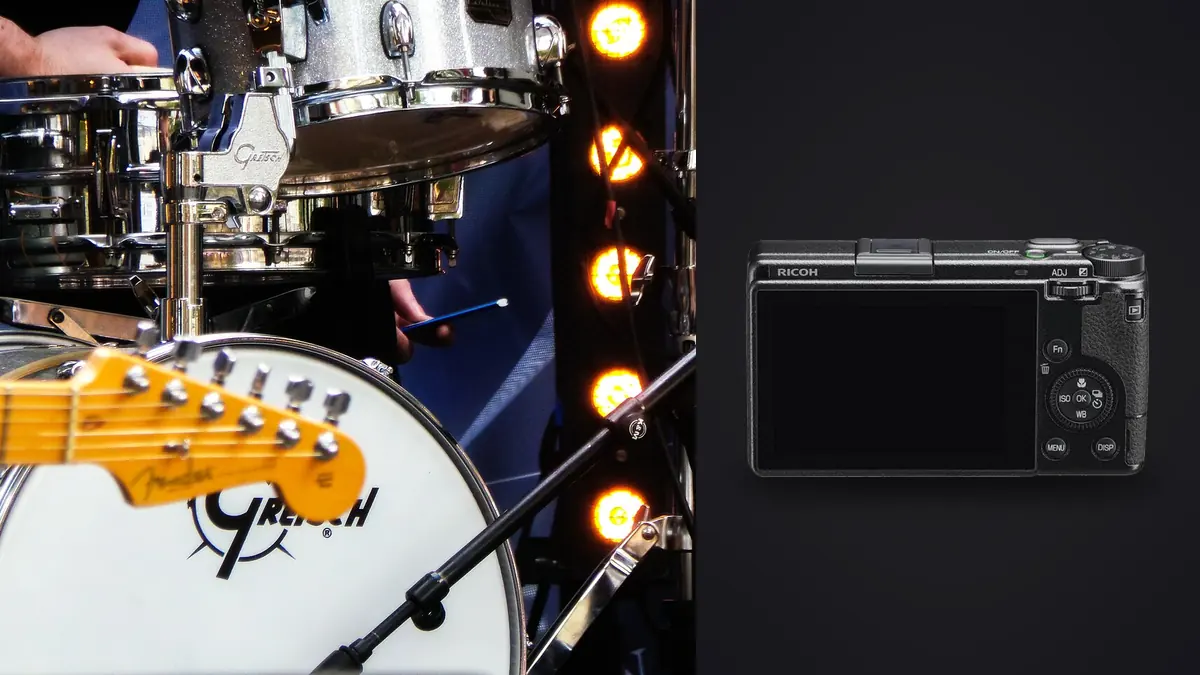
I got asked to shoot a friend's band at a 200-capacity room a couple of years back, and the only camera in my bag that fit in a jacket pocket was the GR IIIx. No lens bag, no strap catching on the crowd, no security guard eyeing me like I was carrying a bazooka. I figured I'd get maybe a dozen usable frames. I walked out with closer to sixty, and that night changed how I think about this camera for anything with a stage and bad lighting.
The GR IIIx is not a concert camera by design. Ricoh built it for street work: a fixed 40mm-equivalent lens (26.1mm actual, f/2.8), a 24.2-megapixel APS-C sensor stuffed into a body that weighs 262 grams, and absolutely no telephoto reach to speak of. None of that reads like a spec sheet for photo pit work. But small venues, low-security clubs, and anywhere you're shooting from inside the crowd rather than behind a barrier are a different animal than an arena tour, and that's exactly where this camera earns its keep.
Why a Fixed 40mm Compact Even Belongs in This Conversation
The honest answer is access. Most club and DIY venue photography isn't shot from a pit with a laminate around your neck. It's shot standing in the crowd, three people back from the stage, trying not to get an elbow in the lens. A camera the size of a large phone doesn't read as "press" to security, which means you get waved through doors that would stop someone carrying a 70-200mm on a full-frame body. I've walked into venues with the GR IIIx that would have made me check a bag or leave a DSLR at coat check.
The 40mm equivalent field of view also happens to match how most of us actually watch a show from the crowd. It's not a telephoto compression shot of the singer's face from thirty feet back. It's a frame that includes the mic stand, the guitarist's hand on the neck, a slice of the crowd's raised arms at the edge. If you've shot with a 50mm on a full-frame body for portraits, this will feel familiar, just a touch wider and forgiving of the fact that you're going to be jostled.
What it can't do is reach. If you're in a pit at a festival stage twenty meters back, this lens is useless to you. No amount of cropping saves a 24-megapixel file shot from that far away when you're already print-cropping for grain and noise. This is a camera for close, chaotic, sweaty rooms, not for stadium stages.
The Light Problem: How Far You Can Actually Push ISO
Concert lighting is the actual test for any camera, not the spec sheet. Most small venues run a mix of colored gels, moving LED washes, and the occasional spotlight that blows out one side of the stage while the other side sits in near darkness. The GR IIIx tops out at ISO 102400 on paper, but I've never used anything above ISO 12800 and called the result usable for anything beyond a black-and-white Instagram post. Here's roughly what I've found workable, based on shooting maybe fifteen different rooms with this camera over two years:
| Venue lighting | Typical ISO I land on | Shutter speed | What the files look like |
|---|---|---|---|
| Small club, warm tungsten wash | 1600-3200 | 1/125-1/200 | Clean enough for full-res web use, mild grain |
| DIY/basement show, single work light | 3200-6400 | 1/60-1/100 | Visible noise in shadows, still fine at web size |
| Moving colored LEDs, mid-size room | 3200-6400 | 1/160-1/250 | Color banding possible under fast strobing, needs a keeper pass |
| Outdoor festival stage at dusk | 800-1600 | 1/250-1/500 | Best files this camera produces live |
| Backlit silhouette moments | 400-800 | 1/250+ | Sensor's dynamic range holds the highlight edge nicely |
The APS-C sensor is genuinely good for its class, better than the older GR II generation by a wide margin, but it's still a smaller sensor than what a lot of working concert shooters carry on Sony or Nikon full-frame bodies. Past ISO 6400, chroma noise starts creeping into shadow areas under mixed colored lighting, and that's the exact condition most club shows throw at you. If I know I'm walking into a room with genuinely bad lighting, I mentally budget for a heavier noise reduction pass afterward rather than expecting clean files straight off the card.
Autofocus in the Dark: Snap Focus Saves You More Than Continuous AF Does
The GR IIIx uses contrast-detect autofocus with no phase-detect pixels, and in low, moving light it hunts. I don't sugarcoat this: if a singer is thrashing under a strobe and you're trying to track their face with the camera's own AF system, you will lose frames to focus hunting. This is where most reviews written by people who never actually shoot low light miss the point of this camera. The workaround is Snap Focus, and it's the single feature that makes this camera viable for gigs. You set a fixed focus distance (I usually run 1.5m or 2m depending on how close I'm standing to the stage), assign it to a function button, and the camera fires instantly at that distance with zero hunting, because it's not hunting at all. It's just placing a hyperfocal-style guess and trusting your framing. Combined with f/2.8 (not razor-thin depth of field, forgiving of a few centimeters of error), this gets you a stack of in-focus frames from a performer moving unpredictably, which continuous AF on this body simply won't deliver reliably in a dark room.
My Actual Focus Workflow at a Show
I split the set into two modes without ever opening a menu. For the first couple songs I let the band find their spots on stage and I shoot with regular single-AF, since the lighting is usually more settled before things get chaotic. Once the pace picks up, I flip to Snap Focus at a distance I've pre-measured by eye against the stage depth, and I stop worrying about hunting entirely. It costs you a small amount of precision on the exact focal plane, but you trade that for actually getting the shot instead of a green confirmation box that never locks.
Shutter Sound and Working the Crowd
The leaf shutter on the GR IIIx is nearly silent, quiet enough that I've shot quiet acoustic sets from the front row without anyone around me noticing I was firing off frames. That's not a small thing. A lot of concert cameras, especially DSLRs with a mirror slap, announce themselves in a way that draws attention during quieter moments between songs, or during a genuinely hushed acoustic number. Being able to shoot without that mechanical clatter means you can work closer and more often without becoming the show yourself.
The tradeoff is that this camera has no viewfinder. You're composing on the rear LCD the entire time, which is fine in a dark club (the screen is bright enough to read easily) but becomes a real problem at an outdoor daytime festival slot, where glare on the screen makes framing a guessing game. Ricoh sells an optional external optical finder that clips into the hot shoe, and if you're shooting daytime outdoor sets regularly it's worth having, but for indoor club work I've never missed a viewfinder once.
Settings I Dial In Before Doors Open
- Mode: TAv (shutter and aperture priority, auto ISO within a capped range). I set a floor of 1/125 and let the camera pick ISO up to a ceiling I set around 6400.
- Aperture: wide open at f/2.8 for almost everything except outdoor daylight sets, where I'll stop down to f/4 or f/5.6 for a bit more depth and to protect against the lens's slightly soft wide-open corners.
- White balance: manual Kelvin, usually somewhere around 3800K to fight the orange stage wash, adjusted per venue rather than trusting Auto WB, which tends to average out colored gels into a muddy gray.
- Image stabilization: on. The three-axis shake reduction genuinely buys you a stop or so at the slower shutter speeds you'll sometimes be forced into, and there's no reason to leave it off.
- File format: RAW + JPEG. The in-camera JPEG engine (particularly the Positive Film profile) actually nails stage color better than my first pass at RAW processing more often than I'd like to admit.
The Three-Song Rule and Where This Camera Fits
If you're shooting an actual photo pit at a mid-size or large venue, you're almost certainly bound by the standard first-three-songs, no-flash rule, and you'll be behind a barrier with real distance between you and the stage. That's the scenario where the GR IIIx's lack of reach genuinely disqualifies it. I wouldn't bring this as my only camera to a pit assignment at a 2,000-cap venue; the 40mm equivalent just can't get you a usable frame of a performer's face from pit distance.
Where it wins outright is smaller rooms with no formal pit at all: DIY shows, 100-to-400 cap clubs, house shows, open mic nights, basement gigs. In those rooms you're standing close enough that 40mm is often exactly the right framing, and the discretion of a pocketable camera with a near-silent shutter matters more than any amount of reach. I've had venue staff wave me past a "no photography" sign because what I was holding didn't register as a camera to them at a glance.
Battery Life and the Boring Stuff That Actually Ruins a Set
CIPA rates the GR IIIx around 200 shots per charge, and in practice a cold room plus heavy screen use for chimping between songs gets you closer to 150 real frames before the battery indicator starts flashing. For a three-song pit slot that's plenty. For a full headline set where you're shooting for ninety minutes, it is not, and I've genuinely lost the second half of a set to a dead battery once because I assumed one charge would carry me through. USB-C charging makes topping up between sets at a festival easy if you've got a power bank, but for a full night out I now carry two spare batteries as a hard rule, not a suggestion to myself.
Buffer is the other quiet limitation. Continuous shooting tops out around 4fps, and RAW+JPEG buffer clears after roughly a dozen frames before the camera slows down to write to card. This isn't a sports camera. If you're trying to spray-and-pray through a jump or a crowd-surf moment expecting a dozen crisp options to pick from afterward, you'll get maybe four or five before the buffer chokes. Timing your bursts around the actual peak moment matters more here than it would on a camera built for high-speed work.
Sorting the Aftermath
Here's the part nobody talks about: even a "quiet" three-song set with this camera can leave you with 200 to 400 frames once you count every burst, every focus-hunting miss, every near-duplicate of the same beat of a song. Culling that pile by eye at 100% zoom, frame by frame, on a laptop at 1am after a show is genuinely the worst part of the job. This is where I lean on software culling rather than my own tired eyes, and it's the actual reason I run everything through imagic before I touch an edit. Because a lot of the frames from a Snap Focus burst are visually near-identical, imagic's duplicate and burst clustering groups them together instead of making me scroll past fifteen versions of the same guitar strum one at a time. Its local sharpness scoring is genuinely useful here too, since it flags which frame in a cluster actually landed focus versus which ones drifted during a strobe hit, which matters a lot given how often this camera's contrast-detect AF misses under moving stage light. And because everything runs locally rather than uploading a night's unreleased band photos to someone's cloud server, I don't have to think twice about privacy before a release date.
Once I've got my keepers picked, the color grading pass is where consistent stage color either happens or doesn't. I built a preset from a batch of edits I was happy with months ago and now run new sets through imagic's apply_my_style feature, which was trained on my own prior edits rather than some generic preset pack, so a new club's mixed lighting gets pulled toward the same look I already know works instead of me re-inventing white balance corrections from scratch every single show.
Frequently Asked Questions
Can the Ricoh GR IIIx replace a zoom lens camera for concert photography?
Not if you need reach. At 40mm equivalent with no zoom, it's genuinely limited to close-range shooting: small clubs, front-row positions, or crowd-level shots where you're standing close to the stage. For photo pit work at larger venues where you're kept behind a barrier, you need something with actual telephoto range. Think of the GR IIIx as a specialist tool for intimate rooms, not a do-everything concert camera.
Is the autofocus fast enough for a moving performer under stage lighting?
Continuous AF struggles in low, changing light because the contrast-detect system has nothing stable to lock onto when a performer moves through shadow and spotlight quickly. Snap Focus, where you preset a fixed distance and skip autofocus entirely, is the more reliable approach for anything faster than a slow ballad, and it's what most experienced GR IIIx shooters end up defaulting to for live music.
What ISO ceiling should I actually set for a typical club show?
Most small venues with mixed colored lighting stay usable up to around ISO 6400 on this sensor, with noticeable but manageable noise. Past that, chroma noise in shadow areas under colored gels gets harder to clean up without losing detail. I set an auto ISO ceiling around 6400 in TAv mode and accept the occasional dark frame rather than pushing to 12800 or beyond as a default.
Does the lack of a viewfinder actually matter for shooting live shows?
Less than you'd expect indoors, where the LCD is bright enough to compose comfortably even in a dark room, and where the camera's small size and quiet shutter matter more for staying unobtrusive. It becomes a real issue at outdoor daytime festival slots, where screen glare makes composing by eye difficult; Ricoh's optional clip-on optical viewfinder is worth considering if you shoot outdoor daylight sets regularly.
Is this a good first camera for someone trying to get into concert photography?
It's a strong choice if you're planning to shoot small, informal shows and value being able to move through a crowd without drawing attention, but it's a rough starting point if your goal is eventually shooting photo pits at larger venues, since you'll outgrow the fixed 40mm reach quickly. A lot of photographers I know use it as a second body for close crowd work alongside a longer lens for pit assignments, rather than as their only camera.