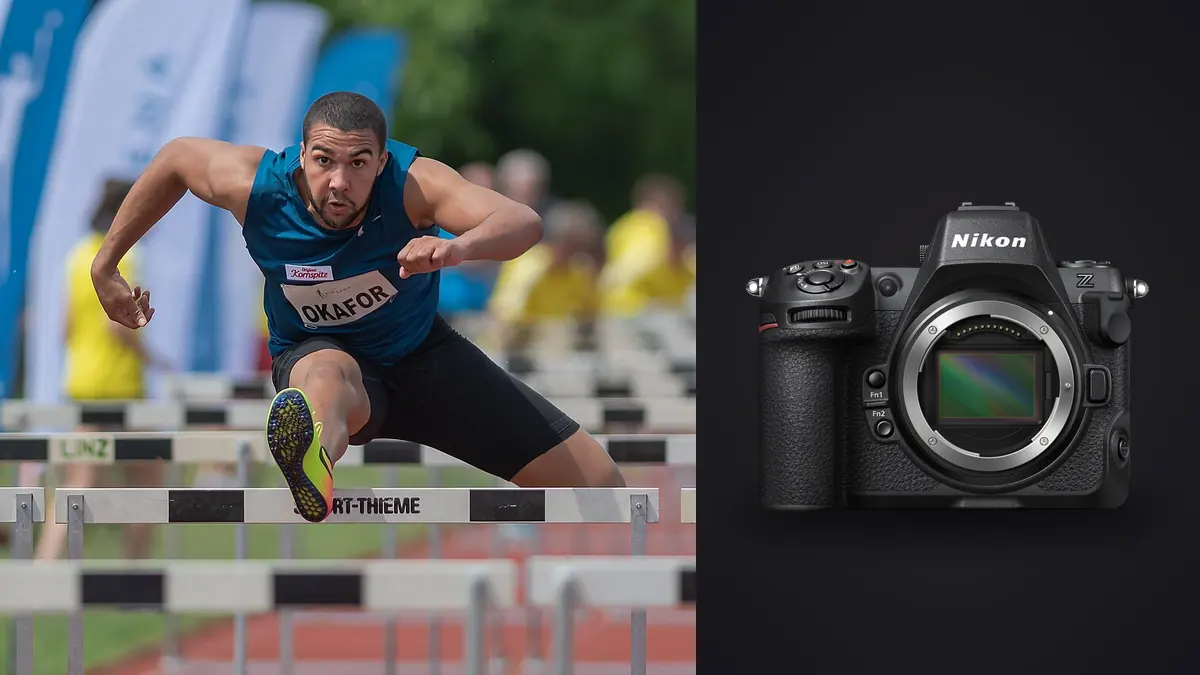
Track and field is a strange sport to shoot because it is really eight or nine different sports stacked into one afternoon. A 100m final lasts under ten seconds and rewards a camera that fires fast and locks focus instantly. Pole vault happens in slow, spread-out attempts where you have thirty seconds of dead time and then a half-second window at the bar. Discus and javelin ask you to track a rotating body and then a thrown object leaving the frame at speed. I have used the Nikon Z8 across two full outdoor seasons now, mostly at regional and state-level meets, and the short version is that it handles this variety better than any body I have owned before it, but it does not do it automatically. You have to set it up differently event to event, and there are a few real limits worth knowing before you commit a whole meet to it.
Why the stacked sensor actually matters here, not just on paper
The Z8 borrows the Z9's 45.7-megapixel stacked CMOS sensor and drops it into a body without a mechanical shutter at all. Every shot is electronic. For most genres that is a footnote. For track it changes how the camera behaves in ways you feel immediately: no shutter shock, no mirror slap, and a viewfinder that does not black out between frames at high burst rates, so you keep the runner or the vaulter in view continuously instead of watching a strobing rectangle. Coming from a DSLR background, that blackout-free finder alone made panning shots at the 200m turn noticeably easier to keep composed.
The stacked readout also keeps rolling shutter distortion under control for most track subjects. Sprinters running roughly parallel to the sensor plane show no visible skew. Where I have seen it creep in is fast lateral motion close to the lens, a relay handoff shot from a low angle with a wide-ish lens, where a baton or an arm mid-swing can pick up a very slight lean. It is subtle enough that I only noticed it pixel-peeping at 100%, not in a printed or web-sized image, but it exists.
Frame rate and buffer, by what you are actually pointing at
Nikon's headline numbers are 20fps in 12-bit lossless compressed RAW, 30fps in JPEG or high-efficiency, and a further mode that jumps to 120fps at roughly 11 megapixels for the moments where you genuinely need to freeze a single frame out of a blur (a foot breaking the finish line, a discus leaving the hand). In practice I use all three modes across a single meet, not just the fastest one, because 20fps RAW eats card space fast across a full day of heats.
Buffer depth is where the card in slot one decides your afternoon. With a fast CFexpress Type B card I can hold 20fps RAW through an entire sprint final without the buffer filling. With a budget CFexpress card, or worse, relying on the SD UHS-II slot as primary, the buffer chokes mid-race and the frame rate visibly drops right when you cannot afford it. I learned this the annoying way at a conference meet, missing the last two strides of a 400m final because I had left the SD card as slot one from a previous shoot.
| Event type | Recommended release mode | AF area mode | Practical note |
|---|---|---|---|
| 100m / 200m starts | 20fps RAW + pre-release capture | 3D-tracking from a fixed start point | Pre-release buffer catches the gun; you rarely react fast enough manually |
| Hurdles | 20fps RAW | Auto-area AF w/ People detection | Vertical motion over the barrier trips up single-point AF; wider area tracks better |
| Long / triple jump | 20fps RAW, two short bursts | 3D-tracking, recompose off the board | Fire on approach and again at takeoff, not one continuous burst for the whole runway |
| Pole vault | Single frames + short burst at the bar | Single-point, manually placed near the bar | Tracking AF loses the athlete against a bright sky background more often than it should |
| Discus / shot put / javelin | 20fps RAW | Dynamic-area AF, small group | Rotational throws need a wider capture area than a static single point can hold |
| Relay exchanges | 30fps JPEG or high-efficiency | Auto-area AF w/ People detection | Two runners in frame; RAW buffer fills fast and you rarely need full RAW here |
That pre-release capture mode deserves its own mention because it is genuinely useful for sprint starts specifically. Half-press the shutter and the camera buffers frames continuously before you fully press it, then commits up to roughly a second of pre-shutter frames once you do. Reaction time to a starting gun is not fast enough to guarantee catching the exact moment of the gun going off and the first movement off the blocks. Pre-release capture removes that guesswork almost entirely, and it is the single setting that changed my start-line shots the most.
Autofocus in practice, not the marketing description
The Z8's subject detection recognizes people, and within that, it is quite good at locking onto a runner's head and shoulders even at a distance and against a cluttered background of other athletes and officials. Where it struggles is anything sideways or partially obscured, which describes a lot of what happens at the top of a hurdle or mid-rotation in a discus throw. For those events I lean on a smaller dynamic-area AF zone that I place manually rather than trusting full-frame auto-area detection, because the system occasionally jumps to the wrong athlete when two competitors cross paths near the frame edge.
3D-tracking is the mode I default to for anything moving in a fairly straight line, which covers sprints, the straightaways of the 400m and 800m, and long jump approaches. You place the point once on the athlete and the camera holds onto them through the frame, recomposing as needed. It is not flawless, background clutter like a scoreboard or another runner crossing close behind can occasionally steal focus, but it recovers quickly and it is far less fussy to manage mid-race than repositioning a single AF point by hand.
The lighting problem nobody warns you about
Because the shutter is fully electronic, the Z8 is more exposed to banding under certain artificial lighting than a body with a mechanical option. Evening meets under older stadium lighting, particularly HID or metal-halide fixtures that flicker at a frequency the sensor's readout can catch, can produce visible horizontal banding in high-speed bursts. Nikon includes a flicker reduction setting that helps considerably, and newer LED stadium lighting is generally much less of a problem than the older fixtures still common at a lot of school and club-level tracks. Worth testing at your specific venue before a big meet rather than discovering it in the edit.
Lens choices that actually make sense for a track oval
A 70-200mm f/2.8 S covers infield events and anything happening near the near straightaway well, sprint starts from a trackside position, hurdles from a slight angle, relay exchanges. It is also light enough to hand-hold for hours, which matters more at a track meet than it does at, say, a wildlife shoot, because you are often moving position between events rather than staying planted.
For anything on the far side of the track, field events happening across the infield, a distant 400m turn, you need real reach. I have used both the 100-400mm S and the 180-600mm here and landed on the 180-600mm as my default for full-meet coverage. It gives up a stop of light compared to the faster options, which matters less outdoors in daylight and matters a lot under stadium lights in the evening. For evening meets I will swap to the 70-200mm f/2.8 and accept the tighter framing in exchange for a cleaner, lower-ISO file.
If I could only bring one lens to a full day of track and field, it would be the 100-400mm S. It is not the longest option and it is not the fastest, but it covers sprint starts at a reasonable distance, most field events from a stands position, and it is light enough that your arm is not dead by the fourth hour of a meet that runs from noon into the evening.
What actually happens to the memory cards
A single day covering a full meet, prelims through finals across running and field events, routinely puts me at 3,000 to 5,000 frames. A lot of that is not variety, it is the mechanical result of shooting 20fps bursts through races that last anywhere from ten seconds to over a minute. A single 400m race at 20fps can produce well over a thousand frames on its own if you hold the shutter the whole way around, though I have learned to fire in shorter bursts rather than holding continuously, both to save card space and because most of those frames are near-duplicates of a runner mid-stride that a human reviewer does not need to see individually.
This is where the culling side of the workflow matters as much as the camera settings. I run everything through imagic once I am back at a laptop, because a stadium with 4,000 track frames and no reliable WiFi is not a place I want to be uploading anything to a cloud service even if I had signal, and imagic processes entirely on-device, so that is not a concern either way. Its duplicate and burst clustering groups those thousand-frame 400m sequences down to the handful of genuinely distinct moments, the start, the lead change, the finish lean, instead of leaving you to scroll through a wall of near-identical frames by eye. The sharpness scoring on top of that catches the frames where a pan missed and the runner's face is soft, which happens more often than I would like to admit when tracking someone at 20fps through a turn.
For a full meet with dozens of races and heats, I also lean on imagic's apply_my_style feature, trained on my own past edits rather than a generic preset pack, so a hurdles shot from the morning heats and a final from under the evening lights land with a consistent look once I actually sit down to edit, instead of every race looking like it was color-graded by a slightly different person. If you have never used quality scoring for a sport this bursty, How AI Photo Culling Works covers the mechanics in more depth than I can here.
Battery life and the grip question
The Z8 does not ship with a built-in vertical grip the way the Z9 does, which is part of why it is roughly 400 grams lighter and noticeably more comfortable to carry around a track all day without a strap cutting into your shoulder. The optional MB-N12 grip adds a second battery and vertical controls, useful if you shoot a lot of vertical frames for field events like pole vault or high jump, but it also brings the weight and bulk back up closer to Z9 territory. I shoot most meets without it and just carry two spare batteries in a pocket. A single battery has gotten me through a full afternoon meet in mild weather; cold evening meets in late season cut that meaningfully, plan for a spare either way.
Frequently Asked Questions
Do I need the MB-N12 grip for a full day of track meets?
Not strictly. The body alone is lighter and easier to carry between events, and a couple of spare batteries in a jacket pocket covers most single-day meets without needing the grip's extra capacity. The grip earns its weight mainly if you shoot a lot of vertical orientation for field events, or if you are covering a multi-day championship where battery swaps between events start to eat into your shooting time.
Is 20fps RAW actually necessary, or would 30fps JPEG cover most track events?
For sprints and anything decided by inches at the line, RAW headroom for exposure and white balance recovery is worth the card space, especially under mixed stadium lighting where getting white balance exactly right in-camera is unrealistic. For relay exchanges and general coverage where you are shooting for volume rather than a single decisive frame, 30fps JPEG or high-efficiency is genuinely enough and saves both card space and culling time afterward.
Will the fully electronic shutter cause problems under stadium lights?
It can, mainly as horizontal banding under older HID or metal-halide fixtures that flicker at a frequency the sensor's fast readout picks up. Nikon's built-in flicker reduction setting reduces this considerably, and it is far less of an issue under modern LED stadium lighting. Test at your actual venue during a practice session before trusting it at a meet you cannot reshoot.
What's the single best lens if I can only bring one to a meet?
The 100-400mm S is the most defensible one-lens answer. It reaches far enough for most field events and turns from a stands position, handles sprint starts at a reasonable working distance, and stays light enough to hand-hold through a multi-hour meet without your arm giving out by the final event.