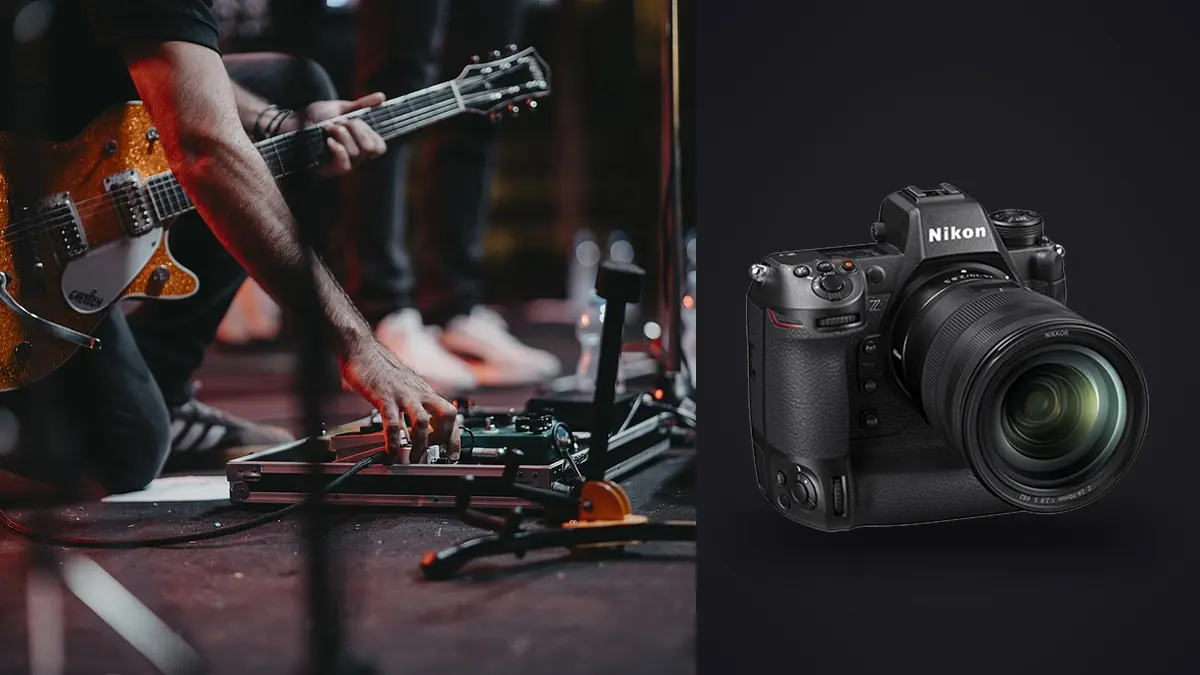
The Nikon Z9 can cover concert photography at a very high level, but capability is not the same as buying fit. Its stacked high-resolution sensor, responsive autofocus, integrated grip, large battery, and durable controls suit demanding assignments. The same body is substantial in a cramped club, its files create storage and processing overhead, and an electronic-only shutter still requires attention under stage LEDs.
A photographer choosing a concert camera should evaluate venue size, access, lens ownership, delivery speed, and physical working style. The Z9 is an excellent answer for some touring, festival, and multi-genre professionals. It can be unnecessary or uncomfortable for someone working small rooms with modest outputs.
Identify the concert jobs that justify a Z9
Large festivals, arena tours, and agency work can reward a body that transitions from pit action to backstage portraits, remote positions, and outdoor weather without changing systems. The integrated vertical grip supports repeated portrait orientation, and the battery capacity reduces changes during long days. Fast subject tracking helps when performers cross cluttered light and equipment.
Small clubs create a different equation. The body may be close to audience members, barriers, and other photographers. A large grip can be harder to maneuver discreetly, and a high-resolution file may exceed every delivery requirement. If the client needs a concise web gallery, a smaller Nikon body may provide the necessary result with less physical and storage cost.
Write down the most demanding actual assignment from the previous season. If it required weather resistance, long battery life, rapid autofocus, high resolution for publication crops, and two orientations under pressure, the Z9 has a strong case. If those needs are hypothetical, money may be better spent on lenses, access, backup, and hearing protection.
Value resolution only when it reaches the client
The Z9's roughly 46-megapixel class files provide useful crop room for distant stages and changing performer positions. They also show focus errors, haze, and lens limitations clearly. Resolution is most valuable when a publication needs multiple crops, a sponsor needs detail, or the photographer cannot always reach the ideal position.
That flexibility has a workflow cost. RAW files occupy cards, copy time, working storage, previews, and archives. A long festival can multiply the impact across several stages. Test the selected RAW compression option through the complete edit and delivery path. The best setting is the smallest proven file that preserves required quality, not the largest file offered by the camera.
Do not use crop room as a substitute for focal length and position. A performer occupying a small fraction of the frame receives fewer pixels and more visible atmospheric haze. Buy the lens range and seek the access that match the assignment. Resolution should protect a near miss, not define the normal capture plan.
Understand the electronic shutter commitment
The Z9 does not rely on a conventional mechanical shutter for still capture. That removes mechanical shutter noise and wear, which is valuable during quiet songs and backstage moments. Its stacked sensor reads quickly, but stage lighting can still create banding or brightness variation at certain shutter speeds.
Concert LEDs vary by venue, fixture, dimming, and color. Test the actual scene at the intended shutter speed, then inspect the full frame. Nikon's flicker-related controls can help in appropriate conditions, but no menu choice replaces a test. A broad band across a face may be invisible in a fast rear-screen glance.
Electronic capture also means the photographer should configure audible or visual release feedback consciously. Too little feedback can lead to accidental long bursts; too much can be distracting. Choose indicators that remain clear in a dark pit without lighting the room or drawing attention from the performance.
Assess body size as a working feature
The integrated grip offers secure handling with larger telephoto zooms and portrait orientation. It also raises the minimum size and weight of the kit. Hold the Z9 with the actual lens for the length of a typical set, including overhead and low-angle positions. A comfortable showroom minute does not represent a festival day.
In a pit, physical profile affects etiquette. The camera should stay within the photographer's space, clear of other heads and sightlines. A compact bag, short strap, and two-lens plan can offset some bulk. If the body discourages movement or causes fatigue that affects framing, its technical advantages are not fully available.
For remote or stage-edge positions, robust controls and battery capacity can be valuable, but permissions and safety govern placement. A camera must never obstruct performers, crew, cables, exits, or pyrotechnic boundaries. Buying a flagship body does not grant broader access.
Match lenses to stage distance
A fast standard zoom handles small rooms, full figures, and groups. A 70-200mm class lens covers deeper stages and isolates expressions. Wider lenses can establish venue scale but require careful edge placement near a tall stage. The Z mount provides strong choices, yet the correct kit still depends on where the credential places the photographer.
Very bright primes help in low light and can produce a distinct look, but changing them in haze, dust, and crowded spaces slows coverage. They make sense when a focal length is known in advance or a second body carries the complementary view. Avoid purchasing a prime based only on aperture if it rarely matches the working distance.
Adapted F-mount lenses may reduce switching cost for existing Nikon users. Test autofocus behavior, balance, and adapter fit with each critical lens. A front-heavy combination on the Z9 may still be workable, but it should be judged through a complete set, not a few static frames.
Compare low-light quality through final output
Concert exposure is usually limited by subject movement and highlight protection, not by a desire to use the lowest ISO. Set shutter speed for the performer, choose aperture for one or more faces, and let sensitivity rise when necessary. A sharp expressive high-ISO file is more useful than a clean blurred one.
Test RAW files under red, blue, magenta, and mixed LEDs. Saturated channels can clip and skin can become difficult to balance even when luminance noise appears acceptable. Process samples with the intended software and export at client dimensions. Noise viewed at extreme magnification overstates what may be invisible in publication.
Compare other candidate bodies using the same lens, framing, exposure, and output. Marketing samples made under unrelated conditions do not answer whether the Z9 is worth its size for a particular venue. A controlled rental reveals autofocus confidence, color recovery, and the true file-handling load.
Include the post-production burden in the purchase
Budget cards, card readers, active storage, backups, and archive capacity alongside the body. Confirm that the workstation can generate previews and move through bursts without interrupting deadlines. If not, the camera purchase may require a broader system upgrade. That cost belongs in the decision even when it is not printed on the camera box.
Local software such as imagic can analyze sharpness, exposure, closed eyes, and composition, then group duplicate and burst frames on Windows or macOS. It keeps photos local and can reduce repetitive technical review. The photographer still selects musical expression, microphone clearance, lighting, and story.
A smaller RAW option or a lower burst rate can reduce overhead when the assignment allows it. Configure an event mode rather than changing quality settings under pressure. The camera hardware guides provide more context for balancing body features with the complete working system.
Use a simple fit decision
| Working need | Z9 fit | Reason |
|---|---|---|
| Long festival days | Strong | Integrated grip, robust controls, and substantial battery suit extended coverage. |
| Large publication crops | Strong | High-resolution files leave useful framing flexibility when capture is close. |
| Tiny crowded clubs | Mixed | Capability is high, but body size and file overhead may work against discretion. |
| Lightweight travel kit | Limited | A smaller body may meet delivery needs with less physical load. |
| Existing Z lens system | Strong | Owned lenses and accessories reduce switching cost and uncertainty. |
Rent the Z9 for the kind of venue that matters most, process a complete set, and note physical fatigue as carefully as autofocus results. Buy it when the entire chain benefits, not simply because it is Nikon's highest-tier body.
Plan backup and failure recovery at venue scale
A flagship body still needs a failure path. The backup should accept at least one useful concert lens, produce the required file type, and have a control layout the photographer can operate in darkness. An older body can serve well if its low-light output and autofocus meet the brief. A backup that remains unfamiliar in the bag is not genuine redundancy.
Decide how lenses move between bodies if the Z9 becomes unavailable. A festival setup might place the standard zoom on the backup and keep the telephoto ready, while a small-club plan may use one compact prime. Rehearse the switch without placing equipment on the floor or opening mounts in haze and dust.
Carry a second card reader and a short list of critical settings. Electronic-shutter behavior, RAW compression, white balance baseline, autofocus area, and card routing should be recoverable quickly. Keep spare batteries and cards separated into ready and used groups so a rushed change does not introduce another problem.
Recovery also includes the workstation. Verify that it can read the chosen CFexpress media and Z9 RAW format before accepting a deadline. Maintain enough local working space for a full event plus an independent copy. A camera that writes rapidly can still be delayed by one slow or incompatible transfer point.
Include support availability in the buying decision. Firmware, service turnaround, rental replacements, and local lens access matter to a working system, even though they do not change image quality. The best fit is the body that can be restored to service without putting the assignment at risk.
Finally, test the backup under the same colored LEDs as the Z9. A replacement body may need different shutter speeds or noise treatment, and that difference should be understood before both cameras contribute to one gallery. Store a small processed sample from each so the editor knows how closely their files can be matched.
Include one mixed-camera export in the rental review and view it beside the Z9 file at client size. The backup succeeds when the pair can be delivered coherently without an emergency reconstruction of color and tone.
Frequently asked questions
Is the Nikon Z9 too large for concert photography?
Not inherently. Its grip and balance suit long lenses and long days, but it can feel intrusive in a small crowded club. Try it with the intended lens in a realistic working posture.
Can the Z9's electronic shutter band under stage LEDs?
Yes, some LED and shutter-speed combinations can produce uneven exposure. Test the actual lighting and use the camera's flicker controls or a different shutter speed when needed.
Does every concert photographer need Z9 resolution?
No. It is useful for publication crops and distant stages, but it also increases storage and processing demands. Final client output should justify the extra information.