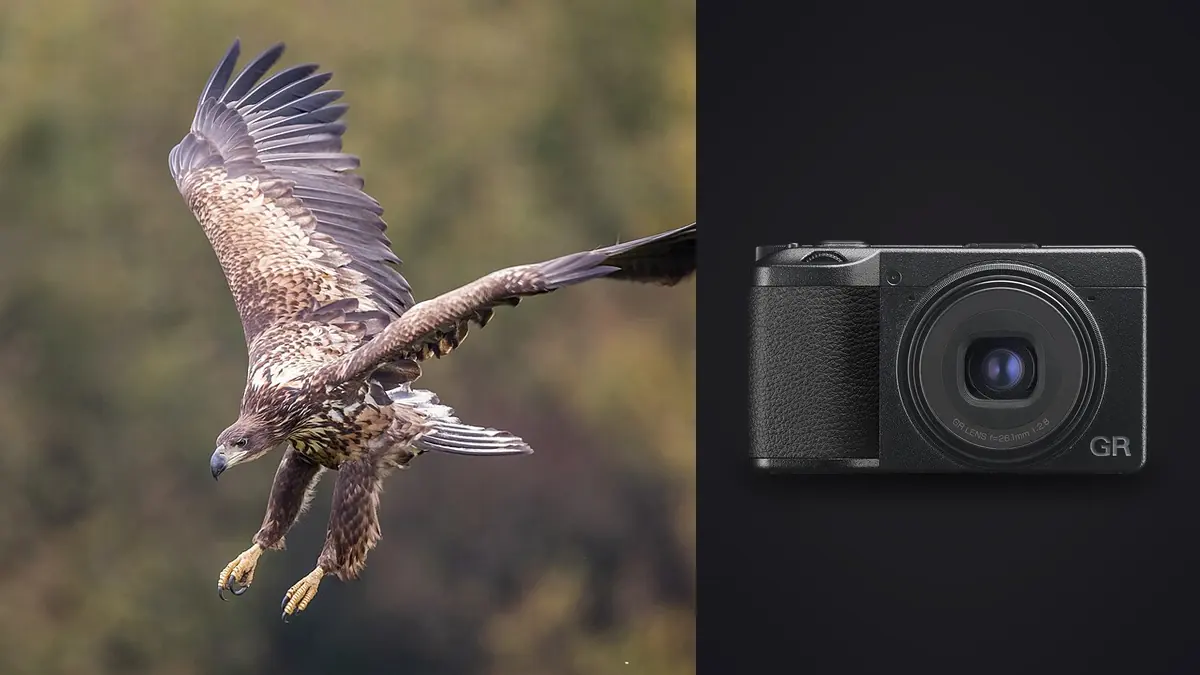
I took a Ricoh GR IIIx to a tidal estuary in early spring hoping to prove myself wrong. The plan was oystercatchers and a scattering of black-headed gulls working the mudflats at low tide, birds that lift off in short, predictable bursts whenever a dog walker gets too close. If any pocket camera was going to fake its way through birds in flight, I figured a clean 24-megapixel APS-C sensor behind a genuinely excellent lens had a puncher's chance. Two hours and roughly 600 frames later, I had four photos I'd actually call keepers, and not one of them had a bird off the ground. That's the honest starting point for this piece: the GR IIIx is one of my favorite cameras to carry every day, and it is a poor tool for birds in flight. Understanding exactly why, and where the real limits sit, is more useful than either claim taken alone.
What the GR IIIx is actually built to do
The GR IIIx pairs a fixed 26.3mm lens (about 40mm full-frame equivalent, f/2.8) with a 24-megapixel APS-C sensor and no anti-aliasing filter, in a body that weighs 178 grams and disappears into a coat pocket. Ricoh built it as a street and travel camera, and on that job it's close to the best in the world: silent, instant to raise and shoot, and sharp enough that you stop thinking about the lens entirely. None of that design brief has anything to do with distant, fast-moving wildlife. The autofocus is contrast-detect only, no phase-detection points, no animal-eye or bird tracking of any kind. Continuous shooting tops out around 4 frames per second, and the buffer is shallow enough that a long burst in raw will bog the camera down after a handful of frames. There's no viewfinder unless you buy the optional optical unit, which has no autofocus assist and is really there for framing in bright sun, not for tracking a moving subject. None of this is a flaw in the camera. It's a camera doing exactly what it was designed to do, which happens to be almost the opposite of what birds in flight demand.
The focal length problem, in real numbers
A 40mm equivalent lens has a diagonal angle of view of roughly 57 degrees. That's a wide-normal field of view, built for a person standing across the street, not a wader thirty meters out over open water. Do the rough math and it gets worse fast. An oystercatcher is about 25cm from bill tip to tail. At 25 meters (a reasonable distance for a bird that's already cautious of you), that bird occupies a sliver of the frame, somewhere in the single-digit percent of frame height. Crop that down to a composition where the bird actually reads as a bird rather than a smudge, and you're throwing away the vast majority of your 24 megapixels to get there. I've pulled crops from that estuary session that started as 6000x4000 files and ended up under 2 megapixels once I cropped tight enough to see a wing shape. That's a print-quality problem as much as a sharpness problem, and no amount of lens quality fixes it, because the lens was never the bottleneck. The bottleneck is that 40mm simply doesn't reach.
How it stacks up against gear people actually use for this
To put the GR IIIx's limits in context, here's how it compares with three cameras birders actually reach for, based on published specs and my own time behind each of them. The "field verdict" column is my own characterization from shooting all four, not a manufacturer claim.
| Camera | Effective reach | AF for moving subjects | Continuous shooting | Raw buffer before slowdown | Field verdict for BIF |
|---|---|---|---|---|---|
| Ricoh GR IIIx | 40mm equiv., fixed | Contrast-detect only, no subject tracking | ~4 fps | Roughly 4-6 frames, then a long stall | Close, slow, or stationary subjects only |
| Sony RX10 IV (bridge) | 24-600mm equiv. zoom | Hybrid phase/contrast, 315 AF points, real-time tracking | Up to 24 fps | Deep enough for short flight sequences, thins out on long bursts | A genuinely usable entry point for BIF |
| APS-C mirrorless + 150-600mm | 225-900mm equiv. | Phase-detect with dedicated bird/animal tracking modes | 15-20 fps | Large, built for extended bursts | A serious BIF setup, heavy and expensive |
| Nikon P1000 (bridge) | 24-3000mm equiv. | Contrast-detect, hunts noticeably at long reach | ~7 fps | Shallow, throttled by processing at full zoom | Extreme reach, AF struggles with fast, erratic flight |
The pattern that jumps out isn't just focal length. It's that every camera actually built for BIF pairs reach with tracking autofocus and a deep buffer, because catching a bird mid-turn is as much about the AF system predicting where it's going as it is about the lens seeing it. The GR IIIx has none of those three ingredients. It's not a smaller version of a BIF camera. It's a different tool entirely, and it shows the moment a wing starts moving.
Where the GR IIIx genuinely earns a place in a birding kit
None of this means the camera is useless on a birding trip. It just means the job shifts. A few situations where I've actually kept the GR IIIx's output:
- Perched, close subjects. Raptor displays, rehab centers, garden feeders where a bird lands within a few meters. At that range, 40mm gives you a decent frame fill and the lens's sharpness carries the shot.
- The moment right before takeoff. A duck bracing with wings half-cocked, a heron leaning into its first stride, is a static enough subject for contrast-detect AF to lock, and it often reads as a more interesting photograph than the flight itself.
- Known flight corridors. Swallows cutting through a barn doorway, gulls following a boat's wake close to the rail. You're not tracking here, you're pre-focusing a fixed zone and timing the shutter release, which sidesteps the AF system entirely.
- Habitat and context shots. Wide environmental frames of the wetland, the hide, the flock lifting off as a mass rather than individuals, for a trip journal or a spread that needs scale rather than detail. The bird doesn't need to fill the frame for this to work.
In practice, most birders who carry a GR IIIx are carrying it alongside real glass, not instead of it. It rides in a pocket for the shots a bulky telephoto rig would miss because it wasn't up and ready in time, while the actual birds get photographed with whatever's on the tripod.
Working around the autofocus instead of fighting it
If you're determined to try flight shots anyway, the single biggest change is abandoning continuous autofocus altogether. Snap Focus mode, which locks the lens to a preset distance (1m, 1.5m, 2m, 5m, infinity, and a couple of steps in between) and fires the instant you press the shutter with zero AF hunting, is the only realistic way to catch fast action on this camera. You pick the distance the bird is going to be at, you wait, and you fire. It's manual focus by another name, and it's far more reliable than letting the contrast-detect system chase a moving target it was never built to follow.
Shutter priority is close to mandatory too. The GR IIIx's leaf shutter tops out at 1/4000s mechanically, which is fine for freezing a wing on a bright day, but flat or overcast light forces a choice between a wider aperture (softer image, thinner focus margin at close range) or a higher ISO than you'd like on a compact sensor. I generally shoot 1/2000s or faster and let ISO float, because a slightly noisy sharp frame beats a clean blurry one every time with a subject this small in the frame.
Crop discipline matters more here than with almost any other genre. Since you're already throwing away most of your resolution to get the bird to a usable size, compose knowing that in advance rather than shooting wide and hoping. A bird small in frame with clean habitat around it, presented deliberately rather than as a failed close-up, holds up a lot better than a desperate crop trying to manufacture a portrait that was never there.
The keeper rate, and why the culling step gets brutal
Here's the part nobody mentions in spec sheets: even with pre-focus and good technique, my hit rate with the GR IIIx on erratic flight is somewhere around 1 usable frame per 40-60 attempts. A proper BIF rig with tracking AF gets me closer to 1 in 8-10 on the same subjects. That gap doesn't just mean fewer good photos, it means a much bigger pile of near-identical, mostly-failed frames to sort through afterward, because you're firing multiple attempts at a bird approaching your pre-focused zone hoping one lands in the right spot at the right instant.
That's exactly the situation where a fast local culling pass earns its keep. Coming back from a morning at the marsh with 500+ frames of birds that are 90% misses (soft focus, bird half out of frame, wing position mid-flap and awkward) is not something you want to eyeball one by one on a laptop screen. I run these through imagic's local sharpness scoring first, which flags the genuinely in-focus frames without me pixel-peeping every single one, and then let it cluster the near-duplicate burst sequences so I'm comparing three or four real contenders from each flight attempt instead of scrubbing through the whole card. Since it's processing on-device with nothing leaving the laptop, I can do this triage at the hide with no signal, which is most of the places worth doing this kind of shooting in the first place. It won't make the GR IIIx's autofocus faster, but it does mean the four keepers from a 600-frame session don't take an hour to find. If you want a broader look at how automated culling actually separates sharp frames from soft ones, this breakdown of how AI photo culling works covers the mechanics in more depth.
Once you've settled on how you like these habitat-heavy, thin-crop wildlife frames edited (I tend to push contrast harder and desaturate slightly to compensate for how flat compact-sensor files get at high ISO), imagic's apply_my_style feature learns that look from your own past edits and applies it consistently to new batches, which matters more than usual here because a crop this aggressive shows every inconsistency in tone between frames. For a workflow that's mostly about triaging large, low-hit-rate bursts fast, it's worth pairing with general habits too, and these workflow tips cover ground beyond just the culling step.
If birds in flight is actually the goal
Be honest with yourself about what you're trying to come home with. If the goal is documenting a birding trip, building a habitat portfolio, or getting close-range, patient shots of perched or feeding birds, the GR IIIx does that job well and does it in a package you'll actually have with you every time. If the goal is genuinely catching birds mid-flight, mid-turn, wings up, the camera to buy is one built around that problem: a bridge camera with real zoom reach and phase-detect tracking, or an APS-C or full-frame body paired with a long telephoto. I carry both now. The GR IIIx stays in a jacket pocket for the walk in, the environment shots, and the lucky close encounter. The actual flight shots come from whatever's on the tripod. Trying to make one camera do both jobs is where the frustration comes from, not from anything wrong with the GR IIIx itself.
Frequently Asked Questions
Can the GR IIIx's autofocus track a bird in flight the way a mirrorless system can?
No. The GR IIIx uses contrast-detect autofocus with no phase-detection points and no subject-tracking modes for animals or birds. It's tuned for quick, confident locks on stationary or slow subjects at close range, and it will hunt or simply fail to keep up with anything moving erratically across the frame. Snap Focus mode, which skips autofocus entirely in favor of a preset distance, works far more reliably for action than letting the AF system try to chase a bird.
Is there a teleconverter or accessory that gives the GR IIIx real telephoto reach?
Not for reach. Ricoh's official conversion lens for the GR series is a wide-angle adapter, not a teleconverter, so there's no accessory path to extra focal length here. The only way to get a bird bigger in the frame is to physically get closer or to crop hard afterward, both of which come with the tradeoffs described above.
What kind of keeper rate should I expect from a session trying birds in flight with this camera?
In my own field use, somewhere around one usable frame per 40 to 60 attempts on genuinely fast, erratic flight, compared to roughly one in 8 to 10 with a camera built for the job (tracking AF, real reach, deep buffer). Perched or slow-moving subjects close to the lens do much better. Budget your expectations, and your card space, accordingly.
Is the GR IIIx weatherproof enough for a morning at a tidal estuary or wetland?
No, and this is worth planning around separately from the autofocus issue. The GR IIIx has no official weather sealing, so drizzle, sea spray, and the general dampness of a dawn wetland session are real risks to the body, not just the image quality. Some owners report it surviving light rain without issue, but that's not a guarantee Ricoh makes, and marshy, salt-air environments are exactly the conditions where I'd rather not test it.