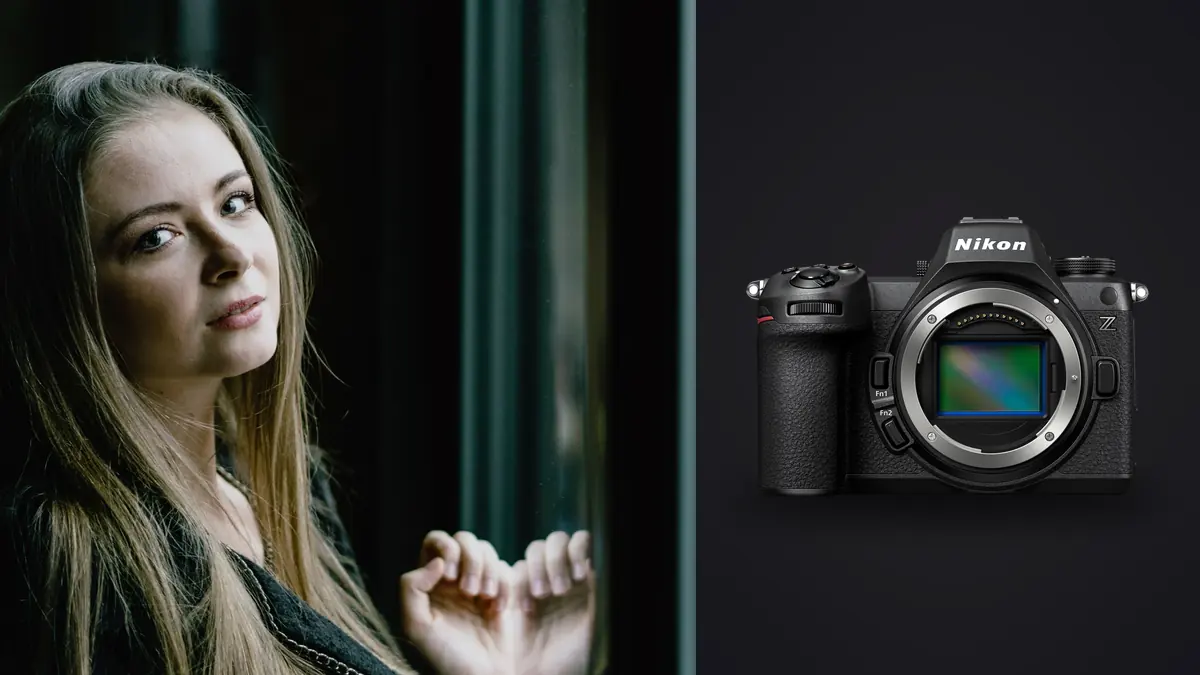
Boudoir work punishes gear the way street photography or landscape work never does. You are usually in a bedroom, a hotel suite, or a small studio set dressed to look like one, with one or two continuous lights, a nervous client, and maybe forty minutes before the mood you built starts to fade. The camera has to disappear into the process. After several years shooting this genre on a mix of bodies, the Nikon Z6 III has become the one I reach for first, not because it is flashy on a spec sheet but because of a handful of specific things it does well in exactly this kind of room.
This isn't a generic camera review. It's a rundown of what actually matters when the subject is six feet away in low, warm light, moving slowly, and trusting you to make her look and feel good in the process.
The sensor and stabilization combination that makes low light workable
Most boudoir sets I've worked run on a single key light, sometimes a small LED panel bounced off a wall or ceiling, sometimes just window light with a diffuser. That means you're regularly shooting at ISO 3200 to 6400 with a shutter speed you'd never choose if you had more light to spend. The Z6 III's partially stacked sensor handles that combination better than the Z6 II did. Noise at 6400 stays fine grained rather than blotchy, which matters enormously when the next stop is a skin-focused retouch where every artifact gets magnified.
The in-body stabilization is the other half of that equation. Rated around 8 stops depending on the lens, it lets me hand-hold at 1/30s or even 1/15s for a static, reclined pose without a tripod eating up floor space in a room that's already tight. Tripods have their place in boudoir for consistency across a series, but there's a real cost to planting one in a small bedroom set: it becomes a physical barrier between you and the client, and it telegraphs "this is a formal photo session" instead of the more intimate, conversational feel that gets better expressions. I use a tripod for maybe a third of a shoot now and handhold the rest, something that simply wasn't reliable on older bodies at these shutter speeds.
Autofocus with lace, sheets, and skin against skin
Eye-detection autofocus sounds like a solved problem until you point it at a subject half-wrapped in a sheer robe against a dark headboard, or lying on white sheets where the eye and the surrounding skin have almost no contrast. The Z6 III's subject detection is good, but boudoir exposes its edge cases more than any other genre I shoot.
Three habits fixed most of my missed-focus frustration. First, I switched to single-point AF with eye-detection as an assist rather than letting wide-area tracking pick a subject on its own; in a scene with lace, pillows, and skin all competing for attention, the camera sometimes locks onto a fold of fabric instead of an eye. Second, at f/1.2 or f/1.4 the depth of field is thin enough that near-eye versus far-eye placement genuinely changes whether a frame is usable, so I recompose deliberately rather than trusting the widest tracking box. Third, back-button focus is close to mandatory here, because a lot of boudoir posing involves the subject settling into a position over several seconds, and you want to lock focus once and reframe slightly without the camera hunting again on the next half-press.
Lens choices that actually earn their keep
I've rotated through most of the Z-mount portrait primes on boudoir work, and they don't all behave the same way once you're shooting three to four feet from a reclined subject.
| Lens | Min. focus distance | Best use in boudoir | Cost tier |
|---|---|---|---|
| Nikkor Z 35mm f/1.4 | ~0.28m | Full-room environmental shots, small-space wides without obvious distortion | Mid |
| Nikkor Z 50mm f/1.2 S | ~0.45m | The workhorse; natural perspective at 3-5 feet, holds detail wide open | Premium |
| Nikkor Z 85mm f/1.2 S | ~0.85m | Compression for close crops; needs more room to work than a small bedroom set often has | Premium |
| Nikkor Z 24-70mm f/2.8 S | ~0.38m | Coverage shots and client walkthroughs where changing primes wastes time | Mid |
| Nikkor Z MC 105mm f/2.8 | ~0.29m | Detail frames: hands, jewelry, fabric texture for album inserts | Mid |
The 50mm f/1.2 S ends up mounted for most of a session because it matches how a small room actually feels: close enough to the subject to keep the conversation intimate, wide enough that you're not backed against a wall trying to fit a full-length pose. The 85mm is gorgeous when there's space for it, but in a genuine bedroom (as opposed to a studio built to look like one) you'll find yourself backed into a closet door more often than you'd like. The macro lens is not a boudoir "must have," but detail shots for album spreads (a hand resting on a collarbone, the texture of a robe) sell print packages, and 105mm at close range does that job better than cropping a 50mm frame ever will.
Camera settings that stopped me second-guessing exposure
I shoot boudoir almost entirely in manual exposure with auto ISO capped at 6400, because the light in these rooms shifts as the subject moves relative to the window or the softbox, and I'd rather the camera compensate on ISO than have me chase shutter speed while also directing a pose. Aperture sits between f/1.8 and f/2.8 for most frames; wide open at f/1.2 looks striking in isolated single-eye close-ups but is a liability the moment the subject's face turns even slightly, since one eye goes soft.
White balance I set manually by Kelvin rather than auto, usually somewhere in the 3200-3800K range for warm LED continuous light, because auto white balance drifts frame to frame as skin tone and fabric color shift in the frame, and that drift becomes a real headache in the edit when you're trying to keep a gallery visually consistent. For shutter mode, I lean on the electronic front-curtain / quiet shutter option for most of the session. It's not fully silent, but it's dramatically less intrusive than a full mechanical clack, and in a genre where the client is already self-conscious, a quieter camera measurably changes how relaxed people look on camera. When strobes come into play I switch back to mechanical shutter to stay inside standard sync speed rather than fight with high-speed sync workarounds mid-session.
The part nobody puts in the camera review: sorting what you shot
A single boudoir session with the Z6 III's higher frame rates and a habit of shooting in short bursts to catch a natural transition between poses can easily produce 1,200 to 1,800 frames. Multiply that by the fact that boudoir poses are inherently repetitive by design (small variations on a small number of positions) and you get a card full of near-duplicate frames where the difference between the keeper and the reject is a fraction of a stop of sharpness on the near eye, or a half-second of expression. Doing that sort manually at 11pm after a shoot is where a lot of photographers in this genre burn out. This is the one place I actually run the take through imagic before touching Lightroom: its duplicate and burst clustering groups those repetitive sequences automatically, and its local sharpness and focus scoring flags which frame in each cluster actually nailed the eye instead of the eyelash. Because it processes everything on the machine rather than uploading someone's most private images anywhere, it's also one of the few tools in this workflow that needs no second thought from a confidentiality standpoint, which matters more in boudoir than in almost any other genre.
If you're new to AI-assisted culling generally and want the mechanics behind why duplicate clustering actually works (and where it still needs a human eye), this breakdown of how AI photo culling works is worth reading before you build it into a paid workflow.
Getting a consistent edit across the whole gallery
Clients notice inconsistency in a boudoir gallery faster than in almost any other type of delivery, because they're looking at their own skin tone across forty or fifty images in a row. A slightly cooler white balance on frame twelve next to a warmer one on frame thirteen reads as sloppy even to non-photographers. Once the culled selects come out of imagic, I run them through the apply_my_style preset feature, which is trained on a batch of my own previously finished boudoir edits rather than a generic filter pack. It gets skin tone and the warm, slightly desaturated look I use for this genre close enough on the first pass that the manual work left is fine-tuning individual frames rather than rebuilding the look fifty times over.
That matters more for a one-person boudoir studio than it might for other genres, because turnaround time is part of what clients are paying for, and the editing stage is usually the actual bottleneck, not the shoot itself. If turnaround is where your own workflow keeps stalling, 10 tips for a faster photo workflow covers more of the habits that shrink that bottleneck beyond just the culling step.
What I'd tell someone buying into this system for the first time
The Z6 III is not the only camera capable of shooting boudoir well; a Z6 II, an a7 IV, or an R6 II will all get you usable files in the hands of someone who understands the light. What the Z6 III buys you specifically is a bit more headroom at high ISO, noticeably better stabilization for the handheld, tripod-free style of shooting this genre rewards, and a quieter shutter option that has a real, measurable effect on how a nervous client behaves in front of the lens. None of that shows up as a single dramatic spec-sheet number, which is probably why it doesn't get talked about much in this context, but it's exactly the kind of incremental advantage that adds up across a full booking calendar.
Frequently Asked Questions
Is the Z6 III too much camera, or too loud, for a boudoir session in a client's own home?
It's not too much camera; the body is compact enough to work handheld in tight bedrooms without feeling clinical. On loudness, the electronic front-curtain and quiet shutter modes get it close to silent for continuous-light work, though you'll still want mechanical shutter with studio strobes for reliable sync.
What ISO ceiling actually makes sense for skin retouching in this genre?
I cap auto ISO at 6400 on the Z6 III for boudoir work. Files stay clean enough at that ceiling to hold up under frequency-separation retouching, while anything past it starts costing you fine skin texture you'll want to preserve rather than smooth away.
Does the in-body stabilization really replace a tripod for available-light boudoir?
For static, reclined poses shot around 1/30s to 1/15s, yes, most of the time. It won't help with a subject shifting mid-pose or with slower shutter speeds needed for deliberately blurred, dreamy frames, so I still keep a tripod nearby rather than leaving it in the car.
How do I keep boudoir images secure once they're off the memory card?
Encrypt the drive you offload to and avoid any tool in your pipeline that uploads originals to a cloud server for processing. That's a big part of why I run culling locally through imagic rather than a cloud-based culling service: the images never leave the machine during sorting, which is one less place private photos could end up somewhere they shouldn't.