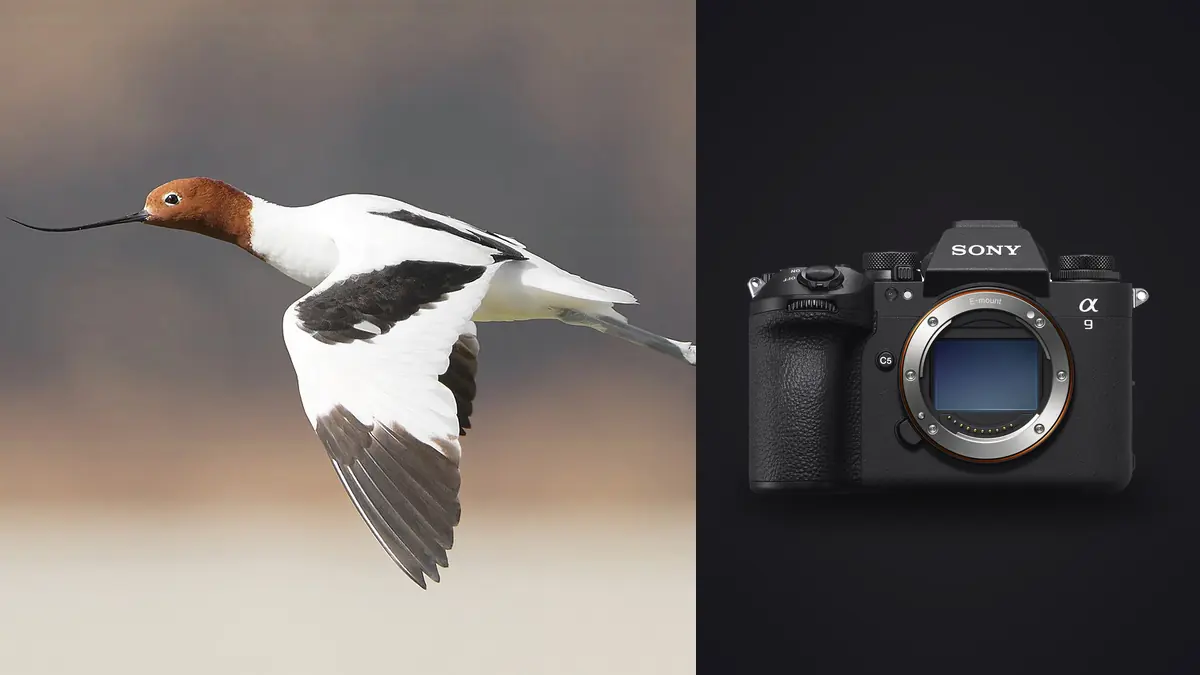
Most camera launches promise a bigger number somewhere. The Sony A9 III's headline number is 120, as in 120 frames per second with full autofocus and auto-exposure tracking, but that's not actually the spec that changes how you photograph a swift cutting across a barn door at head height. The spec that changes that is the global shutter, and after a season of using the A9 III on everything from soaring red kites to hummingbirds at a feeder, I think most of the coverage aimed at the wrong headline.
What the global shutter actually fixes
Every prior stacked-sensor Sony, the A1 included, reads the sensor top to bottom in a rolling fashion. At normal shutter speeds you never notice it. At the shutter speeds and frame rates wildlife shooters actually use, on a fast-moving subject, it shows up as a slight skew or wobble, most visible on propellers, spinning wheels, and yes, wingtips at the bottom of a downstroke. It's subtle enough that most photographers never diagnosed it as the cause of a soft-looking wing edge. They just called it "motion blur" and moved on.
The A9 III's sensor exposes every pixel at the exact same instant, so that skew is structurally impossible. What you get instead is a wing edge that's either sharp or blurred by genuine motion, never geometrically distorted. For a peregrine stoop or a woodpecker's wingbeat, that distinction matters more than it sounds like it should, because it means a 1/3200 shot of a fast wingbeat renders the way your eye expects it to, with clean feather separation at the tip rather than a smeared diagonal.
The second thing global shutter buys you, and this is the one nobody puts in the marketing copy, is flash sync at any shutter speed up to the sensor's mechanical ceiling. If you shoot feeder setups or hide work with fill flash, you're no longer capped at 1/250 sync. You can run 1/2000 with flash to freeze a chickadee's wings while still controlling ambient exposure, which used to require a high-speed sync mode that ate two stops of flash power. On the A9 III it's just how the shutter works.
Autofocus against sky versus autofocus against water
Sony's bird-eye recognition has been strong since the A1, so the A9 III isn't a leap forward there so much as a consolidation. Where it does feel different is in how it holds a small, fast subject against a cluttered or low-contrast background, which is the actual daily struggle in flight photography. A raptor against open sky is close to a solved problem on any recent Sony body. A tern diving against sun-glittered water, or a flycatcher sallying out from a hedge and back, is where AF systems still get confused, and the A9 III's tracking held onto the eye through those scenarios noticeably more often than my A1 did on the same lens.
I'd attribute part of that to processing headroom rather than a fundamentally new algorithm. Reading the whole sensor at once, with no rolling artifacts to correct for, seems to give the AI subject-detection engine cleaner data to work from frame to frame, especially at 120fps where consecutive frames are only 8 milliseconds apart. Whatever the mechanism, the practical result is fewer sequences where the camera locks onto a background branch mid-burst and never comes back.
Where it still struggles: birds that flip from silhouette to backlit to sidelit within a single pass, which happens constantly at dawn over water, and genuinely erratic fliers like swifts and swallows that change direction faster than any tracking algorithm can predict. No camera fixes bad glass or bad panning technique, and the A9 III is no exception.
Frame rate, buffer, and matching drive speed to the bird
The instinct with a 120fps body is to leave it on the top setting and let the camera sort out the keepers. I did that for about two weeks before realizing it was actively making my evenings worse without improving my hit rate. A red-tailed hawk riding a thermal doesn't need 120 frames a second, its wingbeat cadence is slow enough that 20 or 30fps captures every meaningfully different wing position. Burning through a thousand near-identical frames of a soaring bird just means a thousand more files to sort later for the same handful of usable poses.
Where the full 120fps and the one-second pre-capture buffer earn their keep is the split-second stuff: a kingfisher's launch off a perch, a heron's strike, anything with a trigger moment you can't react to in time. Pre-capture rolls a buffer before you fully press the shutter, so as long as you're pre-framed on the perch, you get the launch even if your reaction time is the usual quarter-second too slow. That single feature has salvaged more sequences for me than the frame rate bump itself.
| Flight scenario | Drive speed | Shutter floor | AF area | Field note |
|---|---|---|---|---|
| Soaring raptors, open sky | 20–30 fps | 1/1600–1/2000 | Wide, bird priority | Slow wingbeat, no reason to fill the card |
| Swifts/swallows low pass | 120 fps + pre-capture | 1/3200–1/4000 | Spot / expand flexible spot | Erratic direction beats the tracking before the sensor is the limit |
| Waterfowl skeins at dawn | 20–30 fps | 1/1000–1/1250 | Wide, tracking | Dual base ISO matters more here than fps |
| Perch-to-launch (kingfisher, heron) | 120 fps, 1s pre-capture | 1/2500+ | Small flexible spot on eye | Pre-capture is the actual difference-maker for this shot |
| Feeder work with fill flash | 10–15 fps | Any, flash-synced | Wide | Global shutter removes the old 1/250 sync ceiling entirely |
Dropping drive speed for the slower subjects isn't just about card space, though a full day at 120fps on soaring birds will chew through a CFexpress Type A card faster than you'd think. It's about what happens after you get home, which I'll get to below.
Lenses that actually make sense on this body
The A9 III rewards long, fast glass more than most bodies because its autofocus and buffer depth can keep up with what a 400mm f/2.8 or 600mm f/4 throws at it. The 400mm f/2.8 GM with the 1.4x teleconverter has been my default for anything from mid-sized raptors down to smaller passerines, giving 560mm at f/4, which the A9 III's AF handles without noticeable hunting even in flat overcast light. The 200-600mm G is the more practical choice if you're hiking to a site rather than shooting from a car or hide, and it pairs fine with the body, though you'll notice the extra stop or two of light matters more at 120fps than it does at 20fps, since faster shutter speeds are non-negotiable at the higher drive rate.
The 300mm f/2.8 GM with a 2x teleconverter is the setup I reach for with erratic small fliers like terns and swifts, because the shorter native focal length combined with the crop-in from the TC gives a wider AF-acquisition frame than a 600mm prime would, and re-acquiring a bird that's just changed direction is the whole game with those species.
Settings I've actually landed on
Base ISO on the A9 III sits at 250 rather than the 100 you're used to on other bodies, because of the dual-gain architecture the global shutter design requires. In practice that means overcast BIF days aren't the ISO penalty they sound like on paper, since you're already starting from a slightly elevated base and the second gain step kicks in cleanly around ISO 2500 rather than degrading gradually the way older sensors do. I generally shoot Aperture priority at f/5.6 to f/7.1 depending on the lens, Auto ISO with a floor shutter speed set per scenario from the table above, and AF-C with bird-eye recognition on unless I'm working a species the camera doesn't reliably recognize (a few duller-plumaged waders still get missed more than raptors or waterfowl).
Mechanical shutter stays off entirely. There's no reason to use it on this body since the global shutter has none of the artifacts (banding under LED light, rolling distortion) that made electronic shutter a compromise on older cameras. Silent shooting at full frame rate, full flash sync, no caveats, which took me longer to trust than it should have after a decade of "electronic shutter, but" caveats on every other camera.
The evening after: what 120fps does to your workflow
Here's the part that doesn't show up in spec sheets. A single afternoon at a heronry, mixing pre-capture launch sequences with steady 30fps soaring shots, routinely leaves me with four to six thousand frames. A meaningful fraction of any 120fps burst is functionally identical to the frame before and after it, just eight milliseconds of wing position apart, and sorting that by eye in Lightroom is the single most tedious part of owning this camera. I used to budget almost as much time to culling an outing as I did to shooting it.
That's the specific problem I now offload to imagic rather than doing by hand. It runs entirely on the machine, no upload queue to wait on in the field, and its sharpness scoring will flag which frame in a twelve-shot burst actually has the crispest eye and wingtip rather than making me flick through all twelve at 100% zoom myself. The burst and duplicate clustering is the bigger time saver on 120fps sequences specifically, since it groups the near-identical frames from a single wing-flap cycle so I'm reviewing one representative thumbnail instead of a dozen. Once I've picked keepers, the apply_my_style preset, trained on how I've actually graded my own raptor and waterfowl shots in the past, gets a consistent starting grade across a mixed-light session before I do the manual fine work on the frames that matter. If you haven't looked at how AI-assisted culling actually scores sharpness rather than just guessing from thumbnails, it's worth reading through how AI photo culling works to see what it's checking under the hood. For anyone still doing this by eye through six thousand frames a session, a faster sort-and-select routine is covered in this rundown on speeding up the whole workflow, and the details on imagic's pricing are on its pricing page if you're weighing it against a subscription tool.
Frequently Asked Questions
Do I actually need 120fps for garden and feeder birds, or is that overkill?
For a bird sitting on a perch and occasionally hopping, 120fps is mostly wasted frames. Where it earns its place at a feeder is capturing the actual launch or landing moment, and even then the one-second pre-capture buffer is doing more work than the raw frame rate. I'd run 10 to 15fps for perched behavior and only spin up to full speed when a bird looks like it's about to take off.
How does the global shutter change flash photography for birds specifically?
It removes the old flash sync ceiling entirely. Previous bodies capped mechanical sync around 1/250 to 1/320, forcing high-speed sync (and a real flash power penalty) for anything faster. The A9 III syncs flash at any shutter speed the sensor supports, so a feeder setup with fill flash can run 1/2000 or faster to freeze wingbeats without burning through flash power on HSS overhead.
Is the jump from an A1 or a1 II worth it purely for flight shots?
If your current keeper rate is already high and your main limiter is reach or reaction time, the practical gain is smaller than the marketing suggests, most raptor and waterfowl shots don't stress rolling shutter at all. Where the upgrade shows up clearly is fast erratic fliers (swifts, terns, hirundines) and flash-assisted work, both of which are a smaller slice of most birders' actual shot count than raptors and waterfowl.
Does shooting at 120fps mean my hit rate on sharp wing positions actually goes up?
Yes, but less than the frame rate multiplier implies, because a wingbeat cycle only has so many meaningfully distinct positions within it. Going from 30fps to 120fps gives you roughly four times the frames but nowhere near four times the useful variety, most of the extra frames are near-duplicates a few milliseconds apart. The real gain is a better chance of catching the specific instant, like full extension at the top of a downstroke, rather than more usable variety overall.