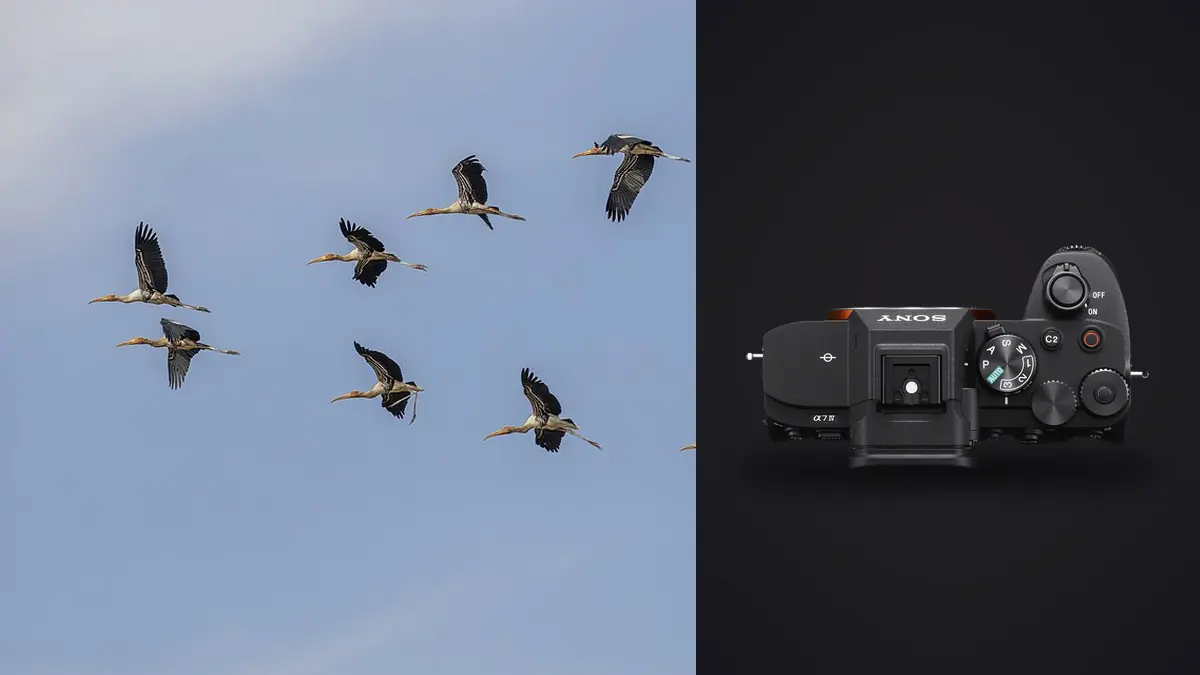
The first time I took a Sony A7 IV out to photograph ospreys diving on a river, I came home with about 340 frames and maybe eleven I'd call sharp. That's not a great hit rate for a camera with a reputation as Sony's do-everything hybrid body. It taught me something worth saying up front: the A7 IV is a genuinely capable wildlife camera, but it is not the effortless bird-in-flight machine some reviews make it sound like. It rewards a deliberate setup far more than a flagship sports body would, and if you skip that setup you'll blame the gear for what is actually a settings problem.
Why I Almost Passed on It for This Kind of Work
I'd used a9 II bodies rented for a couple of shorebird trips before buying my own A7 IV, and the difference in top-end burst speed is real and worth naming honestly. The A7 IV's fastest continuous rate is 10fps, and you only get that with the mechanical shutter locked to compressed raw or JPEG. Switch to the silent electronic shutter, which you'll want for skittish birds that spook at the mechanical shutter's clack, and you're capped closer to 6fps. Shoot uncompressed raw, which some photographers still prefer for maximum tonal flexibility, and the rate drops again regardless of which shutter you're using.
Rolling shutter is the other honest caveat. The A7 IV's sensor readout in electronic shutter mode is on the slower side for this class of camera, and a fast horizontal pan on a swallow or a tern will occasionally skew straight lines in the background, a fence post leaning, a wingtip smearing at the edge of the frame. It's not constant and it's not dealbreaker-bad, but if you're coming from a global shutter body or an a9-series camera, expect to notice it the first time you review a burst at 100%.
None of that made me return the camera. It made me stop expecting it to behave like a $6,000 sports body and start treating it like what it is: a 33-megapixel all-rounder that happens to have a genuinely strong autofocus brain borrowed from cameras a tier above it.
What the Autofocus System Actually Does With Birds
The A7 IV carries 759 phase-detection points across most of the frame, and the real-time tracking algorithm is the same generation of Sony's subject recognition that made the a1 and a9 II so good at holding onto erratic subjects. Set to Animal or Bird recognition, it will find an eye on a perched heron from a surprising distance and it will keep locking onto a moving pigeon's head through branches that would confuse a lot of older AF systems. On birds in flight against open sky, in good light, it's honestly excellent, close to what I got out of the rented a9 II in the same conditions.
Where it starts to show its ceiling is busy backgrounds: a duck taking off against reeds and rippling water, or a raptor crossing in front of a treeline. The tracking box will occasionally jump to a bright leaf or a patch of high-contrast water instead of staying locked on the bird's eye. This is where operator settings matter more than spec sheet numbers.
Focus Area Settings I Actually Use
For a bird against open sky or water, I run Wide focus area with Bird subject recognition turned on and AF Transition Speed set to its fastest option, AF Subject Shift Sensitivity pushed toward the responsive end. The camera does most of the work and I just keep the bird roughly centered.
The moment there's clutter behind the bird, birds weaving between branches, birds lifting off a rocky shoreline, I switch to Zone or a smaller Expand Flexible Spot and take back some manual control over where the camera is allowed to look. It's slower to react but it hunts far less. I keep both configurations saved to two of the custom memory recall positions on the mode dial so I can flip between them without digging through menus mid-sequence, which matters when a bird decides to launch with about a second and a half of warning.
Custom Button Layout
Back-button focus is non-negotiable for this kind of shooting, and I've moved AF-On to the C1 button position that falls naturally under my thumb with a 200-600mm lens mounted, since the stock AF-On button sits slightly awkward with the extra grip weight out front. I also mapped Focus Hold to the lens barrel button (on lenses that have one) so I can lock focus on a perched bird, recompose for a cleaner background, and release without losing the eye lock entirely.
Shutter Speed, Drive Mode, and the Buffer Wall
For anything faster than a lazy gull glide, I don't go below 1/2000s, and for small fast fliers like terns or swallows I'm usually at 1/3200s or faster, aperture wide open on whatever lens I'm running and ISO floating to compensate. The 33-megapixel sensor is reasonably clean up to about ISO 6400 for web and print use, and I'll push it to 12800 in overcast conditions before I start worrying about noise more than I worry about a soft, motion-blurred wingtip.
Buffer is the part nobody tells you about until you hit it mid-sequence. With a CFexpress Type A card and compressed raw, I can hold 10fps for a genuinely long run, well past what I need for a single flight pass. Drop to a fast SD UHS-II card, which is what most people actually have in the second card slot, and I start feeling the buffer tighten up somewhere around 60 to 80 frames before the rate visibly stutters. If you're planning a serious flight-shooting session, buy the CFexpress Type A card before you buy anything else. It's a bigger practical upgrade than most lens purchases for this specific use case.
Lens Choices That Actually Pair Well
The A7 IV's body alone won't get you close enough to most wild birds. Reach matters more than almost anything else in this genre, and the lens you put on the front changes the character of the whole system more than any menu setting will.
| Lens | Focal Range | Max Aperture (long end) | Weight | Notes for BIF work |
|---|---|---|---|---|
| Sony FE 200-600mm G OSS | 200-600mm | f/6.3 | ~2,115g | The default choice for a reason: fast enough AF, teleconverter compatible, but it's a two-handed lens on a long day |
| Sony FE 100-400mm GM | 100-400mm | f/5.6 | ~1,395g | Noticeably snappier AF motor, sharper wide open, better as a walk-around if 600mm isn't essential |
| Sony FE 70-200mm GM II + 2x TC | 140-400mm effective | f/5.6 | ~1,300g combined | Loses some AF speed with the teleconverter attached but doubles as a portrait lens the rest of the week |
| Tamron 150-500mm Di III VXD | 150-500mm | f/6.7 | ~1,725g | The budget entry point, AF is a step behind the Sony glass in low light but very usable in daylight |
| Sigma 150-600mm Sports | 150-600mm | f/6.3 | ~2,100g | Built like a tank, great for tripod or gimbal work, less pleasant handheld for hours |
I've settled on the 200-600mm as my main lens and I rent or borrow the 70-200mm GM II with a teleconverter for trips where I know I'll also want people or landscape shots on the same card. The Tamron is a genuinely reasonable choice if the budget doesn't stretch to Sony's own glass, I've shot alongside a friend using one and her keeper rate on perched birds wasn't far off mine, though she noticed more AF hunting on fast approaching flight shots in dim morning light.
Is APS-C Crop Mode Worth Using?
The A7 IV can shoot in a 1.5x APS-C crop, which turns the 200-600mm into an effective 300-900mm and drops resolution to about 14.6 megapixels. I use it more than I expected to. For a bird that's just too far out to fill the frame at 600mm, cropping in-camera at capture time gives the autofocus system a bigger relative target to lock onto than a distant speck would be at full frame, and 14.6 megapixels is still plenty for web use and reasonable print sizes. The tradeoff is obvious: less resolution to crop further in post, and less room to fix a slightly off composition after the fact. I treat it as a tool for genuinely distant subjects, not a default setting.
A Morning on the Estuary
The session that actually convinced me the system works came on a cold October morning watching a mixed flock of waders working a mudflat as the tide came in. Godwits, a few curlews, and a peregrine that kept making low passes to flush them. I shot in bursts whenever the falcon dropped in, Wide tracking with Bird recognition, 1/3200s, f/6.3 wide open on the 200-600mm, ISO drifting between 800 and 3200 as clouds moved through.
By the time the light got hard around midday I had somewhere north of 1,800 frames on two cards, most of them near-duplicates from continuous bursts where the falcon barely moved between frames three and four. Sorting that by eye on a laptop that evening would have eaten the whole night. Instead I ran the take through imagic, which handles the two things I actually needed: it clustered the burst sequences so I wasn't scrubbing through eleven visually identical frames one at a time, and its sharpness scoring flagged the frames where the peregrine's wingtip had motion blur that wasn't visible on a phone screen but was obvious once I zoomed into the actual pixels. That local scoring runs on the machine, nothing left my laptop, which matters more than people expect when you're reviewing a card full of unpublished work in a hotel room with mediocre wifi. More on how that scoring actually works is in this breakdown of AI photo culling.
What used to be a two-hour cull most nights on a big shoot is closer to twenty minutes now, and the keepers I land on are picked by actual focus data rather than how tired my eyes are by frame six hundred. Once I've got the real keepers isolated, I lean on imagic's apply_my_style preset, trained on my own past edits rather than someone else's preset pack, to get a consistent first pass across the whole set before I do the handful of custom tweaks that any individual frame still needs. If your own culling routine is still eating evenings, these workflow tweaks are worth a look too.
Frequently Asked Questions
Can the Sony A7 IV actually keep up with a fast diving raptor?
In good light against open sky, yes, more reliably than I expected before I owned one. Against cluttered backgrounds or in a full dive where the subject crosses the frame quickly, the combination of a 10fps ceiling and occasional tracking box jumps means you'll lose some frames that a faster body would have caught. Plan on a lower keeper rate than you'd get from an a9-series camera and you won't be disappointed.
Mechanical or electronic shutter for birds in flight?
I default to mechanical for flight sequences specifically because of rolling shutter skew in electronic mode during fast pans. I only switch to silent electronic shutter for perched, stationary subjects where the shutter noise itself would flush the bird before I get the shot.
Do I need a CFexpress Type A card for this, or will a fast SD card do?
A fast SD UHS-II card will get you through most casual outings fine. If you're regularly shooting long, sustained bursts at 10fps, birds circling a nest, a flock lifting off en masse, the buffer depth difference is significant enough that I'd call the CFexpress card a near-essential accessory rather than an optional upgrade.
Is the 33-megapixel sensor a problem for extensive cropping after the fact?
It's a middle-ground resolution, more forgiving than a 24-megapixel body if you need to crop a distant bird tighter, less forgiving than a 50-plus megapixel sensor if you're routinely photographing subjects too far out even for a 600mm lens. Pairing it with real reach up front, rather than relying on cropping to compensate, gets noticeably better results.