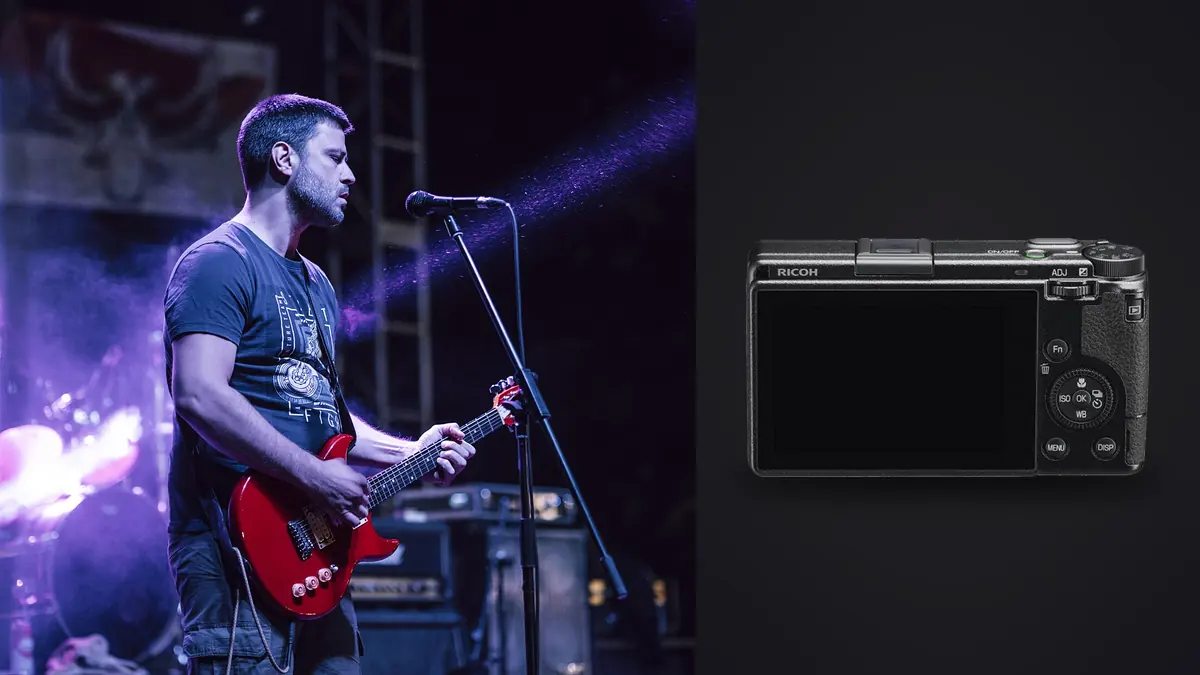
I brought a Ricoh GR IIIx to a show for the first time because my usual bag felt wrong for the room. It was a 150-capacity basement venue, three acts, no photo pit, no barrier, and a promoter who'd already told me flatly that a big lens "makes people nervous down here." So instead of the mirrorless body and 24-70mm I normally carry, I put the GR IIIx on a wrist strap and shot an entire night on a fixed 40mm-equivalent lens. It was not what I expected, in both good and frustrating ways, and it's worth talking through honestly rather than pretending a pocket camera with no zoom is some secret weapon for every kind of live show.
Why a fixed-lens compact even enters this conversation
The GR IIIx is not built for concerts. Ricoh built it for street photography: a 26.1mm f/2.8 lens (40mm full-frame equivalent) on an APS-C sensor, in a body small enough to live in a jacket pocket. Nobody at Ricoh was thinking about stage lighting or crowd surges when they designed it. But that same design brief happens to solve a few problems that show up constantly at small and mid-size venues.
The first is discretion. A photographer standing at the rail with a full-frame body and a 70-200mm f/2.8 reads as "press" or "professional shooter," which can get you pulled aside by security in a room that never issued photo credentials in the first place. The GR IIIx reads as a tourist's camera. I've shot entire sets from the crowd, a few feet from the stage, without a single person on the venue staff giving me a second look. The second reason is weight and speed. At the end of a three-band night you've been standing for five hours, and a camera that weighs under 260 grams and starts up in under a second stops feeling like a convenience and starts feeling like the only reason you got any shots of the last band at all, because your arms aren't dead.
What a 40mm-equivalent lens actually gets you at a show
This is the part people gloss over, so let's do the actual math. At three meters from a performer, the GR IIIx frames roughly waist-up. At six meters you get a full-body shot with some stage behind them. Past about ten to twelve meters, which is a completely normal distance from a barrier to the stage at a mid-size room, a singer becomes a small figure in a wide scene rather than a portrait. There's no way around this with a fixed lens, and the 24.2-megapixel sensor gives you some room to crop after the fact, but cropping a 40mm frame shot from fifteen meters away is not a substitute for a 200mm lens.
What this means practically: the GR IIIx is a close-quarters tool. It's excellent in a basement club where you're standing within arm's reach of the stage, it's excellent backstage and in green rooms, and it's excellent for crowd-level shots that put the audience in the frame with the band as a backdrop. It is a poor choice for anything where you're behind a barrier at an arena or a festival mainstage, shooting from twenty or thirty meters back. I've tried it at a larger outdoor stage and ended up with a folder of technically sharp, completely useless wide shots because the performer occupied maybe eight percent of the frame.
The workaround photographers actually use
Some shooters treat the fixed 40mm as a constraint to work around rather than a limitation to complain about, which changes how you move through a venue. Instead of standing still and zooming, you physically walk the room: side of stage for a tight angle, crowd center for the wide environmental shot, near the monitors for the guitarist's hands. It's more legwork than a zoom lens requires, and it only works in venues small enough that this kind of movement is possible without losing your spot.
Autofocus in a dark room is the real limiting factor
Here's the part that will frustrate anyone coming from a modern mirrorless system with phase-detect autofocus and eye tracking. The GR IIIx uses contrast-detection autofocus, and in the kind of dim, high-contrast, constantly-shifting lighting you get at a live show, it hunts. Not constantly, but often enough that I've missed clean moments waiting for the lens to rack back and forth while a singer's face was lit for maybe half a second by a single spotlight.
The fix, and it's a real one, is Snap Focus. You set a fixed focus distance (I run 2.5 meters for close crowd work, 4 meters for a slightly wider stage angle), and the camera skips autofocus entirely and fires at that pre-set distance the instant you press the shutter. It's the same zone-focusing technique street photographers have used with manual rangefinders for decades, just built into the menu. Once I started using it, my hit rate on decisive-moment shots went up noticeably, because I stopped waiting on the lens and started anticipating the moment myself and firing at the right distance.
How it stacks up against what you'd normally bring
The honest comparison isn't GR IIIx versus nothing, it's GR IIIx versus what most people actually carry to a show. Here's how those choices compare on the things that matter in a venue, based on what I've measured shooting all three across different nights.
| Factor | Ricoh GR IIIx (fixed 40mm f/2.8) | Mirrorless + 24-70mm f/2.8 | Mirrorless + 70-200mm f/2.8 |
|---|---|---|---|
| Usable shooting distance | 0.5 to roughly 6 meters | 1 to 10 meters | 10 to 40+ meters |
| Low-light AF behavior | Contrast-detect, noticeable hunting under 20 lux without Snap Focus | Phase-detect, generally reliable to near-dark | Phase-detect, reliable but slower to acquire at long reach |
| Continuous shooting | ~4 fps, buffer clears after roughly 10 JPEGs or 4 RAW frames | 8-20 fps depending on body, deep buffer | 8-20 fps depending on body, deep buffer |
| Body + lens weight | Under 260g total | 1.1 to 1.4 kg | 1.8 to 2.5 kg |
| Discretion in a small room | Very high, reads as a casual camera | Moderate, reads as "photographer" | Low, reads as press/pro credentials expected |
| Rated battery life (CIPA) | ~200 shots per charge | 350-500 shots per charge | 350-500 shots per charge |
The buffer number is the one that catches people off guard. If you try to burst-fire through a jump or a big crowd moment the way you would on a sports-oriented mirrorless body, the GR IIIx will lock up mid-sequence and make you wait. I've learned to fire single frames at anticipated moments rather than holding the shutter down, which is a different discipline than most concert shooters are used to.
Settings that actually hold up in a venue
A few adjustments made the difference between frustration and usable results. I run shutter priority at 1/250s minimum for anything with movement (a singer whipping their head, a bassist jumping) and drop to 1/125s only for calmer, seated acoustic sets. Auto ISO capped at 6400 keeps noise manageable for web and print use, and I'll let it run to 12800 for the last band of the night in a genuinely dark room, accepting that those frames will be grainy but usable for social posting. The in-body three-axis shake reduction is genuinely useful, but it only compensates for camera movement, not a moving subject, so don't mistake it for a substitute for shutter speed.
For quieter sets, jazz nights or stripped-down acoustic performances where a mechanical shutter clack is genuinely rude in a silent room, the electronic shutter option is worth using. One caveat: under LED stage lighting that flickers at a rate the electronic shutter doesn't sync cleanly with, you can get horizontal banding across the frame. I've had this ruin a handful of otherwise good shots at venues running cheaper LED wash lights, so I test a few frames early in the set before committing to silent shooting for the whole night.
What happens after the show
A three-band night on this camera routinely leaves me with 900 to 1,200 frames, a lot of them near-duplicates from firing multiple single shots at the same moment to compensate for the AF hunting, plus the usual pile of blinks, mic-in-front-of-face shots, and half-focused frames from before Snap Focus had settled on the right zone. Sorting that manually after midnight is not something I want to do, so this is where I lean on imagic. Its local sharpness and focus scoring flags which frame out of five near-identical shots of a singer mid-jump is actually the sharpest one, and the burst and duplicate clustering groups those five together automatically instead of making me click through each one side by side. If you haven't seen how that kind of automated first pass actually works, this breakdown of AI photo culling covers the mechanics in more depth than I will here.
The other thing that matters for show photography specifically: everything runs locally, with no cloud upload. Unreleased live photos, especially from a small venue where the band hasn't cleared anything for release yet, aren't something I want touching a third-party server before anyone involved has seen them. Culling and a first-pass edit happening entirely on my own machine is a real, practical reason to prefer that workflow for this kind of work, not just a privacy talking point. Once the keepers are picked, I run them through a preset built with apply_my_style, trained on my own previously edited concert work, so the moody, high-contrast stage-lighting look I use gets applied consistently across a hundred-plus keepers instead of me manually grading each one at 1am. For the broader routine around getting from "card full of frames" to "gallery ready to send," this workflow guide is a reasonable next read.
Where it genuinely falls short
I don't want to oversell this. The lack of an interchangeable lens is the biggest real limitation, not the low-light AF. You cannot get a wide establishing shot of the whole stage and then a tight face shot without physically walking to a new spot, which isn't always possible once a crowd has filled in around you. There's no built-in viewfinder either (Ricoh sells an optional optical clip-on finder, the GV-3, but it shows no exposure information, so you're mostly composing off the rear screen), and under bright stage wash or colored gel lighting that screen can be genuinely hard to read. It's also a single UHS-I SD card slot with no backup, and the body isn't marketed as weather or impact sealed, which matters more than people think in a room where drinks get spilled and bodies get shoved. I treat it as a second camera or a small-venue specialist, not a primary tool for anything above club-sized rooms.
Frequently Asked Questions
Is the GR IIIx's 40mm equivalent lens enough reach for an arena or festival mainstage?
No. Past about ten to twelve meters the subject becomes too small in the frame to be usable without heavy cropping, and even the sensor's 24-megapixel resolution only buys you so much room. For anything with a real barrier distance, a telephoto zoom on a separate body is still necessary. The GR IIIx belongs in small clubs, backstage areas, and crowd-level shooting where you can physically get close.
Does the in-body shake reduction let me shoot at slower shutter speeds during a show?
It helps with camera shake, meaning your own hand movement, but it does nothing for a moving subject. A performer jumping or headbanging will still blur at 1/60s regardless of how good the stabilization is. Keep your shutter at 1/250s or faster for anything with real movement and treat shake reduction as a safety net for static or slow-moving scenes only.
Should I use the electronic shutter to stay quiet during a set?
For quiet acoustic or seated sets, yes, it's worth it, since the mechanical shutter's clack is noticeable in a silent room. Just test it early against that specific venue's stage lighting first. Some LED rigs cause visible horizontal banding with the electronic shutter that the mechanical shutter doesn't have, and it's better to find that out on frame ten than frame four hundred.
Is it worth carrying as a backup to a mirrorless with a zoom lens?
For close-quarters and backstage work, yes. It's small enough to carry alongside a full kit without adding real weight, and it covers situations a big zoom can't, like slipping through a crowd or shooting candidly in a green room where a large camera would change how people behave around you. As a sole camera for anything beyond a small venue, I wouldn't rely on it.