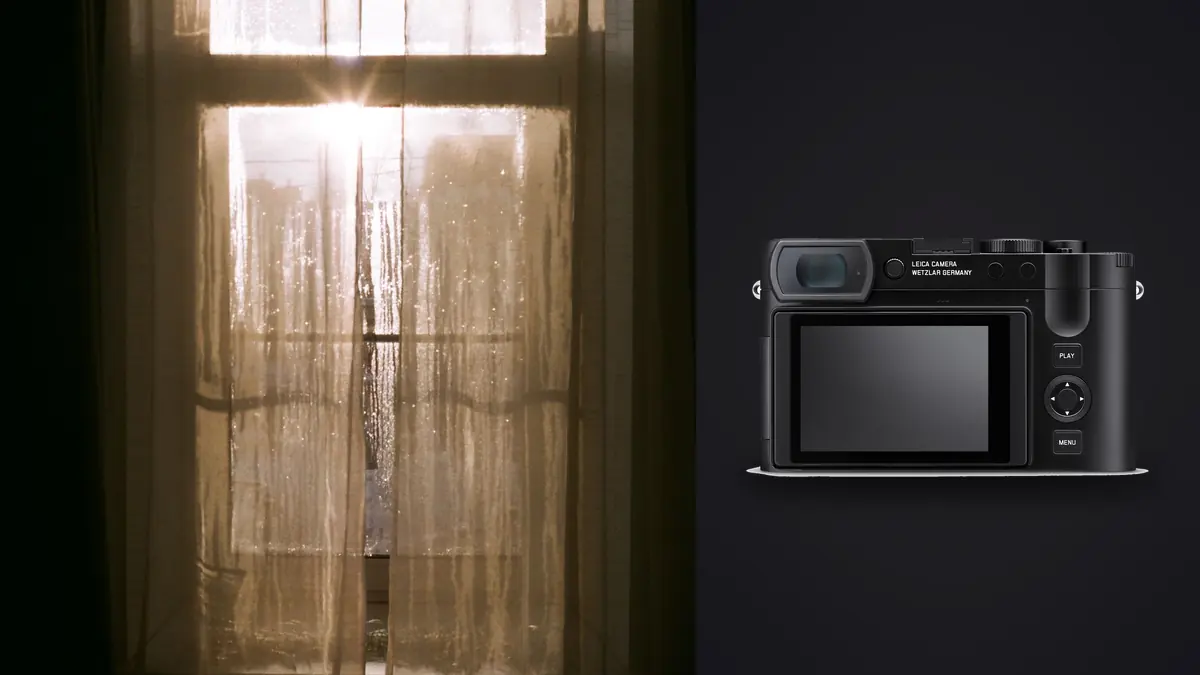
Picture bringing a Leica Q3 into a boudoir session where the client asks if you've forgotten your "real camera." Fair question. She would be used to seeing a 70-200mm parked on a monopod, a flash umbrella in the corner, the whole production. Instead there is a single rangefinder-style body with a lens that doesn't zoom and doesn't come off. No second body. No bag of glass. Just one 28mm f/1.7 Summilux permanently attached to a 60-megapixel sensor. That mismatch between expectation and reality is basically the whole story of using this camera for intimate portrait work. It looks wrong for the job on paper. In the room, it does something most portrait rigs can't.
One lens, and the discipline it forces on you
A 28mm lens is a wide-angle. Most portrait photographers avoid anything under 50mm for close work because wide lenses distort faces when you get near them, stretching noses and flattening ears in ways nobody wants on their body-positive portrait day. So why would anyone shoot boudoir on a 28?
Because on the Q3, 28mm rarely means "close-up face shot." It means environmental intimacy: the unmade bed, the light through a half-open curtain, a shoulder and a doorway in the same frame. Boudoir work leans on context more than most portrait genres realize. The setting, the sheets, the mirror, the way morning light lands on a windowsill, all of that carries as much of the mood as the pose does. A 28mm forces you to include it rather than crop it out, and that's usually a better photograph anyway. For the tight, face-and-shoulders frames clients also expect, you're not stuck. That's where the crop modes come in, and they change the calculus completely.
Working distance changes the conversation, literally
There's a physical side to this too. At 28mm, filling the frame with a face means standing close, often inside two feet. In a bedroom-sized space with a nervous first-time client, that distance can read as invasive rather than intimate. What I've found instead is that the wide field of view lets me stay back, near the doorway or across the room, and still build a full composition. The client gets physical space. I get a natural, unposed energy because nobody feels a lens hovering six inches from their face. The intimacy comes from the image, not from proximity.
What the four crop modes actually give you
The Q3 doesn't zoom, but it does something close: it uses digital crop modes baked into the sensor's resolution, cycling through 28mm, 35mm, 50mm, 75mm, and 90mm equivalent framings via a button on the body. Because the sensor starts at 60 megapixels, even the tightest crop still leaves a usable file. Here's roughly what each mode gives you on a boudoir set, based on the resolution figures Leica publishes for the camera:
| Crop mode | Approx. resolution | Where it earns its keep in a boudoir set | What you give up |
|---|---|---|---|
| 28mm (native) | ~60MP | Wide environmental frames, full-length poses, window light scenes with the room included | Nothing, this is the sensor's full resolution |
| 35mm | ~37MP | Three-quarter body shots, seated poses, a natural "documentary" middle ground | A small resolution trim, still plenty for large prints |
| 50mm | ~19MP | Waist-up portraits, hands and collarbone detail, closer framing without moving | File size drops enough that you notice on heavy crops in post |
| 75mm | ~8MP | Face and shoulders, catching an unguarded expression from across the room | Resolution is fine for web and small prints, tight for large wall art |
| 90mm | ~6MP | Candid close reactions, eye contact shots, moments you don't want to walk toward | Lowest resolution of the set, treat it as a bonus frame, not the hero shot |
In practice I shoot most of a session at 28mm or 35mm and lean on the sensor's resolution to crop in post rather than switching modes constantly, since the crop buttons change the RAW file itself and I don't always want to commit mid-shoot. But the 50mm and 75mm modes are genuinely useful for the moments between poses, when a client relaxes and you want a tighter reaction shot without walking across the room and breaking the mood.
Why silence matters more than sharpness here
Nobody talks enough about shutter noise in this genre. Boudoir sessions run on trust and a slow build of comfort, and a loud mechanical shutter clacking away every time someone shifts their weight is a mood killer. The Q3's electronic shutter is silent, genuinely silent, up to speeds fast enough that you never need the mechanical one indoors. You can shoot a continuous burst while the subject laughs at something and she won't know exactly which frame you kept, because there's no audible tell that a photo happened at all. That matters more than people expect walking in. Clients who are self-conscious about being photographed in this context relax noticeably once they stop hearing the camera. It stops feeling like a photoshoot and starts feeling like being in the room with someone who happens to have a camera.
Shooting by window light instead of strobes
Boudoir sessions often happen in bedrooms, hotel rooms, or small apartments where setting up flash means fighting furniture and ceiling height for very little payoff. The Q3 is built for available light. Wide open at f/1.7 with a sensor that stays clean well past ISO 6400, you can work an entire session off one north-facing window and get skin tones that don't need heavy correction later. The lens has optical stabilization built in, which matters more here than the spec sheet suggests. Boudoir poses often involve slower movement, a slow turn of the head, weight shifting from one hip to the other, and the stabilization buys you a stop or two of shutter speed you'd otherwise lose to camera shake in dim rooms. I'll shoot handheld at 1/30s in a dark bedroom corner and still get a sharp frame more often than I expect to. What I don't love: there's no second lens to reach for when the light gets truly bad and I want a longer, more compressed look. On a job with genuinely poor ambient light, a single continuous LED panel bounced off a wall or ceiling solves it faster than fighting the camera's ISO ceiling. I always bring one, even for shoots I expect to be window-light-only.
The RAW file pile nobody warns you about
Here's the part that surprises photographers switching to the Q3 from a crop-sensor mirrorless body: the files are enormous. A 60-megapixel DNG runs well over 70MB uncompressed, and a two-hour boudoir session shooting bursts at several frames per second adds up to four figures worth of images fast, most of them near-duplicates of the same pose with tiny variations in expression or hand position. That's exactly the kind of pile I stopped sorting by hand a while back. I run a shoot through imagic before I touch a single image in an editor. It scores focus and sharpness locally on the machine, no cloud upload, which matters when the subject matter is this personal and the people in the photos are (understandably) sensitive about where their images travel. It also clusters near-duplicate burst frames together so I'm choosing between five similar shots instead of scrolling past forty. For a genre where half the job is picking the one frame with the right expression out of a burst, that clustering step alone saves real hours per session. The other piece I lean on is the apply_my_style preset feature, which trains on your own past edits rather than a generic filter pack. Boudoir color grading tends to be consistent from shoot to shoot, warm skin tones, soft shadow detail, minimal clipping in the highlights near a window, and having the software apply a look based on my actual edit history gets a first pass much closer to finished than a generic preset would. If you're building out a repeatable culling and editing pipeline for this kind of high-volume, high-similarity shooting, it's worth reading through how AI photo culling actually works before you commit to a workflow, and these workflow tips cover a few habits that pair well with any culling tool, not just this one.
Small details, and where macro mode comes in
Boudoir sets usually end with detail shots: lace texture, a ring on a nightstand, the curve of a strap against skin. The Q3's macro mode brings the minimum focus distance down to roughly 17cm, close enough to fill the frame with fabric texture or jewelry without a dedicated macro lens. It's a small feature, but on a fixed-lens camera it's the difference between getting the detail shot in-camera or not getting it at all. I flip into macro mode for the last ten minutes of a shoot, once the main poses are done and the subject is comfortable enough to let me get genuinely close to small details.
What else goes in the bag
Given how much this camera can carry on its own, my kit for a typical in-home boudoir session is smaller than it's ever been: the Q3, two spare batteries (the battery life is fine but not generous, especially shooting bursts), a single continuous light with a diffuser sock for rooms with genuinely poor window light, and a reflector that folds down to nothing. No lens bag, no tripod most days since handheld with stabilization covers almost everything I need. Clients notice the smaller footprint too. A single small camera reads as far less clinical than a full studio setup crammed into a bedroom, and that changes how people hold themselves in front of it.
Frequently Asked Questions
Is a fixed 28mm lens actually limiting for boudoir photography?
Less than you'd think. The wide field of view suits environmental, context-rich boudoir images better than a tight portrait lens does, and the crop modes cover the tighter framings most sessions still need. The real limitation shows up if you want strong background compression or a shallow, blurred-out backdrop behind a close portrait, which a longer lens does more convincingly than any digital crop can.
Can the Q3 handle a full boudoir session without additional lighting?
In a room with a decent window, yes, comfortably. In a windowless room or after sunset, the sensor's high-ISO performance stretches further than most cameras but it still benefits from one soft continuous light source. I treat a small LED panel as a backup rather than a requirement.
How do the crop modes affect image quality for large prints?
The native 28mm and 35mm crops hold plenty of resolution for large wall prints. The 75mm and 90mm modes drop into single-digit megapixel territory, which is fine for web galleries and smaller prints but starts to show its limits if a client wants a large framed piece from one of those tighter frames.
What's the biggest workflow challenge shooting boudoir on a 60-megapixel camera?
File volume. Bursts of near-identical poses at 60 megapixels each fill storage and slow down manual review fast. Running the take through a local culling tool that clusters similar bursts and flags the sharpest frame in each cluster, rather than opening and comparing every file by eye, is the difference between a same-day turnaround and a multi-day backlog.