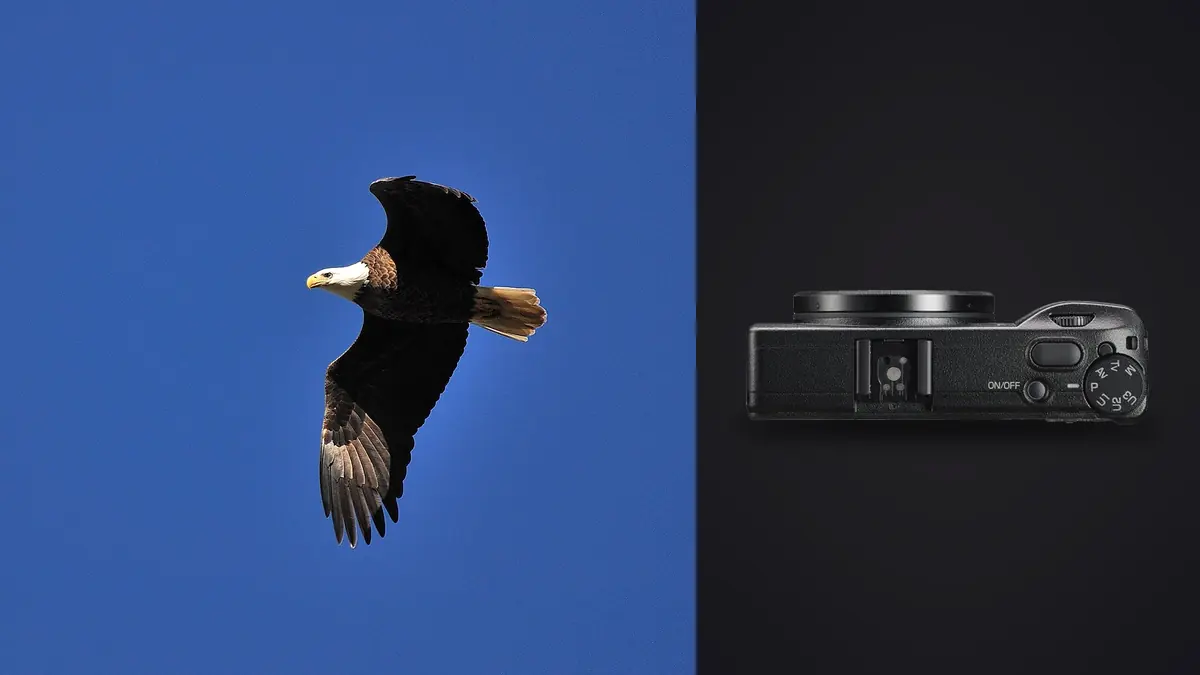
Someone in a photography forum asked me last month whether their Ricoh GR IIIx could "do wildlife." I said yes, technically, the same way a bread knife can technically open a can. It'll work in a pinch, it will not be pleasant, and you'll wish you'd brought the right tool. Then I actually took the GR IIIx out to a wetland reserve for three mornings to see how wrong I was. I wasn't entirely wrong, but the answer turned out to be more specific and more interesting than a flat no.
Why This Pairing Sounds Wrong on Paper
The GR IIIx is built around a fixed 26.1mm f/2.8 lens, which works out to a 40mm field of view once you account for the APS-C sensor crop. Forty millimeters is a normal lens. It's the focal length people use for street photography, environmental portraits, and documentary work where you want the frame to feel like human vision. It is not a focal length anyone has ever chosen for a bird thirty meters up in a tree, let alone one moving through the air at speed.
Then there's the autofocus. The GR IIIx uses contrast-detect AF only, no phase-detection pixels, no dedicated subject tracking for animals or birds. Contrast-detect systems hunt back and forth to confirm focus, which is fine for a stationary subject and genuinely rough for anything crossing the frame. Add a continuous shooting rate in the neighborhood of 4 frames per second and a buffer that fills after a handful of RAW frames, and you have a camera that was engineered for deliberate, considered shooting, not for spraying frames at a fast-moving target and hoping one lands.
So no, this isn't a birds-in-flight camera, and I want to say that plainly before anything else in this piece, because a lot of gear content dances around the obvious limitation to keep the article upbeat. The GR IIIx will not replace a telephoto zoom on a tracking-AF mirrorless body for BIF work. What it can do is something narrower and, for a specific kind of photographer, still worth understanding.
Where the GR IIIx Actually Earns Its Keep
I got usable wildlife frames on all three mornings, but almost none of them were what a birder would call a "keeper" shot in the classic sense of a tight, sharp portrait filling the frame. What worked instead:
Habituated, close subjects. The reserve had a resident group of mute swans and a family of grey herons that had stopped caring about people walking the boardwalk. At five to eight meters, a 40mm lens on a 24MP sensor gives you enough resolution to crop hard afterward and still print something respectable. Wild, skittish songbirds at range were a non-starter. Anything used to foot traffic, though, from park geese to zoo aviary residents to garden feeder visitors shot through a window, sat well within reach.
Environmental wildlife shots. A 40mm equivalent is arguably the best focal length on the market for showing an animal in its habitat rather than isolating it against a blown-out background. A heron standing in reed beds with the whole wetland visible around it is a more honest, more interesting photograph than a cropped headshot, and it's exactly the kind of frame this lens was built for.
Close-focus and insects. The GR IIIx's macro mode focuses down to roughly 12cm, which at 40mm equivalent gives genuinely usable close-up capability for dragonflies, butterflies on flowers, and other small, patient subjects. This is where the lens's actual identity, a compact street and documentary optic, quietly overlaps with nature photography in a way nobody markets it for.
Discretion. At 262 grams and pocket-sized, the GR IIIx does not spook anything the way a photographer hoisting a white 400mm barrel does. I got closer to the herons with this camera in my jacket pocket than I ever have carrying a long lens rig, simply because nothing about my silhouette read as a threat.
The Reach Problem, Quantified
To be concrete about how big the gap is between this camera and an actual wildlife setup, here's how the GR IIIx stacks up against the standard GR III and two genuinely wildlife-capable configurations, on the specs that matter for birds in flight specifically.
| Camera / setup | Effective reach (35mm equiv.) | Autofocus | Burst rate | RAW buffer | Closest focus | Body + lens weight |
|---|---|---|---|---|---|---|
| Ricoh GR IIIx | 40mm fixed | Contrast-detect only | ~4 fps | 4-6 frames | ~12cm (macro mode) | ~262g |
| Ricoh GR III | 28mm fixed | Contrast-detect only | ~4 fps | 4-6 frames | ~6cm (macro mode) | ~257g |
| Bridge superzoom (fixed lens) | up to ~1200-2000mm | Contrast-detect, some phase hybrid | ~7-10 fps | ~30-60 frames | ~1cm at wide end | ~800g-1.3kg |
| Mirrorless + 100-400mm telephoto | 150-600mm (with 1.5-2x crop bodies) | Phase-detect, animal/bird eye tracking | 15-30 fps | 100+ frames (fast card) | ~1-1.2m | ~1.8-2.2kg |
Look at the reach column. Forty millimeters against 150 to 600 isn't a small gap you make up with cropping, it's a different genre of photography. Even the modest bridge superzoom, which nobody would call a premium wildlife tool, out-reaches the GR IIIx by a factor of 30 or more. What the table does show, though, is that the GR IIIx's closest-focus distance and its weight are both genuinely competitive figures, just applied to a completely different kind of subject than birds in flight.
Field Technique If You're Bringing One Anyway
Assuming you already own a GR IIIx and want to use it for wildlife rather than buy a second system, a few things changed how many usable frames I came home with.
Pre-focus and Snap Focus
Rather than relying on the GR IIIx to hunt for focus on a moving heron, I set Snap Focus to a fixed distance (around 5 meters, matching where the birds tended to stand) and used the half-press purely for exposure. This turns the contrast-detect weakness into a non-issue because the camera isn't hunting at all, it's just firing at a pre-set focus distance. It's the same technique street photographers use for capturing fast pedestrian moments, repurposed for wildlife that keeps returning to a predictable spot.
Let the Shake Reduction Do Its Job, Not the AF
The in-body 3-axis Shake Reduction (rated around 4 stops on the GR IIIx) is genuinely useful here, but not the way people expect. It doesn't help freeze a moving bird. What it does is let you shoot handheld at slower shutter speeds for static, perched subjects in low dawn light, which matters a lot given that most good bird activity happens right around sunrise when light is thin.
Shoot Wide, Crop Later, Budget for It
Since 40mm isn't going to fill the frame with a bird, I stopped trying. I composed for the environmental shot and accepted that any tight crop would come out of a 24MP file, which realistically gives you a genuinely detailed final image only down to about a 30-40% crop before resolution and noise start working against you. Plan your framing around that ceiling rather than discovering it in the edit.
Mind the Buffer
With only 4-6 RAW frames before the buffer fills and shooting slows to a crawl, spray-and-pray simply doesn't work on this body the way it does on a proper wildlife rig. I switched to short, deliberate bursts of two or three frames right as a bird settled or took off, rather than holding the shutter down. It meant more missed moments, but also meant the camera never locked up mid-sequence waiting to write to the card.
No Weather Sealing, No Excuses
Wetlands mean condensation, spray, and mud. The GR IIIx doesn't ship with the kind of weather sealing that GR III owners can add with the optional protective kit for the standard model, so I kept a microfiber cloth and a small dry bag on me the whole time and never left the camera exposed between shots.
The RAW Workflow After a Session Like This
Three mornings of this kind of shooting produced a genuinely messy set of files: dozens of near-identical frames of the same heron shifting its weight, a string of soft or missed-focus attempts from moments the AF hunted, and a handful of actual keepers buried in the middle. This is exactly the kind of folder that's tedious to sort by eye, and it's where I lean on AI photo culling rather than clicking through every DNG one at a time.
I run the take through imagic first, since its local sharpness and focus scoring flags which frames in a short burst actually landed critical focus versus which ones the contrast-detect system missed by a hair, something that's hard to judge accurately at thumbnail size on a laptop screen. Its duplicate and burst clustering also groups the near-identical heron frames together automatically, so instead of comparing thirty similar shots one by one I'm comparing four clusters. Because the processing runs locally with no cloud upload, this works fine even shooting from a reserve car park with no signal, which matters more than people expect when you're culling in the field between sessions rather than waiting until you're back home.
For the edit itself, I've trained an apply_my_style preset in imagic on my usual outdoor color work, which keeps the greens in reed beds and the warm dawn light on feathers consistent across a mixed session that also included a few macro dragonfly frames shot in completely different light. Rather than grading each subset by hand, the preset gets me most of the way there and I fine-tune from there.
None of that changes the physics of a 40mm lens, but it does mean the honest limitations of the camera don't compound into hours of manual sorting on top. If you're building any kind of repeatable workflow around a camera that produces a lot of misses per keeper, the culling step matters as much as the shooting technique.
Frequently Asked Questions
Can the Ricoh GR IIIx actually photograph birds in flight?
Rarely, and only under favorable conditions: a large bird, close range, predictable flight path, and good light so the contrast-detect AF has something to grab onto. A heron lifting off from ten meters away with a clean sky background is possible. A songbird crossing the frame at any real distance is not realistic with this lens and AF system. If birds in flight are your primary goal, this isn't the camera for it, full stop.
How much can you crop a GR IIIx RAW file before quality falls apart?
In practice I found a 30-40% crop (keeping roughly a third to two-fifths of the original frame width) still holds up for web use and modest prints, since you're starting from a 24MP file with no anti-aliasing filter. Push much further than that and softness, noise in shadow areas, and the visible limits of the lens's off-center sharpness all start showing. Treat cropping as a finishing touch on a well-composed frame, not a substitute for reach.
Does the Shake Reduction system help with wildlife shots?
It helps with stability, not motion. The in-body stabilization lets you handhold at slower shutter speeds for stationary or slow-moving subjects in low light, which is genuinely useful at dawn and dusk when birds are most active. It does nothing to freeze a bird's wingbeat or a fast-moving animal, that still comes down to shutter speed and light.
Is the GR IIIx worth carrying alongside a dedicated telephoto setup, rather than instead of one?
This is where I landed after the three mornings. As a sole wildlife camera it's frustrating. As a second body in a jacket pocket for the environmental shots a long lens can't take, the close-focus macro opportunities that come up between the main subjects, and the moments where pulling out a big rig would spook something that's just tolerating your presence, it earns its spot. Most of my favorite frames from that trip weren't the swan or heron shots at all, they were the wider habitat images the 40mm lens is actually built for.