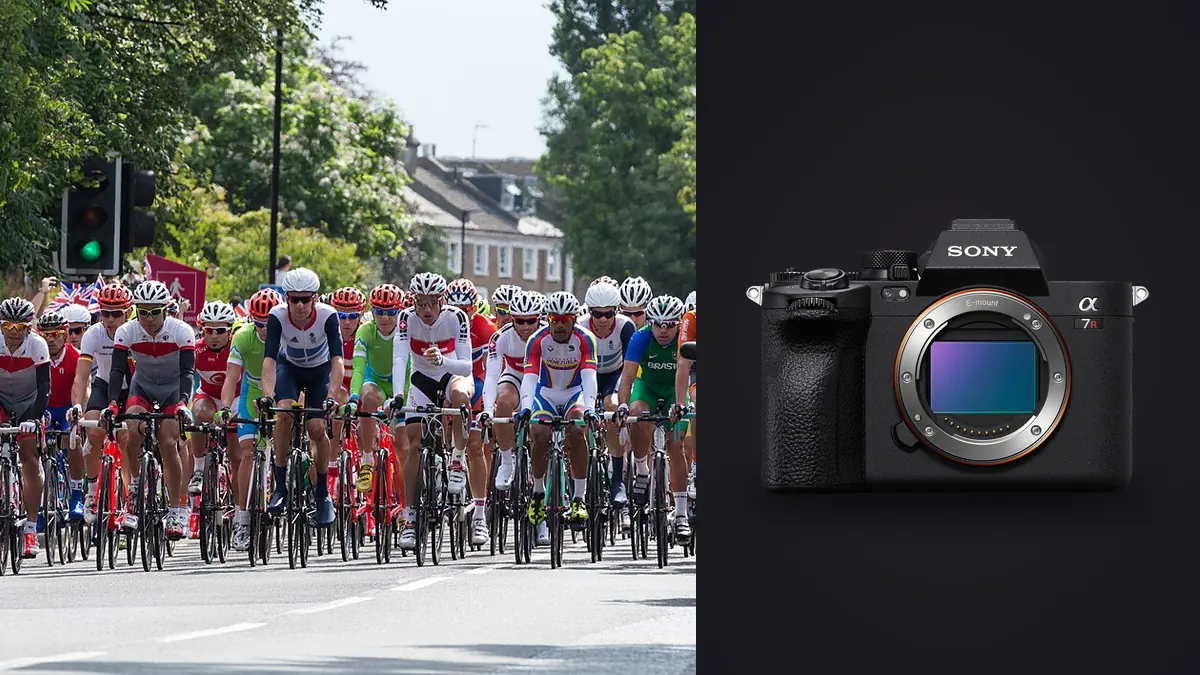
Every gear forum will tell you the same thing about the Sony A7R V and sports: don't. Buy an A9 II, buy an A1, buy anything with a stacked sensor and a shutter that doesn't smear a sprinter's legs into a blur of rolling-shutter jelly. I know the argument because I made it myself for two seasons before I actually tried shooting a full track season on the A7R V, mostly because it was the body I already owned for portrait and product work and I didn't have $4,500 lying around for a dedicated sports camera. What I found surprised me: the A7R V is a genuinely workable track camera, just not for the reasons Sony marketed it for, and not without a few habits you have to unlearn if you're coming from a lower-resolution body.
The 61-Megapixel Sensor Isn't a Liability, It's a Zoom Lens You Already Own
Track meets punish photographers who can't afford long glass. A 400m final happens on the far side of the oval from where credentialed press usually stands, and if you're shooting from the infield rail with a 70-200mm instead of a 400mm or 600mm prime, you're going to come home with athletes who occupy a third of the frame. This is where the A7R V's 61 megapixels stop being a studio-photographer gimmick and start being useful. A frame shot at 200mm and cropped to roughly APS-C dimensions still leaves you with about 26 megapixels, which is more resolution than most dedicated sports bodies capture natively. Crop harder, down to a tight two-thirds frame, and you're still print-viable for anything short of a magazine spread.
I've leaned on this constantly for field events. Long jump and triple jump happen close to the stands, but discus and javelin cages sit far enough out that even a 300mm lens leaves the thrower small in frame. Instead of chasing a longer lens I don't own, I shoot a bit wide and crop in post. It's not a substitute for good glass, and I wouldn't recommend it for the 100m dash where you need every bit of native reach to fill the frame at the finish line, but for anything where the subject holds still for a beat (the wind-up before a throw, the plant before a vault) it buys you flexibility a 24-megapixel sensor doesn't have.
The Autofocus Is Better Than People Assume, With One Real Caveat
Sony carried the AI-based subject recognition system from the A1 and A7 IV down into the A7R V almost unchanged, and on paper that means human pose detection, eye tracking, and full-body recognition even when a runner's face is turned away from the lens. In practice, on the track, it's genuinely good at picking up and holding a sprinter through a 100m or 200m race, including through the moment where their head tilts back near the line. I get a noticeably higher keeper rate tracking runners with the A7R V than I ever did on an older A7 III with the previous-generation AF module.
The caveat is speed, not accuracy. The A7R V tops out at 10 frames per second, whether you're on the mechanical shutter or the electronic one, and that ceiling matters more in relay handoffs and photo-finish-adjacent moments than in almost anything else in the sport. At 10fps you're capturing a frame roughly every 100 milliseconds, which is plenty for a 400m runner's stride but noticeably coarser than the 20 or 30fps you'd get on an A9 II or A1 for catching the exact frame of a baton exchange. I've missed the precise handoff moment on relays more than once because the next usable frame landed a beat too late. If relay handoffs are the bulk of what you shoot, this is the single biggest reason to look elsewhere.
Buffer Depth Is the Bottleneck Nobody Mentions Until It Bites You
Here's the part that actually changed how I shoot: 61-megapixel RAW files are big, somewhere around 60MB compressed and well over 100MB uncompressed, and that means the buffer fills faster than the frame rate alone suggests. At 10fps you can burn through the compressed RAW buffer in under 20 seconds of continuous shooting on a fast CFexpress Type A card, and once it's full the camera slows to card-write speed, which on a track meet with back-to-back heats is exactly when you don't want to be waiting.
| Camera | Max burst rate | Approx. buffer (compressed RAW) | Approx. RAW file size | Rolling shutter feel at 10fps+ |
|---|---|---|---|---|
| Sony A7R V | 10 fps | ~180 frames | ~55-65MB | Noticeable on fast horizontal pans |
| Sony A9 II | 20 fps (electronic) | ~230+ frames | ~24-28MB | Minimal, close to distortion-free |
| Sony A1 | 30 fps (electronic) | ~230-240 frames | ~45-50MB | Essentially distortion-free |
The practical upshot: on the A7R V you have to be more selective about when you hold the shutter down than you would on a body built specifically for this. I've adopted shorter, more deliberate bursts (a second or two around the moment I actually want, rather than holding the trigger through an entire race) partly because the buffer forces the discipline and partly because it means less time later sorting five hundred nearly-identical 60-megabyte files.
Rolling Shutter, and Why I Still Reach for the Mechanical Shutter on Sprints
The A7R V doesn't have a stacked sensor, so its electronic shutter reads the frame slowly enough that fast lateral motion, a sprinter crossing the frame at full speed, a relay baton moving hand to hand, can show up skewed or wobbled if you're panning briskly. It's not dramatic in every shot, but on a tight pan following a runner through the final meters I've seen verticals in the background lean in a way that's obviously wrong once you know to look for it. On an A9 II or A1, with their stacked sensors, this basically isn't a concern at any shutter speed.
My workaround has been boring but effective: I shoot sprints and relays on the mechanical shutter, which sidesteps the rolling shutter skew entirely at the cost of a slightly louder shutter and a marginally reduced maximum frame rate that doesn't actually matter since both shutter types cap at 10fps on this body anyway. For field events, throws, jumps, pole vault, where the subject isn't crossing the frame at sprint speed, I'll use the silent electronic shutter so I'm not adding shutter noise next to the runway or the vault pit during a competitor's approach.
Sprints and hurdles
Mechanical shutter, continuous AF with the human subject recognition set to track the whole body rather than just the eye, since a hurdler's face is rarely pointed at the camera mid-stride. I preposition on the finish line or a hurdle and let the AF hold rather than trying to pan with the runner the whole way down the straight.
Throws (shot put, discus, javelin, hammer)
These events have a genuine pause before the release, the wind-up, the spin, the plant, which is where the A7R V's resolution advantage pays off most. I shoot a touch wider than I would with a longer lens, knowing I can crop the release frame tightly afterward without losing usable detail.
Jumps and vault
High jump and pole vault happen in a fixed, predictable spot, which is the one situation on a track where buffer depth barely matters, you're not holding the shutter for ten seconds, you're firing a short burst around the bar. Long and triple jump are similar, though I shoot slightly earlier in the approach than feels natural because the AF needs a beat to lock onto a runner sprinting straight at the lens.
Lens Pairings That Actually Make Sense Here
I run the A7R V at track meets with a 70-200mm f/2.8 as the primary lens and a 24-70mm f/2.8 for anything happening close to the rail, warmups, medal presentations, the chaos at the finish line after a close race. I don't own a 400mm or 600mm prime and given the crop headroom the 61-megapixel sensor provides, I haven't felt forced to rent one for most collegiate or regional meets. If you're shooting a stadium big enough that even the infield rail puts you 80+ meters from the far straight, that math stops working and you do need real reach, no amount of cropping fixes a subject that's genuinely too small and too far for the lens you have. But for the meets most working photographers actually cover, midsize college and high school stadiums, the resolution-as-reach approach holds up.
The Part That Actually Eats Your Evening: File Management
A three-hour track meet shot at 10fps in bursts, even conservative ones, easily produces two to four thousand frames. At roughly 60 megabytes each in compressed RAW, that's well over 150GB from a single meet, and a huge fraction of those frames are duplicates or near-duplicates of the same stride, the same wind-up, separated by a tenth of a second. Culling that by eye, frame by frame in a normal RAW browser, is genuinely one of the worst parts of shooting sports on a high-resolution body, and it's the tradeoff nobody mentions when they're extolling the A7R V's image quality.
This is where I stopped doing it manually. I run the meet's card through imagic before I touch a single frame in my editor, since it clusters burst sequences and near-duplicate frames locally on my machine (nothing leaves my laptop, which matters when you've got an athlete's unpublished race on the card) and scores sharpness and focus so I'm not squinting at 61-megapixel previews trying to tell which of six near-identical sprint frames actually nailed focus on the eyes. It cuts a two-thousand-frame card down to the handful of genuinely distinct, in-focus moments in maybe fifteen minutes instead of the better part of an evening. For anyone weighing whether the file-size cost of a high-resolution body is worth it for sports, the honest answer is that it's only worth it if your culling step doesn't scale linearly with file count, and a manual pass through a folder full of huge RAWs absolutely does. If you haven't compared tools for this specific problem, it's worth reading through how AI photo culling actually works before you commit to a workflow, because the difference between a culling pass that respects burst context and one that treats every frame independently shows up fast once you're dealing with meet-sized card dumps.
Once the field is narrowed down, I lean on the app's apply_my_style preset, trained on my own past track edits, to get a consistent first pass across the whole set before I go in and hand-finish the handful of hero frames for a gallery or a social feed. Stadium lighting swings wildly between events, harsh midday sun for the morning heats, mixed shade and sun by afternoon finals, and having a starting point that already reflects how I habitually correct for that saves real time on a night with a same-day turnaround.
Frequently Asked Questions
Is the Sony A7R V fast enough for competitive track and field?
For most events, yes, with the relay handoff as the clear exception. Ten frames per second comfortably covers sprints, hurdles, jumps, and throws where the decisive moment isn't measured in hundredths of a second. Where it struggles is the split-second window of a baton exchange, where a body capable of 20 or 30fps will simply hand you more chances at the exact frame.
Do I need a super-telephoto lens to shoot track with this camera?
Not necessarily, and that's arguably the whole case for using a 61-megapixel body here. A 70-200mm cropped in post gets you usable reach for midsize stadiums. For genuinely large venues where subjects are 80 meters or more away even from the infield, you'll still want real focal length, cropping can't manufacture detail that was never resolved by the lens in the first place.
Does the rolling shutter actually ruin action shots, or is it overstated?
It's real but situational. Fast lateral pans, especially following a sprinter at close range with the electronic shutter, can show skew in straight background lines. Switching to the mechanical shutter for those specific shots removes the issue entirely, at no real cost since both shutter modes are capped at the same 10fps ceiling on this body anyway.
How do you deal with the sheer number of files a meet produces?
By not trying to review them one at a time. A three-hour meet at 10fps can produce a couple thousand frames, and going through that manually in a standard RAW browser is a multi-hour slog on top of an already long day. Running the card through a local culling pass that groups burst sequences and flags the sharpest frame in each one is the only way I've found to make a same-day turnaround realistic.