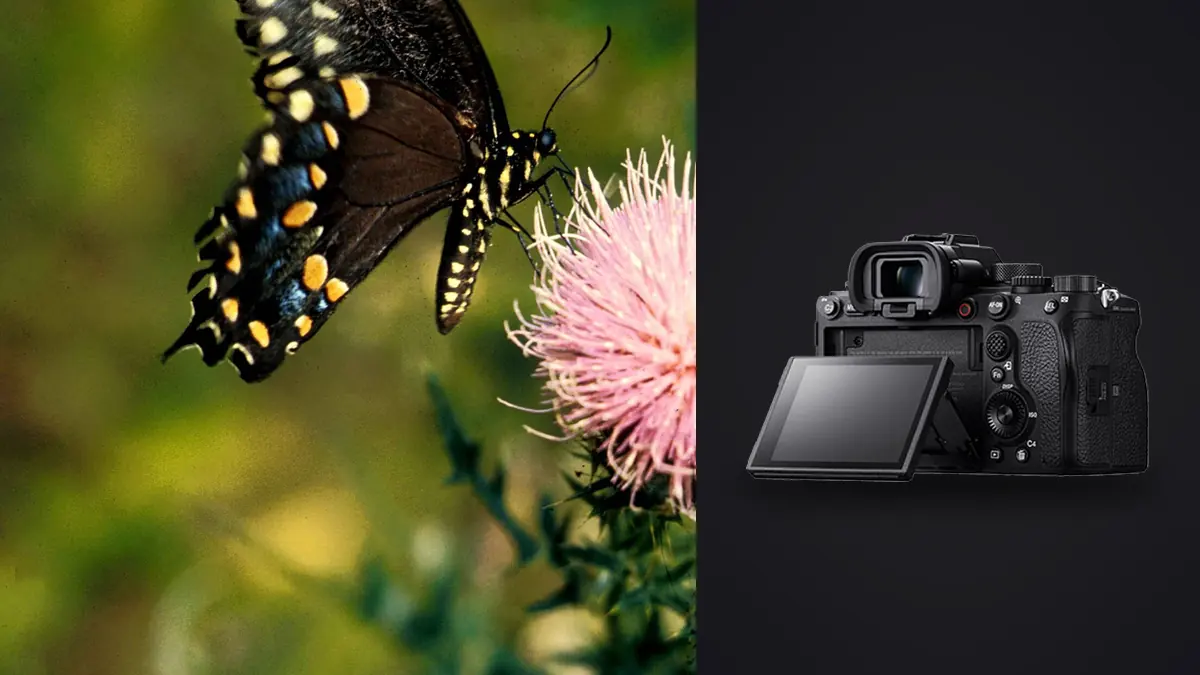
Three seasons of dragging a Sony A1 into wet meadows before sunrise taught me something the spec sheet doesn't: the headline numbers (50 megapixels, 30 frames a second) are not what decide whether you come home with a usable frame of a jumping spider mid-leap. What decides it is quieter stuff. How the shutter behaves once you're at true 1:1 magnification. Whether the autofocus system has any idea what it's looking at when the "eye" it's supposed to track is a few hundred microns across. How much heat your evening workflow can absorb after a morning spent firing bursts at damselflies.
This isn't a spec rundown. It's what changed in my actual approach to insect macro work after switching from a Nikon DSLR body to the A1, and where the camera's reputation as an all-purpose flagship stops matching what happens six inches from a hoverfly.
The resolution trade-off nobody mentions until it bites them
Fifty megapixels sounds like an unambiguous win for macro. In one sense it is: it buys you cropping room when a subject won't let you get physically closer, which happens constantly with dragonflies and robber flies that treat a lens hood as a threat. I've salvaged compositions by cropping a 50MP frame down to something closer to 20MP and still had enough resolution left for a decent print.
The part that gets skipped is what that resolution does to your depth of field math. At high magnification, your working aperture isn't what's printed on the lens barrel. The effective f-number is the marked aperture multiplied by (1 + magnification). Shoot a true 1:1 subject at f/11 and you're actually working at roughly f/22 once you account for the bellows factor. On a 50MP sensor, diffraction softening at f/22 is not subtle. You end up choosing between a sliver of sharp depth of field and outright image softness from diffraction, and there isn't a clean way around that tension except opening the aperture and doing more of the depth-of-field work with flash duration and stacking instead of the aperture ring. That single realization changed my default settings more than any other spec on this camera.
30fps is not a gimmick here, but it changes your evening too
For insects that move in bursts rather than smooth arcs (a mantis strike, a jumping spider's leap, a dragonfly's wing-flick before takeoff) 30fps blackout-free shooting genuinely earns its keep. I've captured a tiger beetle's mandibles opening mid-lunge purely because the camera was still recording frames I couldn't see or react to in real time. A slower body would have given me one frame either side of the moment.
What that buys you comes with a bill. A two-second burst at full resolution and full frame rate is around 60 raw files, and a single skittish subject can easily produce 400 to 600 frames across a morning once you count multiple approach attempts. Buffer depth is generous on CFexpress Type A cards but drops noticeably on UHS-II SD, so cheap out on cards and you'll watch the buffer choke mid-sequence on the exact frame you wanted. The bigger cost is downstream: you come home with several thousand nearly-identical frames of the same six-legged subject, and sorting that by eye is a real evening's work, not a five-minute task. This is the point where I stopped trying to eyeball bursts and let imagic's duplicate and burst clustering group each sequence automatically, with its local sharpness scoring surfacing the two or three frames per burst where the compound eye is actually in focus. It runs on the laptop with no upload step, which matters when you're culling from a tent with no signal two hours after the shoot. If you're skeptical that automated sharpness scoring can actually be trusted on subjects this small, our breakdown of how accurate AI photo scoring really is goes into the mechanics behind that judgment call.
Autofocus: where the reputation and the reality split
The A1's autofocus is excellent for what it was built for: 759 phase-detect points, 92% frame coverage, and real-time tracking that's genuinely sticky on birds, mammals, and human eyes. Insects are a different problem. There's no dedicated insect eye-detection category, and even if there were, a jumping spider's principal eyes or a fly's compound eye don't present the same clean, high-contrast target that a bird's iris does. In practice I get more reliable results from Tracking: Standard with a small flexible spot than I do from any of the animal-eye AF modes when the subject is an arthropod.
At true macro magnifications the bigger issue isn't tracking quality at all, it's depth of field. Once you're inside a centimeter or two of working distance, the plane of focus is thinner than the AF system's ability to reliably land on it shot to shot, especially handheld. For genuinely static or cooperative subjects (a dew-covered spider at first light, a beetle that hasn't noticed you yet) I switch to manual focus and use the A1's focus bracketing function instead of chasing single-shot AF accuracy.
My focus bracketing settings for handheld field stacking
For subjects that will hold still for two or three seconds, I set focus bracketing to 15-25 shots, step width around 3-5 depending on magnification, and shoot at f/8 rather than stopping down further, since the stepping does the depth-of-field work that a smaller aperture would otherwise have to. It's not a studio rail setup, so alignment in stacking software afterward has to do more work, but for a wetland margin at 6am it beats losing the shot entirely to a missed AF point. This only works on subjects that genuinely won't move, which rules out most flying insects and anything already alert to your presence.
Lens pairings that actually get used
I've cycled through four lenses on this body for insect work over three seasons. Here's how they've actually performed in the field rather than on a test chart.
| Lens | Max magnification | Approx. working distance at max mag | AF on the A1 | Where it earns its keep |
|---|---|---|---|---|
| Sony FE 90mm f/2.8 Macro G OSS | 1:1 | ~13cm from front element | Fast, quiet, reliable native AF with OSS | General-purpose insect work, cooperative subjects, the lens I reach for by default |
| Sigma 105mm F2.8 DG DN Macro | 1:1 | ~14-15cm | Native AF, no stabilization of its own (relies on A1's IBIS) | Slightly longer working distance for skittish subjects like dragonflies, cheaper than the Sony |
| Laowa 100mm f/2.8 2X Ultra Macro APO | 2:1 | ~15cm at 1:1, closer beyond that | Manual focus only | Small subjects (springtails, ant heads) where you need more than life-size without a bellows or extension tubes |
| Venus Optics (Laowa) 25mm f/2.8 2.5-5X Ultra Macro | 2.5x-5x | ~40-50mm, extremely tight | Manual focus, manual aperture | Extreme magnification on mites, jumping spider eyes, wing scales; needs a focus rail and patience, unusable handheld on anything alive and mobile |
Note one practical gap: the 90mm G Macro isn't compatible with Sony's own teleconverters, so if you want more reach on a dragonfly that won't let you approach, cropping into the 50MP file is your only in-system option rather than physically extending the lens.
Flash sync and why I stopped trusting ambient light alone
Once you're stopping down for depth of field, ambient light outdoors rarely keeps shutter speeds fast enough to freeze a beating wing, so flash becomes less optional than it feels like it should be. The A1's mechanical shutter syncs at 1/400s, with Sony's own documentation allowing a push to 1/500s if you'll accept minor corner vignetting, which is genuinely useful for macro since it lets you use flash as the main light source rather than pure fill even in bright conditions. I run a small diffused flash off-camera on a bracket rather than the pop-up-adjacent ring lights some macro shooters favor, mostly because a single directional source shows the texture on a beetle's elytra or a moth's scales far better than flat, shadowless lighting does.
For genuinely cooperative subjects, like a spider that's settled into a web at dawn, I'll sometimes skip flash entirely and use a small continuous LED panel instead, since it lets me see exactly how specular highlights fall on compound eyes before I commit to a frame, which flash doesn't let you preview.
Field conditions the spec sheet doesn't cover
Insect macro work means kneeling in wet grass at first light more often than not, since that's when cold-blooded subjects are sluggish enough to approach closely. The A1's weather sealing has held up through genuinely soaked mornings without issue, and I haven't had a card door or dial fail from moisture in three seasons. Battery life takes a real hit in the 30-50°F range typical of early spring mornings when a lot of the best subject behavior happens (fresh emergence, dew-covered wings not yet dry enough to fly). I carry two spares rather than one for anything past a two-hour session in cold conditions, which wasn't necessary with the DSLR I used before.
What happens after the card comes out of the camera
This is the part that changed the most for me, and it has less to do with the camera than with what a 50MP, 30fps body does to your file count. A single productive morning chasing three or four subjects across a marsh edge routinely leaves me with 1,500 to 3,000 raw files, most of them near-duplicates from bursts where only one or two frames actually nailed focus on the eye. Sorting that manually at full resolution, zoomed in to check focus on a compound eye that's a few dozen pixels wide, used to eat two to three hours per outing.
I run the card through imagic before I do anything else now. Its local sharpness and focus scoring flags which frame in each burst is actually sharp where it needs to be, and the duplicate and burst clustering groups the sequences so I'm reviewing maybe 150 candidate frames instead of 2,500. Because everything runs locally with no cloud upload, I can do this from a hotel room or a tent with no signal, which matters more for wetland and forest trips than it did when I mostly shot closer to home. Once I've settled on an edit look for a season (a particular way I want greens and iridescent wing color to render, say), I use the apply_my_style feature to carry that look across the rest of the keepers in one pass rather than re-adjusting sliders on every single frame by hand. If you're new to the idea of software doing the first sorting pass instead of you, this breakdown of how AI photo culling works covers the mechanics in more depth than I will here, and it's a genuinely different workflow shift than most camera upgrades ever deliver.
Frequently Asked Questions
Does the Sony A1's animal Eye AF actually work on insects?
Not reliably, and I stopped expecting it to. The animal-eye category is tuned for the size and contrast profile of mammal and bird eyes, not a jumping spider's array of eyes or a fly's compound eye. Tracking: Standard with a small flexible focus point, aimed manually at the head or eye region, has been far more consistent for me than any of the automated eye-detection modes when the subject is an arthropod.
Is 30fps actually necessary for macro insect work, or is it overkill?
It's overkill for a stationary beetle on a leaf and genuinely useful for anything with fast, discrete movement (a mantis strike, a spider's pounce, a dragonfly's pre-launch wing flick). The trade-off isn't image quality, it's the volume of near-duplicate files you generate and have to sort through afterward, which is worth planning your evening workflow around rather than ignoring.
What aperture should I actually shoot at for insect macro on a 50-megapixel body?
I default to f/8 to f/11 rather than pushing to f/16 or f/22, because the effective aperture at high magnification is already much smaller than the number on the lens barrel once you account for the bellows factor, and diffraction softening on a 50MP sensor at those effective apertures is noticeable at full resolution. I lean on flash duration and, for static subjects, focus bracketing to recover the depth of field I'd otherwise lose by stopping down further.
Do I need the electronic (silent) shutter for insect photography?
It's useful for subjects sensitive to shutter noise and vibration at close range, jumping spiders in particular seem to notice a mechanical shutter clack. Because the A1 has a stacked sensor with a fast readout, rolling shutter distortion on fast wing movement is minimal compared to older non-stacked sensors, which is part of why I use electronic shutter as the default for anything that might spook rather than reserving it as a special case.