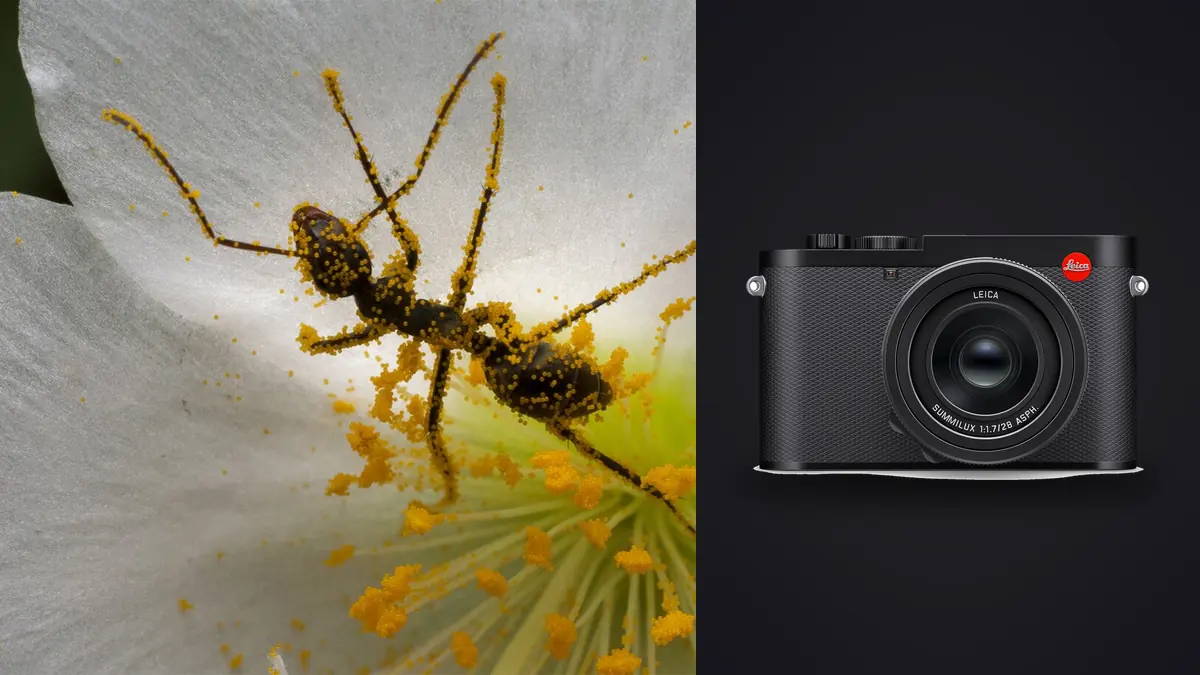
I took the Leica Q3 out to photograph hoverflies on a patch of oregano last summer, mostly out of curiosity rather than any real plan. I own a dedicated macro lens and normally reach for it without thinking twice, but I wanted to know whether the Q3's built-in macro switch was a genuine tool or just a marketing checkbox. Two hours and about four hundred frames later, I had an answer that's more nuanced than either "it works great" or "don't bother," which is usually how these things go with fixed-lens cameras pushed outside their comfort zone.
This isn't a camera built for macro work first. It's a 28mm street and travel camera that happens to have a clever focus collar. Understanding exactly what that collar does, and what it costs you, is the difference between coming home with usable insect shots and coming home frustrated.
What the macro switch actually does
Twist the collar around the lens barrel on the Q3 and you're not swapping optical elements or adding glass. You're shifting the minimum focus distance from the standard 0.3m down to roughly 0.17m, measured from the sensor plane, which pulls the front element to somewhere around 8 to 10cm from your subject at closest focus. That gives a maximum reproduction ratio of about 1:2, meaning your subject renders at half life-size on the sensor. That's respectable for a fixed-lens compact. It is not true macro in the strict 1:1 sense that dedicated macro lenses promise.
For flowers, small objects, or product-style close-ups, 1:2 is plenty. For insects, the number that actually matters isn't the magnification ratio, it's the working distance, and that's where the wide 28mm focal length starts working against you.
Why a wide macro lens fights insect subjects
A 100mm macro lens lets you sit 25 to 30cm away from a dragonfly and still fill the frame at 1:1. The Q3, even in macro mode, needs you within roughly a hand's width of the subject to get anything close to its maximum magnification. That's fine for a slug or a stationary caterpillar. It's a real problem for anything with compound eyes and a flight response, which is most of what people mean when they say "insect macro." I lost count of how many bees, hoverflies, and one particularly patient damselfly took off the instant my shadow or the lens hood crossed some invisible threshold they'd tolerated up to that point. Wide lenses at close range also introduce their own distortion: straight legs and antennae can bow slightly toward the frame edges, which is rarely flattering on a subject already this small and precise.
Subjects that cooperate versus subjects that don't
Cold mornings help enormously, since insects are sluggish before the sun warms their flight muscles. I've had far better luck with grasshoppers and beetles at 7am than with anything airborne at midday. Slow-moving or camouflaged subjects (stick insects, aphid clusters, caterpillars, most spiders sitting in a web rather than moving across it) are realistic targets for the Q3's macro mode. Fast fliers like dragonflies, wasps, and most bees are a much harder ask, and I'd set expectations accordingly before a session rather than after.
Aperture, depth of field, and the light you give up
At 1:2 magnification, depth of field collapses to almost nothing wide open. Shooting an ant at f/1.7 gives you maybe a millimeter of usable focus, which sounds dramatic until you actually try it and realize you can't even keep both antennae sharp in the same frame. In practice I settled on f/8 to f/11 for most insect work with this camera, sometimes pushing to f/13 when I needed the whole body of something larger, like a shield bug, in focus. That aperture choice has consequences. Stopping down that far at close focusing distances eats a lot of light, and since the Q3 has no built-in flash and I wasn't hauling a macro ring light into a field, ISO climbed more than I expected, often into the 1600 to 3200 range even in decent morning sun. The sensor handles that reasonably well thanks to the 60-megapixel BSI design, but you're trading noise for depth of field either way, and there's no getting around that trade with a fixed-lens body.
The crop modes as a partial workaround
One thing that actually helped was the Q3's digital crop framing, which simulates 35mm, 50mm, 75mm, and 90mm fields of view by cropping into the full sensor resolution rather than optically zooming. Because the sensor has so many megapixels to spare, cropping to the 75mm or 90mm frame lines and backing off a little from the subject gave me some breathing room on working distance without fully sacrificing detail. It's not the same as a longer macro lens (you're throwing away real resolution, not gaining true reach), but for a jumpy subject that won't tolerate you at 10cm, shooting the 90mm crop from 20 to 25cm away and cropping slightly further in post was a workable compromise more than once.
Handheld shooting, bursts, and the culling problem nobody warns you about
Because depth of field is so thin and the working distance so short, even a slight forward sway of your body throws focus off entirely. Without a focus rail or tripod (both impractical when you're following a moving beetle through leaf litter), I ended up shooting in short bursts and rocking gently forward and back through the point of focus, hoping one frame in eight or ten landed sharp on the eyes. It's essentially manual focus stacking done with your own body as the rail, which sounds absurd written out but is a real, commonly used macro technique. The obvious cost is volume. A single grasshopper encounter left me with sixty-plus nearly identical frames, most differing only by a millimeter of focus shift. Sorting that by eye on a laptop screen, especially when the difference between "eyes sharp" and "eyes just barely soft" only shows up at 100% zoom, is genuinely tedious and easy to get wrong on tired eyes at the end of a shoot. This is the part of macro work that photography content rarely covers, because it happens after the field session, on a couch, at 9pm. I run those bursts through imagic afterward specifically because its local sharpness scoring was built for exactly this kind of decision: ranking near-identical frames by actual focus accuracy rather than me guessing from a thumbnail grid. The duplicate and burst clustering groups each insect encounter together automatically instead of leaving four hundred loose files in one folder, which matters a lot when a single outing produces that many near-duplicate frames. Everything runs locally on the laptop, which is convenient in the field with no signal, since you're not waiting on an upload to see which frame actually held focus.
A practical comparison
To put the Q3's macro mode in context against the two other realistic options for insect close-ups, here's how they actually compare in the field rather than on a spec sheet:
| Approach | Max magnification | Working distance | Typical field aperture | Autofocus on live insects | Total kit weight |
|---|---|---|---|---|---|
| Leica Q3 macro switch | ~1:2 (half life-size) | ~8-10cm to front element | f/8 to f/11 | Contrast-detect, hunts up close; manual fine-focus recommended | ~743g, single unit |
| 100mm dedicated macro lens on full-frame mirrorless | 1:1 (life-size) | ~28-35cm | f/11 to f/16 | Hybrid AF, usually with a focus limiter switch | ~1.1-1.4kg body plus lens |
| Modern smartphone macro mode | Software-assisted, roughly 1:2 equivalent | ~2-5cm | Fixed, computationally controlled | Fast but shake is heavily amplified at that distance | Pocketable |
What the table doesn't capture is image quality once you crop in. The Q3's 60-megapixel files hold up far better under a tight crop than a phone sensor does, which partially offsets the working-distance disadvantage against a true macro lens. You're paying for that resolution advantage with light and with proximity to a subject that would often rather not have you that close.
Editing insect macro shots without losing the texture
Insect photography lives or dies on texture: the matte dust on a moth's wing, the compound facets of an eye, the slight sheen on a beetle's shell. It's easy to oversharpen these shots into something that looks artificial, or to push clarity so hard that the frame starts to look like a texture filter rather than a photograph. I've settled into a fairly restrained edit for this kind of work, pulling shadows up gently rather than cranking global contrast, and I built that preference into an apply_my_style preset in imagic so every macro batch gets the same restrained treatment automatically instead of me re-deciding it frame by frame at 11pm. It's a small thing, but consistency across a season of insect shots matters more than any single dramatic edit.
Where the Q3 actually shines for this genre
The camera's real strength for insects isn't the macro switch in isolation, it's the combination of that switch with the leaf shutter and the near-silent electronic shutter option. Insects respond to vibration and sudden mechanical noise more than most people expect, and a completely silent shutter let me fire off far more attempts at a resting butterfly than a DSLR's mirror slap ever would have allowed. If you already own a Q3 for street or travel work, that quietness alone makes casual insect close-ups worth attempting even without buying anything extra.
Where I'd stop trying to make it work
If you photograph insects seriously (competition-grade macro, high-magnification subjects like mites or ant faces, anything beyond 1:1), the Q3 isn't the tool, and no amount of technique closes that gap. The fixed 28mm optic simply doesn't have the magnification headroom, and there's no accessory port for extension tubes or diopters the way an interchangeable-lens system offers. I'd treat the Q3's macro mode as a genuinely useful bonus feature for a camera you're already carrying for other reasons, not a reason to buy one specifically for insects. If insects are the primary goal, a 90mm or 100mm macro lens on almost any mirrorless body will outperform it in every measurable way except portability and shutter silence.
Frequently Asked Questions
Does the Leica Q3's macro switch give true 1:1 life-size magnification?
No. It tops out around 1:2, meaning the subject renders at roughly half its actual size on the sensor. Dedicated macro lenses reach 1:1 or beyond. The Q3's high resolution helps close some of that gap when you crop in post, but the optical magnification itself stays at 1:2.
What working distance can I expect when photographing a live insect?
At maximum macro magnification you're typically within 8 to 10cm of the subject, measured to the front of the lens. That's close enough to spook most flying insects, so slow-moving or resting subjects give far more reliable results than anything airborne.
Should I use autofocus or manual focus for insect close-ups on the Q3?
Autofocus tends to hunt at these distances, especially in lower light. I mostly use manual focus with focus peaking enabled, then make small adjustments with body movement rather than relying on the lens to lock quickly on a moving subject.
Is it worth shooting bursts for insect macro with this camera?
Yes, and expect a lot of near-duplicate frames as a result. Because depth of field is so thin at close range, shooting several frames while rocking gently through the focus point is the most reliable way to land sharp eyes. Sorting that volume afterward is really where the work happens, and it's worth having a workflow (I use imagic's sharpness scoring and burst clustering) that handles the grouping and ranking instead of doing it by eye.
If you're weighing the Q3 against other close-focus options for this kind of shooting, it's worth reading up on how AI photo culling actually works before you commit to a high-volume macro workflow, since the editing side of insect photography tends to be more time-consuming than the shooting side once you're honest about the frame counts involved.