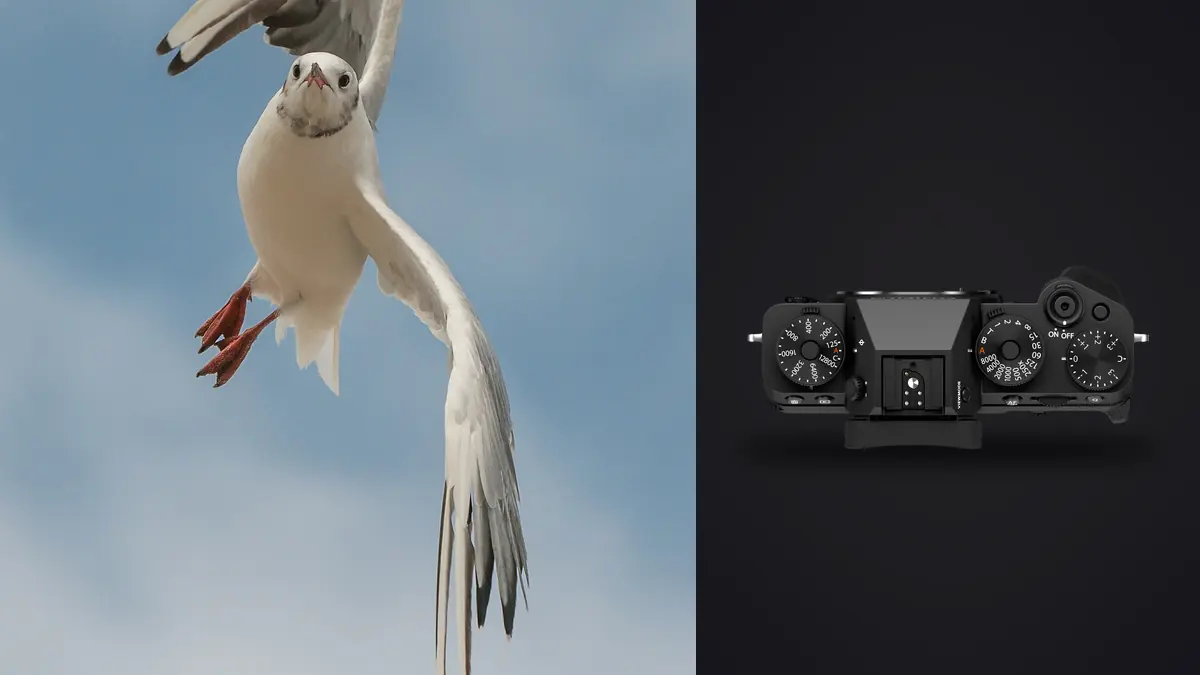
I spent four mornings on a tidal creek in early spring chasing ospreys with a Fujifilm X-T5 and the XF 100-400mm, mostly because I wanted to find out if all the online arguments about this camera being "not a real wildlife body" held up once a bird actually stooped on a fish thirty feet from my position. Some of the complaints turned out to be fair. Most of them missed the point. The X-T5 is not the fastest tool Fujifilm makes for flight photography, that's the X-H2S with its stacked sensor, but it is the one most photographers already own, and it is capable of a very high keeper rate once you stop fighting its defaults.
This isn't a spec sheet regurgitation. It's what changed in my settings, my lens choice, and my culling routine after a season of pointing this camera at things that don't sit still.
The sensor is the whole argument, in both directions
The X-T5 carries Fujifilm's 40.2 megapixel back-illuminated X-Trans sensor, and for birding that resolution cuts two ways. On the plus side, the APS-C crop factor gives you roughly 1.5x more reach than a full-frame body with the same lens, so a 400mm becomes an effective 600mm on the sensor, and at 40 megapixels you can crop a bird that only fills a third of the frame and still come away with a usable 15-18 megapixel file. That flexibility saved several of my osprey shots where the bird banked wide and I couldn't reframe fast enough.
On the downside, that sensor has no optical low-pass filter, which is great for feather micro-detail but means fine repeating patterns (chain-link fencing behind a perched hawk, or the herringbone texture on some gull wing feathers in strong light) can show faint moire. It's not a dealbreaker, it's just a thing you'll notice occasionally and need to fix in post rather than something the sensor quietly handles for you.
The bigger practical issue is that this is not a stacked sensor. The X-H2S reads out much faster, which matters specifically for birds in flight because slow sensor readout is what causes rolling shutter distortion in electronic shutter mode: propellers bend, wingtips skew, and fast pans through bright sky can show banding under certain artificial or flickering light. The X-T5 shows this more than the X-H2S does. It's manageable if you know when to switch back to the mechanical shutter, but it's the single biggest thing reviewers who call this a dedicated wildlife body tend to gloss over.
Shutter mode is not a settings-menu afterthought here
Most people set electronic shutter once and forget it exists. With the X-T5 on birds in flight, which shutter mode you're in changes what kind of failure you'll get on a missed frame, so it's worth treating as a real decision rather than a default.
| Shutter mode | Approx. max frame rate | Rolling shutter risk | Where it earns its keep |
|---|---|---|---|
| Mechanical | 15 fps | None | Backlit flight against bright sky, fast pans, anything where skewed wingtips would ruin the frame |
| Electronic, full sensor width | 20 fps | Highest | Slower, more predictable flight paths (herons, larger raptors soaring rather than flapping hard) |
| Electronic, 1.29x crop readout | 20 fps | Reduced vs. full width | Small fast fliers (terns, swallows, kingfishers) where the extra reach and quieter readout both help |
| Mechanical, single UHS-II card, lossless compressed RAW | 15 fps, buffer clears slowly | None | Only when you have time between passes; not for sustained multi-second bursts |
That last row matters more than people expect. The X-T5 dropped the dual card slot that the X-T4 had, so you're on a single UHS-II SD card, and if you shoot lossless compressed RAW at 15-20 fps you will fill the buffer within a couple of seconds and then sit there watching the frame counter crawl while the bird you wanted flies out of range. Switching to standard compressed RAW instead of lossless roughly doubles your usable burst length before the buffer chokes, and for flight sequences I'd rather have twice the frames at a slightly smaller file size than eight extra megabytes of RAW headroom I never touch in the edit.
Autofocus: what "bird detection" actually does for you
Fujifilm added subject detection, including a dedicated bird mode, to the X-T5 via firmware rather than at launch, and it's genuinely useful, but it's not magic. What it's good at: locking onto a bird's head and eye once the subject is reasonably large in the frame and has decent contrast against its background, like a raptor against open sky or a wader against wet sand. What it struggles with: a small bird deep in branches, a flock where multiple birds overlap, or anything where the background clutter is roughly the same tonal value as the subject. In those situations I turn subject detection off and go back to a single point or a small zone, because the camera guessing wrong costs more frames than the camera not guessing at all.
For AF-C custom settings, I run Set 4 (described in the menu as suited to erratic subjects that accelerate and decelerate) for most in-flight work, and Set 3 for birds on a fairly consistent flight line like gulls working a shoreline. Tracking Sensitivity around 1-2 (biased toward staying locked rather than jumping to a new subject) and Zone Area Switching set to Front kept focus on the bird I wanted rather than snapping to whatever crossed in front of it, which happened constantly with gulls in a mixed flock. These aren't universal numbers, your subject and background will push you in different directions, but they're a sane starting point instead of the factory defaults.
Lens choice changes the AF conversation more than people admit
The XF 100-400mm f4.5-5.6 is the lens most people pair with the X-T5 for birding because it's light enough to hand-hold for hours, and I found the AF kept up fine even wide open at 400mm on relatively fast subjects. The newer XF 150-600mm gives you a genuinely useful 900mm equivalent at the long end, but you're at f8 by 600mm, and on overcast days that pushes shutter speed down or ISO up faster than you'd like, especially once you're also trying to hold 1/2000s or faster to freeze a wingbeat. The XF 500mm f5.6 prime is the one I'd reach for if reach and light-gathering both matter more than versatility, it's noticeably faster to lock focus in low light than either zoom, but it's also the option most people don't already own.
Exposure choices that actually matter for wingbeats
For birds in flight I default to 1/2000s or faster for small, fast-wingbeat species like terns and swallows, and I'll drop to 1/1250s-1/1600s for larger, slower-flapping birds like herons or gulls gliding rather than actively flying. Auto ISO with a floor shutter speed set in the menu (rather than manually chasing ISO between passes) is the only way I've found to keep exposure consistent when a bird moves from open sky into shade under a treeline in the same three-second pass. Aperture priority at f5.6-f8 depending on the lens, and I accept the noise at ISO 3200-6400 on overcast mornings because a sharp, slightly grainy frame beats a clean, motion-blurred one every time.
One thing worth flagging: because the X-T5 sensor has no low-pass filter, files hold up better under noise reduction than you'd expect at 40 megapixels, since you're not fighting softness from the filter on top of whatever NR you apply. I push detail recovery a bit harder in post than I would on an older Fuji body for exactly this reason.
Where the real bottleneck shows up: after the shoot, not during it
Here's the part nobody warns you about before you actually do a few weeks of serious birding with this camera: a single good morning at 15-20 fps produces an absurd number of frames. Four hours at the creek regularly left me with 3,000-4,000 images, and the overwhelming majority of any given flight pass are near-duplicate frames separated by a fraction of a second, where the only real difference is wing position and whether the eye happens to be sharp in that exact instant. Sorting that by hand, frame by frame, at full resolution, is how a hobby starts to feel like a part-time job.
This is the actual reason I moved my culling over to imagic. It runs entirely on my laptop rather than uploading a card's worth of RAW files somewhere, which matters a lot when you're editing from a truck in a parking lot with no signal after a dawn shoot. It groups burst sequences and near-duplicate frames together automatically, so instead of scrolling through 40 nearly identical shots of the same osprey stoop I'm looking at maybe five distinct groups, each one already ranked by local sharpness scoring that's actually paying attention to focus rather than just overall contrast, which matters a lot when the sharpest-looking thumbnail turns out to have a soft eye and a crisp wingtip.
The other piece that's specific to a high-volume genre like flight photography is imagic's apply_my_style preset. I built mine from a batch of ospreys and herons I'd already graded by hand, slightly warm, contrast pushed a touch in the shadows, and now new sessions get a first pass in that same direction automatically instead of me re-inventing the same three sliders on every import. It's not a replacement for individual attention on the keepers, but for the 200 acceptable-but-not-special frames in a session, it gets them to a publishable state without me touching each one. If you're curious how the underlying culling logic actually works rather than taking that on faith, we've written about it separately in how AI photo culling works.
Cold mornings, battery life, and other things that aren't in the spec sheet
Weather sealing on the X-T5 held up fine through drizzle and salt spray on the estuary, no complaints there. Battery life is the more honest concern for birding specifically, because you're often out before sunrise and the temperature drop hits the NP-W235 harder than Fuji's rated shot count suggests. I carry three batteries for a serious morning session and treat the in-camera percentage readout as optimistic once it's under 30% in cold air. None of this is unique to the X-T5, but it's worth planning around if you're used to a camera with better cold-weather stamina.
Frequently Asked Questions
Is the X-T5 actually good enough for birds in flight, or should I save for the X-H2S?
For most birding, yes, it's good enough, and for a lot of situations the difference won't show up in your keeper rate. The X-H2S earns its price with the stacked sensor's faster readout (less rolling shutter, better tracking through erratic flocks) and a deeper buffer, which matters most if you're shooting small, fast, unpredictable subjects like swallows over water. If you're mostly working larger, more predictable fliers like raptors and waders, the X-T5 will keep up and you'll have money left for a better lens instead.
Which shutter mode should I default to for small, fast birds like swifts or terns?
Electronic shutter in the 1.29x crop mode is my default for anything small and erratic, since the faster partial-sensor readout cuts down the rolling shutter distortion you'd get from full-width electronic shutter, and the crop gives you a bit more reach as a side benefit. I switch back to mechanical the moment I'm shooting into bright, high-contrast sky where banding or skew becomes more visible.
Is the XF 100-400mm enough, or do I need to step up to the 150-600mm?
For birds that let you get reasonably close, ospreys over a nest platform, gulls on a beach, herons at a local wetland, the 100-400mm's extra stop of light and faster AF response is worth more than the 150-600mm's additional reach. If you're regularly shooting small songbirds at real distance where you need every millimeter of focal length, the 150-600mm earns its slower aperture. I'd rather have the faster lens and crop in post at 40 megapixels than carry the slower one hoping I won't need the light.
Why do I end up with thousands of near-identical frames from one flight sequence, and what's the fastest way through them?
Because 15-20 fps captures wing position changes faster than the human eye can meaningfully distinguish, most bursts contain far more redundant frames than genuinely different ones. Manually clicking through each is the slow way. I run everything through imagic first, which clusters the burst into groups and surfaces the sharpest frame per group by actual focus data rather than file size or arbitrary position in the sequence, so I'm reviewing a shortlist instead of the raw dump. If your current workflow is still one-by-one in a folder, it's worth reading through our broader notes on building a faster photo workflow before your next big shoot.