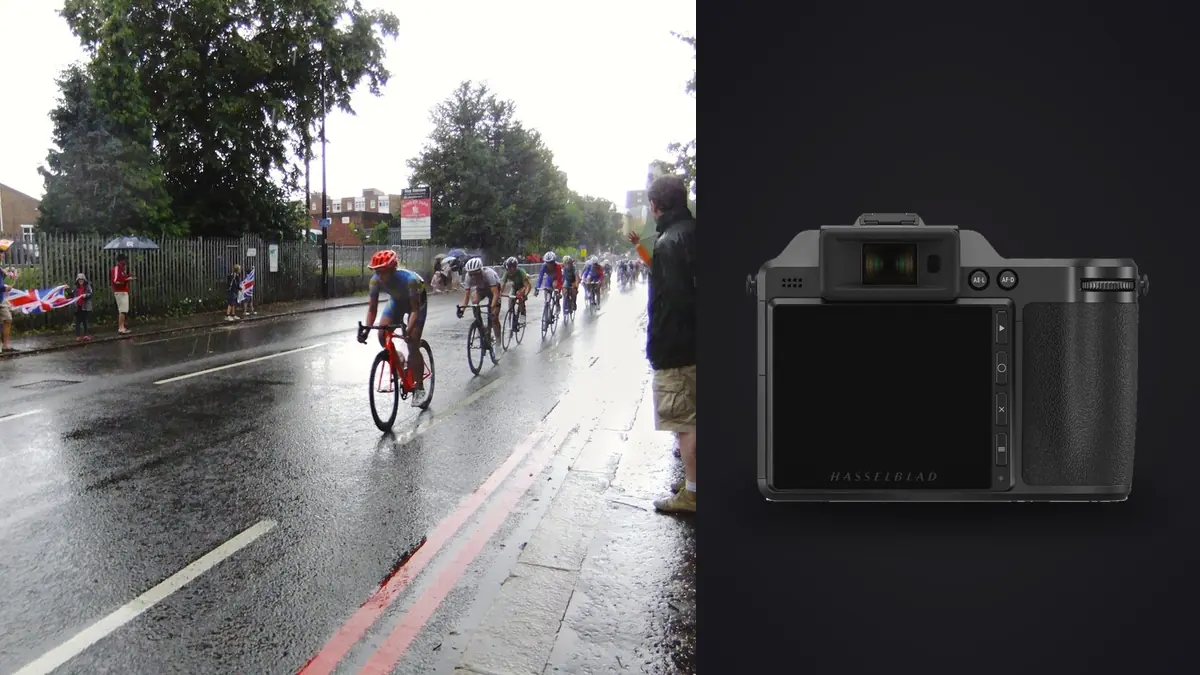
A regional track meet credential landed on my desk the same week I'd been shooting nothing but studio portraits with a Hasselblad X2D 100C, and the assignment editor asked if I could just "bring what you've got." What I had was a medium format body built for architecture and skin tone, about to get pointed at sprinters clearing 100 meters in under eleven seconds. I said yes before thinking it through, which is how you end up writing an article like this one instead of just filing the photos and moving on.
Why This Pairing Sounds Wrong (and Half of It Is)
The X2D 100C was never marketed as an action camera, and Hasselblad has never pretended otherwise. It carries a 100-megapixel, 43.8x32.9mm sensor, five-axis in-body stabilization, a 1TB internal SSD for tethered-free shooting, and a continuous shooting rate that tops out around 3.3 frames per second. Autofocus on the body is contrast-detection only, with no phase-detect pixels on the sensor, which means it hunts, especially against low-contrast backgrounds like a green infield or a grey overcast sky. None of that reads like a spec sheet for covering a 4x100 relay.
Compare that to what most sideline sports shooters carry: mirrorless bodies doing 20-plus frames per second with phase-detect eye and subject tracking that locks onto a bib number and doesn't let go through an entire race. If your job is "document every stride of the 400m final in sharp focus," the X2D 100C loses that fight before the gun even goes off. But a track meet isn't only the race. It's also the twenty minutes before it, the reaction on the infield after it, and the texture of a lane line under stadium lights, and that's where this camera starts to make sense again.
The Autofocus Reality Check
Contrast-detect systems work by nudging the lens back and forth to find the point of maximum edge contrast, and that back-and-forth is exactly what you don't want when a subject is closing distance at fifteen miles an hour. At an evening meet under mixed stadium lighting and dusk, I watched the X2D hunt for a full second and a half trying to lock onto a hurdler mid-approach. By the time it confirmed focus, she'd already cleared the barrier.
The fix isn't better autofocus technique, it's mostly abandoning autofocus tracking altogether. I switched to back-button focus and used the camera almost like a rangefinder: pre-focus on a fixed point, wait for the subject to arrive at that point, fire. For the 100m starting blocks, that meant focusing on the blocks themselves before the athletes even settled in, then not touching focus again until the gun. For high jump and pole vault, I focused on the bar and waited for the apex of the clearance rather than trying to track the approach. The touchscreen's focus peaking overlay helped confirm the plane was right before I committed to a sequence, which is a small mercy contrast-detect systems don't usually offer.
Matching Technique to the Sensor's Rhythm
At 3.3fps, you're capturing roughly one frame every three-tenths of a second. Across a ten-second 100m dash, holding the shutter the entire time nets you somewhere around thirty frames, and because each RAW file is well over 100MB, sustained bursts also lean on the buffer harder than the spec sheet number suggests. In practice I stopped thinking in bursts and started thinking in single, deliberate shots aimed at a specific instant. That's a different muscle than spray-and-pray, and it's honestly closer to how photographers shot sports before continuous autofocus existed at all.
Here's how that broke down across a typical meet, based on what actually worked and what I gave up on entirely:
| Moment | Feasible with the X2D 100C? | Technique | Settings I used |
|---|---|---|---|
| 100m block start | Yes, single frame | Pre-focus on the blocks, trigger on the gun | 1/2000s, f/5.6, ISO 400 |
| Distance race, mid-pack | Yes, easiest of the day | Pre-focused zone, pan with a slower subject | 1/1000s, f/4, ISO 200 |
| Long jump takeoff | Marginal, needed several tries | Focus locked on the board, fire on approach rhythm | 1/2500s, f/5.6, ISO 400 |
| Pole vault clearance | Yes, static peak moment | Manual focus on the bar height, trigger at apex | 1/1600s, f/4, ISO 800 (evening) |
| Javelin release | No, missed every attempt | Shifted to capturing the wind-up instead | n/a |
| 4x100 relay handoff | No, too narrow a window | Focused on the exchange zone box, got one usable frame in five tries | 1/2000s, f/5.6 |
| Medal stand / reactions | Yes, the camera's actual strength | Single-point AF, no rush | 1/500s, f/2.8, ISO 200 |
The pattern is obvious once you see it laid out: anything with a predictable arrival point at a known focal plane works. Anything that requires tracking an unpredictable trajectory in real time doesn't, and no amount of technique closes that gap.
Lens Choices That Actually Earn Their Keep Trackside
The XCD lens lineup wasn't built with reach in mind. Most of the range sits between f/2.5 and f/4.5, and the longest native options, the 90mm and 135mm, are still short compared to the 300mm and 400mm glass sports shooters bring to a track. There's a 1.7x teleconverter available, but attaching it drops light further and makes an already hunt-prone contrast-detect system noticeably worse, since it's now working with less contrast to grab onto. I tried it for exactly one event and went back to shooting without it.
What actually solved the reach problem was position, not glass. I traded my usual sideline spot for a credential closer to the infield curve, near enough that a 90mm could fill the frame on the straightaway without the teleconverter. The 100-megapixel sensor also gives you a real out after the fact: a moderately cropped frame from this sensor still holds up at a two-page magazine spread, so a slightly loose composition in the moment isn't the disaster it would be on a 24-megapixel body. That's a post-capture safety net, though, not a substitute for getting close enough to shoot properly in the first place.
What You're Actually There to Shoot
Once I stopped trying to make the X2D 100C do a sports body's job, the assignment got a lot more enjoyable. This camera's real strength at a track meet has nothing to do with speed. It's the tonal roll-off in harsh midday stadium light, the way backlit dust hangs over the long jump pit at golden hour, the texture of a worn lane line, the specific look of sweat and effort on a face at the finish. Those are static or near-static subjects, and they're exactly the kind of frame a 100-megapixel medium format sensor renders better than almost anything else on the sideline.
My actual shot list ended up looking less like a sports photographer's and more like an editorial photographer covering a sports event: coaches taping ankles before the call to the line, an athlete alone on the infield doing pre-race breathing, hands gripping the starting blocks in the seconds before the gun, the exhausted stillness of the medal stand. None of that needed 20fps. It needed a camera that renders skin and light beautifully when you have half a second to get it right, which is precisely what this one is for.
After the Whistle Blows: Sorting a Few Hundred 100-Megapixel Files
Even a restrained day of shooting adds up fast at this file size. A few hundred frames from the X2D 100C easily crosses 30 to 40GB, and because the frame rate is so low, you don't get the luxury of six near-identical safety shots to fall back on if the one frame you fired is slightly soft. Sharpness margin matters more here than it does with a high-fps body, and scrubbing through full-resolution 100MP RAWs one at a time to check focus on each of them is slow enough to eat an entire evening.
This is the part of the day where imagic actually earns its place in the workflow. Its local sharpness and focus scoring flags which frame in a short sequence is genuinely in focus without uploading a single one of these large RAW files anywhere, which matters a lot when your card is already pushing 40GB and your upload speed is not the bottleneck you want to introduce. The duplicate and burst clustering groups the handful of near-identical starting-block or pole-vault frames together so you're comparing three shots side by side instead of opening and closing each one individually, which is a meaningful difference when every file takes a beat to render at full resolution. Once a look is dialed in for the mixed stadium and dusk lighting these meets tend to have, running apply_my_style on the next event's take saves rebuilding develop settings from a blank slate every single time a new meet lands in the folder. If you haven't compared culling approaches before, how AI photo culling works covers the mechanics in more depth, and these workflow habits are worth adopting regardless of what camera produced the files.
Frequently Asked Questions
Is the Hasselblad X2D 100C a good camera for shooting sprints?
Not for continuous coverage of the race itself. The contrast-detect autofocus and 3.3fps rate can't keep pace with a runner closing distance, so you'll miss more attempts than you land if you try to track a sprinter through the frame. It's a much better tool for the single, pre-focused moment: the gun going off, the lean at the tape, the reaction at the line.
What shutter speed actually freezes a sprinter with this camera?
1/2000s or faster is the range I stayed in for anything moving down the straight, with 1/1600s working fine for slower events like distance races or the moment of clearance in pole vault. The shutter speed isn't the limiting factor here, though. Getting the focus plane right before the athlete arrives is.
Should I use the electronic shutter for quieter shooting on the infield?
I'd avoid it for anything fast. The sensor's readout speed isn't built for quick action, and electronic shutter introduces visible rolling shutter skew on subjects moving quickly across the frame, which shows up as a subtle lean or warp on sprinters and long jumpers. Mechanical shutter cost me a little noise from other photographers noticing the click, but it kept moving subjects looking like straight lines instead of parallelograms.
Is the teleconverter worth carrying to a track meet?
For me, no. The 1.7x teleconverter costs you light and makes an already hunt-prone contrast-detect system slower to lock, which is the opposite of what you need when a subject is closing distance. Getting a better credential position closer to the action solved the reach problem more reliably than any accessory did.