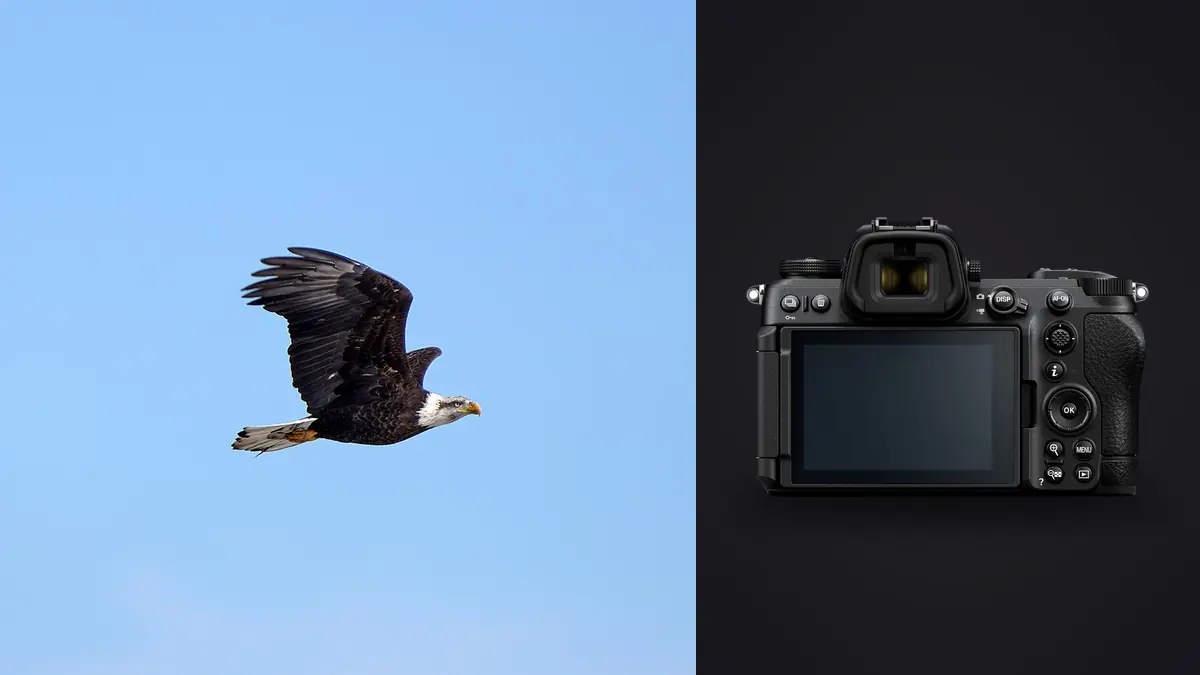
I spent most of last winter parked at a reservoir edge before sunrise, waiting on ospreys and the occasional harrier, with a Z6 III and whatever telephoto I'd talked myself into carrying that week. The camera gets recommended constantly for birds in flight because of the price relative to the Z8, but almost none of the write-ups I read before buying one talked about the actual friction points: where the autofocus argues with itself, what the buffer really gives you at 20fps, and how much time you'll spend afterward sorting three thousand nearly-identical wingbeat frames. This is the version of that article I wish I'd had.
The sensor change that actually matters for BIF
The headline spec on the Z6 III is the partially stacked 24.5MP sensor, and for birders it's worth understanding why that matters more than the megapixel count does. The stacked readout region cuts rolling shutter distortion dramatically compared to the Z6 II, which is the camera most people are upgrading from. On a straight-line pass, a gull or heron banking hard against the wind won't show the skewed, jello-like wing edges that plagued older non-stacked full-frame sensors shooting silent electronic shutter. It's not zero. Push a fast-wingbeat subject like a teal or a peregrine stoop across the frame at a shutter angle the sensor can't quite keep up with, and you'll still see it in maybe one frame out of thirty. But it's rare enough that I now leave the mechanical shutter off entirely and just shoot electronic, which also means no shutter shock and a genuinely blackout-free viewfinder at up to 20fps.
That blackout-free EVF is the part I undervalued before owning the camera. Tracking a tern that's jinking unpredictably over water is a framing problem as much as an autofocus problem, and not losing the subject in a black gap between frames makes a measurable difference in keep rate. It sounds like a marketing line until you've tried to reacquire a fast-moving bird through a viewfinder that blacks out every time you press the shutter.
Autofocus settings for birds in flight
The AF system borrows the subject-detection architecture from the Z8 and Z9, with a dedicated bird-detection category, and it is genuinely better at holding onto a bird against a busy background than anything Nikon shipped before the Z8. But "genuinely better" still means you have to set it up correctly, and the default out-of-box behavior is not what you want for flight work.
Which AF-area mode to leave the camera in
For anything airborne against open sky or water, I run 3D-tracking with Animal detection set to birds, not Wide-Area AF-C (L). Wide-Area works well for a bird perched and static, where you can place the box on the eye and let it sit, but once the subject is moving unpredictably across the frame, 3D-tracking's ability to follow a point you've locked onto beats a fixed detection zone. The one caveat: 3D-tracking needs you to actually place the initial point on the bird, not near it. Against a cluttered reed bed or tree line, the system will happily lock onto a branch a foot behind your subject if your initial placement is sloppy, and once it's committed to the wrong depth it takes a full release-and-reacquire to fix.
Where 3D-tracking and bird-detection still argue with each other
The friction point nobody mentions in the marketing copy: when a bird crosses in front of another bird, or a flock breaks formation, the detection engine sometimes hands focus to whichever subject has the cleanest edge contrast against the sky rather than the one you actually locked onto. I lost a sequence of a kestrel hovering over a hedge to exactly this when a wood pigeon flew through the background thirty feet back. The system isn't broken, it's just making a probabilistic call, and in dense multi-subject scenes it will occasionally guess wrong. Single, isolated bird against open sky or water is where this camera is close to unbeatable for the price. Mixed flocks and busy backgrounds are where you still earn your keeper rate through technique, not the AF system doing it for you.
Lens pairings that actually make sense on this body
The Z6 III is light enough, at roughly 760g body-only, that lens choice changes the whole character of a day's shooting far more than it would on a heavier Z8 or Z9 body. Here's how the realistic options stack up for flight work specifically, not perched portraits.
| Lens | Approx. weight | Handheld tracking feel | Best use case | Where it struggles |
|---|---|---|---|---|
| Nikkor Z 100-400mm f/4.5-5.6 VR S | 1,435g | Fast, easy to swing onto erratic flight paths | Ospreys, gulls, terns over open water where reach under 400mm still fills the frame | Runs out of reach fast on small songbirds or distant raptors |
| Nikkor Z 180-600mm f/5.6-6.3 VR | 1,955g | Manageable handheld for an hour, tiring past that | All-purpose reserve and estuary work, best value-to-reach ratio in the lineup | Slower aperture hurts AF confidence in low dawn light |
| Nikkor Z 800mm f/6.3 VR S PF | 2,385g | Surprisingly trackable given the reach, but narrow field of view punishes late acquisition | Distant raptors, birds you can't approach (herons, eagles on a nest tree) | Almost unusable for a bird crossing close and fast, you simply can't find it in frame in time |
| Nikkor Z 400mm f/4.5 VR S | 1,245g | The best balance of speed and reach for actual flight tracking | Fast, close, unpredictable subjects: swallows, terns diving, hawks stooping | Not enough reach for small or distant subjects, you'll crop hard |
If I had to keep one combination for BIF specifically, it's the 400mm f/4.5. The extra stop of light over the zooms noticeably improves AF confidence in the low, flat light most bird activity happens in, and it's light enough to actually track a fast crossing subject instead of fighting the lens's own inertia.
Exposure settings for first light
Most bird activity worth photographing happens in the hour after sunrise or before sunset, which means you're fighting shutter speed and ISO the entire time. My baseline for flight work is 1/2500s minimum, dropping to 1/1600s only for larger, slower fliers like herons or swans where wing motion blur is less of a giveaway. Auto ISO with a ceiling around 12800 keeps the camera honest. Past that the files get noisy enough that even a strong keeper isn't worth the cleanup time, and I'd rather underexpose slightly and recover in post than push the sensor further.
Metering matters more than people expect here too. Matrix metering against a bright sky consistently underexposes the bird itself by a stop or more, since the meter is averaging in a huge bright background. I dial in +0.7 to +1.0 exposure compensation as a standing habit whenever the subject is airborne against sky, and switch back to neutral the moment it lands against foliage.
What happens after the shoot
Here's the part that doesn't get talked about enough: a productive two-hour session at 20fps on this camera can leave you with four to six thousand frames, and the overwhelming majority of them are the same bird in the same three seconds of wingbeat, six or seven times over. Culling that by eye, frame by frame in Lightroom, is where most of the actual time in this hobby disappears, not in the field.
This is the exact problem I built imagic around, and it's the reason I run every card through it before touching Lightroom at all. The burst and duplicate clustering groups those six-frame wingbeat sequences together automatically instead of making you scroll past near-identical shots one at a time, and the local sharpness scoring flags which frame in each cluster actually nailed focus on the eye, which with a moving bird against a moving background is not always the frame you'd guess from the thumbnail. Because it runs entirely on-device with no upload step, I can do this culling pass sitting in the car in a car park with no signal, which after a morning at a reserve with patchy coverage is more useful than it sounds. If you haven't looked at how automated culling actually separates keepers from near-misses, our breakdown of how AI photo culling works covers the mechanics in more depth than I have room for here.
The other piece that's saved me real time is the apply_my_style preset, trained on my own past edits rather than a generic wildlife preset pack. Bird-in-flight files from this sensor tend to need a fairly consistent recipe (a touch of shadow lift, restrained saturation on blue-grey feather tones, some selective sharpening on the eye) and having that applied automatically to the frames that survive culling means the actual sit-down editing session is closer to twenty minutes than two hours. For anyone drowning in burst files generally, not just from birding, our workflow speed guide has more on trimming that gap between shutter click and finished export.
Frequently Asked Questions
Is the Z6 III fast enough for serious birds-in-flight work, or should I just save for a Z8?
For the vast majority of BIF shooting, yes, it's fast enough. The 20fps electronic burst and bird-detection AF are functionally the same detection engine as the Z8, just running on a body with a smaller buffer and a sensor that isn't fully stacked. Where the Z8 pulls ahead is buffer depth on long sustained bursts and marginally better rolling-shutter control on the very fastest wingbeats. If you're shooting a handful of ten-to-twenty frame bursts per encounter, which is realistic for most flight sequences, you won't hit the Z6 III's limits often enough to justify the price gap.
Does the partially stacked sensor still show rolling shutter with fast wingbeats?
Occasionally, yes, but it's a big improvement over the fully rolling sensor in the Z6 II. On genuinely fast subjects like swifts or a diving falcon, you can still catch the odd frame with slightly skewed wingtips if the bird crosses the frame at high angular velocity. On the slower, more common subjects like gulls, herons, and raptors soaring or gliding, it's a non-issue in practice.
What's a realistic battery life for a full morning of flight shooting?
With the EN-EL15c and heavy use of continuous AF-C tracking plus the electronic viewfinder running the whole time, I get roughly two and a half to three hours of active shooting, which in practical terms means one battery covers a dawn session comfortably but not a dawn-to-midday push. I carry two and swap at the first noticeable voltage warning rather than running one down to empty, since cold mornings drain the second half of a charge faster than the CIPA rating suggests.
Do I need CFexpress cards, or will SD UHS-II keep up at 20fps?
SD UHS-II keeps up for short bursts, five to ten frames at a time, which covers a lot of casual flight shooting. Where it falls behind is sustained tracking of an extended flight sequence, an osprey circling and diving over thirty or forty frames, where the write speed ceiling on SD starts throttling the buffer noticeably faster than CFexpress does. If BIF is your main use case rather than an occasional subject, put the CFexpress card in the primary slot and use SD as overflow or backup rather than the other way around.