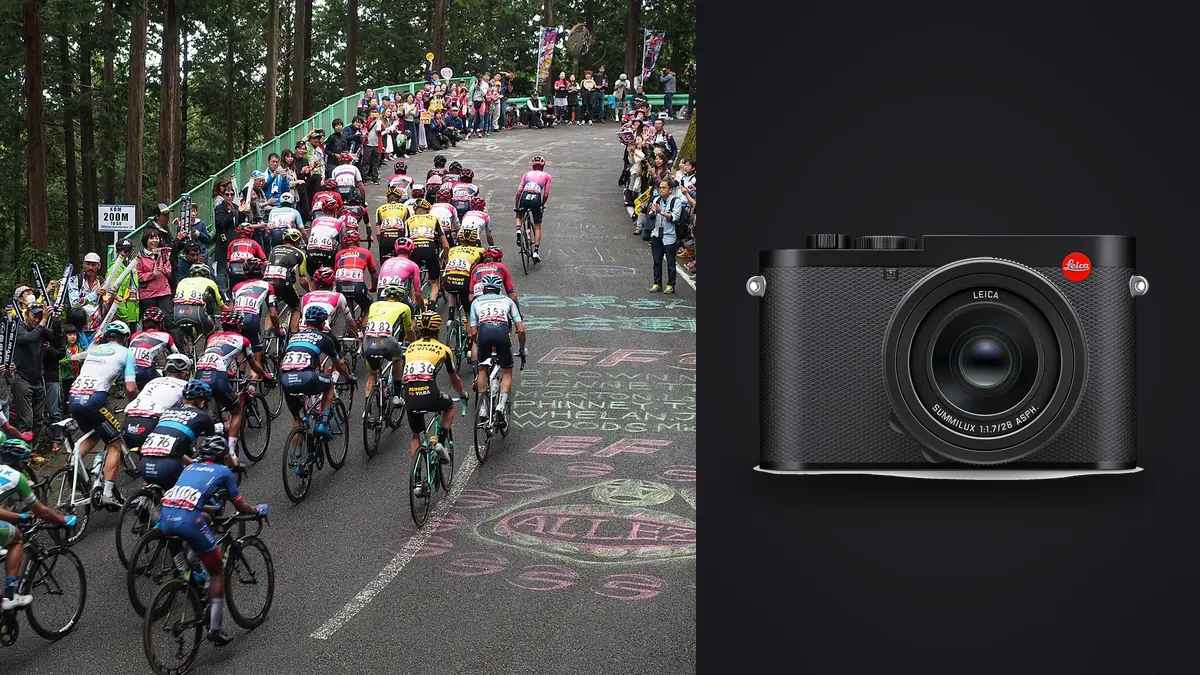
I brought a Leica Q3 to a district qualifying meet in early June, slung across my chest while a 100-400 did the actual work on the primary body. It was a wet morning, the infield was soft enough that my shoes were sinking by the second event, and more than one person on the sideline asked why I had a fixed 28mm lens at a track meet at all. Fair question. The Q3 was never built for this. It has no telephoto reach, no interchangeable glass, and a buffer that will not keep pace with a dedicated sports body shooting raw all day. None of that makes it useless here. It just means you need to be precise about which twenty minutes of a six-hour meet it's actually good for, and stop expecting it to cover the rest.
This is that honest accounting: what the Q3 brings to a track and field day, where the fixed lens genuinely fails you, and the handful of moments where I'd reach for it over a long zoom every time.
What's actually in the box for this kind of work
The relevant numbers, stripped of marketing language: a 60-megapixel full-frame sensor, a Summilux 28mm f/1.7 lens that's sharp wide open, hybrid autofocus that combines phase and contrast detection, a leaf shutter good to 1/2000s, an electronic shutter that goes up to 1/16000s, burst shooting around 15 frames per second in electronic mode, and an IP52 rating for dust and light moisture resistance. Close focus is about 27cm normally and drops to roughly 17cm in macro mode.
On paper that's a fast, high-resolution, weather-resistant compact. In practice, the buffer is the first thing that reminds you this isn't a purpose-built sports camera. Fifteen frames a second sounds competitive until you fill the buffer chasing a false start and the camera slows down mid-sequence while it writes to card. A dedicated sports body with a deep buffer and a proper telephoto doesn't have that problem, but it also doesn't fit in a jacket pocket, and that trade matters more than people admit.
The lens is the whole problem
Track and field happens at a distance. Sprinters run down a straight forty to sixty meters from a typical stand position, throwers work inside a cage well back from the crowd line, and even the long jump runway puts you further from the athlete than a portrait lens wants to be. A 28mm lens, even a very good one, does not close that gap. The Q3's in-camera crop modes to 35mm, 50mm, and 75mm equivalents help, but they're digital crops of the same 60-megapixel sensor, not optical zoom, so every step up in reach costs you resolution.
| Crop mode | Approx. resolution | What it frames from a typical stand-to-track distance (40-50m) | Realistic use at a meet |
|---|---|---|---|
| 28mm (native) | ~60MP | The full home straight, six or more lanes wide | Wide establishing shots of the field, not a single athlete |
| 35mm | ~37MP | Roughly four lanes across | Small-group shots if runners are in the nearer lanes |
| 50mm | ~19MP | One to two lanes | Head-and-shoulders only if the athlete is in lane 1 or 2 |
| 75mm | ~8MP | A single lane, tight framing | Usable for close field events, thin margin for further cropping |
Compare that to what a 400mm f/2.8 or even a modest 150-600mm zoom gives you from the same seat, and it's not close. Those lenses exist because track and field genuinely requires that reach. The Q3's crop modes are a convenience feature built for street and travel photography, where you're already near your subject. Asking them to substitute for real telephoto glass at a track meet is asking the camera to do a job it was never designed for, and it shows immediately the first time a runner is in lane 6 instead of lane 1.
Where it actually earns a spot in the bag
Once I stopped trying to use the Q3 as a second sports camera and started using it for what a fast 28mm actually does well, it became worth carrying.
- Starting blocks, up close. Club and regional meets often let credentialed photographers get near the blocks before a race. At that distance, 28mm f/1.7 low to the ground produces a genuinely different frame than anything a telephoto gets from the stands, tense hands, spikes digging in, the false-start gun barely out of frame.
- Field events, when access allows. Shot put, long jump, javelin, and discus cages often put a photographer much closer to the action than the sprint straight does. At those distances, native 28mm or a light 35-50mm crop covers the whole motion without needing reach.
- Behind the scenes. Coaches pacing the infield, warmups, relay handoff practice before the actual race, medal ceremonies, team huddles. This is close-range, unscripted, and exactly what a fast wide prime is built for.
- Detail work. Starting blocks, batons, spike plates, a stopwatch in a coach's hand. The Q3's close focus (down to about 17cm in macro mode) picks up texture a telephoto simply can't get near.
- A second body that doesn't slow you down. Working a 400mm on a monopod and needing to grab a candid moment fast, without a lens change, is where a compact second body earns its keep regardless of brand.
Leica also sells a Q3 variant with a fixed 43mm Summilux instead of the 28mm, which narrows the reach gap slightly for field events and closer sprint work if you're choosing between the two for this kind of coverage. It's still not a telephoto, but it's a meaningfully different starting point than 28mm if track and field is more than an occasional assignment for you.
Autofocus and burst rate under real pressure
Continuous autofocus on the Q3 has genuinely improved over earlier Leica compacts, and at close range, starting blocks, a thrower mid-spin, a coach walking toward camera, it keeps up fine at f/1.7 to f/2.8. Where it struggles is the same place any contrast-assisted hybrid system struggles: a small, fast subject crossing the frame edge to edge at distance. That's rarely the situation you're in with a 28mm lens anyway, since anything far enough away to need tracking is also too far away to be usable in the frame at all. The 15fps electronic burst is plenty for the close moments this camera is good for, but it's worth knowing the electronic shutter can introduce rolling shutter skew on fast horizontal motion, a sprinter's legs at full stride 20 meters away can show a slight lean or warp if you're not careful with shutter speed. For anything close and fast, I'd rather drop to a slower burst with the mechanical leaf shutter than chase 15fps and deal with skewed frames later.
Weather and handling on an actual outdoor circuit
The IP52 rating is real and it matters more than it sounds. It won't survive a downpour or a dunk, but light rain, blowing dust off a dry infield, and general outdoor grime are exactly what it's rated to shrug off, and that qualifying meet's drizzle didn't slow it down once. As a second body it's also just lighter and smaller than carrying two full-size setups, which matters across a six-hour meet where your shoulders are already carrying a monopod and a long lens. Battery life is the one place I'd flag honestly, it's not generous for a full day of shooting, so a spare or two in a jacket pocket is not optional.
After the gun goes off: sorting through the bursts
The part nobody warns you about with any high-resolution burst-capable camera is what happens after the meet, when you're staring at several hundred near-identical frames of a starting-block sequence or a throw and trying to find the one that's actually sharp. This is where I lean on imagic rather than clicking through everything by eye. It runs entirely on the laptop, no upload required, which matters at a venue with no reliable wifi and a school or club waiting on same-day photos. The local sharpness scoring flags which frame in a burst is actually in focus rather than just close, and the duplicate and burst clustering groups near-identical shots so you're reviewing one representative frame per moment instead of forty variations of the same throw. If you haven't looked at how that clustering actually works under the hood, it's worth a read: how AI photo culling works covers the mechanics in more depth than I can here. For a same-day turnaround, I also lean on imagic's apply_my_style feature, trained on my own past edits, to get a consistent look across a gallery fast instead of re-grading every image from scratch. If speed on meet day is the actual bottleneck for you rather than gear, 10 tips for a faster photo workflow is a decent companion read alongside this one.
Frequently Asked Questions
Can the Leica Q3 replace a telephoto zoom for track and field?
No. This isn't a close call. The fixed 28mm lens, even with in-camera crop modes out to 75mm, doesn't have the reach for sprint or middle-distance events from a typical stand or infield-rail position. Bring it as a second body for close-range moments, not as your primary tool for covering the actual races.
Are the crop modes good enough for a runner in lane 5 or 6?
Not really. By the time you crop to 75mm equivalent you're down to roughly 8 megapixels, and a runner two or three lanes out from you is still small in frame at that focal length. It works for a runner right in front of you, and falls apart fast as the lane number climbs.
Does the Q3 hold up in rain at an outdoor meet?
The IP52 rating gives it real protection against light rain and dust, which covers most drizzly meet mornings. It's not built for sustained heavy rain or any kind of submersion, so treat it the way you'd treat any weather-resistant, not weatherproof, body.
If I already have a long lens, what's the actual case for bringing a Q3 too?
Close-range work the telephoto can't do well: starting blocks up close, field events where you have proximity access, behind-the-scenes and coach/athlete moments, and detail shots of gear and texture. It's a second-body convenience for a different kind of frame, not a substitute for reach.