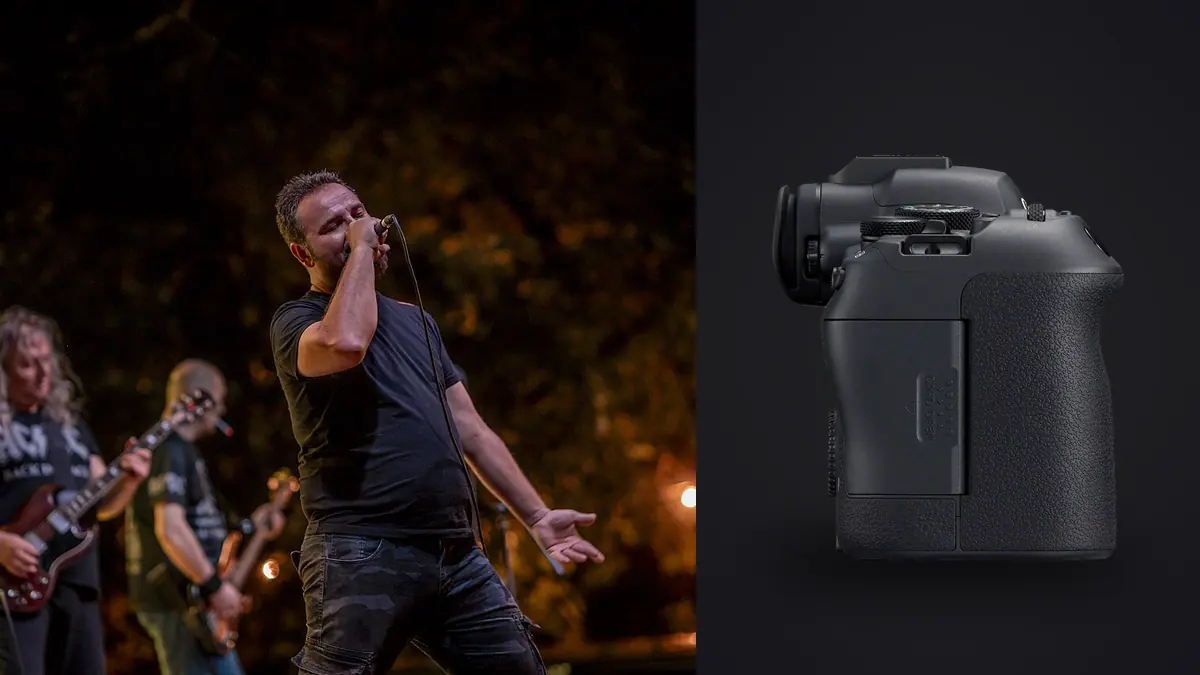
The first time I brought the Canon EOS R6 Mark II into a photo pit, I was still shooting the first R6 as a backup body and half expecting the "Mark II" label to mean marginal gains. It didn't feel marginal by the second song. The autofocus held onto a singer's face through a haze machine and a strobe wash that would have sent my old 6D hunting for focus in the dark, and I came home with a keeper rate on the front three songs that was noticeably higher than what I was used to. That's really the whole pitch of this camera for live music work: it doesn't do anything flashy, it just fails less often in the exact conditions where cameras usually fail.
What actually changes when the house lights are the only light you get
Concert photography is a lighting problem before it's anything else. You're rarely fighting motion blur so much as you're fighting a lighting rig that swings between a 1/125s-friendly wash and a single hard spotlight three stops darker, sometimes within the same chorus. The R6 Mark II's 24.2MP sensor isn't chasing resolution records, and that's the right trade for this job. Files stay clean up to ISO 6400 without much thought, still usable at 12800, and I've pulled frames shot at 25600 that were fine for web and print-on-demand merch after a pass of noise reduction. Past that it gets rough, but by then you're usually in a room dark enough that the shot wasn't happening on most cameras anyway.
The bigger practical win is the in-body stabilization. Canon rates it up to 8 stops with certain RF lenses, and while I don't trust marketing stop-counts literally, I can say I've handheld the RF 24-70mm f/2.8L at 1/60s and gotten sharp frames of a stationary keyboard player, which matters when a spotlight operator decides to underexpose everything for mood. Stabilization doesn't freeze a moving drummer, obviously, so it's not a substitute for shutter speed on the subjects that actually move fast. It buys you a stop or two of ISO headroom on everyone else in the frame.
Eye detection autofocus is the other piece that changes what's shootable. Canon claims tracking down to roughly -6.5 EV with a fast lens, and in real rooms that translates to the camera finding and holding a singer's eye through a lot of ugly, uneven stage lighting that used to require manual focus and a lot of missed frames. It's not flawless. Hair, a hand mic held up near the face, or a sudden lighting cut will still throw it off for a frame or two. But it recovers fast, and it recovers on its own, which is the whole point when you don't get a second take.
The settings I actually dial in, by venue
I stopped trying to have one "concert preset" a few years ago because a 200-cap club and an amphitheater main stage are different jobs wearing the same clothes. Here's roughly what I start with and adjust from, depending on where I'm standing.
| Venue / situation | ISO range | Shutter speed | Aperture | Shutter type / drive |
|---|---|---|---|---|
| Small club, no pit, house lights only | 6400-12800, Auto ISO capped | 1/200s (singer), 1/320s (drummer) | f/1.8-f/2.8 | Mechanical, single or low-speed continuous |
| Mid-size venue, barricade pit, moving lights | 3200-8000 | 1/250s base, ready to drop to 1/160s in dark passages | f/2.8 | Mechanical, 12fps high-speed continuous |
| Festival stage, LED video wall behind band | 1600-6400 | 1/320s to freeze fast-moving pit chaos too | f/2.8-f/4 | Mechanical only, anti-flicker on |
| Outdoor daylight slot / golden hour set | 100-800 | 1/500s+ | f/2.8-f/5.6 | Electronic first-curtain, 40fps burst fine |
| Acoustic set, silence required | 1600-6400 | 1/125s, subject usually stationary | f/2.0-f/2.8 | Fully electronic (silent), single shot |
I lean on Auto ISO with a minimum shutter speed floor almost everywhere except the acoustic sets, where I have time to think and prefer manual control over the whole exposure. Aperture priority with exposure compensation dialed to -2/3 is my default for anything with moving lights, because concert lighting blows out highlights constantly and the camera's metering wants to protect shadows that don't matter.
Electronic shutter and the LED wall problem nobody warns you about
This is the setting mistake I see other photographers make with this camera. The R6 Mark II's electronic shutter tops out at 40fps and is genuinely silent, which sounds perfect for a hushed acoustic moment or a quiet festival slot where a shutter clack carries. The catch is rolling shutter readout, and modern LED stage lighting and video walls run on PWM dimming that most eyes never notice but that a rolling electronic shutter can turn into visible horizontal banding across the frame, especially at faster shutter speeds. I've had entire bursts ruined by banding on an LED backdrop wall during a festival headline set because I forgot to switch off electronic shutter after a quiet opener.
The camera's anti-flicker detection helps and it does work, but it's tuned for flicker frequency, not every dimming pattern a lighting designer's rig produces, and it doesn't do anything for rolling-shutter banding specifically, only exposure-level flicker between frames. My rule now is simple: mechanical shutter is the default for anything with stage lighting rigs, moving lights, or an LED wall. Electronic shutter only comes out for daylight sets, true acoustic sets where the lighting is static and warm, or when I genuinely need the silence and I've test-fired a few frames first to check for banding on that specific rig.
Buffer, cards, and getting through a three-song set without missing the chorus
Most club and festival photo passes still run on the old three-songs-no-flash rule, which means you get roughly nine to twelve minutes to get everything: wide stage shots, tight portraits of each member, crowd shots if the barricade allows it, and reaction shots from the pit. That's not a lot of time to be waiting on a buffer to clear.
With dual UHS-II SD slots and fast cards, the R6 Mark II's RAW buffer at 12fps mechanical holds up well past what a single song's worth of bursts needs, and I've never actually hit a hard buffer wall shooting compressed RAW in a normal three-song pass. Where it gets tighter is if you're shooting RAW+JPEG for a quick turnaround delivery to a publicist, or if you're running 40fps electronic bursts on a fast-moving performer, where the buffer will start to slow write-out noticeably after a few seconds of sustained fire. I shoot compressed RAW almost exclusively for this reason. Uncompressed RAW at high frame rates fills the buffer fast enough that I've genuinely lost the tail end of a good crowd-surf moment waiting for the camera to catch its breath.
Battery life is a non-issue for a single show. The LP-E6NH gets me through a three-band bill without swapping, even with a lot of chimping between songs to check exposure on a dark stage. Festival days are different: if I'm shooting six or eight acts back to back across ten hours, I bring two spares and don't think twice about it.
Lenses that actually earn their keep in the pit
The RF 24-70mm f/2.8L is the one lens I wouldn't shoot a club gig without. It covers the wide stage shot and a reasonably tight solo shot without a lens change, and f/2.8 combined with the R6 II's high-ISO tolerance means I'm rarely wishing for faster glass in a normal-sized venue. For bigger stages and photo pits set further back, the RF 70-200mm f/2.8L is the other half of the kit, and its own optical stabilization stacking with the body's IBIS is genuinely useful for the moments you're shooting handheld at the long end in low light.
The RF 50mm f/1.2L gets pulled out for the darkest, smallest rooms, mostly singer-songwriter and acoustic sets where I want shallow depth of field and don't need the reach. It's heavy and it's not a lens I'd want to shoot a whole festival with, but for a single moody set it's worth the weight. I've also had good results adapting older EF glass through the RF adapter when budget matters more than autofocus speed, though I'd only recommend that for slower-paced sets where the older AF motor isn't fighting a drummer mid-solo.
Getting from a few thousand frames to a gallery someone actually wants to see
A single three-band bill at 12fps easily produces two to three thousand frames by the end of the night, and that's before a festival day multiplies it across six or eight acts. The camera doesn't solve that problem, and honestly neither does any camera. What's changed my workflow more than any camera upgrade is running that pile through imagic before I ever open a full editor. It scores sharpness and focus locally on the machine, which matters a lot for concert work specifically because a frame can look fine at a glance on a laptop screen and still be soft where it counts, on the eyes, when a singer moved half a step during a slow shutter moment.
The burst and duplicate clustering is the other piece that actually saves time on a night like this. Twelve frames per second on a chorus hook produces a dozen nearly identical shots, and imagic groups those bursts so I'm picking the one sharp, well-timed frame out of a cluster instead of scrolling past eleven near-duplicates one by one. Because it runs fully offline, I'm not uploading a headliner's unreleased tour photos to anyone's cloud before the band's own PR team has cleared them, which has come up more than once with bigger acts.
I also built out an apply_my_style preset trained on my own past concert edits, the contrasty, slightly warm look I use for most club shows, and running a first pass with that before I go frame by frame gets me most of the way to a finished gallery much faster than starting from a flat RAW every time. It's not a replacement for actually looking at each image, but it means the mechanical part of the edit is mostly done before I sit down. If you're trying to tighten up the whole pipeline from card dump to delivered gallery, it's worth reading through how AI photo culling actually works and pairing it with some of the habits in these workflow tips, because the camera only solves half the time problem on a night like this.
Frequently Asked Questions
Is the Canon EOS R6 Mark II actually good enough for paid concert photography work?
Yes, for the vast majority of club, festival, and touring photo pit work. The autofocus tracking and high-ISO usability are the two things that matter most in this genre, and both hold up well past the 24.2MP resolution figure that sometimes gets dismissed as "only" mid-range. Where you'd want more is large-format print work or arena tours where a publication wants extreme crops, but for gig posters, social content, and most editorial use it's more camera than the job requires.
Should I use the electronic shutter or the mechanical shutter for a show?
Default to mechanical for anything with moving stage lights, LED walls, or PWM-dimmed fixtures, which covers most modern venues. Electronic shutter's silence is genuinely useful for hushed acoustic sets or daylight festival slots with steady lighting, but test a few frames first if you're unsure, since rolling shutter banding under certain LED rigs can ruin an otherwise good burst.
How high can I push the ISO in a genuinely dark club?
Files stay clean and usable through about ISO 6400 to 8000, still workable at 12800 with a light noise reduction pass, and I've kept select frames shot at 25600 for smaller-output use like social posts. Past that the noise becomes hard to hide in shadow areas, though by that point most rooms are dark enough that very few cameras would still be delivering a usable frame.
Do I need a battery grip or backup battery for a full festival day?
For a single headline show, no, one LP-E6NH comfortably covers a three-band bill including a lot of screen-checking between songs. For a full festival day shooting six or more acts back to back, bring at least one spare battery. A grip is more about handling comfort for long days than a real necessity, since the single-battery runtime is solid on its own.