 \n
\nI spent three days shadowing a market renovation crew last spring with a Canon EOS R3 slung across my chest, and by the second afternoon I'd stopped thinking about the camera at all. That's the real test for any body used in documentary work: does it disappear into the process, or does it keep interrupting you with decisions you shouldn't have to make mid-scene. The R3 mostly disappears, though not in the way people usually mean when they praise a camera for street shooting. It's not small, it isn't quiet by default, and it doesn't try to look unassuming. What it does is get out of the way of the decision that actually matters on the street: where to point the camera and when to press the shutter. Focus tracking, exposure, buffer depth, it handles all of that on its own.
\n\nWhy the Autofocus Actually Changes How You Work
\n\nCanon's Dual Pixel CMOS AF II on the R3 isn't new technology anymore, but it's still the part of this camera that changes how you physically move through a scene. Subject detection for people, animals, and vehicles locks onto a face or a body shape fast enough that you can raise the camera, half-press, and fire inside about a second without hunting. For documentary work where a moment might last two or three seconds total, that's the difference between having the shot and having a blurred foreground.
\n\nThen there's Eye Control AF, the feature everyone brings up first, and one that deserves a more honest take than most reviews give it. It tracks where your eye is looking inside the viewfinder and moves the AF point there. When it's calibrated well, and calibration takes a genuine five minutes of sitting still and following dots rather than a quick setup, it lets you recompose by looking at a different part of the frame instead of dragging a joystick. I've had it work brilliantly in even light with no glasses on, and I've had it drift and misfire on a job shot half in shadow while wearing prescription sunglasses. It's a real feature, not a gimmick, but not one you should build your entire shooting method around until you've tested it in your own conditions for a week or two.
\n\nWhat matters more day to day is how the R3 holds focus once it has it. Tracking through a crowd, with three or four bodies crossing in front of your subject, it rarely loses the lock and rarely jumps to the wrong face. That reliability lets you keep your eye on composition and timing instead of babysitting the AF point.
\n\nThe Size Problem Nobody Solves for You
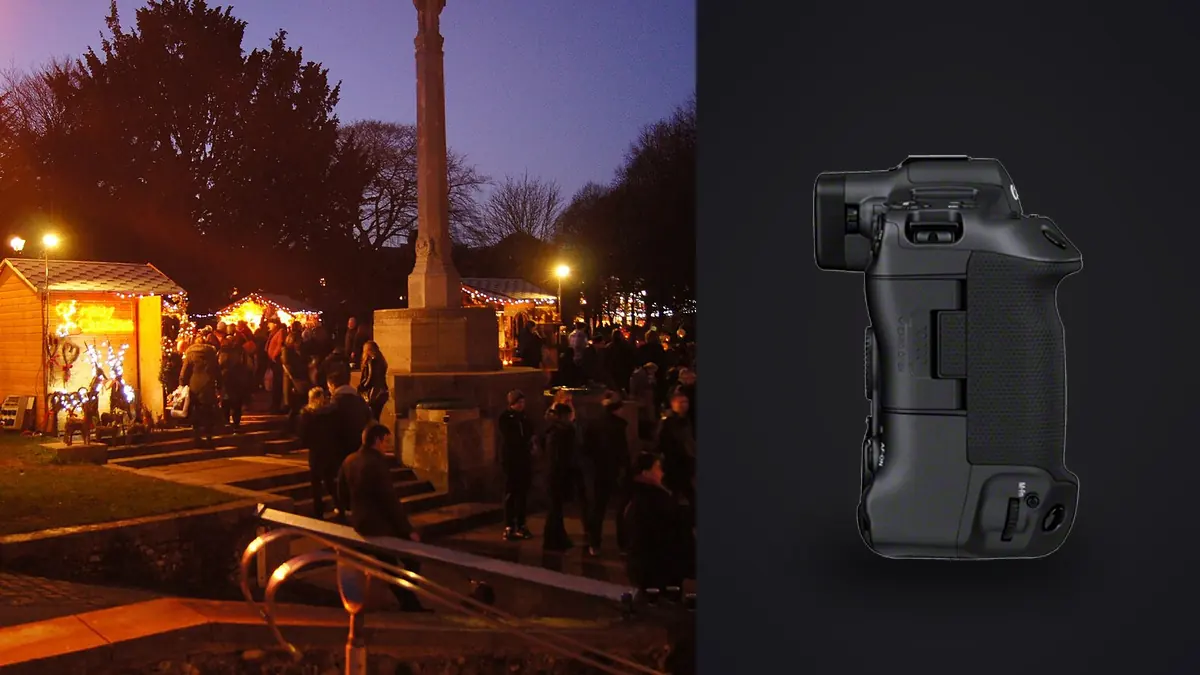
\n\nHere's the trade-off nobody selling this camera dwells on: at 1015 grams body only, before a lens, battery, or card, the R3 is not a discreet camera. It has an integrated vertical grip styled after Canon's 1-series bodies, so there's no way to make it smaller by pulling a grip off the way you can with an R6 or R5. Paired with something like the RF 24-105mm F4L, you're carrying close to 1.7kg around your neck for a full day, and people on the street notice a camera that size. Kids ask about it. Vendors change their posture when they see it pointed their way. If your documentary work depends on subjects forgetting you're there, the R3 makes that harder, not easier.
\n\nWhat it gives back is stability and grip comfort a compact camera can't match over a twelve-hour shoot day. The deeper handgrip and the built-in vertical controls mean you can shoot portrait-orientation frames without twisting your wrist into an awkward angle, which matters more than it sounds when you're doing it two hundred times in an afternoon. For assignment-style documentary work, moving between formal portraits, wide establishing shots, and fast reactive moments in the same hour, that ergonomic consistency is worth more than shaving off three hundred grams. For pure candid street photography, where anonymity is the whole strategy, I'd genuinely point people toward something smaller. The R3 is built for photographers who need speed and reliability more than invisibility.
\n\nWhere the Electronic Shutter Actually Earns Its Keep
\n\nSet the R3 to its fully electronic shutter mode and it makes no sound at all. No mirror slap (there's no mirror to begin with), no mechanical click, nothing. Combined with a blackout-free electronic viewfinder even at the top 30fps burst rate, you can shoot through an entire sequence, a hand reaching for a door, a face turning toward light, a quiet moment at a memorial service, without a single audible or visual cue telling anyone nearby that a picture was just taken. That matters enormously in the kind of documentary work where a shutter click breaks the moment: courtrooms, religious services, hospital rooms, any quiet interior scene where sound draws eyes.
\n\nThe caveat is rolling shutter risk with fast-moving elements under electronic shutter, and flicker under certain artificial lighting (fluorescent tubes, some LED panels) that can band across frames if anti-flicker mode isn't on. I keep the R3 set to detect flicker automatically and it catches most of it, but I still run a test burst under unfamiliar lighting before committing to a long silent sequence. The mechanical shutter is still there at 12fps if you'd rather not think about either issue, and for a lot of daylight street work I default to it just to keep one less variable in play.
\n\nThe Stacked Sensor Matters More for Motion Than People Give It Credit For
\n\nThe R3's 24.1MP sensor is stacked and back-illuminated, which is the real engineering reason the electronic shutter is usable at all for anything with motion in it. Readout speed is fast enough that panning shots of motorbikes weaving through market traffic, a genuinely common documentary subject in a lot of cities, come out with straight verticals instead of the slanted \"jello\" effect you get on cameras with slower sensor readout. I've shot the same kind of scene on an older R6 and watched a moving rickshaw wheel smear into a diagonal mess under electronic shutter. The R3 handles it cleanly. If your documentary work involves vehicles, market stalls with fast hand movement, or anything spinning, this is the spec quietly doing the most work.
\n\nHow It Stacks Up Against Other Street and Documentary Choices
\n\nThe R3 isn't the only camera built for this kind of work, and it's worth being honest about where it wins and where it doesn't. Here's how it compares against a few cameras that regularly come up in the same conversation.
\n\n| Camera | Body weight | Max burst (electronic) | Native ISO range | Shutter sound | Launch price (body) |
|---|---|---|---|---|---|
| Canon EOS R3 | 1015g | 30fps | 100-102,400 | Silent electronic, or mechanical option | $5,999 |
| Canon EOS R6 Mark II | 588g | 40fps | 100-102,400 | Silent electronic, or mechanical option | $2,499 |
| Sony A7 IV | 658g | 10fps | 100-51,200 | Silent electronic, or mechanical option | $2,499 |
| Fujifilm X100V | 478g | 11fps | 160-12,800 | Near-silent leaf shutter | $1,399 |
| Leica Q2 | 734g | 10fps | 50-50,000 | Near-silent leaf shutter | $5,795 |
The number that surprises people is the R6 Mark II's 40fps, faster on paper than the R3's 30fps. What that comparison misses is buffer depth and rolling shutter control. The R3's stacked sensor and larger buffer sustain long raw bursts without the readout artifacts and buffer stalls you start hitting on the R6 II somewhere past a few seconds of continuous 40fps shooting. Fixed-lens options like the X100V and Q2 win decisively on size and social discretion, at the cost of never changing focal length and never matching the R3's tracking through a moving crowd.
\n\nLenses Worth Actually Building a Documentary Kit Around
\n\nThe RF mount lens lineup has matured enough that you don't need expensive L-series glass for every focal length. For documentary work specifically, I keep coming back to four options.
\n\n- \n
- RF 35mm F1.8 Macro IS STM (around 305g): the closest thing to an all-purpose documentary prime, wide enough for environmental context, fast enough for interior light, and the built-in close-focus ability is genuinely handy for detail shots of hands, tools, or objects that carry part of the story. \n
- RF 24-105mm F4L IS USM (around 700g): the zoom I reach for on assignments where I don't know exactly what I'll need before I arrive. Not the fastest glass, but the range covers wide establishing shots through to loose portraits without a lens change. \n
- RF 16mm F2.8 STM (around 165g): cheap, light, and useful for the close, wide, immersive frame a lot of documentary photographers reach for when they want the viewer to feel embedded in a scene rather than watching from a distance. \n
- RF 85mm F2 Macro IS STM (around 500g): for the quieter portrait moments inside a documentary story, sitting with someone rather than following them, this stays compact enough that it doesn't change the mood of the room. \n
What I'd avoid, at least as a primary lens for this kind of work, is the RF 50mm F1.2L. It's an exceptional piece of glass on paper, but it's heavy (around 950g) and slower to rack focus than the STM primes, and on a body that already weighs over a kilo, adding a lens that size turns a documentary kit into something you actively feel by hour four.
\n\nWhat Happens After the Card Comes Out
\n\nShoot a single afternoon of street documentary work at 30fps and it's easy to come home with four or five thousand frames, most of them two or three near-identical exposures of the same half-second. That's the part of owning a camera like this that doesn't get talked about enough: the R3 doesn't just capture more moments, it multiplies your editing workload if you don't have a system for cutting the burst fat quickly.
\n\nThis is where I stopped trying to cull manually in a grid view and started running everything through imagic first. It scores sharpness and focus locally on the machine (nothing leaves your laptop, which matters when you're handling images from a private event, a courtroom, or a subject who agreed to be photographed but not to have their photos pass through someone else's cloud server), and it clusters burst sequences and near-duplicates automatically, so a forty-frame burst of someone turning toward a door collapses down to the two or three frames that are actually sharp and well-timed. It's the difference between a two-hour cull session and a fifteen-minute one, which on a multi-day documentary project adds up to real time back. If you want more on how that scoring works under the hood, this piece on how AI photo culling works goes into the mechanics.
\n\nOnce the edit set is narrowed down, I've also leaned on imagic's apply_my_style preset, which trains on your own past edits rather than a generic filter pack, to get a documentary series looking consistent before the raw files even open in a full editor. It isn't a replacement for careful grading on the frames that matter most, but for the volume a camera like the R3 generates, having a starting point that already looks like your own work saves real desk time. For more on trimming the rest of the pipeline, these workflow tips cover the path from card to delivery.
\n\nStaying in the Field Without Worrying About Power or Cards
\n\nThe LP-E19 battery in the R3 is the same one used in Canon's 1D X bodies, and it shows in how long the camera actually lasts. CIPA rates it conservatively around 620 shots per charge through the viewfinder, but in real documentary use, where you're not chimping every frame and you're mixing in long stretches of just carrying the camera, I've regularly gotten 900 to 1,200 frames out of a single charge across a working day. Dual card slots (one CFexpress Type B, one SD UHS-II) mean you can write raws to the fast card and JPEGs to SD for instant backup, useful when you need to hand off a selects folder to an editor before you've even left the location.
\n\nBuilt-in GPS tags every frame with location data automatically, which sounds minor until you're captioning a documentary series six weeks later and can't remember which market or which block a given frame came from. And the weather sealing, rated to the same standard as Canon's 1-series bodies, means I've shot through genuine downpours without a second thought, which isn't something I'd say about most cameras in this size class outside the true flagship tier.
\n\nFrequently Asked Questions
\n\nIs the Canon EOS R3 too big and obvious for candid street photography?
\nFor pure candid work where staying unnoticed is the whole point, yes, it's a real compromise. At over a kilogram body-only with an integrated grip, it reads as \"professional camera\" to anyone who notices it, and that changes how people behave around you. It works better for documentary projects where subjects already know they're being photographed, or for street work done more openly, engaging with people rather than shooting from a distance.
\n\nDoes Eye Control AF actually work reliably for fast, unpredictable street subjects?
\nIt works well once properly calibrated for your eye and your typical shooting position, but it's sensitive to eyewear, uneven light on your face, and rushed calibration. I'd treat it as a genuinely useful secondary tool for quick point placement rather than something to depend on entirely for fast, critical documentary sequences until you've tested it thoroughly in your own conditions.
\n\nHow much storage should I plan for a full day of R3 street shooting?
\nAt 30fps in raw, a single ten-second burst can produce 300 frames. A busy day of documentary shooting with several long bursts can easily fill 100 to 150GB. I'd plan for at least a 256GB CFexpress card per shooting day, and budget real time afterward for a fast first pass cull. Running that pass through imagic's local duplicate and burst clustering, with nothing leaving the machine before you've reviewed it, is what turns that first pass into fifteen minutes instead of a multi-hour slog.
\n\nIs the R3 worth it over a Canon R6 Mark II for documentary work specifically?
\nIf your work depends on tracking reliability through crowds, extended silent shooting without rolling shutter artifacts, and all-day ergonomic comfort, the R3's stacked sensor and integrated grip earn their price premium. If you're mostly shooting slower-paced documentary work, portraits, and static scenes, the R6 Mark II gets you close to the same image quality for under half the price, and its smaller body is genuinely easier to carry and less conspicuous.